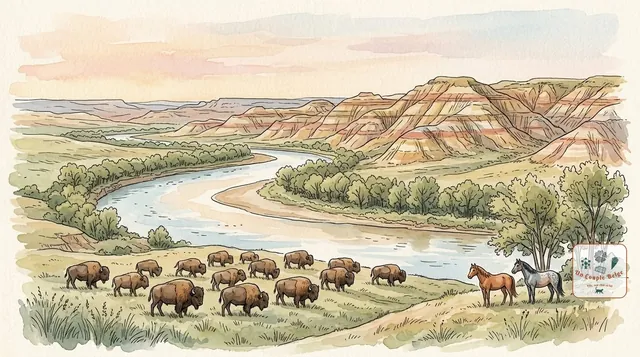
North Dakota: badlands, bison and a great silence
Updated on
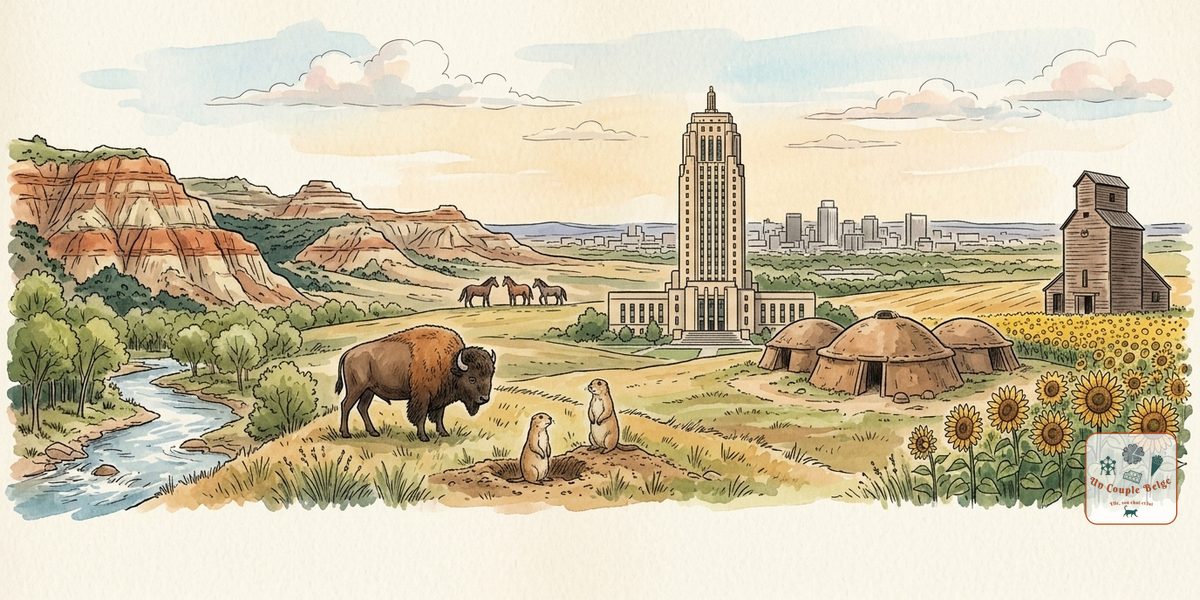
North Dakota carries a reputation it has earned: it’s regularly one of the least visited states in the United States, and many Americans have never set foot there. Right at the top of the Great Plains, up against the Canadian border, it mostly brings to mind cold, wheat and the film Fargo 🎬.
And yet there’s something fascinating about this great emptiness. North Dakota hides badlands in improbable colours, where Theodore Roosevelt came to rebuild himself, bison and wild horses, giant sculptures planted in the middle of wheat fields, and a history of Native American peoples, explorers, Scandinavian pioneers and oil. It’s a state of immense sky and silence, ideal for those running away from the crowds.
North Dakota at a glance
- Capital: Bismarck
- Largest city: Fargo
- Population: about 790,000
- Area: about 183,000 km², six times Belgium
- Joined the Union: 1889, 39th state, on the same day as South Dakota
- Time zone: Central Time (7 hours behind Brussels), Mountain Time in the south-west
- Nicknames: Peace Garden State, Roughrider State
- Highest point: White Butte, 1,069 metres
Geography: from the Red River Valley to the badlands
The east, the Red River Valley, on the Minnesota border, is an absolutely flat plain, the former bed of a glacial lake. Its soils, among the most fertile in the world, produce wheat, sugar beet and sunflowers.
The centre is a region of hills and small lakes, the “prairie potholes”, where millions of ducks nest.
The Missouri River crosses the west of the state, held back by Garrison Dam in an immense lake, Lake Sakakawea.
The west, finally, is drier and more rugged, with the badlands of the Little Missouri and the oil fields of the Bakken formation.
A bit of history
The Mandan, the Hidatsa and the Arikara lived along the Missouri in villages of earthlodges, growing corn, while the Lakota and the Dakota (who gave the state its name) hunted bison on the plains. In 1804-1805, Lewis and Clark spent the winter at Fort Mandan, where they met Sacagawea, a young Shoshone woman who would guide them to the Pacific.
The railway arrived in the 1870s, followed by waves of Norwegian immigrants and Germans from Russia. North Dakota and South Dakota became states on the same day, in 1889: President Harrison is said to have shuffled the documents so that nobody would ever know which had been signed first. In the 1880s, a young Theodore Roosevelt came here to raise cattle after the deaths of his wife and mother, an experience which, in his own words, made him a president. In the 21st century, the Bakken shale oil boom has made North Dakota one of the country’s leading oil producers.
The must-sees
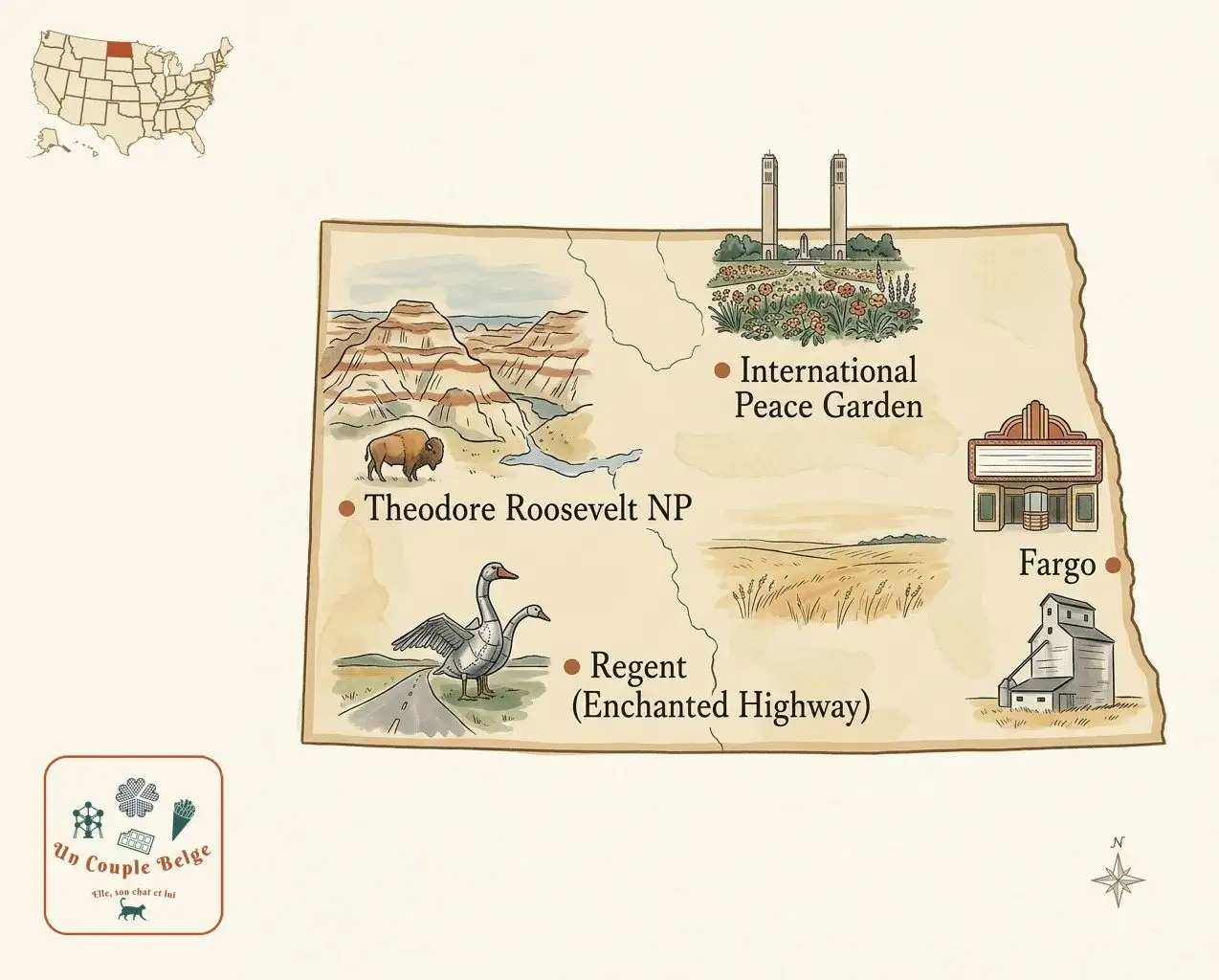
Theodore Roosevelt National Park
In the west, Theodore Roosevelt National Park protects badlands striped with red, ochre and grey layers, where you come across bison, wild horses, elk and prairie dog towns. It’s divided into three units. The South Unit, near Medora, is the most visited, with its scenic drive (fully reopened in late 2025, after six years of works) and the Painted Canyon overlook. The North Unit, wilder, has even more spectacular scenery. And the small Elkhorn Ranch site marks the location of Roosevelt’s ranch.
The small town of Medora, the gateway to the park, lives to the rhythm of summer: an outdoor musical, and the famous Pitchfork Steak Fondue, where steaks skewered on pitchforks are cooked in vats of boiling oil. The Theodore Roosevelt Presidential Library, built in the badlands, opened on 4 July 2026.
The Maah Daah Hey Trail, a trail of more than 230 kilometres through the badlands, is one of the great mountain-bike routes in the United States.
The Enchanted Highway
Along some fifty kilometres of country road, between the Gladstone exit on Interstate 94 and the village of Regent, a local man, Gary Greff, has been installing giant metal sculptures in the middle of the fields since the 1990s: geese in flight (one of the largest scrap-metal sculptures in the world), pheasants, a family of giants, a fisherman, Theodore Roosevelt on horseback… The Enchanted Highway has become an attraction in its own right, free of charge, with a gift shop in Regent.
Bismarck and the Missouri
The capital, Bismarck, sits on the Missouri. Its State Capitol, an Art Deco tower of some twenty storeys, is nicknamed “the Skyscraper on the Prairie”. The North Dakota Heritage Center, right next door, is an excellent free museum on the state’s history. To the south, Fort Abraham Lincoln State Park holds Custer’s house, from which he set off in 1876 for the Little Bighorn, and On-A-Slant Village, a reconstructed Mandan village of earthlodges.
To the north, the Knife River Indian Villages National Historic Site preserves the traces of former Hidatsa villages and a reconstructed earthlodge, and Fort Mandan recalls Lewis and Clark’s winter.
Fargo
The state’s largest city has nothing of the bleak mood of the Coen brothers’ film. Fargo is a lively university town, with a pleasant centre, microbreweries and the Fargo Theatre, an Art Deco cinema. The actual wood chipper from the film is on display at the visitor centre, where you can have your photo taken in a hat with ear flaps.
The north
Right in the north, on the border itself, the International Peace Garden, a garden planted in 1932 straddling North Dakota and Manitoba, celebrates peace between the United States and Canada. A little further south, the small town of Rugby claims the title of geographical centre of North America. In Minot, the Scandinavian Heritage Park brings together a Norwegian stave church and traditional Nordic buildings.
Itinerary ideas
4-5 days, east to west. Fargo (1 day) → Jamestown and its giant buffalo → Bismarck and Fort Abraham Lincoln (1 day) → Enchanted Highway → Medora and the South Unit of Roosevelt National Park (1-2 days) → North Unit.
In combination. North Dakota combines with South Dakota (the Black Hills are 4 hours from Medora), Montana (Glacier and Yellowstone) or Minnesota.
On the plate
North Dakota’s cooking is that of the Germans from Russia and the Scandinavians:
- knoephla soup, a creamy soup with potatoes and small dumplings;
- fleischkuechle, fried turnovers stuffed with meat;
- kuchen, a custard and fruit tart found in every bakery and at every church supper;
- lefse, a Norwegian potato flatbread, served with butter and sugar;
- bison and beef from the ranches;
- and honey: North Dakota is the leading honey producer in the United States. It’s also the leading producer of sunflowers and of durum wheat, the kind used for pasta.
Culture and trivia
- Salem Sue, in New Salem, is a giant Holstein cow 12 metres tall, towering over the prairie.
- North Dakota and South Dakota were born on the same day, and it’s still not known which is officially the 39th or the 40th state. In alphabetical order, North comes first.
- The climate is one of the most extreme in the country: over 40 °C in summer, and below –40 °C in winter.
When to go
- Summer (June to September): the only real tourist season, with Medora in full swing, the badlands accessible and long evenings. Hot in July-August.
- September-October: autumn colours in the badlands, fewer people and ideal temperatures for hiking.
- Spring: short and muddy, sometimes with flooding on the Red River.
- Winter (November to March): very cold and windy, with blizzards. For fans of cross-country skiing and extreme experiences.
Practical information
- Recommended length of stay: 4 to 5 days for Fargo, Bismarck and Roosevelt National Park.
- Getting there: Fargo and Bismarck airports are served by connecting flights. Amtrak’s Empire Builder train crosses the north of the state.
- Getting around: a car is essential.
- Budget: one of the cheapest states in the country. In the oil patch in the west, however, hotels can be expensive.
- Things to watch out for: fill up and take water before heading onto the small roads of the west. Keep your distance from the bison in Roosevelt National Park.
- One more tip: book the Medora Musical and the Pitchfork Steak Fondue ahead in July-August.