Georgia: Atlanta, Savannah and the Deep South
Updated on
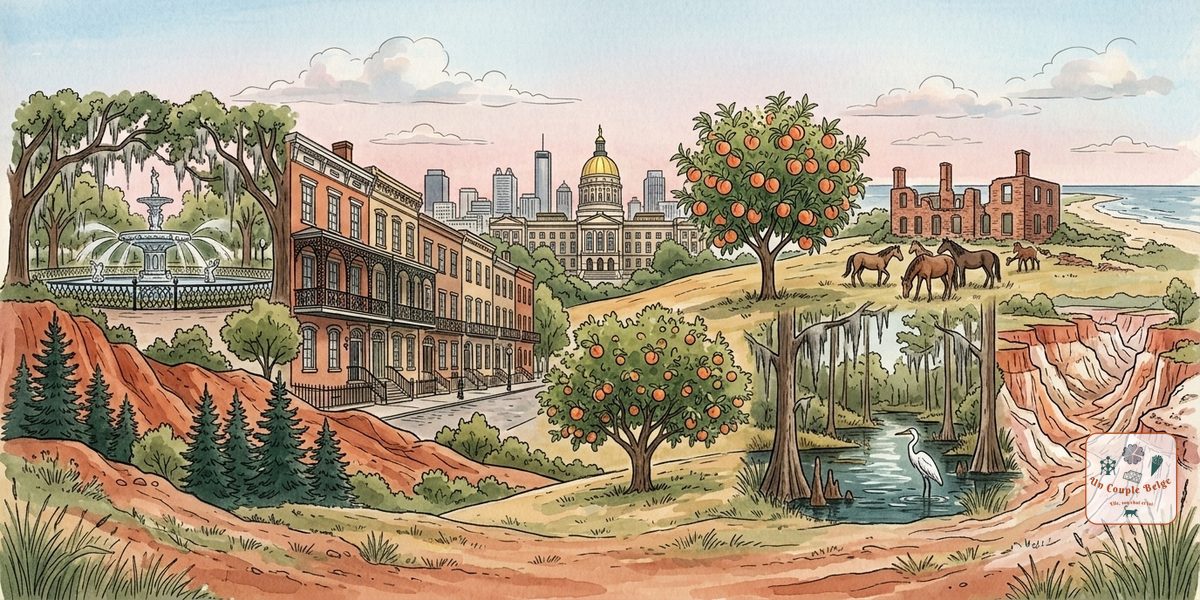
In Europe, Georgia has a slight image problem: people confuse it with the country in the Caucasus, or reduce it to a place you pass through between Florida and the Carolinas. A pity, because this Deep South state sums up, all by itself, a good part of America’s complexity. Atlanta, a modern, buzzing metropolis, capital of African American culture and birthplace of Martin Luther King. Savannah, an 18th-century city left almost intact beneath its oaks draped in Spanish moss. And between the two, bluish mountains in the north, golden marshes in the south and wild islands on the Atlantic.
You feel the weight of American history here, in its most painful as well as its most creative aspects. And you eat very well.
Georgia at a glance
- Capital and largest city: Atlanta
- Population: about 11 million
- Area: about 154,000 km², a little over five times Belgium
- Joined the Union: 1788, 4th state
- Time zone: Eastern Time (6 hours behind Brussels)
- Nicknames: Peach State, Empire State of the South
- Highest point: Brasstown Bald, 1,458 metres
Geography: from the Appalachians to the Atlantic
The north is mountainous: these are the Blue Ridge Mountains, the southern tip of the Appalachians, with forests, waterfalls and lakes. This is where the Appalachian Trail begins.
The Piedmont, in the centre, is a region of hills where Atlanta, Athens, Macon and Augusta are found.
The coastal plains occupy the whole southern half: fields of peanuts, cotton and pecans, pine forests and, right in the south, the Okefenokee Swamp.
The coast, finally, is only about 160 kilometres long, but it’s lined with salt marshes and barrier islands: Tybee, Sapelo, St. Simons, Jekyll and Cumberland.
A bit of history
The Creek and the Cherokee occupied the territory when General James Oglethorpe founded Savannah in 1733, the last of the thirteen British colonies. Georgia became the 4th state in 1788. In the 19th century, cotton and slavery made its wealth, and the discovery of gold at Dahlonega in 1829 hastened the expulsion of the Cherokee, deported to Oklahoma on the “Trail of Tears”.
During the Civil War, the Union general Sherman burned Atlanta in 1864, then led his “March to the Sea” as far as Savannah, which he spared in order to offer it as a “Christmas gift” to President Lincoln. After the war, Atlanta rebuilt itself and became the capital of the “New South”.
In the 20th century, the city was at the heart of the civil rights movement, around Martin Luther King, born in Atlanta in 1929. It hosted the 1996 Olympic Games, and the state has become a major hub for film and television series thanks to tax incentives.
The must-sees
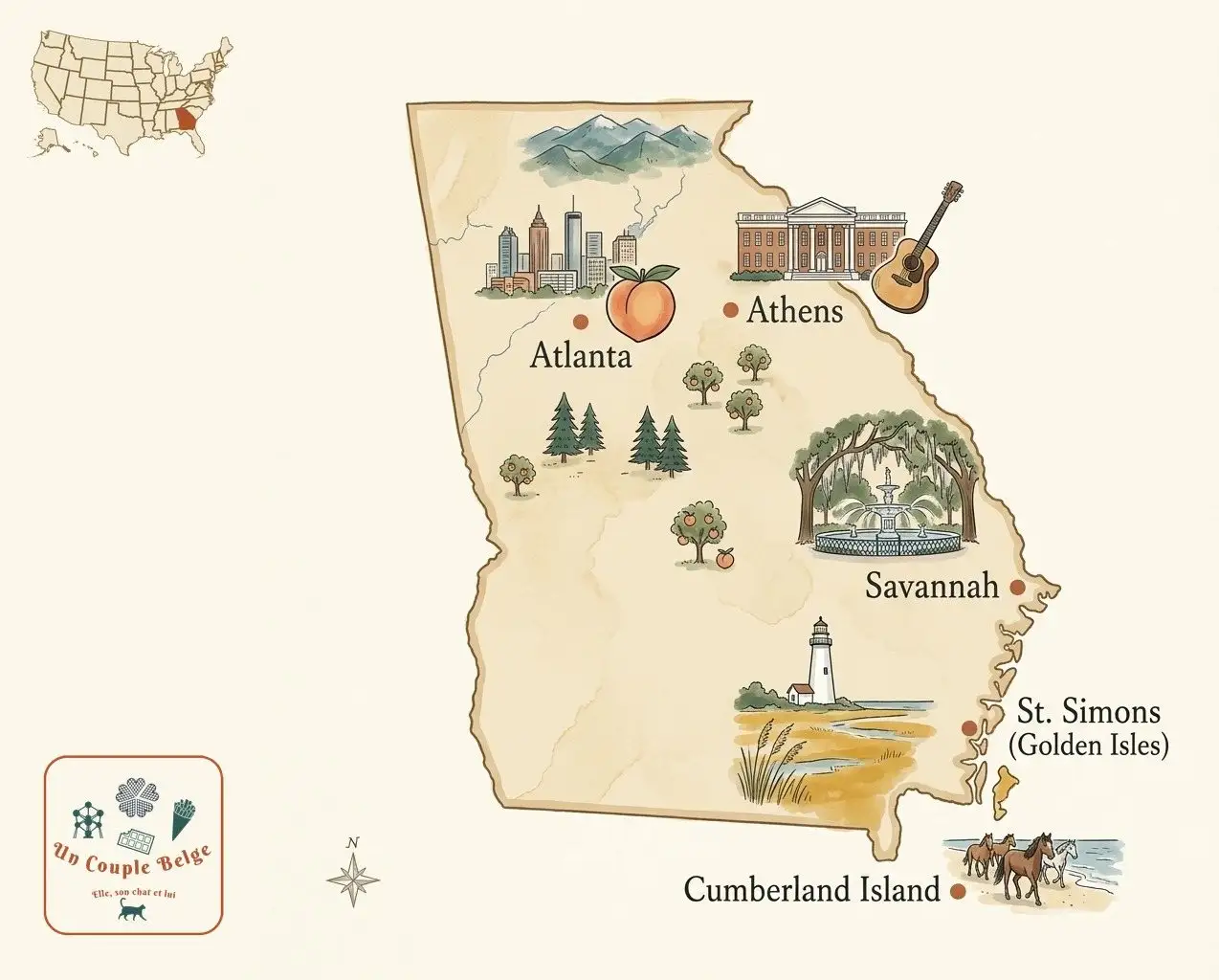
Atlanta
Atlanta no longer looks anything like the Old South of Gone with the Wind 🎬 (whose author, Margaret Mitchell, was from here). It’s a metropolis of skyscrapers and motorways, the capital of American hip-hop and a hub for the film industry.
The free Martin Luther King Jr. National Historical Park brings together his birth home, Ebenezer Baptist Church where he preached with his father, and the tomb where he rests with his wife Coretta, in the Sweet Auburn district. The National Center for Civil and Human Rights rounds off the visit with a gripping simulation of the sit-ins at segregated lunch counters.
For the rest, the World of Coca-Cola tells the story of the birth of the soda (and lets you taste around a hundred drinks from all over the world), the Georgia Aquarium is one of the largest in the world, with its whale sharks, and the CNN Center was long a must. To catch your breath, the Atlanta BeltLine, a former railway line turned into a walking path, links lively neighbourhoods such as Inman Park and Old Fourth Ward, with Ponce City Market, a former Sears warehouse converted into a food hall.
Savannah
Savannah is probably the most beautiful city in the South. Oglethorpe laid it out around squares linked by a grid plan, and 22 of these shaded squares have survived, lined with Georgian and Victorian houses and oaks trailing their Spanish moss. The historic district is explored on foot, by trolley or by horse-drawn carriage.
Don’t miss Bonaventure Cemetery, made famous by the book and then the film Midnight in the Garden of Good and Evil 🎬, Forsyth Park and its fountain, and River Street, whose old cotton warehouses now house bars and shops. Savannah allows alcohol in plastic cups on the streets of the historic district, which makes for a relaxed mood in the evening. Twenty minutes away, Tybee Island is the beach for Savannah’s residents, with its lighthouse.
The Golden Isles and Cumberland Island
Further south, the Golden Isles are a string of quiet islands. At the end of the 19th century, Jekyll Island was the private club of America’s greatest fortunes (Rockefeller, Vanderbilt, Pulitzer). Their giant “cottages” can be visited, and Driftwood Beach, covered in bleached tree trunks, is superb at sunrise. St. Simons Island has a pretty lighthouse and fine centuries-old oaks.
Right in the south, Cumberland Island National Seashore can only be reached by ferry from St. Marys, with a limited number of visitors. You come across wild horses on deserted beaches, and the ruins of a Carnegie family mansion. Book the ferry ahead.
On Sapelo Island, the community of Hogg Hummock is one of the last Gullah Geechee communities, the descendants of enslaved West Africans who have kept a language and culture of their own.
The north and the mountains
An hour and a half from Atlanta, the northern mountains are beautiful in autumn. The Appalachian Trail starts at the summit of Springer Mountain and stretches more than 3,500 kilometres to Maine. Amicalola Falls, the highest waterfall in the state, is accessible to everyone, as is Tallulah Gorge, with its suspension bridge. Dahlonega, the town of the 1829 gold rush, is now surrounded by vineyards, and Helen is an improbable Bavarian-style village, with its half-timbered houses and its beer festival in autumn. The highest point, Brasstown Bald, offers a view over four states in clear weather.
The rural south
In the south-west, Plains is the village of Jimmy Carter, the former peanut farmer who became president. He taught Sunday school there for decades, died there in late 2024 at the age of 100 and is buried there. His boyhood farm and the old school are national sites. Not far away, Andersonville keeps the memory of a Civil War prison camp, where nearly 13,000 Union soldiers died, and houses the National Prisoner of War Museum. Further west, Providence Canyon, nicknamed “Georgia’s Little Grand Canyon”, is a network of coloured gullies carved by the erosion of farmland in the 19th century.
The Okefenokee Swamp
Right in the south, on the Florida border, the Okefenokee National Wildlife Refuge is one of the largest blackwater swamps in North America, covering nearly 180,000 hectares. You explore it by canoe or small boat, among the cypresses, water lilies and alligators, with black bears and carnivorous plants. The site has been a UNESCO World Heritage Site since July 2026.
Athens and Augusta
Athens, a university town 1 hr 30 from Atlanta, gave birth to R.E.M. and the B-52’s and still has an excellent music scene. Augusta hosts the Masters every April, one of the most prestigious golf tournaments in the world, and pays tribute to James Brown with a statue right in the city centre.
Itinerary ideas
One week, the classics. Atlanta (2-3 days) → Savannah (2-3 days) → Jekyll Island or Tybee (1-2 days). About 500 kilometres.
10 days, north to south. Atlanta → the northern mountains (Dahlonega, Helen, Amicalola) → Athens → Savannah → Golden Isles → Cumberland Island → Okefenokee.
In combination. Savannah is only 2 hours from Charleston (South Carolina), and the coast continues towards Florida. Atlanta is also the ideal gateway to Alabama and Tennessee.
On the plate
- Peaches in summer, in a cobbler (a warm dessert with a crisp topping) or on their own, bought from roadside stands.
- Pecans, in pie or in pralines. Georgia is the country’s leading producer.
- Boiled peanuts, peanuts boiled in salted water, sold at the roadside. Georgia alone produces nearly half of America’s peanuts.
- Vidalia onions, so sweet that people eat them almost like apples, grown only in the south-east of the state.
- Shrimp and grits and seafood from the coast, Brunswick stew, a stew of meat and vegetables, and fried chicken.
- And two institutions: Chick-fil-A, founded near Atlanta in 1946, and The Varsity, the largest drive-in in the world, open in Atlanta since 1928.
Culture and trivia
- Coca-Cola was invented in Atlanta in 1886 by John Pemberton, a pharmacist looking for a remedy. It was sold for 5 cents a glass at the counter of Jacobs’ Pharmacy. The brand still has its headquarters in Atlanta.
- The Waffle House Index: the Waffle House chain, born near Atlanta in 1955, is open 24 hours a day and almost never closes. The federal disaster agency (FEMA) unofficially uses the state of its restaurants to gauge the severity of a hurricane: open, closed or on a limited menu.
- The “Peach State” isn’t the leading peach producer: California and South Carolina grow more. But the peach remains the state’s emblem.
- Atlanta airport is one of the busiest in the world.
- Ray Charles was born in Albany, in southern Georgia, and his version of Georgia on My Mind has become the official state song.
When to go
- Spring (March to May): the best time. The azaleas and dogwoods bloom in Savannah and Atlanta, and it’s mild.
- Summer (June to August): hot and very humid, often above 32 °C with afternoon thunderstorms. Perfect for the beach, less so for walking around town.
- Autumn (October-November): very pleasant, with the colours in the northern mountains. Hurricane season runs until the end of November on the coast.
- Winter: mild on the coast, sometimes cold in Atlanta and snowy in the mountains. Quiet and cheap.
Practical information
- Recommended length of stay: 7 to 10 days to combine Atlanta, Savannah, the coast and the mountains.
- Getting there: Atlanta airport has direct links to many European cities (Amsterdam, Paris, Frankfurt, and Brussels in season with Delta). It’s a convenient gateway to the whole Southeast.
- Getting around: a car is essential outside Atlanta. Atlanta’s rail system (MARTA) links the airport to the city centre.
- Budget: moderate, Atlanta being more affordable than the big coastal cities. Savannah’s historic centre is a little more expensive.
- Things to watch out for: Atlanta’s traffic jams are legendary, so avoid rush hour. In the south and near the marshes, protect yourself from mosquitoes and ticks.
- One more tip: in Savannah, visit the historic district early in the morning or late in the day in summer, and book the Cumberland Island ferry several weeks ahead.