Maryland: Chesapeake Bay and America in miniature
Updated on
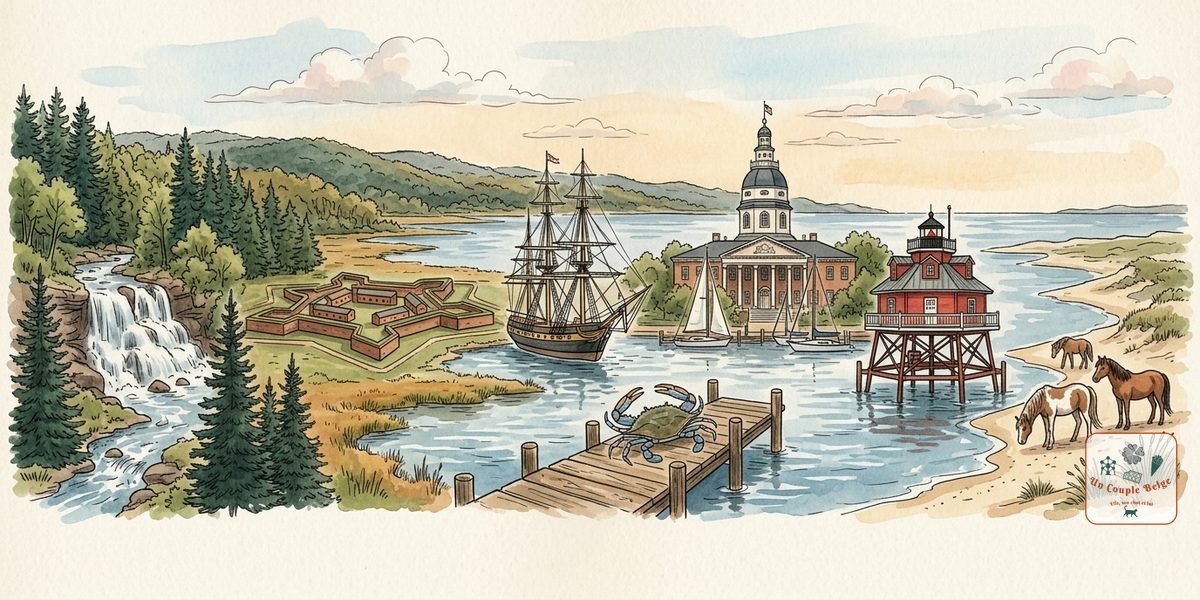
Maryland has a size problem, literally. Wedged between Virginia, Pennsylvania and Washington, which it almost surrounds, it’s one of those states you drive through on the way from Washington to New York without stopping. That’s a pity, because in a single day on the road it shows you an immense bay covered in crab boats, colonial brick towns, Atlantic beaches, wild ponies and wooded mountains.
It’s nicknamed “America in Miniature”, and the name is well earned. For Belgians, there’s something familiar about it too: Maryland is roughly the size of Belgium. Except that here, everything revolves around a blue crab covered in spices.
Maryland at a glance
- Capital: Annapolis
- Largest city: Baltimore
- Population: about 6.2 million
- Area: about 32,000 km², roughly the size of Belgium
- Joined the Union: 1788, 7th state
- Time zone: Eastern Time (6 hours behind Brussels)
- Nicknames: Old Line State, Free State, America in Miniature
- Highest point: Hoye-Crest, on Backbone Mountain, 1,024 metres
Geography: a bay in the middle
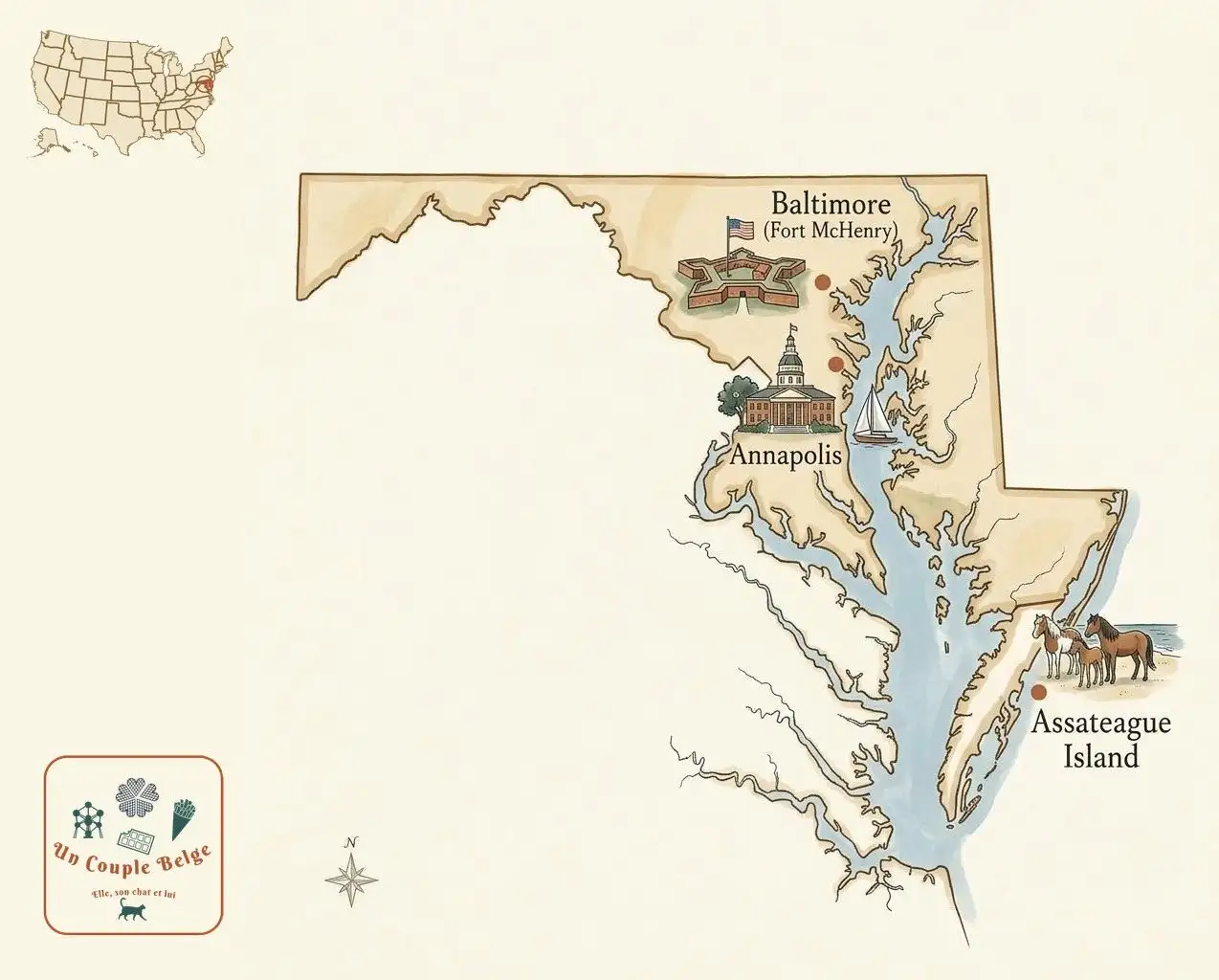
Chesapeake Bay, the largest estuary in the United States, cuts Maryland in two along its whole length.
The Eastern Shore, east of the bay, is a flat, rural peninsula of fields, marshes and fishing villages, as far as the Atlantic beaches (Ocean City, Assateague).
The centre, around Baltimore, Annapolis and the Washington suburbs, holds most of the population.
The west, finally, as narrow as a panhandle, pushes into the Appalachians, with forests, lakes and ski resorts.
A bit of history
Maryland was founded in 1634 by Lord Baltimore as a refuge for persecuted English Catholics, and named in honour of Queen Henrietta Maria, wife of Charles I. St. Mary’s City, the first capital, adopted a law of religious toleration as early as 1649, one of the first in the New World. Annapolis became the capital in 1695, and briefly hosted the Congress of the United States in 1783-1784.
During the War of 1812, the British bombardment of Fort McHenry, in Baltimore, inspired the American national anthem. A slave state that stayed in the Union during the Civil War, Maryland was crossed by escape networks to the North, and it was on its soil that the Battle of Antietam took place in 1862, the bloodiest single day in American military history. Frederick Douglass and Harriet Tubman, two great figures of the fight against slavery, were born on the Eastern Shore.
The must-sees
Baltimore
Baltimore carries a difficult reputation, partly built by the series The Wire 🎬. The reality is more nuanced and more endearing. The Inner Harbor, the redeveloped port, brings together the National Aquarium, one of the best in the country, historic ships and restaurants. The Fell’s Point district, with its cobbles and 18th-century taverns, is ideal in the evening, as is Hampden with its quirky shops.
Star-shaped Fort McHenry tells the story of the night in 1814 when Francis Scott Key, seeing the flag still flying in the morning, wrote The Star-Spangled Banner. The American Visionary Art Museum shows self-taught artists, disconcerting and touching. And the city is also that of Edgar Allan Poe, whose house and grave can be visited. The American football team, the Ravens, in fact owes its name to his poem The Raven. Baseball games are played at Camden Yards, a much-loved retro ballpark.
Annapolis
Half an hour to the south, Annapolis is one of the prettiest state capitals in the country: cobbled streets lined with 18th-century brick houses, a harbour full of sailing boats and a State House that is the oldest still in use by a legislature. The city is also home to the United States Naval Academy, whose campus can be visited. It’s a sailing town: in summer you can go out on the bay on a schooner.
Chesapeake Bay and the Eastern Shore
To reach the Eastern Shore, you cross the Chesapeake Bay Bridge, a bridge nearly 7 kilometres long above the bay, impressive to drive over. On the other side, St. Michaels is a charming harbour town with the Chesapeake Bay Maritime Museum, Easton and Oxford have pretty old houses, and the fishing villages of the bay still live off crab and oysters.
Further south, the Harriet Tubman Underground Railroad National Historical Park, near Church Creek, tells the story of this woman born into slavery in the area, who escaped in 1849 and then came back several times to guide dozens of other enslaved people to freedom. Right next door, Blackwater National Wildlife Refuge is a paradise for birds, with bald eagles and thousands of geese in winter.
Assateague and Ocean City
On a barrier island on the Virginia border, Assateague Island National Seashore is home to wild horses that have lived free on the beach and in the dunes for centuries. Legend has it that they descend from survivors of a Spanish shipwreck. You often come across them on the road or among the bathers: keep your distance, they bite and kick. You can camp beside the beach.
Just to the north, Ocean City is Maryland’s big seaside resort, with a boardwalk nearly 5 kilometres long, rides, fries and taffy. Lively and popular in summer.
Western Maryland
In the west, Frederick has a pretty historic centre and good restaurants. The Antietam battlefield, near Sharpsburg, where more than 22,000 soldiers were killed, wounded or went missing in a single day in September 1862, is one of the best preserved in the country. Along the Potomac, the towpath of the C&O Canal can be cycled for nearly 300 kilometres all the way to Washington. Further west, Deep Creek Lake, the largest lake in the state, and Swallow Falls make a good nature weekend. Just across the state line, in West Virginia, Harpers Ferry is not to be missed.
St. Mary’s City and the south
At the southern end of the bay, Historic St. Mary’s City, Maryland’s first capital, is an open-air museum that recreates the 17th-century colony, with a ship, a farm and a Native American village.
Itinerary ideas
A weekend. Baltimore (1-2 days) and Annapolis (1 day).
5-7 days, the bay and the sea. Baltimore → Annapolis → Bay Bridge → St. Michaels and the Eastern Shore → Blackwater and the Harriet Tubman park → Assateague and Ocean City.
In combination. Maryland combines naturally with Washington, Virginia (Shenandoah, the Chincoteague ponies, just south of Assateague), Pennsylvania (Gettysburg is 1 hour from Baltimore) and Delaware.
On the plate
- Blue crabs, steamed and covered in Old Bay seasoning (a blend created in Baltimore in 1939). You crack them with a mallet on a table covered in newspaper, and it easily takes two hours.
- Crab cakes, patties of crab meat with as little filler as possible. The pride of the state.
- Maryland crab soup, a crab soup with vegetables and tomato.
- Oysters from the bay, and soft-shell crabs, moulting crabs eaten whole, fried.
- Smith Island cake, a cake of 8 to 10 thin layers, the state’s official dessert.
- Berger cookies, Baltimore biscuits covered in a thick layer of chocolate fudge.
- Pit beef, a sandwich of charcoal-grilled beef, a Baltimore speciality.
Culture and trivia
- The American national anthem, The Star-Spangled Banner, was born in Baltimore in 1814. It only became official in 1931.
- The Preakness Stakes, the second leg of horse racing’s Triple Crown, has been run in Maryland every May since 1873, usually at Pimlico Race Course, in Baltimore (the 2026 race was run at Laurel Park while Pimlico was being rebuilt).
- Frederick Douglass, born into slavery on the Eastern Shore around 1818, escaped at the age of 20 and became one of the greatest orators in American history.
- Maryland crab is becoming scarce: a good share of the crab meat served in the state actually comes from Asia. For real local crab, ask for “Maryland blue crab”.
- Jousting, a knightly sport in which riders have to spear rings with a lance, is Maryland’s official sport.
When to go
- Spring (April-May): mild and in bloom, perfect for Baltimore and Annapolis.
- Summer (June to August): hot and humid, the season for beaches, sailing and crabs.
- Autumn (September-October): the best time, with crabs still around, fewer people and autumn colours in the west.
- Winter: cold but often mild near the bay, ideal for watching the geese at Blackwater and skiing in the west.
Practical information
- Recommended length of stay: a weekend for Baltimore and Annapolis, 5 to 7 days with the Eastern Shore and the west.
- Getting there: Baltimore-Washington airport (BWI) is served by connecting flights and sometimes direct ones from Europe. The Washington airports (Dulles, Reagan) are also very close.
- Getting around: the train (MARC and Amtrak) links Baltimore to Washington. A car is essential for the bay and the beaches.
- Budget: moderate, more affordable than Washington. Ocean City gets expensive at the height of summer.
- Things to watch out for: in Baltimore, find out which neighbourhoods to avoid, especially in the evening. The Bay Bridge is often jammed on Fridays and Sundays in summer.
- One more tip: book a table at a real waterside “crab house”, and bring a T-shirt you don’t mind staining.