New Jersey: the Jersey Shore, Springsteen and diners
Updated on
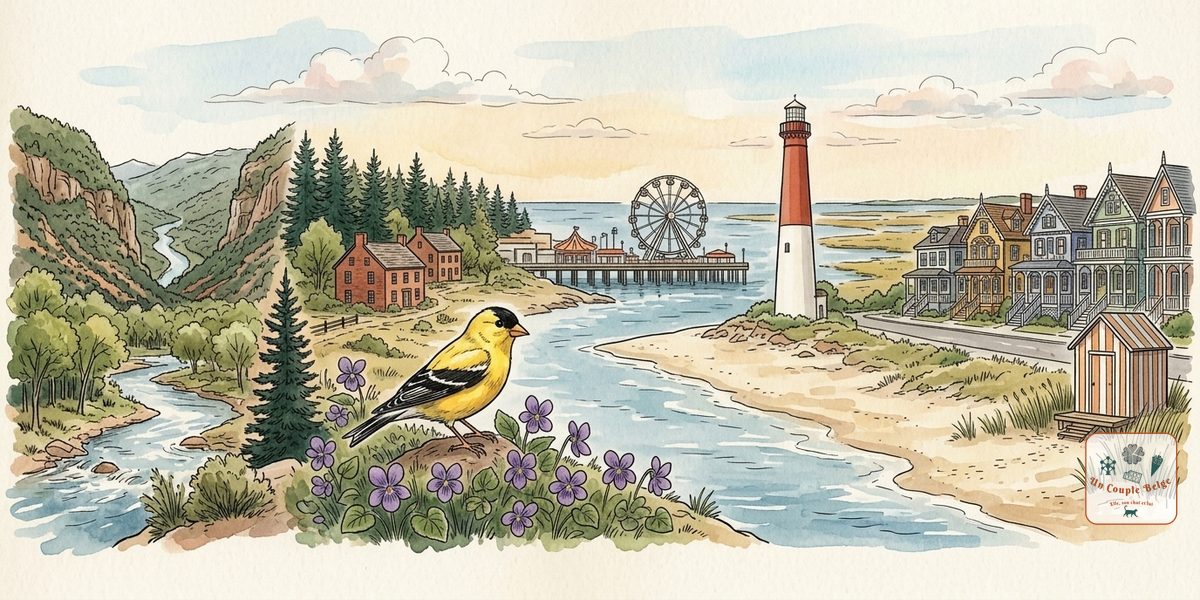
New Jersey carries a reputation it only half deserves: that of an endless industrial zone, wedged between New York and Philadelphia, seen through the window as you speed along the turnpike between refineries and warehouses. Even its official nickname, the “Garden State”, raises a smile from those who have only seen that.
And yet. New Jersey is also more than 200 kilometres of beaches and boardwalks, retro seaside resorts, an immense and mysterious pine forest, a listed Victorian town at the end of the coast, Princeton University, Edison’s laboratory and the home of Frank Sinatra and Bruce Springsteen. It’s the most densely populated state in the country, with a humour, an accent and a quick wit all its own. And for travellers it’s also an excellent gateway to New York.
New Jersey at a glance
- Capital: Trenton
- Largest city: Newark
- Population: about 9.3 million, the highest density in the United States
- Area: about 22,600 km², a little under three-quarters of Belgium
- Joined the Union: 1787, 3rd state
- Time zone: Eastern Time (6 hours behind Brussels)
- Nickname: Garden State
- Highest point: High Point, 550 metres
Geography: the urban north, the wild south
The north-east, facing Manhattan, is a dense urban area: Newark, Jersey City, Hoboken, with unbeatable views of the New York skyscrapers.
The north-west is hilly and wooded, with the Appalachians, the Delaware Water Gap and the Appalachian Trail.
The centre, with Princeton and Trenton, makes the transition towards Philadelphia.
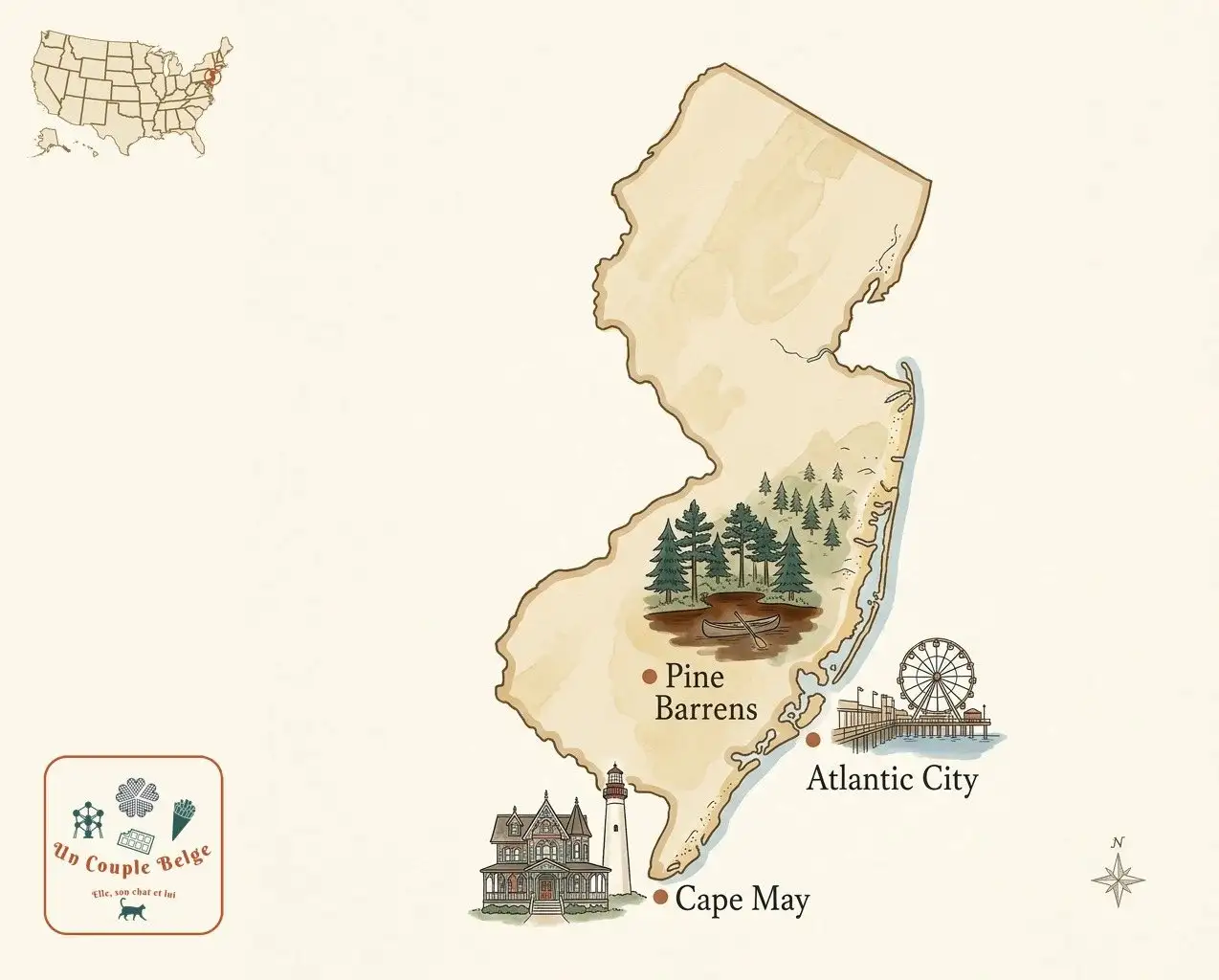
The south is flat and rural, with the Pine Barrens, an immense pine forest, blueberry and cranberry farms, and the Atlantic coast, the Jersey Shore, from Sandy Hook to Cape May.
A bit of history
The Lenape lived here when the Dutch and the Swedes settled in the 17th century, before the English took control. During the War of Independence, New Jersey was a major battleground: on Christmas night 1776, George Washington crossed the icy Delaware and surprised the Hessian troops at Trenton, a victory that revived the revolution. He then spent two winters with his army at Morristown.
In the 19th century, New Jersey industrialised very quickly: Paterson became the silk capital thanks to its waterfalls, and in 1876 Thomas Edison set up the world’s first industrial research laboratory at Menlo Park. In the 20th century, the shore became the playground of New Yorkers and Philadelphians, and Atlantic City the leisure capital of the East Coast, until the arrival of the casinos in 1976.
The must-sees
The Jersey Shore
The New Jersey coast lines up fine sandy beaches, piers and boardwalks with their rides, pizza stands and taffy. Each town has its own atmosphere:
- Sandy Hook, in the north, a wild peninsula with the oldest working lighthouse in the United States (1764) and a view of Manhattan;
- Asbury Park, the successful revival of a neglected resort, with its legendary venue the Stone Pony, where Bruce Springsteen started out;
- Point Pleasant and Seaside Heights, popular and lively;
- Island Beach State Park and Barnegat Lighthouse, for wild beaches;
- Atlantic City and its boardwalk, the first in the world (1870);
- Ocean City, family-oriented, where alcohol is banned;
- Wildwood, with its immense free beaches, its amusement piers and its 1950s “doo-wop” motels with neon signs;
- and Cape May, right at the end.
To get onto the beach, many towns ask for a small pass, the “beach tag”, in summer.
Cape May
At the southern tip of the state, Cape May is one of the oldest seaside resorts in the country, and the whole town is a National Historic Landmark: hundreds of colourful Victorian houses, many of which have become bed and breakfasts. It’s also one of the best places on the East Coast for watching migratory birds, especially in autumn, when thousands of raptors pass the point. At sunset, on Sunset Beach, people hunt for “Cape May diamonds”, quartz pebbles. A ferry links Cape May to Lewes, in Delaware.
Atlantic City and Lucy the Elephant
Long before Las Vegas, Atlantic City was the great leisure destination of the East Coast. Its street names were used in the version of Monopoly published in the 1930s: Boardwalk, Park Place, Marvin Gardens. The casinos, in place since 1976, have had their ups and downs, but the boardwalk remains a classic. Right next door, in Margate, Lucy the Elephant, a six-storey building in the shape of an elephant built in 1881, can be visited inside.
The Pine Barrens
In the south-centre lies an immense and little-known forest: the Pine Barrens, about 445,000 hectares of pines, bogs and tea-coloured rivers, stained by tannins. It’s a UNESCO biosphere reserve. You can canoe down the rivers (the Batsto or the Mullica), visit the abandoned village of Batsto, and listen to stories of the Jersey Devil, a winged creature said to have haunted the forest since the 18th century. New Jersey’s hockey team is in fact named after it.
Facing Manhattan
Liberty State Park, in Jersey City, offers one of the finest views of Manhattan and the Statue of Liberty. It’s also a convenient departure point for the ferries to the Statue of Liberty and Ellis Island, with shorter queues than in Manhattan. Hoboken, Frank Sinatra’s home town, has a promenade along the Hudson with a view of the skyscrapers and plenty of bars. Many travellers in fact stay in Jersey City or Hoboken, cheaper than Manhattan and a few minutes away by train.
Princeton and Edison
Princeton, a small university town with a neo-Gothic campus, is home to one of the most prestigious universities in the country. Albert Einstein lived here from 1933 until his death in 1955, working at the Institute for Advanced Study. His house is private, but the town is pleasant for a stroll.
Thomas Edison National Historical Park, in West Orange, preserves the laboratory where Edison worked after Menlo Park, with its machines, its phonographs and the first film studio in history, the “Black Maria” (a replica). Fascinating.
Nature in the north
In the north-west, the Delaware Water Gap is a gorge where the Delaware River cuts through the Appalachians, with hikes, canoeing and the Appalachian Trail. In Paterson, the Great Falls, a 23-metre waterfall in the middle of the city, have become a national park. And right in the north, High Point State Park offers a view over three states from its obelisk.
Itinerary ideas
A long weekend on the shore. Asbury Park → Island Beach → Atlantic City → Wildwood → Cape May, following the Garden State Parkway.
With New York. Stay in Jersey City or Hoboken to visit New York, then spend 2-3 days on the Jersey Shore or in Princeton.
In combination. New Jersey slots in between New York and Philadelphia, and the Cape May ferry lets you carry on to Delaware and Chesapeake Bay.
On the plate
- New Jersey proclaims itself the “Diner Capital of the World”, with more than 500 of these chrome-clad restaurants open late, often 24 hours a day.
- Pork roll, a processed pork meat served in a breakfast sandwich with egg and cheese. In the north it’s called “Taylor ham”, in the south “pork roll”, and the debate is deadly serious.
- Disco fries, fries smothered in brown gravy and melted cheese, to be eaten at the diner after a night out.
- Trenton tomato pie, a pizza where the tomato sauce goes on top of the cheese.
- Jersey tomatoes in summer, and blueberries: the first cultivated blueberry was developed in the Pine Barrens, in 1916.
- Saltwater taffy, a soft, chewy sweet in many flavours, said to have been born on the Atlantic City boardwalk.
- Newark’s Italian hot dog, a sausage in half a round loaf with fried potatoes, peppers and onions.
Culture and trivia
- You can’t pump your own petrol: New Jersey is the only state where self-service at the pump is banned, under a 1949 law. An attendant does it.
- “Jughandles”: on many main roads, you never turn left directly. You have to take a slip road on the right that loops back around. Confusing at first.
- Frank Sinatra, Bruce Springsteen, Whitney Houston and Bon Jovi come from New Jersey.
- The New York Giants and Jets football teams actually play in New Jersey, at MetLife Stadium, which hosted the FIFA World Cup final in July 2026.
- Thomas Edison registered more than 1,000 patents, a large share of them in New Jersey, which nicknamed him “the Wizard of Menlo Park”.
When to go
- Summer (June to August): the season for beaches, boardwalks and nightlife on the shore. Very busy at weekends.
- September: the water is still warm, the crowds have gone. Perhaps the best time for the shore.
- Autumn (October): bird migrations at Cape May, colours in the north-west.
- Spring: mild, quiet and pleasant.
- Winter: cold and grey. The shore is asleep, but Cape May lights up for Christmas.
Practical information
- Recommended length of stay: a long weekend for the shore, or a few days in addition to New York or Philadelphia.
- Getting there: Newark airport is one of New York’s major airports, with many direct flights from Europe, including Brussels.
- Getting around: NJ Transit trains link New York to Hoboken, Princeton, Asbury Park and Atlantic City. A car is still more practical for following the coast.
- Budget: variable, from moderate in Seaside or Wildwood to high in Cape May in summer. Staying in Jersey City is often cheaper than in Manhattan.
- Things to watch out for: the motorways are often jammed and tolled; an E-ZPass transponder is very handy. On Friday evenings in summer, the road to the shore is saturated.
- One more tip: buy your day “beach tag” when you arrive at the beach, and end the evening in a diner.