Time difference and time zones in the United States: finding your way and limiting jet lag
Updated on
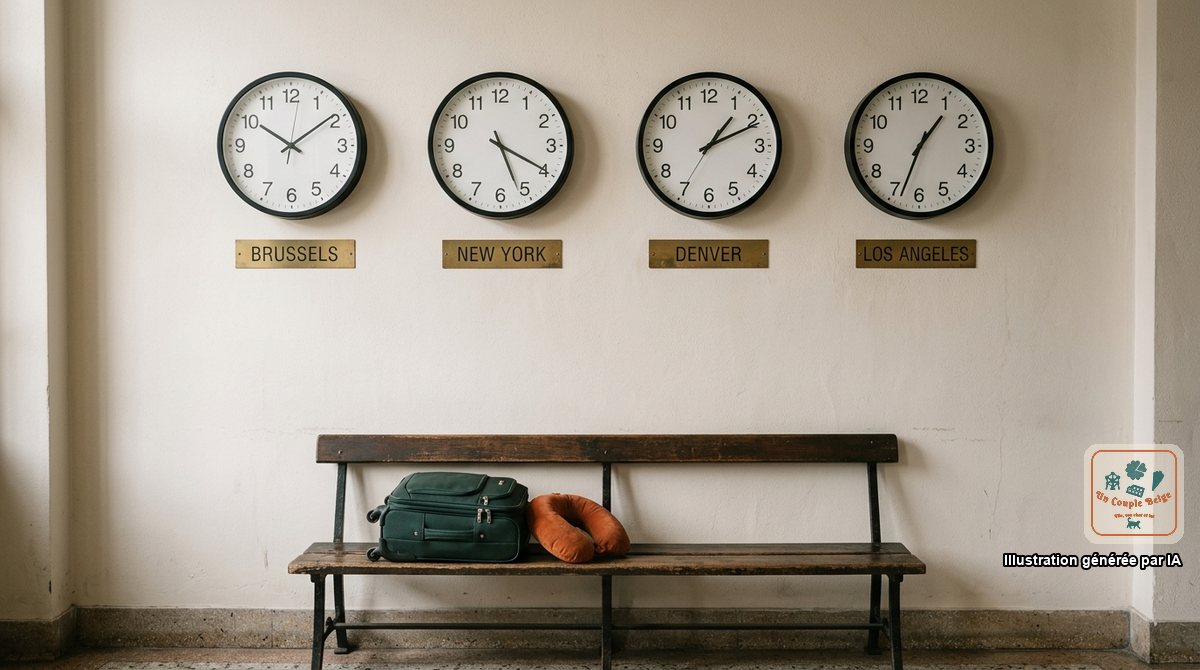
There are two time differences to manage in the United States. The one with Belgium, which affects your sleep. And the one between states, which affects your bookings: you can change time three times in a single day’s driving without noticing.
The time zones compared with Brussels
| Time zone | Difference from Brussels | Some cities and regions |
|---|---|---|
| Eastern (ET) | − 6 hrs | New York, Washington, Boston, Miami, Orlando, Atlanta |
| Central (CT) | − 7 hrs | Chicago, New Orleans, Dallas, Nashville |
| Mountain (MT) | − 8 hrs | Denver, Salt Lake City, the Utah parks, Yellowstone |
| Pacific (PT) | − 9 hrs | Los Angeles, San Francisco, Las Vegas, Seattle |
| Alaska | − 10 hrs | Anchorage |
| Hawaii | − 11 hrs in winter, − 12 hrs in summer | Honolulu |
When it’s noon in Los Angeles, it’s 9pm in Brussels: bear that in mind before calling the family.
The clocks don’t change on the same dates. The United States moves to daylight saving time on the second Sunday in March and goes back to standard time on the first Sunday in November. Europe changes at the end of March and the end of October. For two or three weeks in March, and one week at the end of October, the gap is therefore an hour smaller.
The Arizona trap
Arizona doesn’t observe daylight saving time. From March to November it is therefore on the same time as California and Nevada, and an hour behind Utah. In winter it’s on the same time as Utah.
An exception within the exception: the Navajo Nation, which covers north-east Arizona, does observe daylight saving time. As a result, in summer:
- Page, Horseshoe Bend, the Grand Canyon: Arizona time.
- Monument Valley, Canyon de Chelly: Navajo time, which is an hour later.
- Antelope Canyon tours leave from Page and generally follow Page time, but always check your confirmation.
The other changes along the way
- Between Las Vegas and Zion, you lose an hour on entering Utah.
- Hoover Dam straddles Nevada and Arizona.
- Some states are cut in two: north-west Florida, west Texas, Tennessee, Kentucky, the two Dakotas, Nebraska, Kansas, Idaho and Oregon.
In an itinerary, note visit times in local time, with the name of the time zone beside them.
Limiting jet lag on the way out
Heading west, the day gets longer: it’s the easier direction. You arrive tired, but you only have to hold out until the evening.
- On the plane, set your watch to arrival time and avoid sleeping if you land in the afternoon.
- On arrival, stay outside, in the light, and walk. On our first day in Los Angeles (coming out on December 20, 2026), we went up to watch the sunset at Griffith Observatory rather than collapsing at the hotel.
- Hold out until 9pm, local time. Take a nap at 5pm and you’ll be up at 2 in the morning.
- Eat at local mealtimes, even if you aren’t hungry.
And on the way back
This is the hard direction. The flight leaves at the end of the day, lasts eight to eleven hours, and lands in the morning in Belgium after too short a night.
- Sleep on the plane as soon as possible: eye mask, earplugs, and a meal eaten at the airport rather than on board.
- On arrival, don’t go to bed. A nap of twenty to thirty minutes in the early afternoon at most, then a proper night in the evening.
- Get out into the daylight in the morning, on the days that follow.
- Keep a day or two before going back to work. Allow roughly one day of recovery per hour of time difference to get back to normal sleep: almost a week when coming back from California.
Telling the time the American way
Times are given on a twelve-hour clock: a.m. for the morning, p.m. for the afternoon and evening. 12 a.m. is midnight and 12 p.m. is noon, which catches everyone out at least once. A booking at 7:30 p.m. is 19:30.
The other everyday differences (dates, measurements, temperatures) are gathered in our conversion sheet.