Phone and internet in the United States: eSIM, roaming or local SIM card?
Updated on
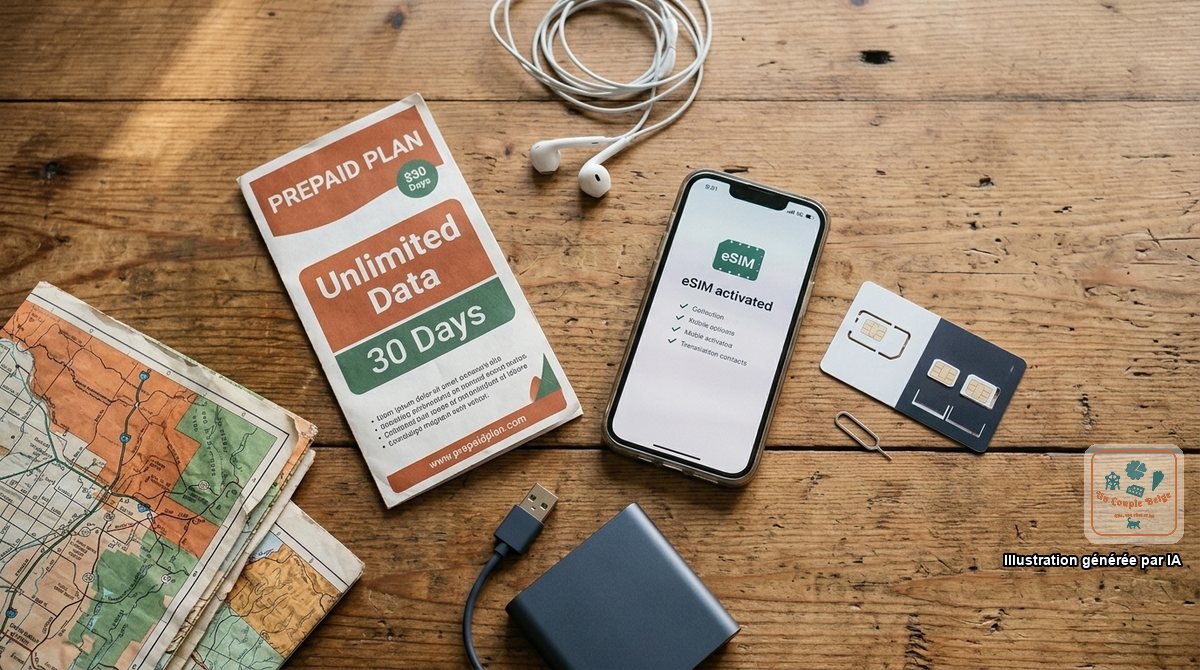
On a road trip, the phone is used for everything: GPS, bookings, weather, translation, calls to motels.
But the United States is outside the European Union, and therefore outside “roam like at home”. Without preparation, the bill when you get back can be steep.
The three options
| Option | Upside | Downside |
|---|---|---|
| Belgian roaming | Nothing to install, you keep your number | Expensive on a long stay |
| Travel eSIM | Installed from Belgium, often far cheaper | Data only, compatible phone required |
| American SIM card | An American number | A shop to find on arrival |
1. Roaming with your Belgian operator
Proximus, Orange, Telenet, Base and the others offer travel plans or options for the United States (by the day, by the week or by data volume).
- Advantages: you keep your number, and there’s nothing to install.
- Drawbacks: often expensive for a long stay, limited volumes.
With Proximus, for example, a daily pass kicks in automatically as soon as you use data outside the European Union (7.49 euros per day of use, capped at about 60 euros a month). Orange and Telenet have comparable plans. Prices change often: check your operator’s offer before you leave. If you don’t want to use it, switch off mobile data abroad in the phone’s settings.
2. A travel eSIM
This is the simplest option to set up. An eSIM is a virtual SIM card that you download onto the phone via an app or a QR code, before departure.
- Advantages: installed from Belgium, activated on arrival, prices often far lower than roaming, your Belgian SIM card stays active for text messages (bank codes!), and you keep your Belgian number on WhatsApp and other messaging apps.
- Drawbacks: data only (no American number in most plans), and the phone must be eSIM-compatible and unlocked. If you need to make calls, pick a plan that includes calls and an American number.
There are many apps selling them, with plans from a few GB to unlimited, for 7 to 30 days.
3. An American SIM card
You can buy a prepaid SIM card on the spot (T-Mobile, AT&T, Verizon or their low-cost brands), in a shop or in some supermarkets.
- Advantages: an American number, handy for calling hotels and restaurants or receiving confirmation texts, and good data deals.
- Drawbacks: you have to find a shop on arrival, and your Belgian SIM is removed (unless you have dual SIM).
The big American operators also offer their prepaid plans as an eSIM, which saves a trip to a shop.
The network: very good in town, absent elsewhere
The three big networks (Verizon, AT&T, T-Mobile) don’t have the same coverage. Verizon is often cited as the most present in the rural areas of the West, but no network covers the bottom of the canyons. If your eSIM lets you choose the network, that can matter.
Preparing the phone before you leave
- Offline maps: download the areas along your route in Google Maps (or use Maps.me or Organic Maps). GPS works even with no signal.
- NPS App (national parks): download each park to use it offline.
- Bookings as PDFs or screenshots: tickets, hotels, car rental, ESTA.
- Offline translation if you aren’t comfortable in English.
- Car charger (USB or cigarette-lighter socket) and a power bank.
Wifi
Almost all hotels, motels, cafés (Starbucks, McDonald’s) and park visitor centers have free wifi. At campgrounds, it’s more hit and miss.
Avoid checking your bank accounts on an open public wifi network, or use a VPN.
Electricity: remember the adapter
American sockets are type A/B (two flat pins), at 110-120 volts. You need an adapter. Phone, laptop and camera chargers almost all handle 110 V (check for “100-240 V” on them). European hairdryers and straighteners, on the other hand, often don’t.
For some years now, most hotels have fitted their rooms with USB-A or USB-C ports: you can recharge your small devices with just the cable, without an adapter.
Our advice
- Install the eSIM at home, on wifi, and only activate it on arrival.
- Keep your Belgian SIM active to receive texts from your bank, but switch off mobile data on that line.
- Warn family and friends about the areas with no signal during the road trip, to avoid worrying them.
For our part, we’ve always used an American SIM card bought in advance from SimUSA, usually for a month. We activate his first, then hers a few days later: that way we keep coverage right up to the last days of the trip.
Some links on this page are affiliate links: we may earn a small commission, at no extra cost to you, if you book through them.