American Samoa: the only national park in the southern hemisphere
Updated on
How long should you spend there?
At a glance
- Entrance fee
- Free. There is no ticket office and no ticket.
- Best time to go
- All year round, in a hot, humid climate. The driest months run from May to October.
- Book ahead
- Flights, which are few, and accommodation, which is very limited. Homestays are arranged in advance.
- Getting around
- By plane from Honolulu to Pago Pago, then by car or local bus on the island of Tutuila.
| Walks and hikes | Distance | Time | Level |
|---|---|---|---|
| Mount 'Alava | 11.3 km (round trip) | 4 to 5 hrs | strenuous |
American Samoa is a small archipelago in the South Pacific, more than 4,000 km from Hawaii. The national park spreads over three of its islands: Tutuila, Ofu and Ta’ū. It’s the only national park in the United States south of the equator, and one of the hardest to reach.
History and origins
Samoans have lived here for about 3,000 years. Their traditional way of life, fa’a Samoa, rests on the extended family, the village and its chiefs. It’s still in force.
That is what makes the park unique. In Samoa, land belongs to families and cannot be sold. When the park was created, in 1988, the US government was therefore unable to buy it. It leases it from the villages, under a 50-year lease signed in 1993. The inhabitants continue to farm and fish there.
What to do there
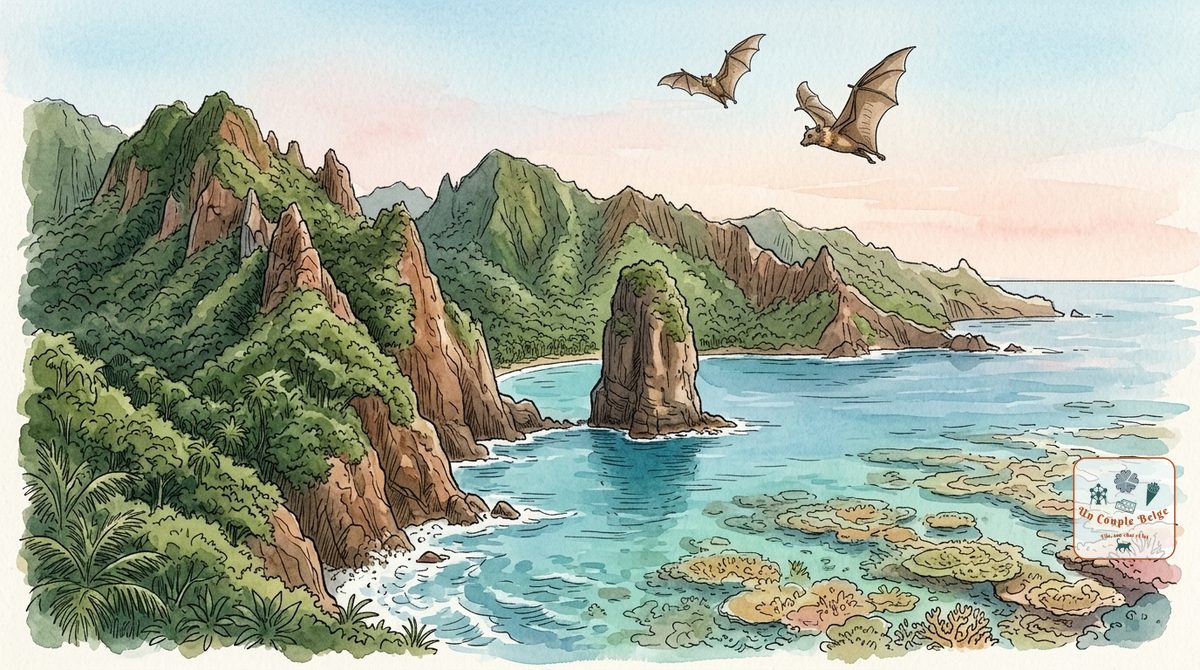
- Pago Pago harbour: an old crater flooded by the sea, ringed by green mountains. It’s one of the best-sheltered natural harbours in the Pacific.
- Mount ’Alava: a ridge trail through the tropical forest to a summit overlooking the harbour. A more athletic variant strings together dozens of ladders and hundreds of steps.
- The road to Vatia: it crosses a pass and drops down to a village on the north coast, facing Pola Island, a rock covered in seabirds.
- The fruit bats: large bats that eat fruit and fly in broad daylight. They pollinate the forest, and are easy to see above the trees.
- Ofu: a white-sand beach at the foot of volcanic peaks, with a coral reef just offshore. It’s often named among the most beautiful in the Pacific, and there’s almost nobody there.
- Ta’ū: the most remote island, with sea cliffs among the highest in the world and traditional villages.
Stories and good to know
- American Samoa is one of the last places on the planet to change date. A hundred kilometres away, the independent State of Samoa is a day ahead.
- The park protects one of the few tropical rainforests on US soil.
- Help is a long way off. On Ofu and Ta’ū there’s no hospital, and an evacuation can take several days.
Practical information for your trip
- Getting there: the only scheduled flights leave from Honolulu, two or three times a week, and take about 5 hrs 30. For Ofu and Ta’ū you then need a small plane, with unreliable schedules. Keep a day or two in hand before your flight home.
- Formalities: it’s a US territory, but with its own entry control on arrival. You need a passport valid for six months and a return ticket. European travellers generally have to apply online, a few days before departure, for a 30-day entry permit, for a fee. Sources don’t all agree: check with the American Samoa authorities before booking.
- Currency and language: the US dollar. Samoan and English are spoken.
- On the ground: rent a car in Pago Pago, or take the local buses, colourful little trucks that stop on request.
- Equipment: walking shoes, mosquito repellent, mask and snorkel. Bring everything: you’ll find almost nothing on the small islands.
Quick quiz
Question 1 / 3
Where to stay near American Samoa: the only national park in the southern hemisphere
Stay22 affiliate links: if you book through here, we earn a small commission at no extra cost to you. Thanks for your support!
On the ground

Sponsored by UnCoupleBelge
Follow us on Instagram
Box sponsored by a partner
Comments