Congaree: the last great old-growth hardwood forest of the Southeast
Updated on
How long should you spend there?
At a glance
- Entrance fee
- Free. There is no ticket office and no ticket.
- Best time to go
- Spring and autumn. Summer is stifling and infested with mosquitoes, and the forest is often flooded in winter.
- Book ahead
- None, except for the firefly evenings, in mid-May, allocated by lottery.
- Getting around
- By car to the visitor center, then on foot on the boardwalk or by canoe on the creek.
| Walks and hikes | Distance | Time | Level |
|---|---|---|---|
| The Boardwalk Loop | about 4 km (loop) | 1 hr to 1 hr 30 | easy |
| The Weston Lake Loop | about 7 km (loop) | 2 to 3 hrs | easy |
Congaree is a floodplain forest in South Carolina. This kind of forest once covered the whole of the south-eastern United States. Almost everywhere, it has been cut down. Here, a large intact piece remains, with some of the tallest trees in the eastern United States.
History and origins
Several times a year, the Congaree River bursts its banks and covers the forest floor. It leaves behind a very fertile silt. With the heat and humidity, the trees grow taller here than elsewhere: some exceed 50 metres.
It was this waterlogged ground that saved the forest: getting the timber out was too difficult. When the loggers came back, in the 1960s, local people rallied. The site was protected in 1976 and became a national park in 2003.
What to do there
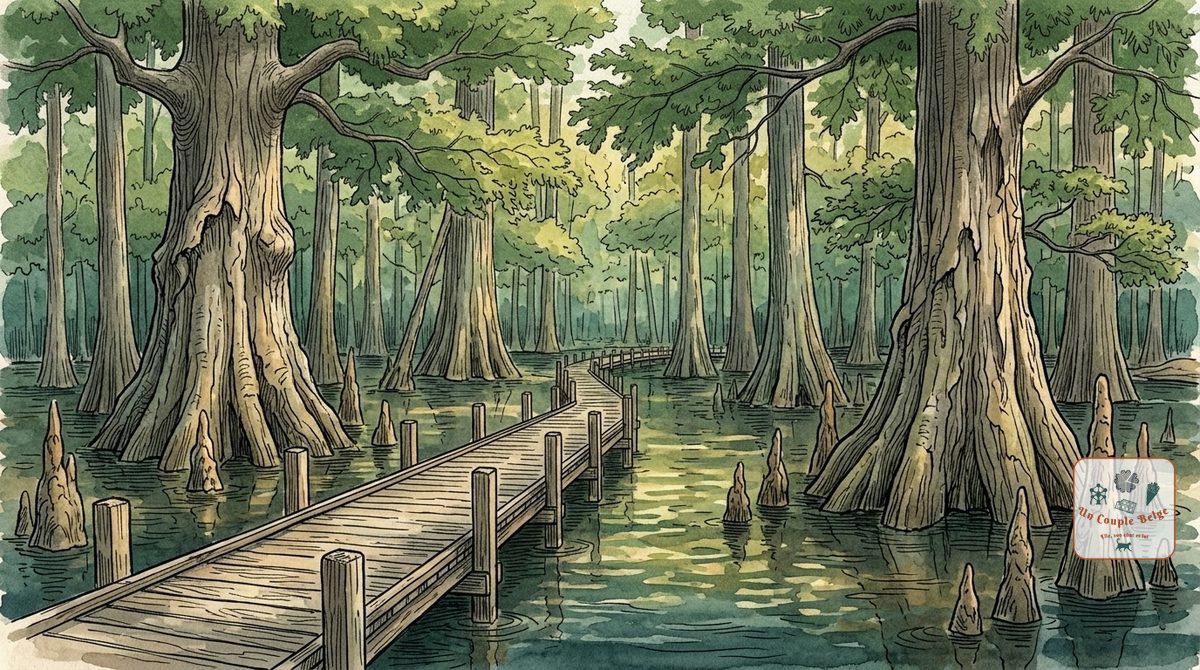
- The boardwalk: a loop on stilts that crosses the forest at head height, then at ground level. You pass among the bald cypresses, with their “knees”, roots that stick up out of the ground like skittles.
- Weston Lake: an old arm of the river, where you see turtles, herons and sometimes an alligator.
- Canoeing on Cedar Creek: the finest way to see the forest, from a dark, calm creek, under a canopy of trees. You bring your own boat, or rent one in Columbia.
- The champion trees: the park has a large number of record trees, the tallest of their species in the country.
- The fireflies: for two weeks in mid-May, thousands of fireflies flash together, in the same rhythm. The phenomenon is rare, and the park limits access.
Stories and good to know
- The cypress “knees” still puzzle botanists. Nobody really knows what they are for.
- Congaree is one of the least visited national parks in the contiguous United States.
- The forest is still standing partly thanks to a local journalist, Harry Hampton, who pleaded its cause for years. The visitor center bears his name.
Practical information for your road trip
- Getting there: the park is 30 minutes from Columbia, the capital of South Carolina, and about 2 hrs from Charleston.
- Equipment: repellent in every season, water, and shoes that don’t mind mud if you leave the boardwalk.
- Where to stay: in Columbia. The park has only two small primitive campgrounds.
- Combine it with: Charleston and Savannah, on a route through the Southeast.
Quick quiz
Question 1 / 3
Where to stay near Congaree: the last great old-growth hardwood forest of the Southeast
Stay22 affiliate links: if you book through here, we earn a small commission at no extra cost to you. Thanks for your support!
On the ground

Sponsored by UnCoupleBelge
Follow us on Instagram
Box sponsored by a partner
Comments