Great Smoky Mountains: the most visited national park in the United States
Updated on
How long should you spend there?
At a glance
- Entrance fee
- Free. You do, however, need a parking tag whenever you park for more than 15 minutes: $5 a day, $15 a week.
- Best time to go
- April and May for the flowers, October for the autumn colours. Summer is hot, humid and very busy.
- Book ahead
- None to enter. The firefly evenings, in early June, are allocated by lottery.
- Getting around
- By car, on the road that crosses the park from one state to the other. No shuttle.
| Walks and hikes | Distance | Time | Level |
|---|---|---|---|
| The Kuwohi tower | 1.6 km (round trip) | 45 min | moderate |
| Laurel Falls | 4.2 km (round trip) | 1 hr 30 | easy |
| Alum Cave Bluffs | 7.4 km (round trip) | 3 hrs | moderate |
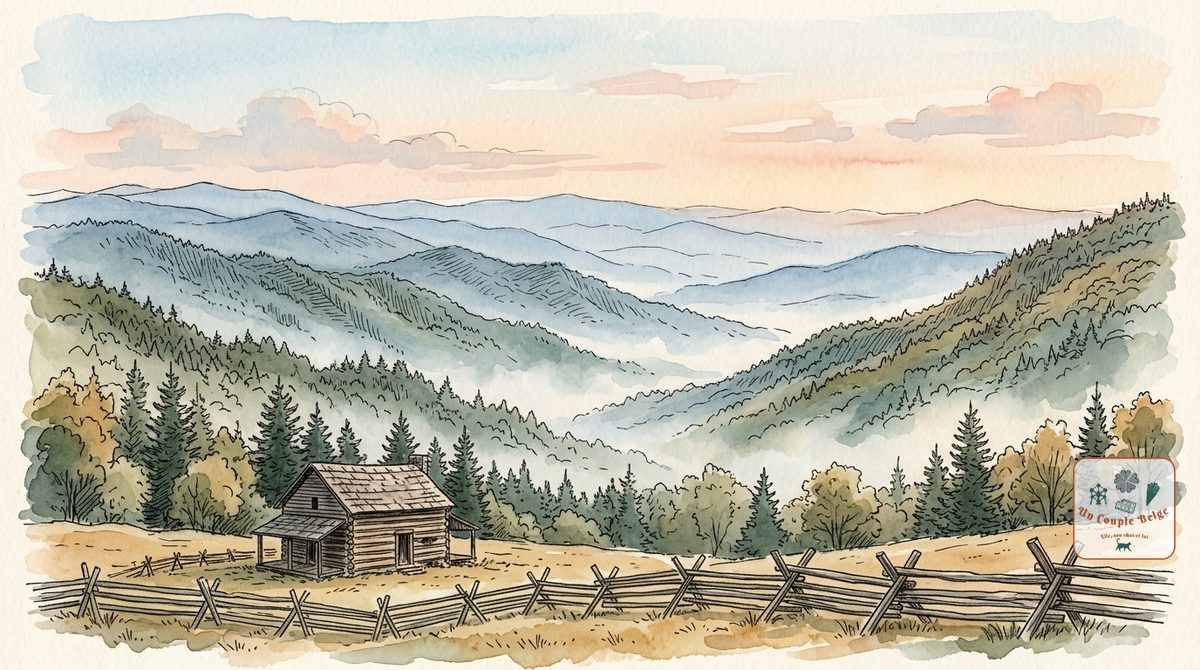
The Great Smoky Mountains are old, rounded mountains, covered in forest from end to end, straddling Tennessee and North Carolina. A bluish haze almost always hangs over the ridges: that’s what gives them their name. The park receives more than twelve million visitors a year, twice as many as the Grand Canyon.
History and origins
These mountains are Cherokee country. In 1838, most of the Cherokee were deported to Oklahoma, on the “Trail of Tears”. A few hundred hid in the heights. Their descendants still live in Cherokee, at the south entrance to the park.
In the early 20th century, the logging companies stripped the slopes bare. Residents of both states campaigned to save what was left. The park was created in 1934. To do so, thousands of farms and plots had to be bought up, and the families who lived there moved out. Their barns and churches remain.
What to do there
- The Newfound Gap Road: it crosses the park over a pass, from Gatlinburg to Cherokee. In an hour you go from hardwood forest to the firs of the summits.
- Kuwohi: the highest point in the park, at 2,025 metres. A paved path, short but steep, climbs to a spiral observation tower. In clear weather you can see seven states.
- Cades Cove: a valley of meadows ringed by mountains, with log cabins, churches and a 19th-century mill. A one-way road goes round it. You see deer, wild turkeys and often bears.
- The waterfalls: there are dozens of them. Laurel Falls and Grotto Falls are the easiest to reach.
- Roaring Fork: a narrow one-way road deep in the forest, along a mountain stream, starting from Gatlinburg.
- The autumn colours: from late September at altitude to early November in the valleys, the slopes turn red and gold.
- The fireflies: in early June, near Elkmont, thousands of fireflies flash together, in the same rhythm.
Stories and good to know
- Kuwohi was called Clingmans Dome until 2024. The summit has taken back its Cherokee name, which means “mulberry place”.
- The park is the salamander capital of the world: there are some thirty species.
- Entry is free because Tennessee banned any toll on the road when handing it over to the park, in 1951.
Practical information for your road trip
- Getting there: Gatlinburg, on the Tennessee side, is an hour from Knoxville. Cherokee, on the North Carolina side, is an hour from Asheville.
- Traffic jams: in summer and in October, set off before 8am. The Cades Cove loop can take three hours at a crawl. On certain summer days, it’s reserved for pedestrians and bikes.
- Closures: roads and trails regularly close after storms or for works. Look at the Current Conditions page.
- Where to stay: in Gatlinburg, very touristy, or in Townsend and Bryson City, which are quieter. The park has only one lodge, reached on foot, and campgrounds.
- Combine it with: the Blue Ridge Parkway and Shenandoah, further north, or Nashville.
Quick quiz
Question 1 / 3
Where to stay near Great Smoky Mountains: the most visited national park in the United States
Stay22 affiliate links: if you book through here, we earn a small commission at no extra cost to you. Thanks for your support!
On the ground

Sponsored by UnCoupleBelge
Follow us on Instagram
Box sponsored by a partner
Comments