Virgin Islands: dream beaches given by a Rockefeller
Updated on
How long should you spend there?
At a glance
- Entrance fee
- Free, except for the beach at Trunk Bay: $5 per person aged 16 and over.
- Best time to go
- From December to April, the dry season. From June to November it's hurricane season.
- Book ahead
- Accommodation, scarce and expensive on the island, months ahead for winter.
- Getting around
- By plane to the island of St. Thomas, then by ferry. On the island, by rental car or shared taxi. You drive on the left.
| Walks and hikes | Distance | Time | Level |
|---|---|---|---|
| Ram Head, from Salt Pond Bay | about 3.2 km (round trip) | 1 hr 30 | moderate |
| Reef Bay Trail | about 7 km (round trip) | 3 to 4 hrs | strenuous |
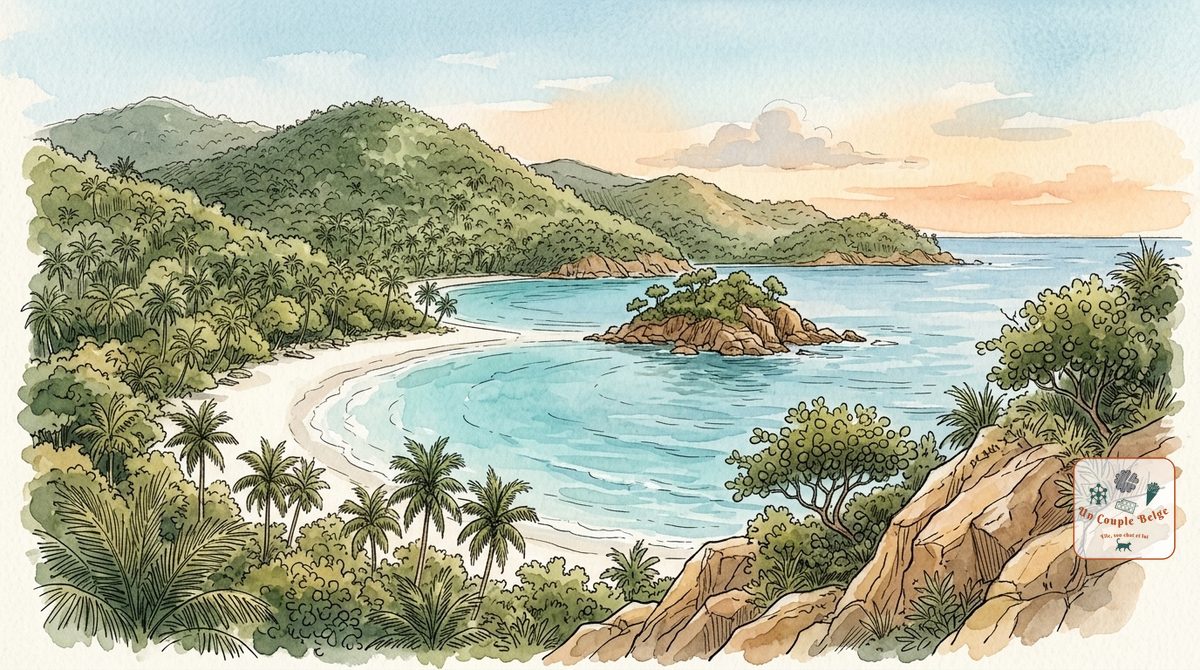
St. John is the smallest of the three US Virgin Islands, in the Caribbean. It has no airport and few buildings, and the national park covers nearly two-thirds of its area. Forested hills run down to bays of white sand, fringed with reefs.
History and origins
The Taíno lived on the island before the Europeans arrived. They left carvings on the rocks of a waterfall. In 1718, Denmark took possession of St. John and covered it with sugar cane plantations, worked by enslaved Africans. In 1733 they rebelled and held the island for six months. Slavery was only abolished there in 1848.
The United States bought the islands from Denmark in 1917. In the 1950s, Laurance Rockefeller acquired half of St. John and gave it to the nation to make a park. It was created in 1956.
What to do there
- Trunk Bay: the most photographed beach in the Caribbean, a crescent of white sand facing an islet. An underwater trail, marked with submerged signs, lets you discover the corals with a mask.
- Maho Bay: a calm, shallow bay, carpeted with seagrass. You are almost certain to swim with green turtles there.
- Cinnamon Bay and Hawksnest: two other large beaches on the north coast, less busy.
- The Annaberg ruins: the remains of a sugar plantation, with its windmill, its boiling house and the quarters of the enslaved. Signs tell the story of their lives.
- Reef Bay Trail: a trail that descends through the forest, passes the Taíno carvings and ends on a beach, near an old sugar mill.
- Salt Pond Bay and Ram Head: in the south-east, a quiet beach and a trail to a rocky headland, facing the open sea.
Stories and good to know
- In 2017, two category 5 hurricanes hit the island two weeks apart. The vegetation has grown back, but some buildings have still not been rebuilt.
- Free-roaming donkeys and mongooses wander along the roads.
- The park also protects a large expanse of sea and reefs around the island.
Practical information for your trip
- Getting there: you land on St. Thomas, then take a 20-minute ferry to Cruz Bay. The entry rules are those of the United States.
- Budget: accommodation and food are expensive. Do some shopping at the supermarket in Cruz Bay.
- Where to stay: in Cruz Bay or Coral Bay, in villas and small guesthouses. The park has a beachside campground, at Cinnamon Bay.
- Combine it with: St. Thomas, and the British Virgin Islands, very close by boat.
Quick quiz
Question 1 / 3
Where to stay near Virgin Islands: dream beaches given by a Rockefeller
Stay22 affiliate links: if you book through here, we earn a small commission at no extra cost to you. Thanks for your support!
On the ground

Sponsored by UnCoupleBelge
Follow us on Instagram
Box sponsored by a partner
Comments