Alabama: civil rights, rockets and white sand
Updated on
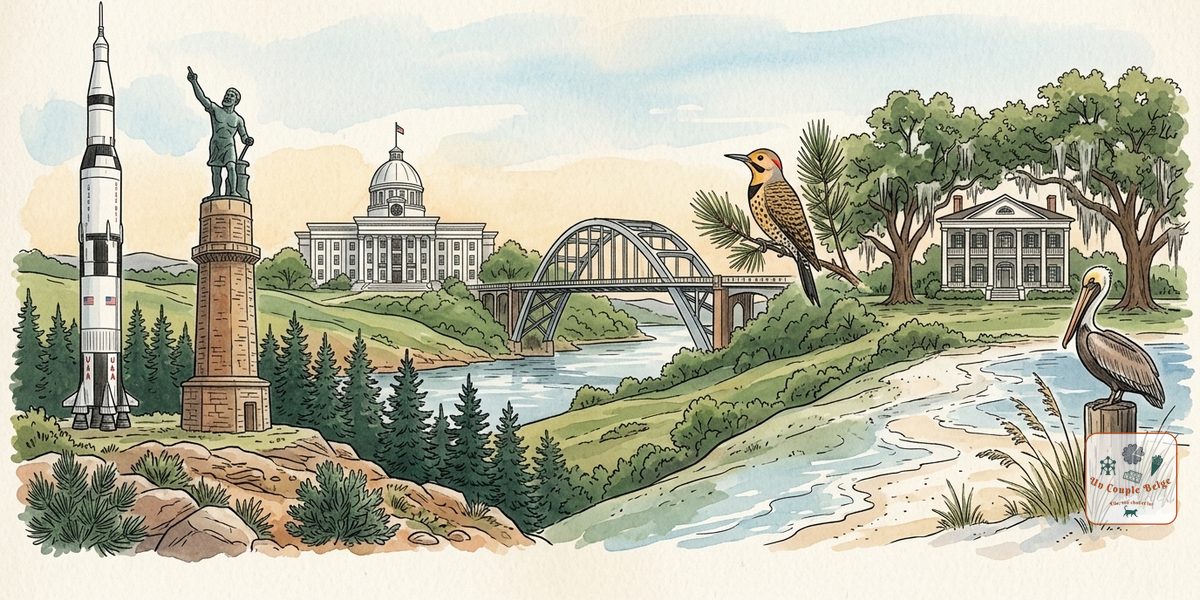
People often drive through Alabama without stopping, between Atlanta and New Orleans, or on their way to the Florida beaches. That’s a pity. In a few hours on the road, you go from a city that built the Apollo rockets to a bridge where marchers were beaten in 1965, then to beaches with sand so white it squeaks underfoot.
It’s a state that doesn’t fit any box. Its most famous song, Sweet Home Alabama, was written by a band from Florida. Its official nickname, the “Yellowhammer State”, comes from a bird (the northern flicker) that almost nobody can recognise. And it carries both one of the darkest pages in American history and one of the moments when the country tipped the right way. For that alone, it deserves a few days of your time.
Alabama at a glance
- Capital: Montgomery
- Largest city: Huntsville (which recently overtook Birmingham)
- Population: about 5 million
- Area: about 135,000 km², a little over four times Belgium
- Joined the Union: 1819, 22nd state
- Time zone: Central Time (7 hours behind Brussels)
- Nicknames: Yellowhammer State, Heart of Dixie
- Highest point: Mount Cheaha, 734 metres
Geography: from the Appalachian foothills to the Gulf of Mexico
Alabama divides quite naturally into four pieces.
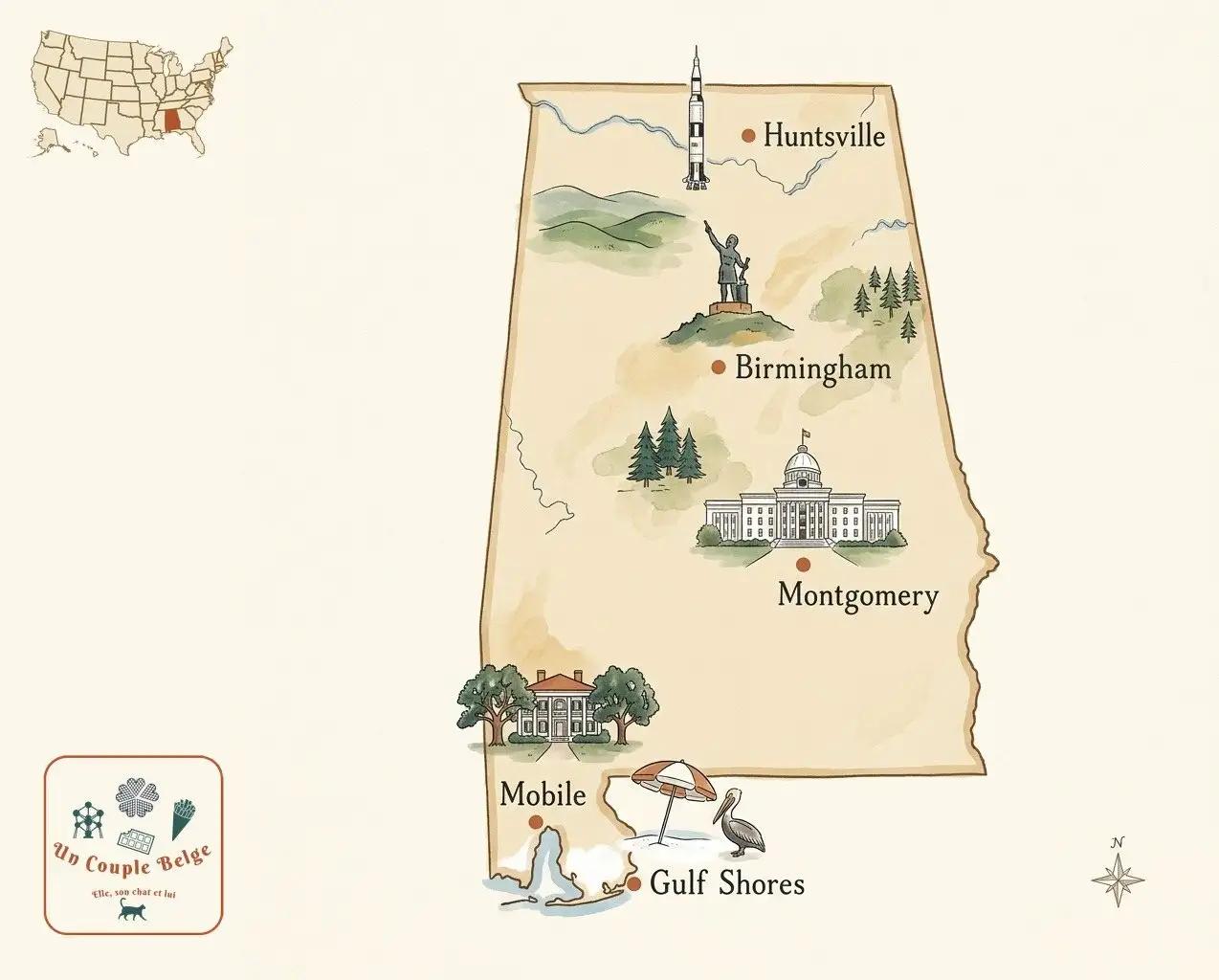
The north is hilly and wooded. These are the last foothills of the Appalachians, crossed by the Tennessee River. Here you’ll find Huntsville, the Muscle Shoals studios and some lovely natural spots such as Little River Canyon, one of the deepest canyons in the eastern United States.
The centre revolves around Birmingham, a former steel town, and Tuscaloosa, the university town.
The Black Belt crosses the state from east to west. The name comes from the dark, fertile soil that made the fortune of the cotton plantations, and therefore of slavery. Today it’s one of the poorest regions in the country, and it’s where Montgomery and Selma are.
The south, finally, runs down to Mobile Bay and a short coast on the Gulf of Mexico, about 85 kilometres of beaches between Dauphin Island and Orange Beach.
A bit of history
Before Europeans arrived, the land belonged to the Creek, the Cherokee, the Choctaw and the Chickasaw. The French founded Mobile in 1702: it’s one of the oldest cities in the South. The Spanish, the British and then the Americans followed, and the Native American nations were driven west in the 1830s.
The 19th century meant cotton, slavery, then the Civil War. Montgomery was the first capital of the Confederate States in 1861, before the government moved to Richmond. After the war, segregation laws (the “Jim Crow” laws) settled in for nearly a century.
That’s why, in the 1950s and 1960s, Alabama became the heart of the civil rights movement: the Montgomery bus boycott in 1955, the Birmingham demonstrations in 1963, the Selma marches in 1965, which led directly to the Voting Rights Act. At the same time, Huntsville was turning into the capital of the space race. Two very different stories unfolding at the same moment, a few hours’ drive from each other.
The must-sees
Montgomery: Rosa Parks and a memorial that stays with you
It was in Montgomery that Rosa Parks refused, in December 1955, to give up her seat to a white passenger on a bus. Her arrest set off a 381-day boycott, led by a young 26-year-old minister, Martin Luther King. The small Rosa Parks Museum stands almost on the spot of the arrest. It’s sober and well done.
But the visit that stays in your mind is the National Memorial for Peace and Justice, opened in 2018. Hundreds of hanging steel blocks bear the names of lynching victims, county by county. Right next door, the Legacy Museum connects slavery, segregation and today’s mass incarceration. It’s hard going, but it’s probably the most important place in the state. Allow half a day for the two.
Selma and the Edmund Pettus Bridge
On 7 March 1965, 600 marchers set off from Selma for Montgomery to demand the right to vote. On the Edmund Pettus Bridge, the police charged them with clubs and tear gas: this was “Bloody Sunday”. Two weeks later the march set off again, this time protected by the National Guard, and reached Montgomery 25,000 strong.
The bridge is still there, with its name in big letters, and the town around it has changed little since. The 87 kilometres of US Route 80 between the two cities now form the Selma to Montgomery National Historic Trail, with an interpretive centre halfway along, in Lowndes County.
Birmingham, the old steel town
Birmingham has kept the memory of 1963 at the heart of its city centre: the 16th Street Baptist Church, where a Ku Klux Klan bomb killed four little girls, Kelly Ingram Park just opposite, where the police set dogs and fire hoses on the demonstrators, often teenagers, and the Birmingham Civil Rights Institute, the most complete museum on the subject in the state.
But Birmingham isn’t only a memorial. Sloss Furnaces, a converted former blast furnace, is worth a visit for its industrial atmosphere. The Avondale district and the city centre have filled up with breweries and good restaurants. And the statue of Vulcan, the largest cast-iron statue in the world, watches over the city from the hill of Red Mountain.
Huntsville, “Rocket City”
A complete change of mood in the north. After the Second World War, the US Army settled Wernher von Braun and his team of German engineers in Huntsville. It was here that the Saturn V rocket, the one used for the Apollo missions, was designed.
The U.S. Space & Rocket Center displays a real one, hung horizontally in a hangar: 111 metres long, you really have to step back to see all of it. It’s also the home of Space Camp, which welcomes children (and adults) from all over the world. Even if you aren’t a space enthusiast, allow at least half a day.
Muscle Shoals, the sound of the South
In a small town in the north-west, two studios recorded an insane number of classics: Aretha Franklin, Wilson Pickett, the Rolling Stones (Brown Sugar), Paul Simon, Bob Seger… FAME Studios and the Muscle Shoals Sound Studio can both be visited. You walk into the rooms where those tracks were recorded, often with a guide who knows all the stories. The documentary Muscle Shoals 🎬 (2013) is a good appetiser before you go.
Right next door, in Tuscumbia, the birthplace of Helen Keller, Ivy Green, tells the story of the deaf and blind child whose teacher Anne Sullivan taught her to communicate.
Tuskegee
Between Montgomery and the Georgia border, Tuskegee brings together two national sites. Tuskegee University, founded in 1881 by Booker T. Washington, where the scientist George Washington Carver worked. And the Tuskegee Airmen National Historic Site, on the airfield where the first Black American military pilots were trained during the Second World War.
Mobile, the old French city
Mobile was founded by the French, and you can still feel it a little in the street names and in the architecture, with its houses with wrought-iron balconies and its oaks draped in Spanish moss. Above all, the city lays claim to the first Mardi Gras in America, celebrated from the early 1700s, well before New Orleans. The parades take place in the weeks leading up to Ash Wednesday. The mood is more family-friendly than at its big Louisiana neighbour.
In the bay, the Second World War battleship USS Alabama can be visited from the engine room up to the turrets. South of the city, Bellingrath Gardens are magnificent in spring, when the azaleas bloom.
Gulf Shores and Orange Beach
Nobody thinks of Alabama for the beach, and yet. At Gulf Shores and Orange Beach, the sand is made of very pure quartz washed down from the Appalachians: it’s white, fine, and it squeaks underfoot. The water is warm from May to October, and prices are generally gentler than in Florida, right next door. For something wilder, the Bon Secour National Wildlife Refuge protects dunes where loggerhead turtles come to lay their eggs in summer, and Fort Morgan, at the tip of the peninsula, keeps the walls of a 19th-century fort.
On the nature side
The north-east is the greenest part of the state. Little River Canyon National Preserve follows a river that flows almost entirely along the top of a mountain, with waterfalls and a scenic road on the canyon rim. DeSoto State Park, right next door, has pretty trails and waterfalls. Closer to the centre, Mount Cheaha, the highest point, offers an open view over forests as far as the eye can see. Nothing spectacular by the standards of the American West, but good days of hiking far from the crowds.
Itinerary ideas
4-5 days, civil rights. Birmingham (1 day), Montgomery (a day and a half), the road to Selma (half a day), and possibly Tuskegee. Many travellers arrive via Atlanta, 2 hrs 30 from Birmingham.
7-10 days, north to south. Huntsville and the Space Center → Muscle Shoals → Birmingham → Montgomery and Selma → Mobile → Gulf Shores to finish with your feet in the water. About 800 kilometres in all, with no long driving day.
A combo with the neighbours. Alabama goes very well with Tennessee (Nashville is under 2 hours from Huntsville), Georgia (Atlanta), or Mississippi and Louisiana by following the coast towards New Orleans.
On the plate
Alabama is first and foremost barbecue, with a speciality you’ll find almost nowhere else: white sauce, made with mayonnaise, vinegar and pepper, invented in the 1920s at Big Bob Gibson’s in Decatur. It’s served on smoked chicken. It surprises you, then you ask for more.
Also worth tasting:
- fried green tomatoes, green tomatoes breaded and fried. Fannie Flagg’s novel (and the film Fried Green Tomatoes 🎬) was inspired by the Irondale Café, near Birmingham, which still serves them;
- Conecuh sausage, smoked in the south of the state, which turns up more or less everywhere;
- boiled peanuts, peanuts boiled in salted water, sold at the roadside;
- West Indies salad from Mobile, a salad of marinated crab meat;
- oysters and “royal red” shrimp from the Gulf;
- Lane cake, a bourbon-soaked cake with dried fruit and nuts, the state’s official dessert.
Culture and trivia
- College football is a religion. The Iron Bowl, the annual game between the University of Alabama (Tuscaloosa) and Auburn, brings the state to a standstill every late November. The Tuscaloosa stadium holds more than 100,000. Even if you don’t understand the rules at all, a game on an autumn Saturday is an experience: marching bands, car parks turned into giant picnics from the morning onwards (“tailgating”)…
- Monroeville, in the south, is the hometown of Harper Lee, the author of To Kill a Mockingbird. Her childhood friend Truman Capote spent his summers there. Every spring, the locals perform the stage adaptation of the novel in the old courthouse.
- Hank Williams, a pioneer of country music, and Nat King Cole were born in Alabama. Montgomery has a museum devoted to the former.
- In Scottsboro, the Unclaimed Baggage Center resells the contents of suitcases lost by airlines and never claimed. You’ll find everything there, from clothes to cameras, and it has become an attraction in its own right.
- A few Alabama counties are still “dry”, or partly so: no alcohol sales, or only in certain towns. Don’t count on being able to buy a beer everywhere.
When to go
- Spring (March to May): the best time. It’s mild, the azaleas are in bloom in Mobile, and the coast isn’t yet packed. Be aware that it’s also tornado season: keep an eye on weather alerts.
- Summer (June to August): hot and very humid, often above 32 °C with heavy heat. Perfect for the beach, less so for walking around town.
- Autumn (September to November): very pleasant from October, with the atmosphere of the football games as a bonus. Hurricane season runs until the end of November on the coast.
- Winter (December to February): mild in the south, sometimes chilly in the north, and very quiet. Mardi Gras in Mobile falls in February or early March.
Practical information
- Recommended length of stay: 5 to 7 days for the essentials, 10 days to take your time.
- Getting there: Birmingham, Huntsville, Montgomery and Mobile airports are mostly served by connecting flights. Atlanta (Georgia) is often the most convenient and cheapest gateway from Belgium.
- Getting around: a car is essential. Public transport between the cities is almost non-existent.
- Budget: fairly affordable for the United States. Motels and restaurants are clearly cheaper than in Florida or the big East Coast cities.
- Things to watch out for: download a weather app with alerts (tornadoes in spring, hurricanes from June to November). In summer, carry water and avoid long visits on foot in the middle of the day.
- One more tip: for the coast, book well ahead if you’re travelling during the American school holidays (June-July), when families from the South arrive en masse.