Arkansas: the nature state nobody saw coming
Updated on
Ask ten people to locate Arkansas on a map, and half will hesitate. Wedged between the Mississippi, Texas and Missouri, with no big metropolis and no world-famous monument, it’s probably one of the most low-key states in the country for foreign travellers. And that’s exactly what makes it interesting.
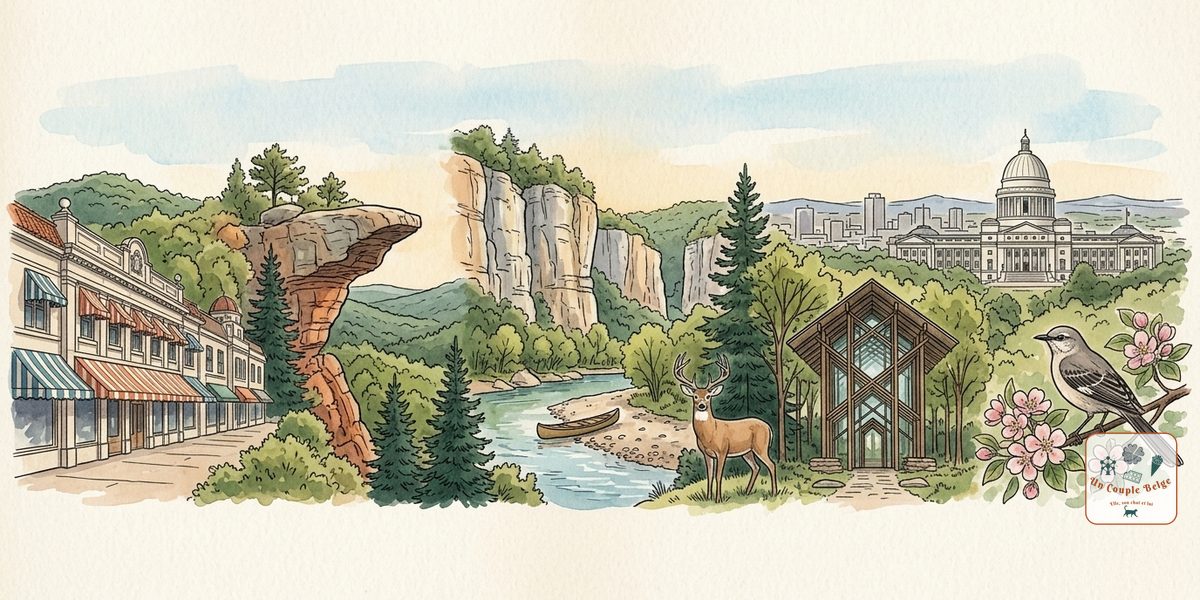
Arkansas chose “The Natural State” as its official nickname, and for once the slogan doesn’t lie: forest-covered mountains, crystal-clear rivers you paddle down by canoe, hot springs in the middle of a town and an ancient volcano where you can hunt for diamonds. Add to that an important role in recent American history: Bill Clinton, Walmart, Johnny Cash and the Little Rock Nine all come from here.
Arkansas at a glance
- Capital and largest city: Little Rock
- Population: about 3 million
- Area: about 138,000 km², four and a half times Belgium
- Joined the Union: 1836, 25th state
- Time zone: Central Time (7 hours behind Brussels)
- Nickname: The Natural State
- Highest point: Mount Magazine, 839 metres
- Pronunciation: “AR-kan-saw”, without the final “s”. It has even been written into a state law since 1881.
Geography: mountains to the west, Delta to the east
Arkansas splits in two, almost diagonally.
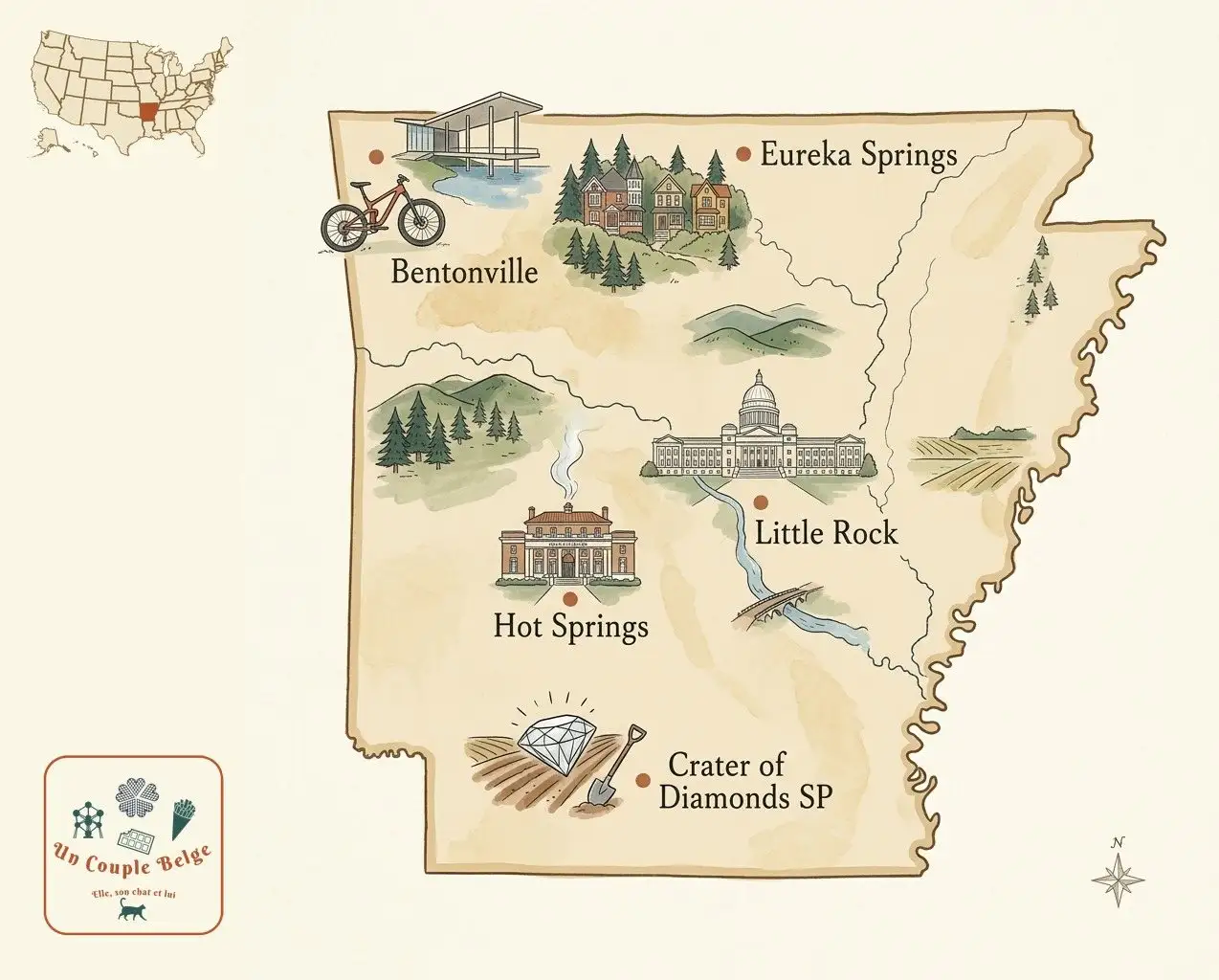
In the north-west, the Ozarks: an old range with rounded summits, cut by clear rivers and covered in hardwood forest. It’s the most touristy region, with Eureka Springs, the Buffalo River, Fayetteville and Bentonville.
In the west and centre, the Ouachita Mountains, one of the few ranges in the United States that runs east-west, with the national forest of the same name and the spa town of Hot Springs.
In the east, the Mississippi Delta: a completely flat plain of rice, cotton and soybean fields as far as the eye can see. Arkansas is the leading rice producer in the United States. It’s also blues country, around Helena.
In the south, the Gulf coastal plains, more wooded, with the Crater of Diamonds near Murfreesboro.
A bit of history
The name comes from the Quapaw, a Native American people whom French explorers called the “Arkansas”. The French founded Arkansas Post in 1686, the first European settlement in the lower Mississippi valley. The territory passed to the United States with the Louisiana Purchase in 1803 and became a state in 1836.
Arkansas joined the Confederacy during the Civil War, then long remained a poor, rural state, mocked in the rest of the country as “hillbilly” territory. The 20th century put it back in the spotlight several times: the Little Rock crisis in 1957, the birth of Walmart in the 1960s, then the election of Bill Clinton, a former governor, to the presidency in 1992.
The must-sees
Hot Springs
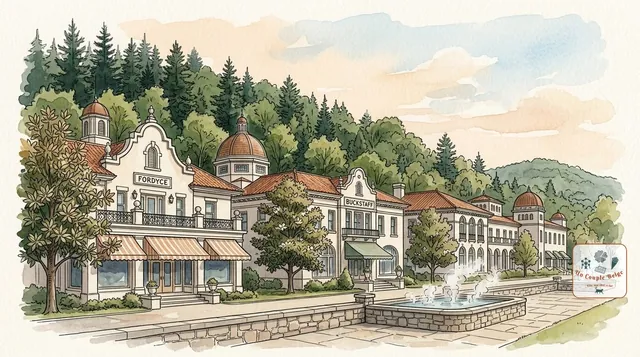
Right in the town centre, Hot Springs is the most urban of America’s national parks. On Bathhouse Row, a line of early 20th-century bathhouses with neoclassical façades recalls the days when Americans came here for their health. The water that gushes out at over 60 °C fell as rain about 4,000 years ago before rising back up through the rock. You can still drink it for free at the town’s fountains.
In the 1920s and 1930s, Hot Springs was also a gangsters’ hideout, Al Capone first among them, who came to enjoy the baths and the illegal casinos. The Gangster Museum of America tells the story of that era. To soak yourself, two historic establishments are still operating: the Buckstaff, old-school, and the Quapaw, with its more modern pools.
The Ozarks and the Buffalo National River
In 1972, the Buffalo National River became the first river in the United States to be given “national river” status. Its clear water flows at the foot of limestone bluffs that exceed 150 metres in places. In spring, when the level is good, you paddle down it by canoe or kayak over one day or several, with outfitters who run the shuttle. You camp on gravel bars at the water’s edge. In summer, often only the lower river remains navigable.
On foot, the star hike is Whitaker Point (Hawksbill Crag), a rocky spur above the valley that has become one of the most shared photos of the state. Further east, Blanchard Springs Caverns can be visited with a Forest Service guide.
Eureka Springs
This small Victorian town is built on a hillside, to the point where some houses have an entrance at ground level on one side and on the second floor on the other. The winding streets are full of galleries, shops and small restaurants, with an unapologetically bohemian feel. Right nearby, Thorncrown Chapel, a chapel of wood and glass deep in the forest, is a little architectural gem. More kitsch, the Christ of the Ozarks statue towers over the neighbouring hill.
Bentonville and Crystal Bridges
Bentonville is Walmart’s town. The five-and-dime Sam Walton opened here in 1950, on the central square, well before the first Walmart, has become a small free museum. But people mostly come for Crystal Bridges, a first-rate museum of American art, opened in 2011 by the heiress Alice Walton. The glass-and-wood building spans a wooded ravine, the collection runs from the 18th century to today (Georgia O’Keeffe, Norman Rockwell, Andy Warhol…) and admission to the permanent collection is free.
Bentonville has also established itself as a mountain-biking capital, with hundreds of kilometres of trails that start right from the town centre.
Little Rock
The capital made history in September 1957, when nine Black students, the “Little Rock Nine”, tried to enter Central High School, until then reserved for whites. Governor Orval Faubus sent in the National Guard to stop them, and President Eisenhower had to dispatch army paratroopers to escort them. The school is still in use, and the Central High School National Historic Site, just opposite, tells this story with striking archive material.
The Clinton Presidential Center, beside the Arkansas River, retraces Bill Clinton’s presidency, with a replica of the Oval Office. In the evening, the River Market district is where the bars and restaurants are, and the Big Dam Bridge, one of the longest pedestrian and cycle bridges in the country, is an easy ride across.
The Crater of Diamonds
It’s probably the most unusual attraction in the state. At Crater of Diamonds State Park, near Murfreesboro, anyone can search for diamonds in the ploughed field of an ancient volcanic crater, and keep what they find. Most visitors leave empty-handed, but hundreds of stones are discovered every year, often small, sometimes much less so. The largest diamond ever found in the United States, the Uncle Sam, more than 40 carats, was dug up here in 1924. Come after heavy rain: the water washes the soil and makes the stones on the surface shine.
Mountain View and the music of the Ozarks
Around Mountain View, traditional mountain music has never died out. The Ozark Folk Center keeps alive the crafts and music inherited from the first Scottish and Irish settlers. On Saturday evenings, on the courthouse square, musicians bring out their banjos and fiddles and play in a circle. Anyone can join in.
The Delta and the blues
In the east, the small town of Helena, on the Mississippi, hosts the King Biscuit Blues Festival every October, one of the oldest blues festivals in the country. The radio show King Biscuit Time, broadcast from here since 1941, is one of the oldest blues programmes in the world. Johnny Cash grew up a little further north, in Dyess, a farming colony created during the Great Depression. His boyhood home has been restored and is open to visitors.
More on the nature side
Petit Jean State Park, Arkansas’s first state park, has fine waterfalls and viewpoints over the Arkansas River valley. Mount Magazine, the highest point, is a well-known paragliding spot. And the Ouachita National Forest has hundreds of kilometres of trails, and lakes for fishing or swimming, such as Lake Ouachita, with its very clear water.
Itinerary ideas
5-7 days, the nature loop. Little Rock → Hot Springs (1-2 days) → Crater of Diamonds → back north through the Ouachitas → Buffalo River (2 days) → Eureka Springs → Bentonville. About 900 kilometres, on mountain roads that are slower than the map suggests.
A long weekend in the Ozarks. Bentonville and Crystal Bridges, Eureka Springs, then a day’s canoeing on the Buffalo.
In combination. Arkansas slots in easily between Memphis (2 hours from Little Rock) and Texas, or between Branson (Missouri) and New Orleans.
On the plate
Arkansas cooking is Southern cooking, simple and generous.
- Cheese dip, a melted cheese sauce served with tortilla chips. Arkansas claims to have invented it (in 1935, in a Hot Springs restaurant) and even holds a world championship.
- Fried pickles, battered gherkins, invented at a drive-in in Atkins in the 1960s.
- Catfish, breaded and fried, with hushpuppies (fried cornmeal balls).
- Biscuits with chocolate gravy, a warm chocolate sauce over breakfast biscuits, an Ozark speciality.
- Possum pie, with no possum in it, rest assured: it’s a layered dessert of chocolate, cream and pecans.
- And rice, of course, since the state is the country’s leading producer.
Culture and trivia
- Walmart was born here: Sam Walton opened his first Walmart store in Rogers in 1962. The company still has its headquarters in Bentonville.
- Bill Clinton was born in Hope, in the south of the state. His birthplace can be visited.
- The Razorbacks of the University of Arkansas, in Fayetteville, have a unique rallying cry: “Woo Pig Sooie!”, which imitates a hog call. The mascot is a wild boar.
- Toad Suck Daze, in Conway, is a spring festival whose main attraction is a toad race. The name is said to come from the boatmen who drank in a riverside tavern until they “swelled up like toads”.
- Maya Angelou spent part of her childhood in Stamps, in the south of the state, which she describes in I Know Why the Caged Bird Sings.
When to go
- Spring (April to June): the best time for the Buffalo River, when the water level allows canoeing, and for the waterfalls. Watch out for tornadoes and violent storms in spring.
- Summer (July-August): hot and humid, often above 33 °C. Ideal for the lakes, less so for hiking.
- Autumn (October to early November): the Ozarks take on magnificent colours, and it’s festival season.
- Winter: quiet and fairly mild, perfect for the baths at Hot Springs. A few spells of snow or ice in the mountains.
Practical information
- Recommended length of stay: 5 to 7 days for the essentials.
- Getting there: Little Rock airport and Bentonville’s (Northwest Arkansas) are served by connecting flights. Memphis, Dallas and Tulsa are alternatives.
- Getting around: a car is essential, and the mountain roads take longer than expected.
- Budget: one of the most affordable states in the country, for accommodation as well as food.
- Things to watch out for: in the Ozarks, beware of ticks and poison ivy when hiking. Some counties are “dry” and don’t sell alcohol.
- One more tip: for the Buffalo River, check the water level with an outfitter before booking. Too low in summer, too high after heavy rain.