Connecticut: New England between New York and Boston
Updated on
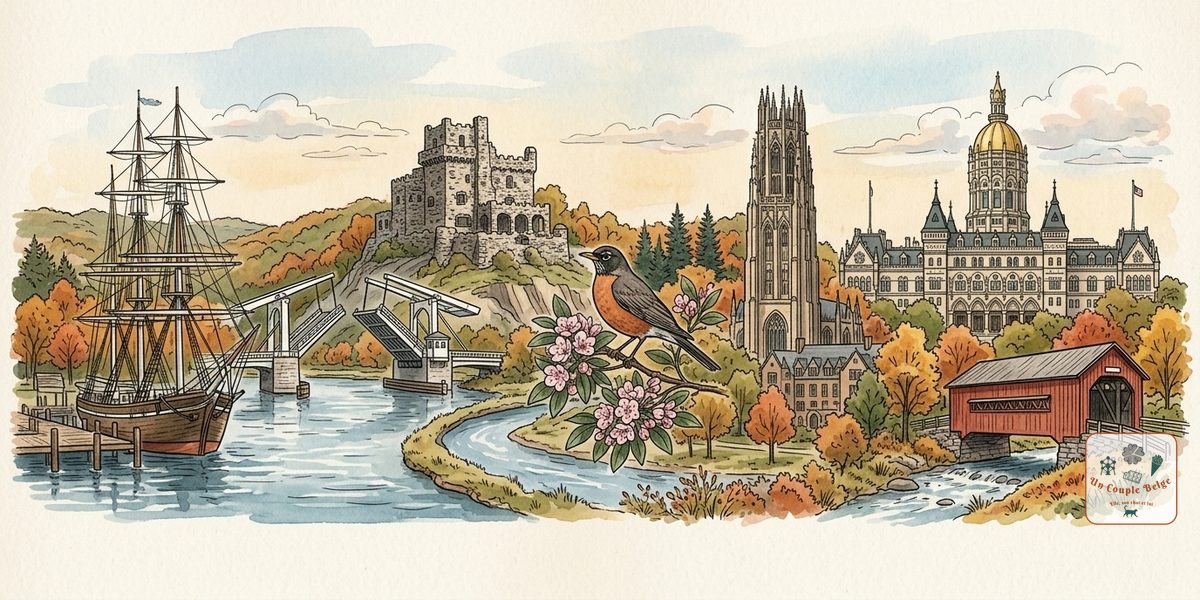
Between New York and Boston, Connecticut has long been seen as a corridor you drive through on Interstate 95 on your way somewhere else. It deserves better. This small state, one of the thirteen founders of the United States, packs into a tiny territory colonial villages that seem frozen since the 18th century, wooded hills that blaze every autumn and a coast where fishing harbours sit alongside estates worthy of a Fitzgerald novel.
It’s a quieter, older America, far from skyscrapers and wide-open spaces. And as you can cross the state from end to end in two hours, it combines very easily with a stay in New York or a tour of New England.
Connecticut at a glance
- Capital: Hartford
- Largest city: Bridgeport
- Population: about 3.6 million
- Area: about 14,400 km², less than half of Belgium. It’s the third-smallest state in the country.
- Joined the Union: 1788, 5th state
- Time zone: Eastern Time (6 hours behind Brussels)
- Nicknames: Constitution State, Nutmeg State
- Highest point: the slope of Mount Frissell, 725 metres (the summit itself is in Massachusetts)
Geography: three moods in a two-hour drive
The coast, along Long Island Sound, runs from Greenwich, in New York’s smart suburbs, to the fishing villages of the east such as Stonington and Mystic. Sandy or pebble beaches, small harbours, rocky islets.
The Connecticut River valley cuts the state from north to south, with Hartford and the old villages of Essex and Old Lyme. A very particular tobacco is still grown here, under netting, used to wrap premium cigars.
The north-west, with the Litchfield Hills, already looks like Vermont: hills, forests, lakes, red barns and dry-stone walls. The Appalachian Trail passes through.
The north-east, nicknamed “The Quiet Corner”, is the most rural and most peaceful part of the state.
A bit of history
Europeans settled in the Connecticut valley from the 1630s. In 1639, the settlers of Hartford, Windsor and Wethersfield adopted the Fundamental Orders, often presented as the first written constitution in modern history. That’s where the official nickname “Constitution State” comes from.
The state played an important role during the War of Independence, then became an industrial power in the 19th century: clockmaking, firearms (Colt in Hartford, Winchester in New Haven), sewing machines, whaling ships in New London and Mystic. Hartford became the “insurance capital of the world”, a title it still claims. In the 20th century, the submarines of Groton, including the Nautilus, the first nuclear submarine, left their mark on the Cold War.
The must-sees
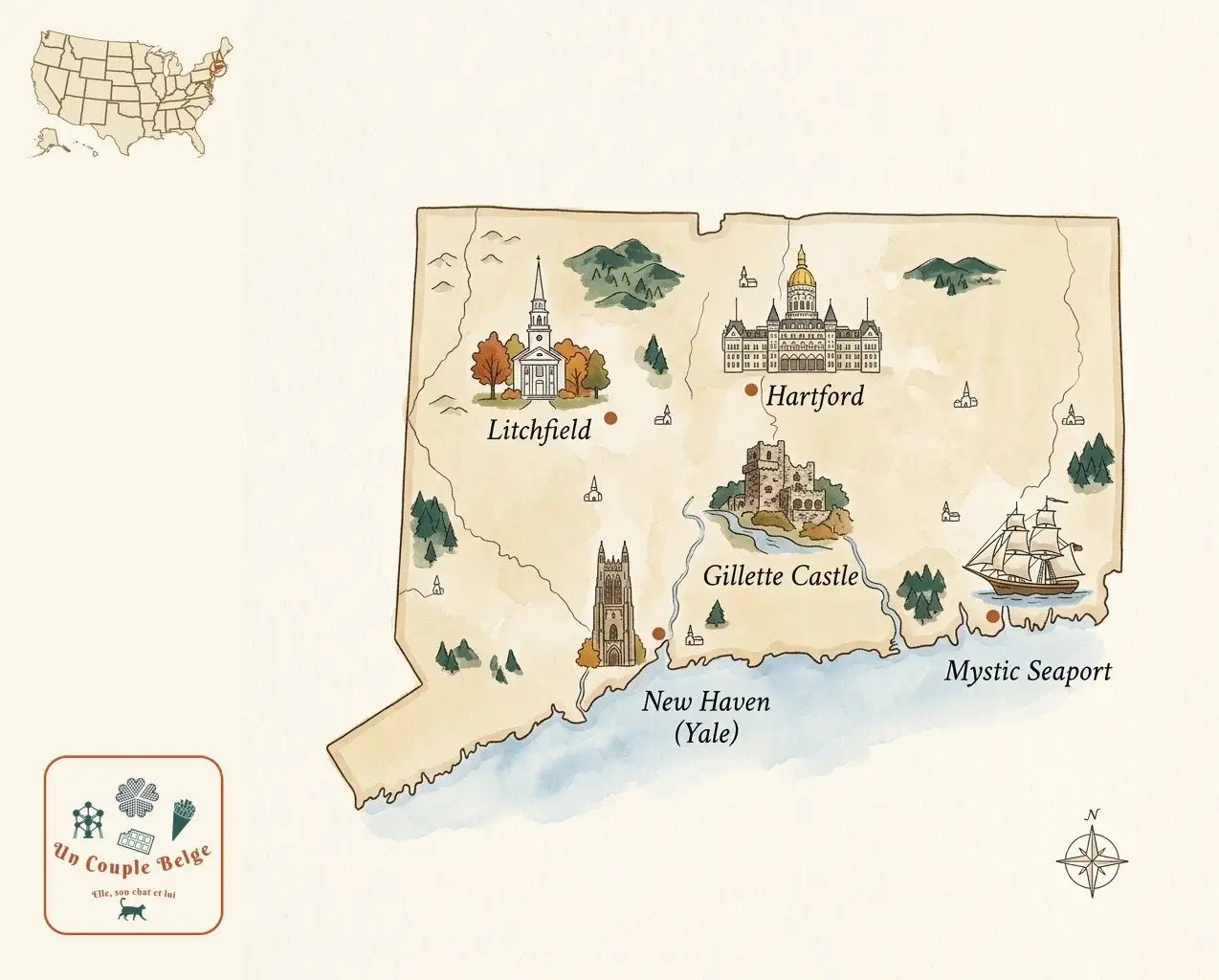
Mystic and the eastern coast
Mystic Seaport Museum, the largest maritime museum in the United States, recreates a 19th-century port village, with its sail loft and cooperage. You go aboard the Charles W. Morgan, the last wooden whaling ship still afloat in the world. The village of Mystic itself is charming, and its aquarium is one of the few in the country to keep belugas.
Next door, Stonington is a pretty fishing village, and in Groton, the Submarine Force Museum lets you visit the USS Nautilus, the first nuclear-powered submarine, which passed under the North Pole in 1958.
Hartford
The capital has two houses that are worth the detour on their own. The Mark Twain House, an extravagant Victorian home in coloured brick, where the writer spent his most productive years and wrote The Adventures of Tom Sawyer and much of Huckleberry Finn. And, right next door, that of Harriet Beecher Stowe, the author of Uncle Tom’s Cabin.
Hartford also has the Wadsworth Atheneum, the oldest public art museum in the United States still in operation, founded in 1842, with a fine collection of European and American painting.
New Haven and Yale
New Haven is first of all Yale, with its neo-Gothic courtyards that could easily be mistaken for Oxford. Several of its museums are free: the Yale University Art Gallery, the Yale Center for British Art and the Beinecke Library, whose translucent marble walls protect a Gutenberg Bible. The Peabody Museum, for its part, is known for its dinosaur skeletons.
It’s also the pizza capital of the East Coast (more on that below), and a lively student town, with good theatres.
The Connecticut valley
On a hill above the river, Gillette Castle is a stone castle built by William Gillette, the actor who played Sherlock Holmes on stage for decades and popularised the famous curved pipe. The interior is full of locks and mechanisms he invented himself. Just below, a small ferry has been crossing the river since 1769.
In Essex, the Essex Steam Train combines a steam train ride with a river cruise. The village of Old Lyme was the haunt of the American Impressionist painters, and the Florence Griswold Museum tells that story.
The Litchfield Hills
In the north-west, the Litchfield Hills are at their most beautiful in autumn, with country roads lined with stone walls and villages such as Litchfield, Kent and Washington. Kent Falls, a series of cascades, is easy to reach, and the Appalachian Trail makes for fine day hikes. It’s an alternative that is often cheaper and less crowded than Vermont.
The rest of the coast
Closer to New York, Greenwich and Westport are very affluent towns. On the coast, the Maritime Aquarium in Norwalk is devoted to the wildlife of Long Island Sound, and the SoNo (South Norwalk) district lines up restaurants and galleries in former warehouses. In New Canaan, the Glass House by the architect Philip Johnson, a house entirely walled in glass, can be visited by reservation.
Further east, the Thimble Islands, a string of small rocky islands off Branford, can be discovered on a short cruise, and Hammonasset Beach is the largest public beach in the state.
The casinos
In the east of the state, two immense complexes rise from the middle of the forest: Foxwoods and Mohegan Sun, among the largest casinos in the country, run by the Mashantucket Pequot and Mohegan nations. Even if you don’t gamble, the contrast with the surrounding countryside is striking. Right next door, the Mashantucket Pequot Museum is one of the best Native American museums in New England.
Itinerary ideas
A weekend from New York. New Haven (pizza and Yale) → Essex and Gillette Castle → Mystic. The Metro-North train links New York to New Haven in about 2 hours.
4-5 days, the coast and the hills. Greenwich → Norwalk → New Haven → Old Saybrook and Essex → Mystic and Stonington → Hartford → Litchfield Hills. Preferably follow Route 1 rather than Interstate 95.
In combination. Connecticut combines with Rhode Island (Newport is 1 hour from Mystic), Massachusetts (Boston is 2 hours from Hartford) or a tour of New England in the autumn.
On the plate
- New Haven pizza, called “apizza” and pronounced “ah-beets”: thin crust, charred edges, baked in a coal-fired oven. Frank Pepe (1925) and Sally’s Apizza have been fighting over the title for generations. Their speciality: the white clam pie, a pizza with clams, garlic and olive oil, with no tomato sauce.
- The Louis’ Lunch hamburger, in New Haven, which claims to be the first American hamburger, around 1900. The patty is cooked in period vertical broilers, served on toasted white bread, and ketchup is banned.
- The steamed cheeseburger, a burger cooked in steam, a speciality of the Meriden area.
- The Connecticut-style lobster roll: hot, drizzled with melted butter, whereas Maine’s is cold and made with mayonnaise.
- Oysters and clams from Long Island Sound, and apples from the orchards in autumn.
Culture and trivia
- The nickname “Nutmeg State” is said to come from Connecticut pedlars who sold fake wooden nutmegs to gullible buyers. A reputation for sharp dealing that has become a point of local pride.
- The frisbee: according to legend, Yale students threw the empty pie tins of the Frisbie Pie Company, a Bridgeport bakery, to each other, shouting “Frisbie!”. The toy’s name is said to have been inspired by it.
- Many well-known names come from here: ESPN has its headquarters in Bristol, Subway was founded in Bridgeport in 1965, and Connecticut is home to a PEZ candy museum, in Orange.
- The first telephone directory was published in New Haven in 1878. It had 50 names.
- Katharine Hepburn, the actress with the most Oscars, spent a large part of her life in Old Saybrook, on the coast.
- Lake Compounce, in Bristol, is the oldest amusement park in the United States still in operation, opened in 1846.
When to go
- Autumn (late September to late October): the best time, for the colours in the Litchfield Hills and the Connecticut valley.
- Summer (June to August): for the coast, the beaches and the cruises. Hot and sometimes humid, with lots of people at weekends.
- Spring (May-June): mild and in bloom, a good, less busy alternative.
- Winter: cold and often snowy, quiet, but the museums and the pizza keep going all year.
Practical information
- Recommended length of stay: 3 to 5 days, or a few stops on a wider tour of New England.
- Getting there: via the New York or Boston airports, or via Bradley International, near Hartford.
- Getting around: a car is preferable for the villages and the countryside. The train (Metro-North and Amtrak) serves the coast well between New York, New Haven and Mystic.
- Budget: high on the coast and near New York, more affordable inland and in the north-east.
- Things to watch out for: Interstate 95 is often saturated, especially on Friday evenings and Sundays. Leave yourself a margin.
- One more tip: book the inns of the Litchfield Hills early for peak autumn colour, and be prepared to queue outside the New Haven pizzerias at the weekend.