Delaware: the First State, small but full of surprises
Updated on
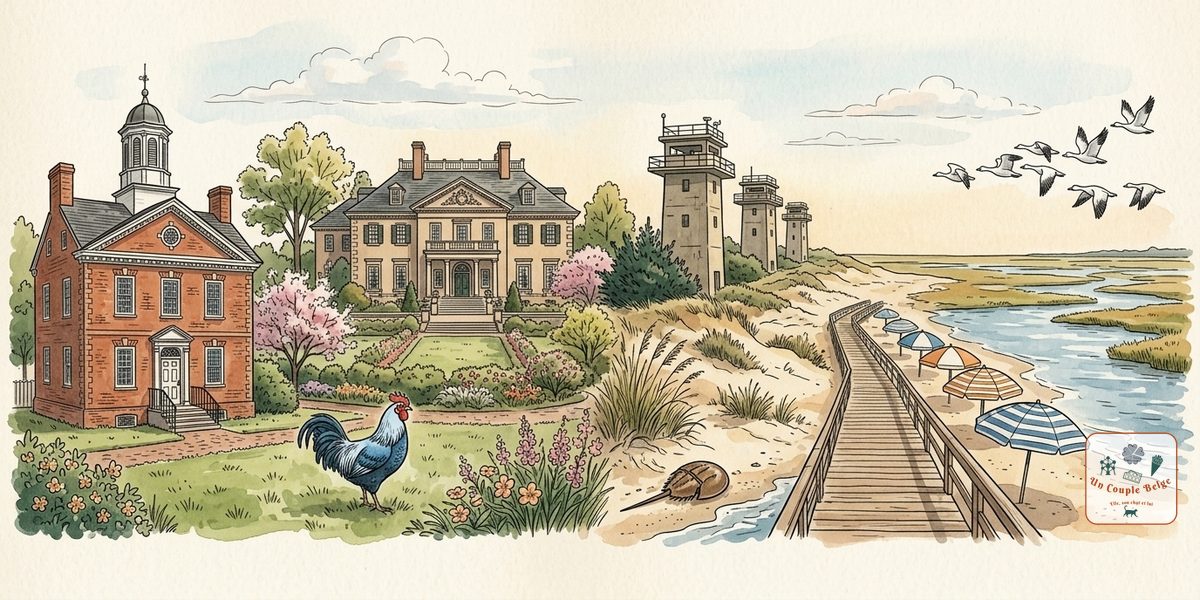
On a map, Delaware looks like a comma slipped between Maryland, Pennsylvania and the Atlantic. It’s the second-smallest state in the country, after Rhode Island, and you can cross it from north to south in barely two hours. Yet its name appears on the articles of incorporation of most major American companies. It doesn’t try to impress by size, and its influence hides rather in legal and tax details.
Its official nickname, “The First State”, is no marketing slogan. On 7 December 1787, Delaware became the first of the thirteen states to ratify the US Constitution, and it has gone first in every official ceremony ever since. But it’s also a state of beaches that get very busy in summer, of marshes where thousands of migratory birds stop over in spring, and of colonial towns that have stayed off the mass-tourism trail.
Delaware at a glance
- Capital: Dover
- Largest city: Wilmington
- Population: about 1 million
- Area: about 6,450 km², roughly a fifth of Belgium
- Joined the Union: 1787, the 1st state
- Time zone: Eastern Time (6 hours behind Brussels)
- Nicknames: The First State, Small Wonder, Blue Hen State, Diamond State
- Highest point: Ebright Azimuth, 137 metres. It’s one of the flattest states in the country.
Geography: three counties, three moods
Delaware has only three counties, and each has its own character.
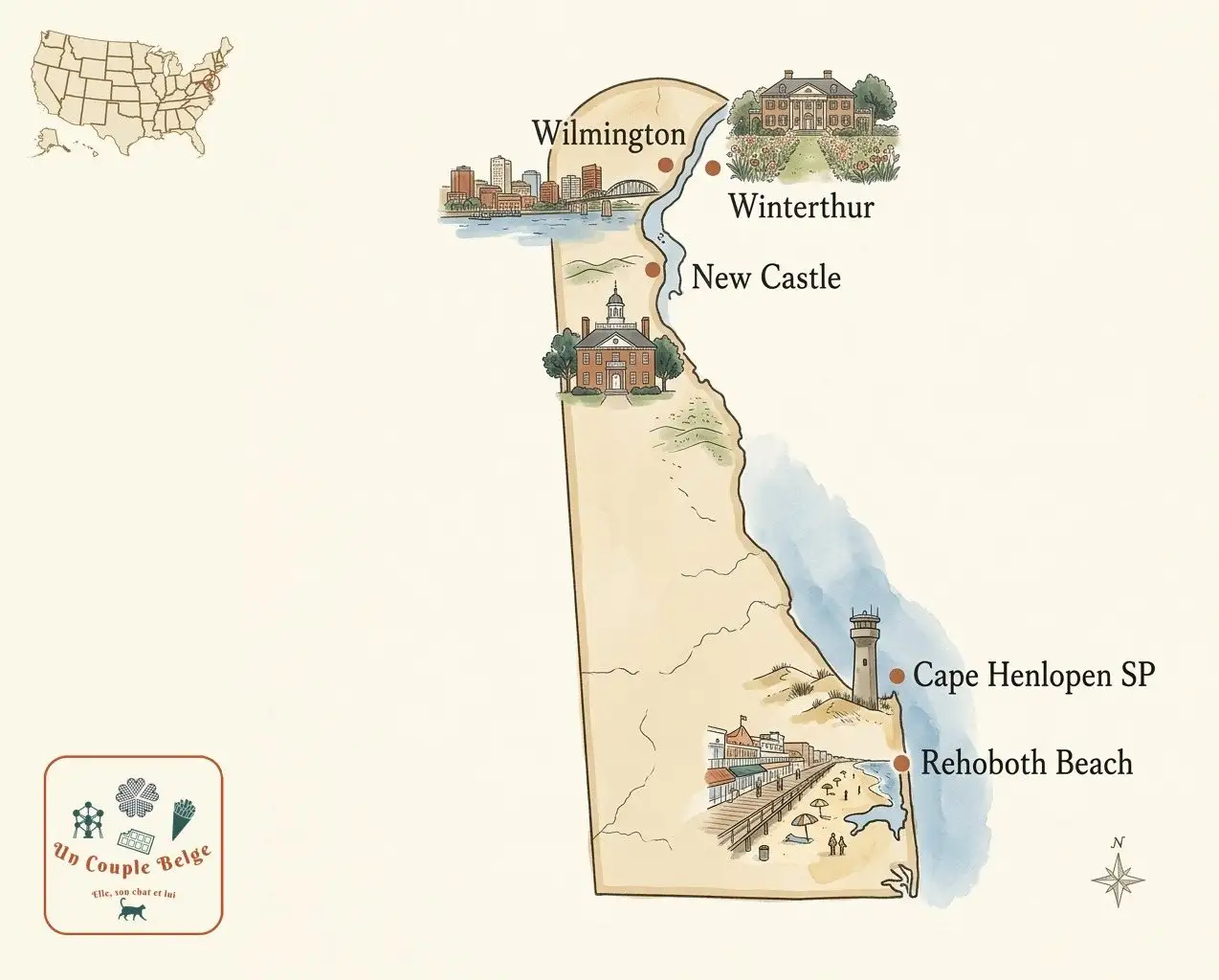
New Castle County, in the north, is urban and hilly: Wilmington, the Brandywine Valley with the great du Pont estates, and the old town of New Castle.
Kent County, in the centre, is agricultural, with Dover, the capital, and large fields of corn and soybeans running down to Delaware Bay and its marshes.
Sussex County, in the south, holds most of the Atlantic coastline (Lewes, Rehoboth Beach, Bethany Beach, Fenwick Island) and a hinterland of poultry farms, pine forests and bald cypresses.
The state’s name comes from the Delaware River, itself named in honour of Thomas West, Baron De La Warr, colonial governor of Virginia, who never set foot in the region.
A bit of history
Before Europeans arrived, the Lenape and the Nanticoke lived along the bay. The Dutch founded a first trading post at Lewes in 1631, then the Swedes settled at Wilmington in 1638 (Fort Christina). The English took control in 1664, and William Penn landed at New Castle in 1682. Delaware was long part of Pennsylvania before gaining its autonomy.
In the 19th century, the du Pont family, newly arrived from France, set up its gunpowder mills on the Brandywine River in 1802. The company became a chemical giant, and the family shaped the state’s economy for more than a century. Delaware was a slave state that nevertheless stayed in the Union during the Civil War.
In the 20th century, its very favourable corporate law attracted thousands of companies, and the state became a major legal and financial centre. More recently, it has mostly been associated with Joe Biden, senator for Delaware for 36 years before becoming vice-president and then president.
The must-sees
Wilmington and the Brandywine Valley
Around Wilmington, the du Pont family left impressive estates. Nemours Estate is a French-style château built for Alfred I. du Pont, with formal French gardens among the largest in North America. The Winterthur Museum, the former home of Henry Francis du Pont, houses one of the richest collections of American decorative arts, in an immense park that is magnificent in spring, when the azaleas bloom.
The Hagley Museum, on the site of the first du Pont powder mills beside the Brandywine, tells the story of the company’s beginnings, with demonstrations and the original family home. And just across the state line, in Pennsylvania, Longwood Gardens is one of the most beautiful botanical gardens in the country.
In town, the Riverfront, a former industrial area along the Christina River, has been converted into a promenade with restaurants and museums.
New Castle
A few minutes south of Wilmington, New Castle is one of the best-preserved colonial towns in the United States. Cobbled streets, 18th-century brick houses, the old courthouse where the colonial government sat: you’d think you were in a period film, without the crowds. It was here that William Penn first set foot in America in 1682.
A little further south, from Delaware City, a ferry leads to Fort Delaware, a fort on an island in the river that served as a prison camp for Confederates during the Civil War. Costumed guides bring the period back to life in summer.
Dover
The capital is a quiet little town. On the Green, the central square, the delegates ratified the Constitution in 1787. The Old State House and the neighbouring museums tell this story soberly. At the air force base, the free Air Mobility Command Museum lets you climb aboard military transport aircraft. And motor racing fans know Dover Motor Speedway, nicknamed the “Monster Mile”.
Lewes and Cape Henlopen
Lewes, founded by the Dutch in 1631, presents itself as “the first town in the First State”. It’s a pretty little port, the departure point for the ferry to Cape May, in New Jersey, which crosses the bay in 1 hr 30.
Right next door, Cape Henlopen State Park protects wild dunes, a pine forest and concrete observation towers from the Second World War, from which lookouts watched for German submarines. You can climb one of them for the view.
Rehoboth Beach and the beaches
Rehoboth Beach is the liveliest seaside resort, with its boardwalk, its arcades, its fries and its taffy. It’s very popular with people from Washington, two and a half hours’ drive away, to the point of being nicknamed “the Nation’s Summer Capital”. As there’s no sales tax in Delaware, the outlets on Route 1 also draw a lot of people.
Further south, Dewey Beach is the party beach, Bethany Beach the family one, and Fenwick Island marks the border with Maryland. Between Dewey Beach and Bethany Beach, Delaware Seashore State Park offers long, wilder beaches.
Nature: horseshoe crabs and birds
Every spring, Delaware Bay hosts one of the world’s largest gatherings of horseshoe crabs, those prehistoric creatures that come to lay their eggs on the beaches, especially on the evenings of the full moon and new moon in May and June. Their eggs feed migratory birds such as the red knot, which stops over here between South America and the Arctic. Bombay Hook National Wildlife Refuge is the best place to watch these migrations.
In the south, Trap Pond State Park is home to the northernmost bald cypress forest in the United States, to be explored by canoe.
Itinerary ideas
2-3 days, north to south on Route 1. Wilmington and the Brandywine (1 day) → New Castle → Dover → Lewes and Cape Henlopen → Rehoboth Beach. About 150 kilometres.
In combination. Delaware slots easily into an East Coast trip: Philadelphia is 30 minutes from Wilmington, Baltimore 1 hour, Washington 2 hours. The Lewes ferry lets you carry on to Cape May and the New Jersey shore.
On the plate
- Blue crabs, steamed and dusted with Old Bay, to be cracked open with a mallet on a table covered in newspaper.
- Thrasher’s fries, on the Rehoboth boardwalk since 1929: sprinkled with cider vinegar, no ketchup.
- Scrapple, a pan-fried loaf of pork and cornmeal, eaten at breakfast.
- The Bobbie from Capriotti’s, a chain born in Wilmington: a sandwich of turkey, stuffing and cranberry sauce, like a Thanksgiving dinner in a roll.
- Chicken and slippery dumplings, a chicken stew with wide, flat noodles.
- Peach pie, the state’s official dessert, and saltwater taffy from Dolle’s, in Rehoboth.
- And the beers of Dogfish Head, in Milton, one of the pioneering breweries of American craft beer, known for its “archaeological” recipes recreated with researchers from residues found at ancient sites.
Culture and trivia
- A corporate paradise: more than half of the publicly traded companies in the United States are incorporated in Delaware, thanks to corporate law honed over more than a century and a specialised court, the Court of Chancery. Many have no office there at all.
- The chicken industry was born here by accident: in 1923, Cecile Steele, a farmer in Ocean View, received 500 chicks instead of 50. She raised them for their meat, and unknowingly invented the industrial farming of broiler chickens.
- Return Day: two days after each election, in Georgetown, the winning and losing candidates parade together in carriages, then a real hatchet is buried in the sand. A unique tradition that goes back to the 18th century.
- No sales tax: residents of neighbouring states come to do their shopping in Delaware.
- The Blue Hen is the official state bird, in memory of a breed of fighting cocks that Delaware’s soldiers took with them during the War of Independence.
When to go
- Summer (June to August): beach season, lively but expensive and packed at weekends.
- Spring (May-June): perfect for the Brandywine gardens and the spectacle of the horseshoe crabs and migratory birds.
- September: the water is still warm, the crowds have gone and prices drop. Perhaps the best time for the coast.
- Winter: quiet and fairly cold. The du Pont estates have lovely Christmas decorations.
Practical information
- Recommended length of stay: 2 to 4 days, ideally as part of a wider East Coast trip.
- Getting there: Delaware has no major airport. You arrive via Philadelphia (30 minutes from Wilmington) or Baltimore. Amtrak stops in Wilmington on the New York-Washington line.
- Getting around: a car is essential to get out of Wilmington and reach the beaches.
- Budget: moderate, except in high season on the coast. The absence of sales tax makes shopping a little cheaper than elsewhere.
- Things to watch out for: few pitfalls, apart from mosquitoes and ticks near the marshes in summer.
- One more tip: avoid Route 1 to the beaches on Friday afternoons and Sunday evenings in summer. Traffic jams can triple the journey time.