Indiana: the Indy 500, the dunes and basketball
Updated on
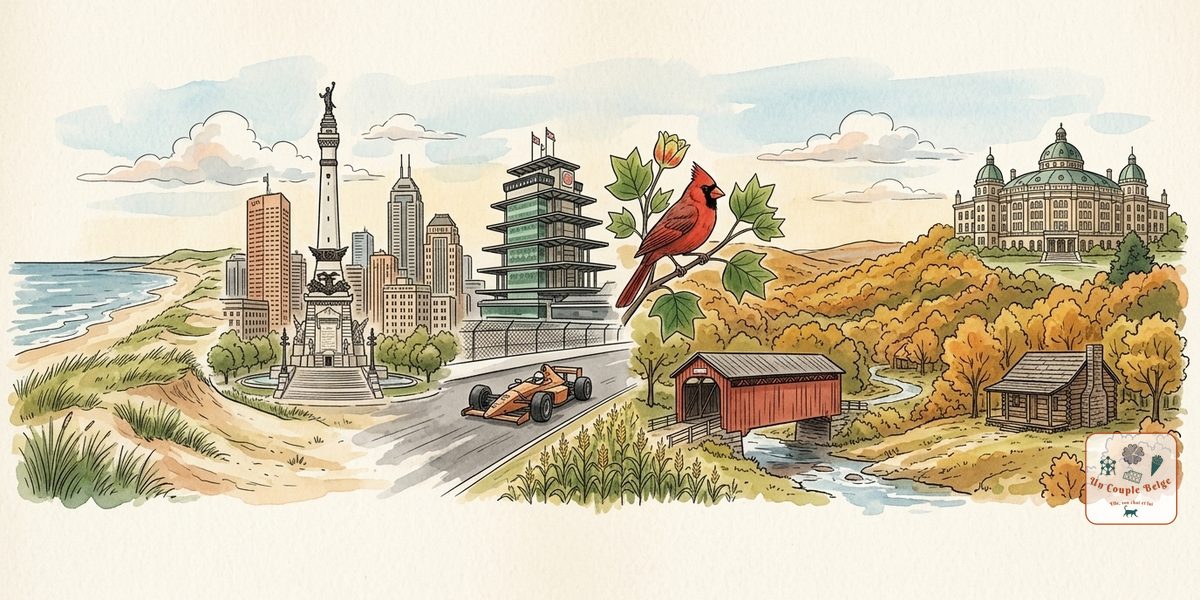
Indiana is the state nobody looks at. Millions of Americans cross it every year on the motorway, between Chicago and Ohio, without ever getting off. As a result, it’s seen as a mere transit zone, flat and featureless. That means missing a state that stages the biggest single-day motor race in the world, lives basketball like a religion, and hides sand dunes as tall as buildings on the shore of Lake Michigan.
It’s called the “Hoosier State”, though nobody really knows where the word comes from. Its official motto, “Crossroads of America”, says it well: more motorways cross here than almost anywhere else. But you only have to leave the main route to find wooded hills, Amish villages, covered bridges and small towns that have kept their old-time America.
Indiana at a glance
- Capital and largest city: Indianapolis
- Population: about 6.9 million
- Area: about 94,000 km², a little over three times Belgium
- Joined the Union: 1816, 19th state
- Time zone: Eastern Time for most of the state (6 hours behind Brussels), Central Time for the north-west (near Chicago) and south-west corners
- Nickname: Hoosier State
- Highest point: Hoosier Hill, 383 metres
Geography: from Lake Michigan to the Ohio River
The north borders Lake Michigan for about sixty kilometres, between the steel mills of Gary and the dunes. Further east, around Elkhart and Shipshewana, lies one of the largest Amish communities in the country.
The centre is a vast farming plain of corn and soybeans, with Indianapolis in the middle.
The south is completely different: wooded hills, caves, lakes and small towns on the Ohio River, which marks the border with Kentucky. It’s the prettiest part of the state.
A bit of history
The Miami, the Potawatomi, the Shawnee and other peoples lived in the region when the French set up trading posts there in the 18th century, such as Vincennes. After the War of Independence, American settlers poured in, and the Native American nations were pushed back or deported, notably on the Potawatomi “Trail of Death” in 1838.
Indiana became a state in 1816. Abraham Lincoln spent part of his childhood there, from the age of 7 to 21. In the 19th and 20th centuries the state industrialised: steel in Gary, cars in Indianapolis and South Bend (Studebaker), pharmaceuticals (Eli Lilly). The Indianapolis 500 race was launched in 1911.
The must-sees
Indianapolis and the Indy 500
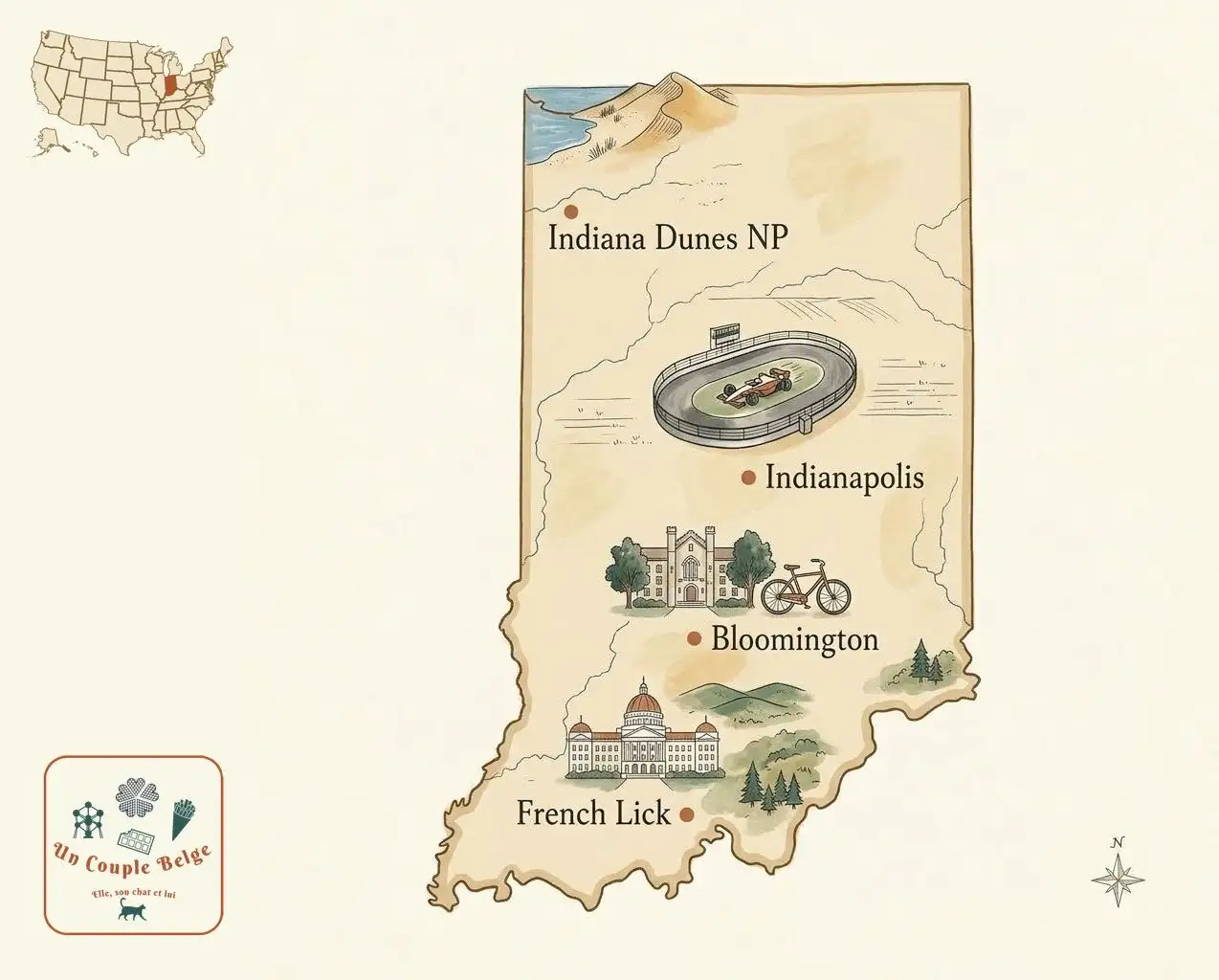
Indianapolis owes its worldwide fame to a race: the Indianapolis 500, run every year in late May since 1911 at the Indianapolis Motor Speedway. With more than 300,000 spectators, it’s the best-attended single-day sporting event in the world. All through May, the city lives to the rhythm of the “500 Festival”, with a parade and neighbourhood parties. Outside race time, you can visit the track museum and take a lap of the circuit by bus. Tradition has it that the winner kisses the row of bricks at the finish line.
The city itself is more pleasant than you might think. The centre is organised around Monument Circle, the Cultural Trail links the neighbourhoods by bike, and the canal makes a good walk. The Children’s Museum of Indianapolis is the largest children’s museum in the world, with life-size dinosaurs. And the Kurt Vonnegut Museum pays tribute to the writer, a native of the city. More ideas on Visit Indy.
Indiana Dunes
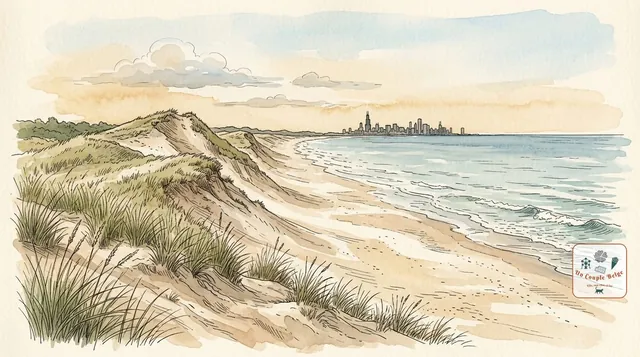
Indiana Dunes National Park, which became a national park in 2019, protects around twenty kilometres of beaches and dunes on the southern shore of Lake Michigan, some of them nearly 60 metres high. You swim there in summer as you would at the seaside, climb the three dunes of the “3 Dune Challenge” in the neighbouring state park (Mount Baldy itself can only be climbed with a ranger), and watch migratory birds. It was on these dunes that scientific ecology was born in the United States, at the beginning of the 20th century. A small oddity: from some beaches you can see the chimneys of the nearby steel mills and, in clear weather, the skyscrapers of Chicago.
The south: hills, caves and covered bridges
Brown County State Park is the largest state park in Indiana, nicknamed the “Little Smokies”. Its wooded hills blaze with colour in autumn. The neighbouring small town of Nashville (nothing to do with the one in Tennessee) has been an artists’ colony for a century, with galleries and shops. Bloomington, a lively university town, is twenty minutes away.
To the west, Parke County proclaims itself the “Covered Bridge Capital of the World”, with around thirty 19th-century wooden bridges. Every October, its festival draws crowds. Further south, the Marengo and Bluespring caves can be visited, and Madison, on the Ohio, is a pretty 19th-century town.
French Lick and West Baden
In the south-west, French Lick and West Baden Springs were fashionable spa resorts at the beginning of the 20th century, visited by presidents and gangsters. The West Baden Springs Hotel has a circular atrium topped by a dome which, when it was built in 1902, was the largest free-span dome in the world. Both hotels have been carefully restored. French Lick is also the home town of Larry Bird, the Boston Celtics legend.
Santa Claus, Lincoln and New Harmony
In the south, a small town really is called Santa Claus. Its post office receives thousands of children’s letters every December, and volunteers answer them. It also has the Holiday World amusement park. Right nearby, the Lincoln Boyhood National Memorial protects the farm where Abraham Lincoln grew up and his mother’s grave.
In the far south-west, New Harmony was home to two successive utopian communities in the 19th century. The village has kept its period houses and a labyrinth.
Columbus, capital of modern architecture
It’s one of the biggest surprises in the state. In this town of 50,000 people, the Cummins company has, since the 1950s, funded schools, churches and public buildings designed by the greatest architects (Eero Saarinen, I. M. Pei, Richard Meier…). The result: a density of modern architecture unique in the United States, to be discovered on a guided tour.
The north: Amish country and Notre Dame
Around Shipshewana, Middlebury and Nappanee, you share the road with the black buggies of the Amish. Markets, farms and family restaurants let you discover this community, provided you respect their refusal to be photographed. In South Bend, the campus of the University of Notre Dame, with its golden dome and its legendary football team, and the Studebaker museum are worth a visit.
Itinerary ideas
4-5 days, the south in autumn. Indianapolis (1 day) → Parke County and its covered bridges → Bloomington and Brown County → Columbus → French Lick → Santa Claus and Lincoln. Ideally between late September and mid-October.
A weekend from Chicago. Indiana Dunes (1 day) → Amish country (1 day) → South Bend.
In combination. Indiana combines with Chicago, Louisville (Kentucky, just across the Ohio River) or Cincinnati (Ohio).
On the plate
- The pork tenderloin sandwich: a pork cutlet pounded flat, breaded and fried, twice the size of the bun. The state’s speciality.
- Sugar cream pie, Indiana’s official pie, made with cream and sugar, inherited from the Amish and Shaker communities.
- Persimmon pudding, a cake made with wild persimmons, celebrated every autumn in Mitchell.
- The shrimp cocktail at St. Elmo Steak House, in Indianapolis, famous for its horseradish sauce that brings tears to your eyes.
- Amish cooking: fried chicken, mashed potatoes, home-made bread and pies.
- Popcorn: Orville Redenbacher, whose brand is known all over the country, was from Indiana and developed his popping corn varieties there.
Culture and trivia
- “Hoosier Hysteria”: high school basketball is a passion. Until 1997, the high school championship brought all schools, small and large, together in a single bracket. In 1954, tiny Milan High School beat a big Indianapolis school, a story that inspired the film Hoosiers 🎬. Some high school gyms can hold more than 9,000 people.
- Michael Jackson and his brothers were born in Gary. The family home, a very small one, can be seen from the outside.
- James Dean grew up in Fairmount, which devotes a museum and a festival to him.
- The milk tradition: since the 1930s, the winner of the Indy 500 has drunk a bottle of milk in Victory Lane.
- Changing the clocks: Indiana only adopted daylight saving time statewide in 2006.
When to go
- Spring (May-June): the month of May in Indianapolis, for the Indy 500 and the festival, and pleasant temperatures. Watch out for storms and tornadoes.
- Summer (July-August): hot and humid, perfect for the dunes and the lakes.
- Autumn (late September to late October): the most beautiful time for the south, the hills and the covered bridges.
- Winter: cold and grey, with snow, especially near Lake Michigan. Of little interest, except for the basketball games.
Practical information
- Recommended length of stay: 4 to 5 days for Indianapolis and the south, or a few stops on a wider trip through the Midwest.
- Getting there: Indianapolis airport is served by connecting flights. Chicago is a 3-hour drive away.
- Getting around: a car is essential outside Indianapolis.
- Budget: one of the most affordable states in the country, except during the Indy 500, when prices soar.
- Things to watch out for: in Amish country, slow down on country roads; the buggies are slow and hard to see at night.
- One more tip: for the Indy 500, book tickets and accommodation months ahead. For autumn colours, aim for mid-October.