Iowa: the farming heart of the Midwest
Updated on
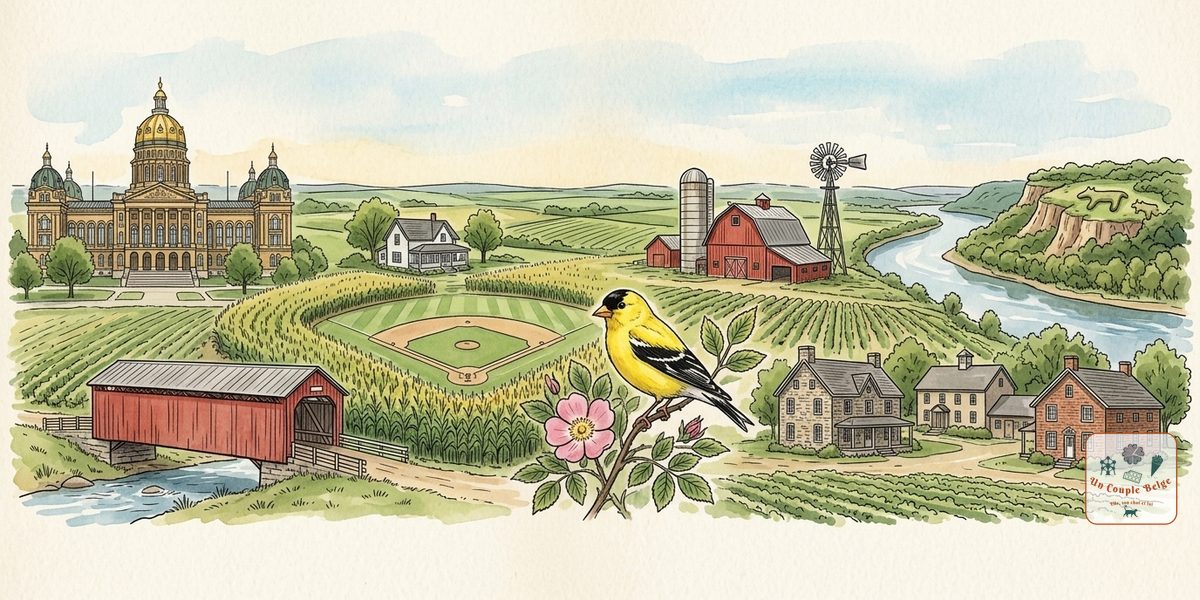
Iowa has an amusing paradox. It’s a rural state of barely more than 3 million people, known mostly for its cornfields stretching to the horizon, and yet every four years the world’s cameras turn to it for the caucuses, the kick-off of the presidential primaries. The rest of the time, it goes back to its life as the country’s breadbasket: Iowa is the leading producer of corn and hogs in the United States, and there are about seven pigs per inhabitant.
But reducing it to its silos would be unfair. The state hides villages founded by German, Dutch and Norwegian immigrants, the covered bridges made famous by Clint Eastwood and Meryl Streep, a baseball diamond planted in the middle of a cornfield and Native American mounds sculpted in the shape of bears and birds. It’s a quiet, welcoming America, best discovered on the back roads.
Iowa at a glance
- Capital and largest city: Des Moines
- Population: about 3.2 million
- Area: about 146,000 km², nearly five times Belgium
- Joined the Union: 1846, 29th state
- Time zone: Central Time (7 hours behind Brussels)
- Nickname: Hawkeye State
- Highest point: Hawkeye Point, 509 metres, in the middle of a farm
Geography: between two great rivers
Iowa lies between the Mississippi to the east and the Missouri to the west. In between, gentle hills and plains covered in corn and soybeans: nearly 90% of the land is farmed, a record proportion.
Two regions escape this image. In the west, the Loess Hills run along the Missouri: hills of fine wind-blown silt, a landscape found on this scale only in China. In the north-east, the Driftless Area, spared by the glaciers, has limestone bluffs, steep-sided valleys and trout streams along the Mississippi.
A bit of history
Peoples such as the Ioway (who gave the state its name), the Sauk, the Meskwaki and the Sioux lived here. The region passed to the United States with the Louisiana Purchase in 1803, and after the Black Hawk War (1832), settlers moved in en masse. Iowa became a state in 1846.
The 19th century brought German, Dutch, Scandinavian and Czech immigrants, whose traces can still be found in the villages. Iowa became a great farming state, then an industrial one built around food processing and farm machinery. Since 1972, the Iowa caucuses have opened the presidential primary season. The Republican Party still launches its race here, but the Democrats moved their first contest elsewhere from 2024.
The must-sees
Des Moines and the Iowa State Fair
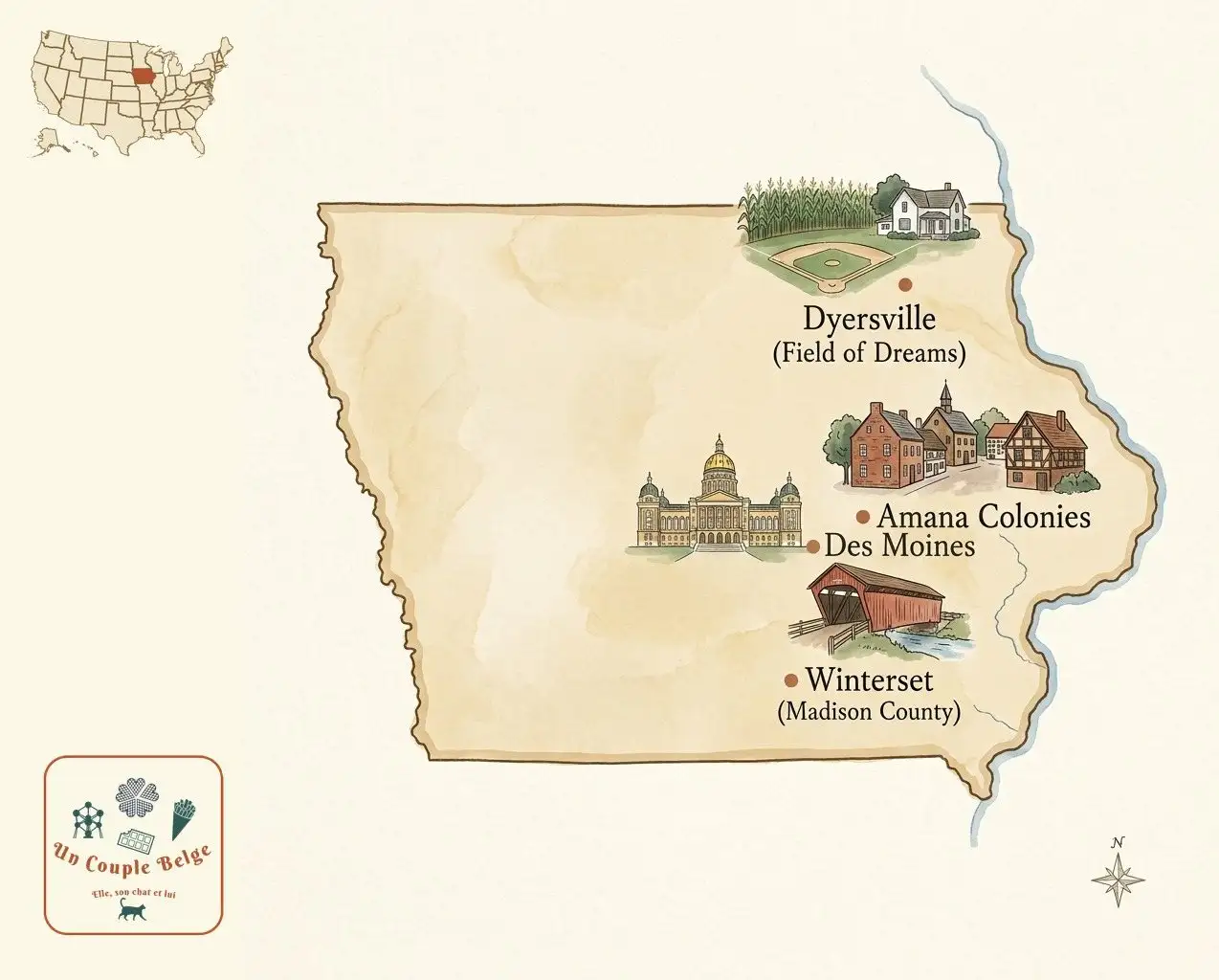
Des Moines is a human-sized capital, with a compact centre and a State Capitol topped by a dome covered in gold leaf. The Pappajohn Sculpture Park displays contemporary art outdoors for free, and the Saturday morning farmers’ market, in summer, is one of the largest in the country.
But the city lives above all for the Iowa State Fair, about ten days in August: one of the biggest agricultural fairs in the United States. You admire the famous butter cow, sculpted every year since 1911, livestock competitions, and an insane amount of food fried and served on a stick (even butter). Presidential candidates come to shake hands and give a speech on a hay bale, an obligatory stop in American politics.
The Field of Dreams
In Dyersville, in the east of the state, the baseball diamond from the film Field of Dreams 🎬 (1989), where Kevin Costner sees legendary players return out of the cornfield, still exists. You can play there freely, throw a few balls and walk into the corn. In 2021 and 2022, Major League Baseball even held real games there, the players making their entrance from among the stalks. Information on Travel Iowa.
The bridges of Madison County
Half an hour south-west of Des Moines, Madison County was made famous by the novel The Bridges of Madison County 🎬, then by Clint Eastwood’s film with Meryl Streep. Six 19th-century wooden covered bridges survive, including the Roseman Bridge from the film, to be explored in half a day from Winterset (Explore Madison County). Winterset is also the birthplace of John Wayne, who has a museum there.
The Amana Colonies
To the east, the Amana Colonies are seven villages founded in 1855 by a German religious community, the Inspirationists, who lived communally there until 1932. The “Great Change”, that year, turned their economy into private businesses. The villages have kept their brick and timber houses, their furniture workshops, a brewery and restaurants serving generous German food, family-style, shared in the middle of the table.
The immigrant villages
Pella, near Des Moines, was founded by the Dutch. A windmill, gabled houses and a canal: every May, the Tulip Time festival has locals parading in clogs among thousands of tulips. Decorah, in the north-east, keeps a strong Norwegian heritage, with the Vesterheim museum, and a lovely area for hiking and kayaking. Elk Horn, in the west, has an authentic Danish windmill, dismantled in Denmark and rebuilt piece by piece.
Effigy Mounds and the Mississippi
In the north-east, Effigy Mounds National Monument protects more than 200 Native American mounds, around thirty of them in the shape of animals (bears, birds) visible from the sky. The trails lead to overlooks above the Mississippi. The road that follows the river, with the towns of Dubuque (and its Mississippi River museum), McGregor and Guttenberg, is very beautiful in autumn. Not far away, Maquoketa Caves can be explored on your own.
Iowa City and the east
Iowa City, a lively university town, is a UNESCO “City of Literature”, thanks to its famous Writers’ Workshop, which has trained many American writers. Right nearby, West Branch is home to the birthplace and presidential library of Herbert Hoover.
Curiosities
The little white house from Grant Wood’s painting American Gothic is in Eldon, in the south-east. You can have your photo taken there in costume, pitchfork in hand. Near Clear Lake, a memorial marks the site of the plane crash that killed Buddy Holly, Ritchie Valens and The Big Bopper in 1959, “the day the music died”. The Surf Ballroom, where they gave their last concert, is still operating. And Riverside proclaims itself the “future birthplace of Captain Kirk”, the hero of Star Trek 🎬, who will be born here in 2228.
Itinerary ideas
4-5 days, the eastern loop. Des Moines (1 day) → Winterset and the bridges of Madison County → Pella → Amana Colonies → Iowa City → Dyersville and the Field of Dreams → Effigy Mounds and the Mississippi.
Driving across. Iowa is often crossed between Chicago and South Dakota (Badlands, Mount Rushmore) or Nebraska. Des Moines, Madison County and the Loess Hills are good stops along the way.
For cyclists. In late July, RAGBRAI crosses Iowa from west to east by bike in a week, with tens of thousands of participants and a party atmosphere in every overnight town.
On the plate
- The pork tenderloin sandwich, a breaded pork cutlet far bigger than the bun, which Iowa disputes with Indiana.
- The Maid-Rite, or “loose meat sandwich”, loose ground beef served in a small bun, at a local chain born in 1926.
- Sweet corn in August, to be bought at the roadside.
- The breakfast pizza from Casey’s petrol stations, a local institution.
- Dutch letters from Pella, S-shaped puff pastries filled with almond paste.
- Scotcheroos, squares of puffed rice cereal with peanut butter and chocolate, and the German cooking of the Amana Colonies.
Culture and trivia
- The first electronic digital computer was designed in the late 1930s at Iowa State University by John Atanasoff and Clifford Berry. A court recognised its priority in 1973.
- Gravel roads: Iowa has tens of thousands of kilometres of unpaved roads serving the farms. Gravel cyclists love them.
- The Grotto of the Redemption, in West Bend, is an immense artificial grotto covered in precious stones and shells, built by a priest over more than 40 years.
- The High Trestle Trail, a cycle path on an old railway line, crosses a viaduct lit up in blue at night.
- The caucuses are held in gymnasiums and church halls, where voters gather by candidate to vote.
When to go
- Summer (June to August): the season of fairs, festivals and RAGBRAI. Hot and humid, with thunderstorms.
- Autumn (September-October): the best time, with the harvest, the colours along the Mississippi and the covered bridge festival in Winterset.
- Spring (April-May): mild, with Tulip Time in Pella in early May. Watch out for tornadoes.
- Winter: cold, windy and snowy. Of little interest to tourists.
Practical information
- Recommended length of stay: 4 to 5 days for a loop, or a few stops on a drive across the Midwest.
- Getting there: Des Moines airport is served by connecting flights. Chicago is about a 5-hour drive from Des Moines, Omaha (Nebraska) 2 hours.
- Getting around: a car is essential.
- Budget: one of the most affordable states in the country.
- Things to watch out for: few pitfalls, apart from the weather (violent storms and tornadoes in spring, blizzards in winter).
- One more tip: if you’re in Des Moines during the State Fair in August, book accommodation several weeks ahead.