Kansas: the prairie, the sky and the legends of the West
Updated on
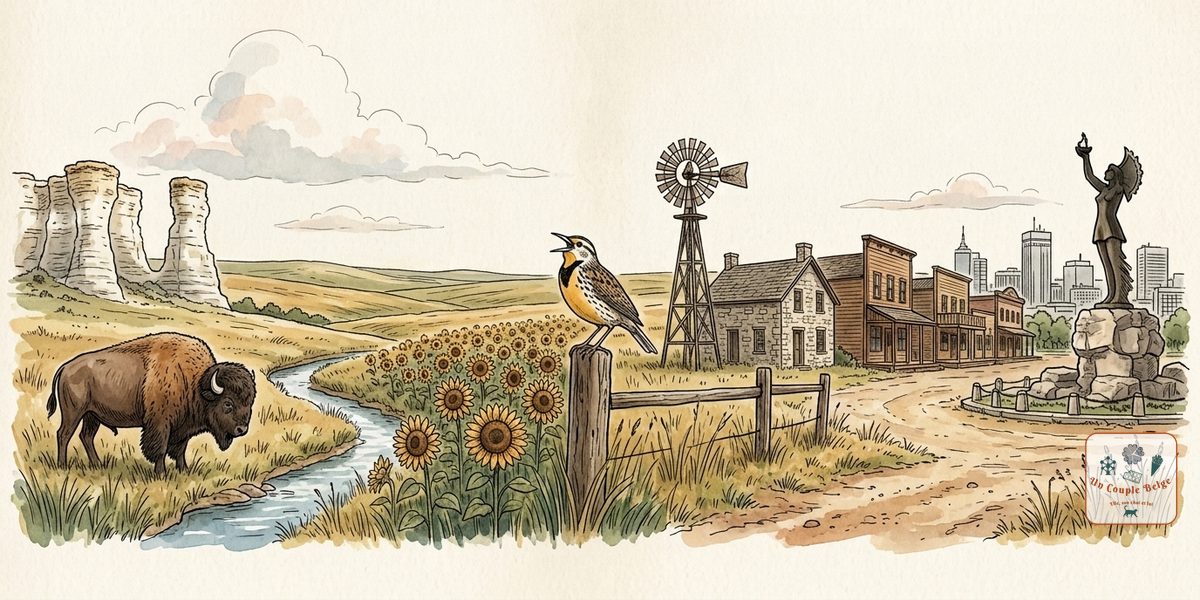
Kansas almost always gets the same reaction: a joke about Dorothy and her dog Toto, then the image of a flat rectangle between two more interesting states. The reputation is a little harsh, and a little deserved: Kansas makes no effort to win you over at first glance. No mountains, no ocean, no postcard city.
What it does have is a sky that takes up two-thirds of the landscape, grassy hills that roll like a sea, storms you can see coming half an hour ahead, and a handful of improbable stories. An activist who smashed up bars with a hatchet, an aviator who vanished over the Pacific, a president who grew up in a modest house in Abilene before commanding the Allies in Europe. Kansas is crossed by car with the window down, and it’s better told than shown.
Kansas at a glance
- Capital: Topeka
- Largest city: Wichita
- Population: about 2.9 million
- Area: about 213,000 km², roughly seven times Belgium
- Joined the Union: 1861, 34th state
- Time zone: Central Time (7 hours behind Brussels), except for a few counties in the far west, on Mountain Time
- Nicknames: Sunflower State, Wheat State
- Highest point: Mount Sunflower, 1,232 metres, a simple spot in the middle of a pasture. Western Kansas is far higher than the whole of Belgium.
Geography: from the prairie to the High Plains
Kansas rises gently from east to west, from 200 metres to more than 1,200 metres above sea level, without your noticing.
The east is the greenest and most populated part, with Kansas City (on the Kansas side), Lawrence, Topeka and wooded hills.
The Flint Hills, in the east-centre, are a band of hills covered in tall grass: the last large piece of natural prairie in North America.
The centre, around Wichita, Salina and Hutchinson, is the agricultural heartland: wheat, sorghum and sunflowers.
The west, finally, belongs to the High Plains, dry and immense, with chalk formations that rise out of nowhere and enormous cattle feedlots.
A bit of history
The Kansa (Kaw), the Osage, the Pawnee and the Comanche lived on these plains, where millions of bison grazed. In the 19th century, the Oregon and Santa Fe trails crossed the region, then Kansas Territory was opened to settlement in 1854.
In the 1850s, supporters and opponents of slavery clashed so violently that people spoke of “Bleeding Kansas”, a prelude to the Civil War. Kansas entered the Union in 1861 as a free state. After the war, the great Texas cattle herds were driven up to the railheads of Abilene and Dodge City: this was the era of cowboys and legendary lawmen.
In the 20th century, Kansas became the country’s wheat basket and, surprisingly, a major centre of aviation. In 1954, the Supreme Court ruling Brown v. Board of Education, which began at a school in Topeka, put an end to school segregation in the United States.
The must-sees
The Flint Hills and the Tallgrass Prairie
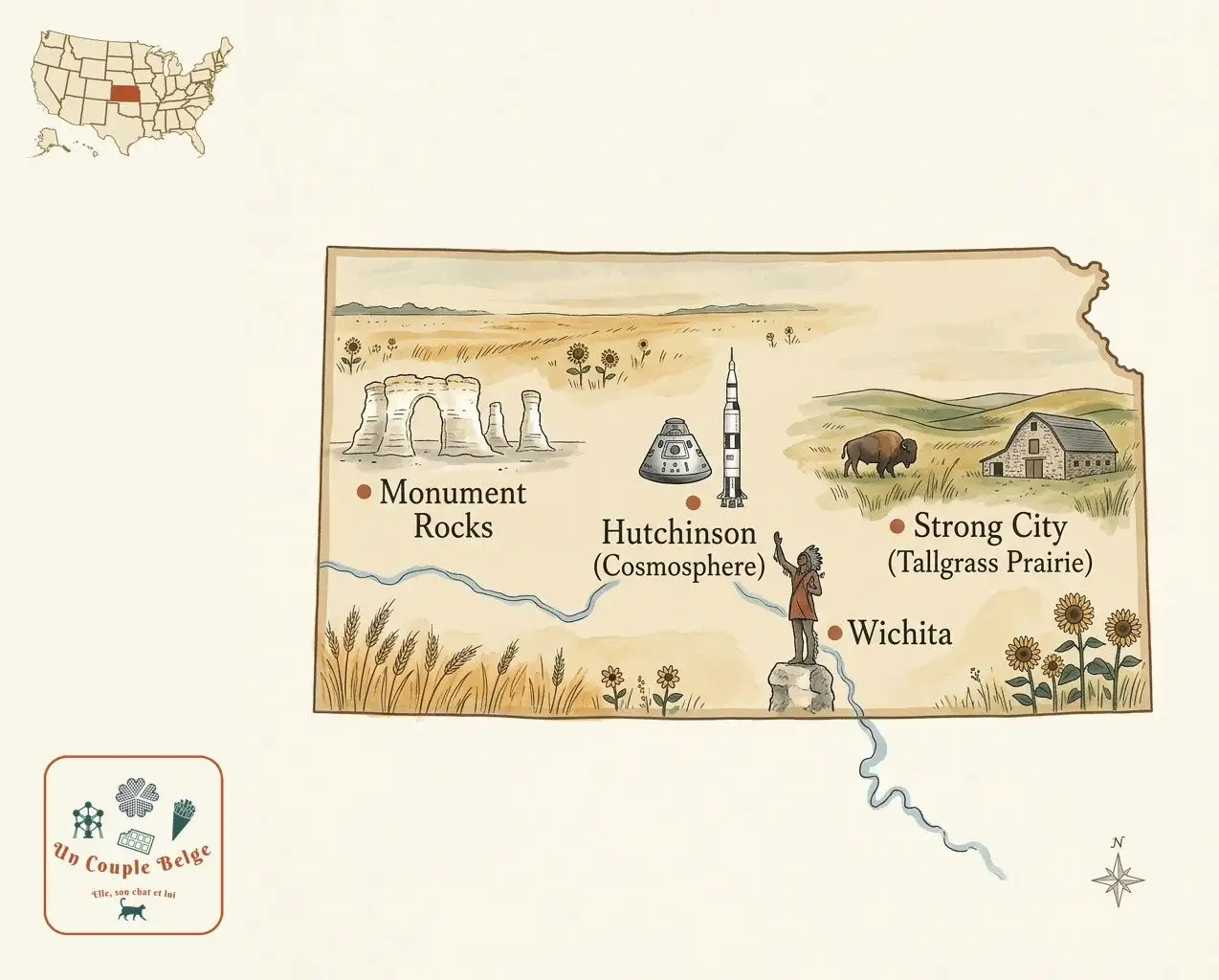
Less than 4% of the tallgrass prairie that once covered the centre of America has survived, and most of it is here. The soil, too stony (hence “flint”), discouraged the plough. The Tallgrass Prairie National Preserve, near Strong City, protects a 19th-century ranch and hills where a bison herd has been reintroduced. Trails let you walk through the grasses, which grow taller than an adult by the end of summer.
The Flint Hills National Scenic Byway follows Highway 177 for about 75 kilometres between Council Grove and Cassoday. In spring, ranchers burn the prairie to regenerate it, and the night-time fires on the hills are an impressive sight.
Wichita, aviation capital
Wichita has called itself the “Air Capital of the World” since the 1920s, and it’s no joke: Cessna, Beechcraft and Learjet were born here, and the city still produces a large share of the world’s business aircraft. The Kansas Aviation Museum is housed in the airport’s former Art Deco terminal. In town, Old Town has good restaurants and bars, and the Keeper of the Plains, a tall statue of a Native American warrior at the confluence of two rivers, is lit by flames at nightfall.
Wichita is also the birthplace of Pizza Hut, in 1958, and White Castle, the first burger chain, in 1921. The first Pizza Hut building has been moved to the state university campus, where it has become a small museum.
Hutchinson: the Cosmosphere and a salt mine
An hour from Wichita, the Cosmosphere is one of the best space museums in the world, with the Apollo 13 capsule, Soviet spacecraft and a gallery devoted to the space race. Right nearby, Strataca takes you 200 metres underground into a working salt mine, with a little train through the galleries.
Abilene and Eisenhower
In Abilene, a former railhead town for the Texas cattle herds, Dwight D. Eisenhower grew up in a modest house before commanding the Allied forces in Europe and becoming president. His home, his museum and his presidential library can be visited, as can his grave. The old town has kept a few façades from the cowboy era.
Dodge City and the Wild West
At the end of the 19th century, Dodge City was one of the most violent towns in the West: a buffalo hide market, a railway station, saloons. Wyatt Earp and Bat Masterson wore the lawman’s star here. The Boot Hill Museum recreates the main street of the period, with costumed shows in summer. It’s touristy and makes no apology for it, but it’s based on a true story. An hour’s drive away, Fort Larned is a remarkably well-preserved military fort from the 1860s.
The chalk pyramids of the west
In the west, the landscape changes. Monument Rocks, nicknamed the “chalk pyramids”, are 80-million-year-old formations rising from the plain, on private land freely open to the public. You can walk among the blocks, with no fence and no ticket booth. Not far away, Castle Rock and Little Jerusalem Badlands State Park offer other spectacular chalk formations, and the museum in Hays displays fossils of marine reptiles found in the area, which was then covered by an inland sea.
Topeka and the east
The capital is home to the Brown v. Board of Education National Historic Site, in the former Monroe School, which tells the story of the fight against school segregation. Lawrence, a lively university town, is one of the most pleasant in the state, and Kansas City, straddling two states, is the barbecue capital (the city centre is on the Missouri side).
The land of Oz, and other curiosities
In Wamego, the Oz Museum gathers everything to do with The Wizard of Oz 🎬, the 1900 novel and the 1939 film whose heroine, Dorothy, is swept away by a tornado from her Kansas farm. Atchison, on the Missouri, is the birthplace of Amelia Earhart, the first woman to fly solo across the Atlantic, who disappeared in 1937: the house where she was born is a museum.
Kansas loves roadside curiosities: the world’s largest ball of twine in Cawker City, regularly enlarged by visitors, the Garden of Eden in Lucas, a garden of concrete sculptures built by a Civil War veteran, and the geographic centre of the 48 contiguous states, near Lebanon. Finally, a short piece of Route 66 crosses the south-east corner of the state for about twenty kilometres, with the town of Galena and the tow truck that inspired Mater in Cars 🎬.
Itinerary ideas
5 days, east to west. Kansas City → Lawrence → Topeka → Flint Hills and Tallgrass Prairie → Abilene → Wichita → Hutchinson → Dodge City → Monument Rocks. About 800 kilometres, then on towards Colorado.
A long weekend. Wichita, Hutchinson and the Flint Hills.
Driving across. Many travellers cross Kansas on Interstate 70 between Kansas City and Denver. Abilene, the chalk pyramids and the Garden of Eden are good breaks along the way. For Route 66 fans, the short south-eastern stretch takes an hour between Missouri and Oklahoma.
On the plate
- Kansas City barbecue, with its sweet, smoky sauces and its burnt ends, the caramelised pieces from the point of the beef brisket.
- Steak: Kansas is a big cattle state, and the steakhouses of Wichita or Dodge City are excellent.
- Bierocks, small buns stuffed with ground beef and cabbage, a legacy of the Volga German immigrants.
- Chili with cinnamon rolls: a strange but very widespread pairing, served in Kansas school canteens.
- The fried chicken of Pittsburg, in the south-east, where two rival restaurants, Chicken Mary’s and Chicken Annie’s, have been facing each other for decades.
Culture and trivia
- Carrie Nation, a temperance activist, smashed up saloons with a hatchet at the beginning of the 20th century. Kansas banned alcohol as early as 1881, well before national Prohibition, and its alcohol laws still vary from county to county.
- The Arkansas River is pronounced “ar-KAN-zas” in Kansas, and “AR-kan-saw” in the state of Arkansas. Each is convinced it’s right.
- Kansas is the country’s leading wheat producer, and in late summer its sunflower fields are a sight to see.
- Kansas is at the heart of “Tornado Alley”, and many houses have a storm cellar.
When to go
- Spring (April to June): the prairie turns green again and the wildflowers bloom. It’s also the height of storm and tornado season: keep a weather alert app handy.
- Summer (July-August): hot, often above 35 °C, but the sunflowers bloom in late August.
- Autumn (September-October): mild and bright, the best time for a road trip.
- Winter: cold, windy, sometimes with blizzards. Of little interest to tourists.
Practical information
- Recommended length of stay: 4 to 6 days for an east-to-west road trip, a long weekend for Wichita and the Flint Hills.
- Getting there: Wichita and Kansas City (Missouri) airports are served by connecting flights. Denver is a 7-hour drive from Wichita.
- Getting around: a car is essential.
- Budget: very affordable, for accommodation, petrol and meals.
- Things to watch out for: Kansas is right in Tornado Alley. Between April and July, follow the weather, locate your hotel’s shelter and take the sirens seriously.
- One more tip: fill up regularly in the west, where petrol stations can be very far apart.