Kentucky: bourbon, horses and giant caves
Updated on
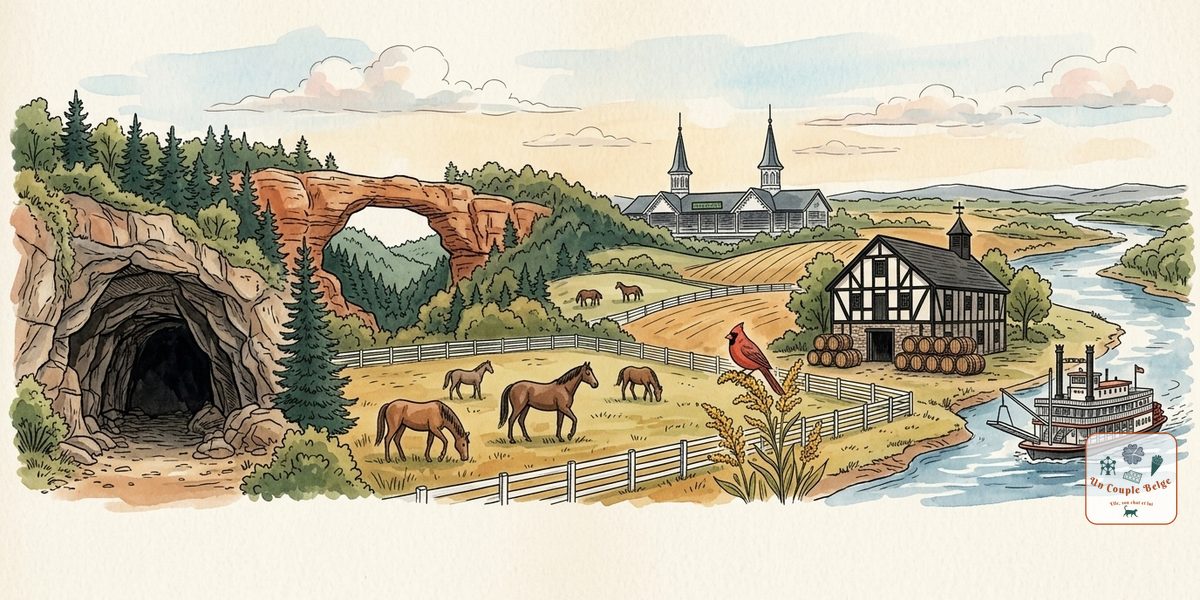
You come to Kentucky for the bourbon, and you leave having walked underground in the longest known cave in the world, cheered racehorses worth more than a house and eaten fried chicken in the town where Colonel Sanders launched his recipe.
Straddling the Midwest and the South, Kentucky doesn’t really belong to either. To the east, the Appalachian mountains have the drawl, the old ballads and the history of coal. In the centre, the bluegrass pastures around Lexington line up white fences and horse farms as far as the eye can see. To the west, lakes and rivers dominate. And everywhere you sense the pride of a state that has turned a corn whiskey and a horse race into two symbols of America.
Kentucky at a glance
- Capital: Frankfort
- Largest city: Louisville
- Population: about 4.5 million
- Area: about 105,000 km², a little under three and a half times Belgium
- Joined the Union: 1792, 15th state. Officially, it’s a “Commonwealth”.
- Time zone: Eastern Time in the east (6 hours behind Brussels), Central Time in the west (7 hours behind)
- Nickname: Bluegrass State
- Highest point: Black Mountain, 1,263 metres
Geography: from the Appalachians to the western lakes
The east is mountainous and wooded: these are the Appalachians, with steep-sided valleys, mining towns and forests such as Daniel Boone National Forest, home to the Red River Gorge.
The Bluegrass, in the centre, around Lexington and Frankfort, is a region of gentle hills with limestone pastures, ideal for horse breeding. It’s also bourbon country.
The Pennyroyal and the Knobs, in the south-centre, hide limestone bedrock riddled with caves, including Mammoth Cave.
The west, flatter, is bordered by the Ohio and the Mississippi, with immense reservoirs such as those of Land Between the Lakes.
The Ohio River marks the whole northern border of the state, facing Indiana, Ohio and Illinois.
A bit of history
For the Cherokee, the Shawnee and other peoples, Kentucky was a hunting ground. In 1775, the pioneer Daniel Boone opened the Wilderness Road through the Cumberland Gap, a pass in the Appalachians, and tens of thousands of settlers followed him west. Kentucky became the 15th state in 1792.
A slave state, it nevertheless stayed in the Union during the Civil War, deeply divided: Abraham Lincoln and Jefferson Davis, the presidents of the two sides, were both born here, about 160 kilometres apart. Bourbon and thoroughbred breeding developed in the 19th century, and the Kentucky Derby was first run in 1875. In the 20th century, Appalachian coal supported the east of the state, before a long decline.
The must-sees
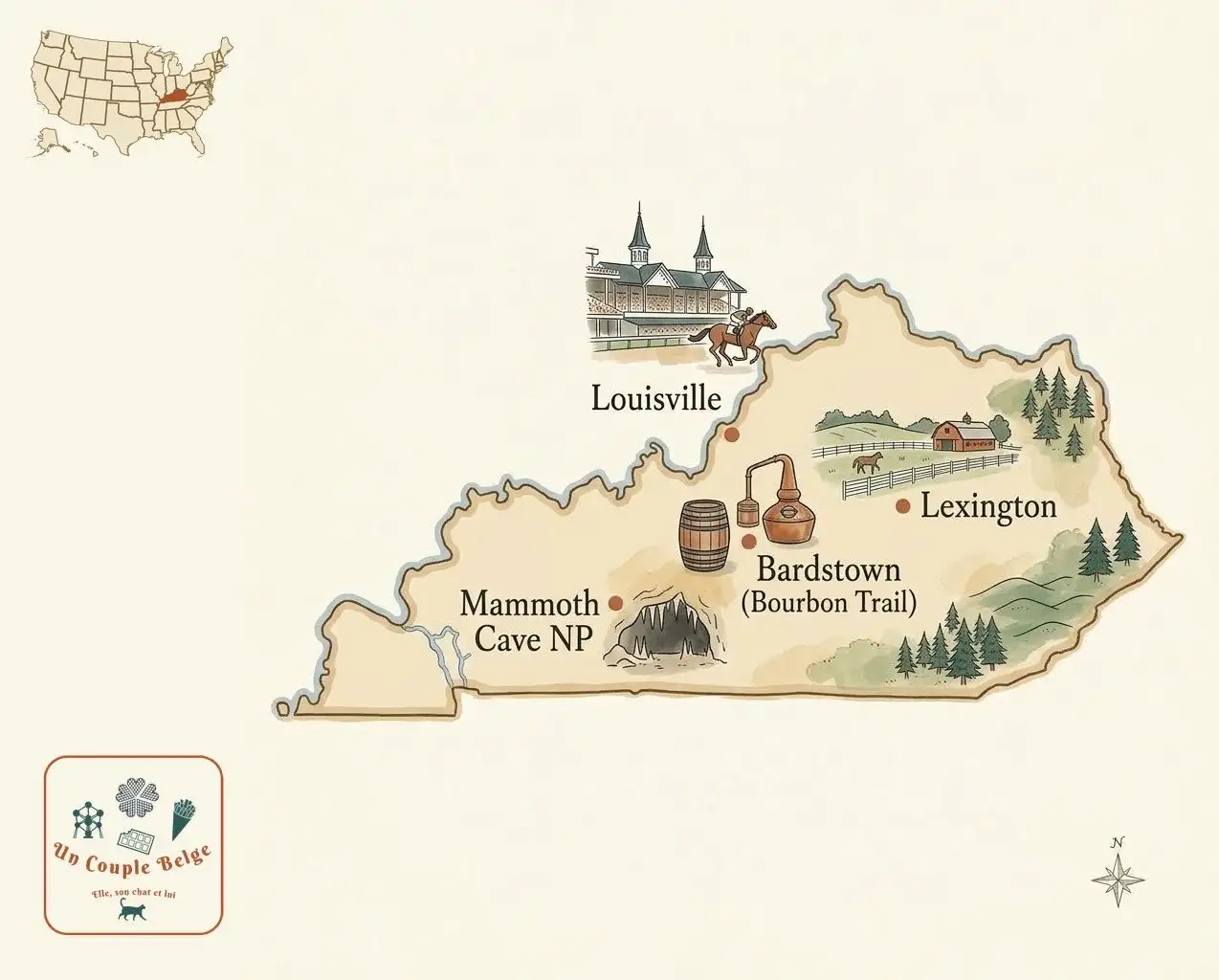
Mammoth Cave
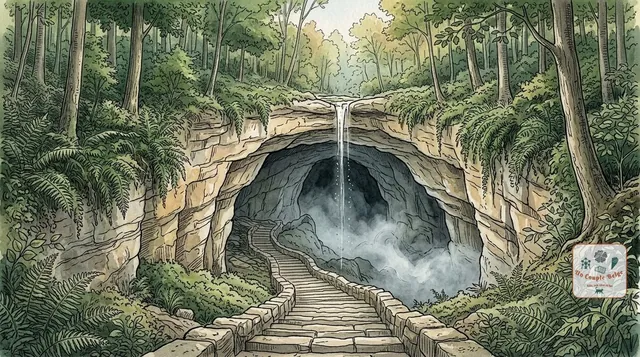
Mammoth Cave National Park, near Bowling Green, protects the longest known cave system in the world: more than 680 kilometres of mapped passages, and cavers discover more every year. It can only be visited with a ranger, in small groups, on tours of 1 to 6 hours: immense chambers, underground rivers, limestone “drapery” formations and tight squeezes for the more adventurous. Book ahead in summer, as tours sell out fast. Above ground, the forest has fine trails and you can canoe down the Green River.
The Bourbon Trail
More than 95% of the world’s bourbon is produced in Kentucky. The Kentucky Bourbon Trail links the major distilleries: Buffalo Trace (free tours), Maker’s Mark and its bottles sealed with red wax, Woodford Reserve among the horse farms, Wild Turkey, Four Roses, Jim Beam… Each offers a tour and tasting, often by reservation. The smoothness of the local bourbon is put down to the region’s limestone water, naturally stripped of its iron.
Bardstown, which proclaims itself the “Bourbon Capital of the World”, is the best base, with many distilleries nearby and My Old Kentucky Home, the mansion that inspired the state song. In Louisville, the Urban Bourbon Trail lets you taste without driving.
Louisville and the Kentucky Derby
On the first Saturday of every May, the Kentucky Derby, run at Churchill Downs without interruption since 1875, sets Louisville alight for “the most exciting two minutes in sports”. Big hats, mint juleps and an immense crowd: it’s as much a social event as a race. Out of season, the Kentucky Derby Museum tells this story and offers tours of the barns.
Louisville is also worth the detour for the Muhammad Ali Center, devoted to the boxer who was born here, the Louisville Slugger Museum, with the world’s largest baseball bat at the entrance, the Victorian houses of the Old Louisville district and the Big Four pedestrian bridge, which crosses the Ohio to Indiana.
Lexington and horse country
Around Lexington, Bluegrass Country lines up thoroughbred farms, with their black or white fences. The Kentucky Horse Park presents dozens of breeds and a museum of the horse. Some farms can be visited by reservation. In April and October, the races at Keeneland, an elegant track more intimate than Churchill Downs, are an excellent option. Not far away, Shaker Village of Pleasant Hill brings a 19th-century religious community back to life, with its stone buildings, its farm and a good restaurant.
Red River Gorge and the east
An hour east of Lexington, the Red River Gorge, in Daniel Boone National Forest, looks like a piece of the West that strayed into the Appalachians: more than a hundred natural sandstone arches, cliffs and forests that turn red in October. It’s one of the top climbing destinations in the United States. You can also hike to the Sky Bridge arch or to Natural Bridge State Park.
Further south, Cumberland Falls, nicknamed “the Niagara of the South”, is one of the few places in the world where you can see a moonbow, a lunar rainbow, on clear nights around the full moon. In the far south-east, Cumberland Gap National Historical Park protects the pass the pioneers used.
And more…
- Hodgenville: Abraham Lincoln’s birthplace, a log cabin housed inside a neoclassical memorial.
- Fort Knox: the gold of the United States is kept here, and obviously can’t be visited, but the nearby General Patton museum is open.
- Bowling Green: the National Corvette Museum, famous since a sinkhole swallowed eight Corvettes in 2014, and the neighbouring plant where they’re built.
- Land Between the Lakes: a peninsula between two giant lakes, with a prairie where bison and elk live.
- Williamstown: the Ark Encounter, a full-size Noah’s Ark built by a creationist organisation. Surprising, in every sense of the word.
Itinerary ideas
5 days, the classic loop. Louisville (1-2 days) → Bardstown and the Bourbon Trail (1-2 days) → Mammoth Cave (1 day) → Lexington and the horse farms (1 day) → Red River Gorge. About 500 kilometres.
One week, with the Appalachians. The same loop, extended to Cumberland Falls (for a full-moon night), Corbin and the Cumberland Gap.
In combination. Kentucky pairs perfectly with Tennessee: Nashville is 1 hr 30 from Mammoth Cave, and the Great Smoky Mountains are close to the Cumberland Gap.
On the plate
- The Hot Brown, invented in 1926 at the Brown Hotel in Louisville: an open-faced sandwich of turkey and bacon, covered in Mornay sauce and browned in the oven.
- Burgoo, a thick stew of several meats and vegetables, served at celebrations and at the races.
- The mutton barbecue of Owensboro, smoked mutton, a speciality unique in the United States.
- Fried chicken: Harland Sanders perfected his recipe at his service station in Corbin, where the original restaurant can be visited.
- Derby pie, a chocolate and walnut pie, and bourbon balls, chocolate and bourbon sweets.
- Beer cheese, a cheese spread made with beer, born in Winchester, and Benedictine, a cucumber spread invented in Louisville.
- And of course the mint julep: bourbon, fresh mint, sugar and crushed ice, served in a metal cup.
Culture and trivia
- Isaac Murphy, born into slavery in 1861, won the Kentucky Derby three times. African American jockeys dominated the early years of the race before being shut out by segregation.
- Bluegrass, a style of folk and country music played on banjo and mandolin, owes its name to the band of Bill Monroe, a Kentucky native. You can still hear it in Lexington’s bars and at summer festivals.
- Loretta Lynn, the “coal miner’s daughter” of the song and the film, grew up in the Kentucky Appalachians.
- “Happy Birthday to You” was composed in Louisville in the late 19th century by two schoolteacher sisters, Patty and Mildred Hill.
- Some counties are still “dry”: you can’t buy alcohol to take away there. Quite something in the bourbon state.
When to go
- Spring (April-May): the best time, with the Derby, the Keeneland races, foals in the fields and trees in blossom. Watch out for violent storms.
- Summer (June to August): hot and humid. Ideal for Mammoth Cave (it’s 12 °C all year round inside) and the lakes.
- Autumn (September-October): magnificent colours in the Red River Gorge and the Appalachians, the Keeneland races in October, the bourbon festival in Bardstown in September.
- Winter: cold but quiet; the distilleries and caves stay open.
Practical information
- Recommended length of stay: 5 to 7 days.
- Getting there: Louisville and Lexington have airports served by connecting flights. Cincinnati, whose airport is actually in Kentucky, and Nashville are good alternatives.
- Getting around: a car is essential.
- Budget: moderate. Prices soar in Louisville during Derby week.
- Things to watch out for: don’t drive after a tasting. Several companies offer organised tours of the Bourbon Trail, with a driver.
- One more tip: book tours of the popular distilleries (Buffalo Trace, Maker’s Mark, Woodford Reserve) and of Mammoth Cave several weeks ahead, especially in summer and autumn.