Louisiana: jazz, bayous and Cajun cooking
Updated on
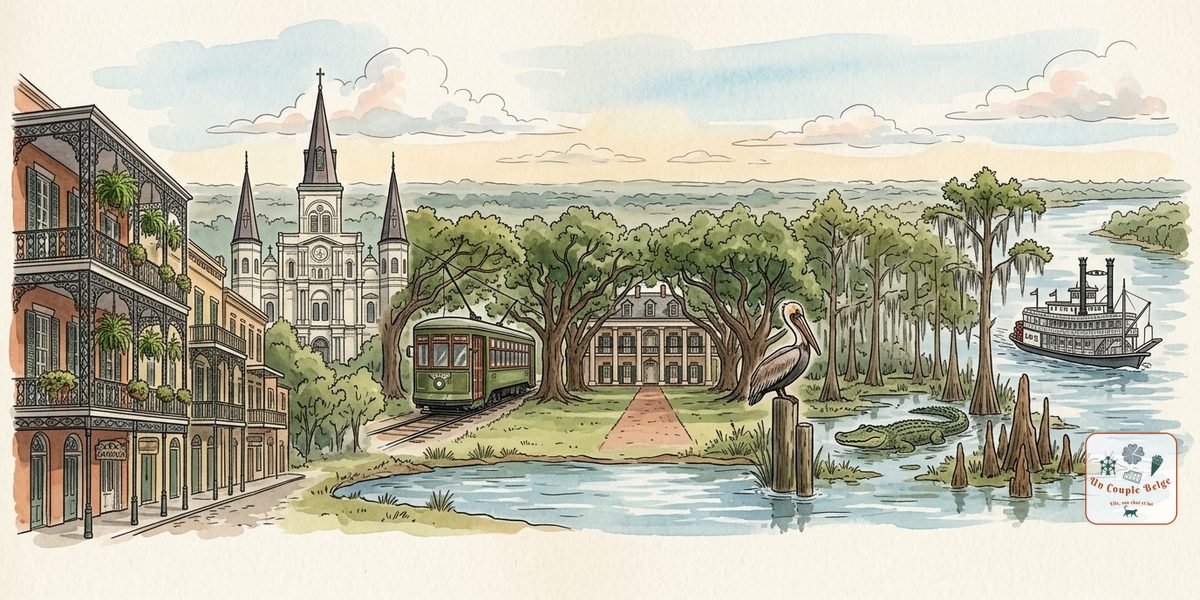
Louisiana is like no other American state. It was born from layer upon layer of French, Spanish, African, Caribbean and Native American histories, which have produced a language with a lilting accent, a cuisine that takes its time and a music that drifts out of open doors at all hours.
For a French-speaking traveller, it’s also a strange and endearing trip: town names in French, “Bienvenue en Louisiane” signs, bayous where a few old-timers still speak an 18th-century French, and a word, “lagniappe”, that little extra given without being asked, which sums up the whole local mindset.
Louisiana at a glance
- Capital: Baton Rouge
- Largest city: New Orleans
- Population: about 4.6 million
- Area: about 135,000 km², a little over four times Belgium
- Joined the Union: 1812, 18th state
- Time zone: Central Time (7 hours behind Brussels)
- Nicknames: Pelican State, Bayou State, Sportsman’s Paradise
- Highest point: Driskill Mountain, 163 metres. Part of New Orleans is below sea level.
- A peculiarity: Louisiana has no counties, but “parishes”
Geography: the Mississippi and the swamps
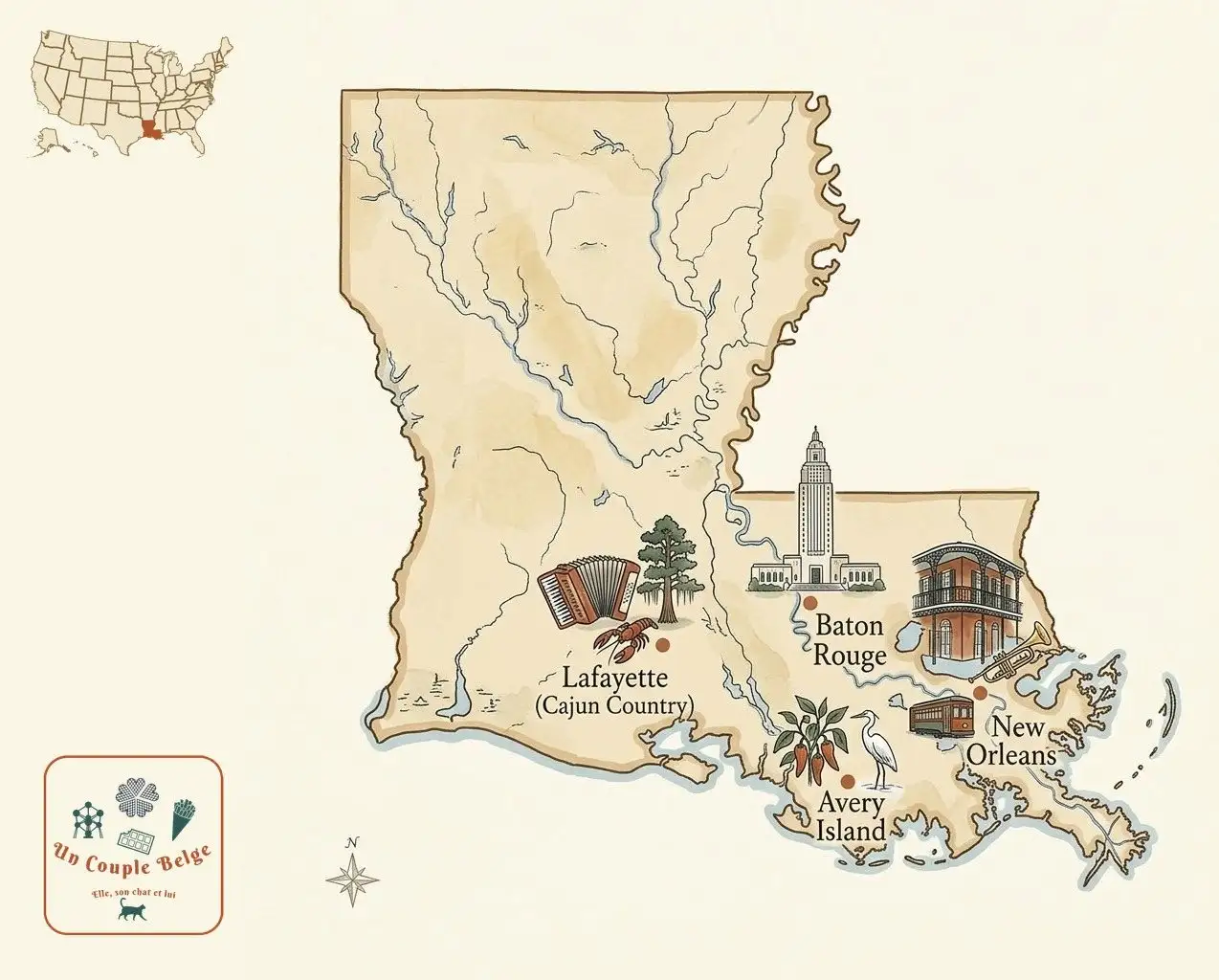
New Orleans and the south-east sit on the Mississippi Delta, between the river, Lake Pontchartrain and the Gulf of Mexico.
Acadiana, or Cajun country, occupies the south-centre and south-west, around Lafayette, with the immense swampy Atchafalaya Basin, the largest wooded wetland in the United States.
The Mississippi valley, between New Orleans and Baton Rouge, is lined with former plantations and petrochemical plants.
The north, around Shreveport, Monroe and Natchitoches, is drier, more wooded and culturally closer to Texas and Arkansas.
The coastline, made of marshes and bayous, retreats every year: Louisiana loses the equivalent of a football field of coast roughly every two hours, eaten away by erosion and rising waters.
A bit of history
In 1682, the explorer Cavelier de La Salle claimed the whole Mississippi basin for France and named it Louisiana, in honour of Louis XIV. New Orleans was founded in 1718. The region passed to Spain in 1763, which rebuilt the city after two great fires, then briefly returned to France before Napoleon sold the entire territory to the United States in 1803. This “Louisiana Purchase” doubled the size of the country at a stroke.
In the meantime, thousands of Acadians driven out of Canada by the British in the mid-18th century had taken refuge in the southern swamps: they are the ancestors of the Cajuns. Louisiana became a state in 1812, and the Battle of New Orleans, in 1815, saw the Americans defeat the British. The economy then rested on sugar, cotton and slavery.
In the 20th century, French was banned in schools from 1921, and it wasn’t until 1968 and the creation of CODOFIL that it was rehabilitated. In 2005, Hurricane Katrina flooded 80% of New Orleans and killed more than 1,800 people in the region. The city has since largely been rebuilt.
The must-sees
New Orleans
No American city resembles New Orleans. The French Quarter, with its wrought-iron balconies covered in ferns, is in fact mostly Spanish in architecture. Bourbon Street is where the bars and the excess are concentrated, but Royal Street and its antique shops, Jackson Square and its cathedral, and the French Market are far more pleasant during the day.
In the evening, head for Frenchmen Street, where jazz is played live in a dozen clubs, often with no cover charge. Preservation Hall keeps traditional jazz alive in a small wooden room. The city gave birth to jazz, and Louis Armstrong grew up here.
To get out of the Quarter, the St. Charles streetcar, in service since 1835, leads to the Garden District and its grand houses surrounded by oaks, and to Lafayette Cemetery, with its above-ground tombs. The National WWII Museum is one of the best museums in the United States. The Tremé neighbourhood, one of the oldest African American neighbourhoods in the country, is the cradle of “second lines”, those brass band parades that wind through the streets on Sundays. And the tomb of Marie Laveau, the voodoo queen, in St. Louis Cemetery No. 1, can only be visited with a licensed guide.
Cajun country and the bayous
Two hours to the west, another world begins: Cajun country. Around Lafayette, people eat differently, you sometimes still hear French spoken, and people dance to Cajun and zydeco music at the weekend. The Blue Moon Saloon in Lafayette and the little village dance halls welcome everyone. Vermilionville, a reconstructed village, introduces Acadian and Creole culture. In Breaux Bridge, the “Crawfish Capital of the World”, the Saturday zydeco breakfasts have locals dancing from first thing in the morning. St. Martinville keeps the oak of Evangeline, the heroine of Longfellow’s poem about the deportation of the Acadians.
A boat trip in the Atchafalaya Basin, from Henderson or Breaux Bridge, lets you glide between bald cypresses draped in Spanish moss, with a good chance of seeing alligators, herons and turtles. You can also take a swamp tour near New Orleans, in the Honey Island or Jean Lafitte swamps.
Avery Island and Tabasco
South of Lafayette, on a salt dome surrounded by marshes, the McIlhenny family has been making Tabasco sauce since 1868, with peppers fermented and aged for up to three years in old bourbon barrels. A visit to the factory and the neighbouring tropical gardens, full of egrets and alligators, makes a nice detour (Tour Louisiana).
The plantation road
Between New Orleans and Baton Rouge, the road that follows the Mississippi, the Great River Road, is lined with former plantations. Oak Alley is famous for its avenue of 28 centuries-old oaks. Laura, a Creole plantation, tells the story of one family over four generations. And Whitney Plantation, the only one devoted entirely to the history of slavery, from the point of view of the enslaved, is the most important and most moving visit in the region.
Baton Rouge
The capital deserves a stop for its State Capitol, the tallest in the United States, built in the 1930s by Governor Huey Long, who was assassinated there in 1935. The view from the 27th-floor observation deck is free. The destroyer USS Kidd is moored on the Mississippi.
The north and Natchitoches
Natchitoches, founded in 1714, is the oldest town in Louisiana. Its historic centre on the Cane River served as the setting for the film Steel Magnolias 🎬, and its meat pies, turnovers filled with spiced meat, are an institution. The Christmas lights draw crowds there every year. Further south, Kisatchie National Forest offers fine hikes.
Itinerary ideas
A long weekend. New Orleans (3-4 days), with an excursion into the bayous or along the plantation road.
One week, city and Cajun country. New Orleans (3 days) → plantation road (1 day) → Baton Rouge → Lafayette and Cajun country (2 days) → Avery Island and the bayous of the Atchafalaya.
In combination. Louisiana combines with Mississippi and Memphis by following the river north (the “Blues Highway”), or with Texas to the west.
On the plate
Louisiana cooking is divided between Creole cuisine, urban and refined, born in New Orleans, and Cajun cuisine, rustic and rural, born in the bayous. The two meet over:
- gumbo, a thick roux-based stew, with seafood, chicken or sausage, served with rice;
- jambalaya, a rice dish with sausage, chicken or shrimp;
- étouffée, crawfish or shrimp simmered in a thick sauce;
- the crawfish boil, boiled crawfish tipped out onto a table covered in newspaper, from late February to June;
- the po’boy, a sandwich on crusty French bread, with fried shrimp or roast beef and gravy;
- the muffuletta, an enormous round sandwich of cold cuts and olive salad, invented at Central Grocery;
- red beans and rice, traditionally served on Mondays;
- boudin and cracklins, sold in the petrol stations of Cajun country;
- beignets from Café du Monde, open since 1862, with a chicory coffee;
- king cake during Mardi Gras season, and bananas Foster, flambéed with rum;
- and to drink, the Sazerac, among the oldest American cocktails, and the Hurricane, made with rum and passion fruit.
Culture and trivia
- Mardi Gras actually lasts several weeks. Dozens of “krewes”, private clubs, each organise their own parade and throw beads and trinkets to the crowd. Its colours, purple, green and gold, date from 1872. In the Cajun countryside, the Courir de Mardi Gras sees masked riders go from farm to farm begging for the ingredients of a big gumbo.
- Louisiana law is partly inherited from the Napoleonic Code, an exception in the United States.
- The Jazz & Heritage Festival, in late April and early May, and the Festival International de Louisiane in Lafayette, in April, are two of the best music festivals in the country.
- The tombs are built above ground in the cemeteries of New Orleans, because of the very high water table. They’re nicknamed the “cities of the dead”.
- The word “Cajun” comes from a corruption of “Acadian”.
When to go
- February-March: Mardi Gras season (dates vary with Easter). A wild atmosphere, very high prices.
- Spring (March to May): the best time, mild, with the music festivals and the height of crawfish season.
- Summer (June to September): very hot, very humid, with thunderstorms almost every day. It’s low season, with gentler prices.
- Hurricane season: from June to November, peaking in August-September.
- Autumn and winter (October to January): pleasant and drier, with the Christmas lights and the bonfires on the Mississippi levees on Christmas Eve.
Practical information
- Recommended length of stay: 3 to 4 days for New Orleans, one week with Cajun country.
- Getting there: New Orleans airport is served by connecting flights, or by a few seasonal direct flights from Europe.
- Getting around: New Orleans can be explored on foot and by streetcar. A car is essential for the plantations and Cajun country.
- Budget: medium to high in New Orleans, especially during the festivals. Cajun country is very affordable.
- Things to watch out for: in New Orleans, stick to busy streets in the evening and take a taxi back late at night. Protect yourself from the sun and mosquitoes. Follow the weather during hurricane season.
- One more tip: book several months ahead for Mardi Gras and Jazz Fest, and always keep a little room for a beignet.