Massachusetts: Boston, Cape Cod and the cradle of America
Updated on
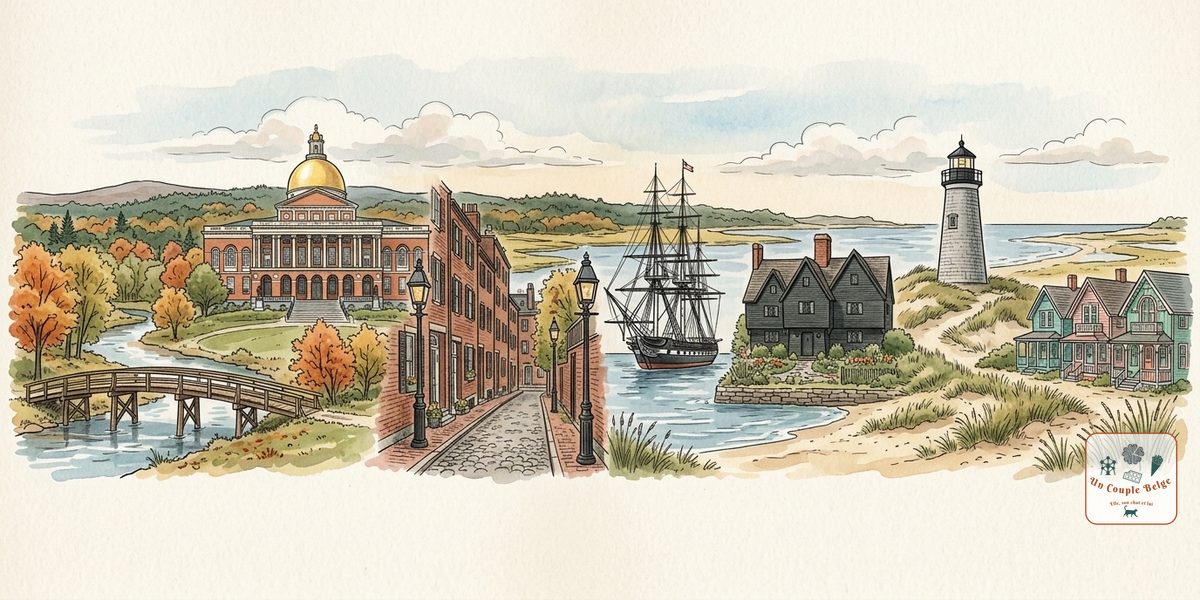
Massachusetts is full of paradoxes. It’s one of the smallest American states, a little smaller than Belgium, and you can cross it from east to west in three hours. And yet it holds an enormous place in the country’s history. This is where the Mayflower Pilgrims landed in 1620, where the American Revolution broke out, where some of the most famous universities in the world are found.
But Massachusetts isn’t only a history book. It’s also Boston, one of the most pleasant cities in the United States to explore on foot, the dunes and lighthouses of Cape Cod, the smart islands of Martha’s Vineyard and Nantucket, and to the west the hills of the Berkshires, where classical music rings out among the forests in summer. All within a few hours’ drive.
Massachusetts at a glance
- Capital and largest city: Boston
- Population: about 7 million
- Area: about 27,000 km², a little less than Belgium
- Joined the Union: 1788, 6th state. Officially, it’s a “Commonwealth”.
- Time zone: Eastern Time (6 hours behind Brussels)
- Nicknames: Bay State, Old Colony State
- Highest point: Mount Greylock, 1,064 metres
Geography: from the bay to the Berkshires
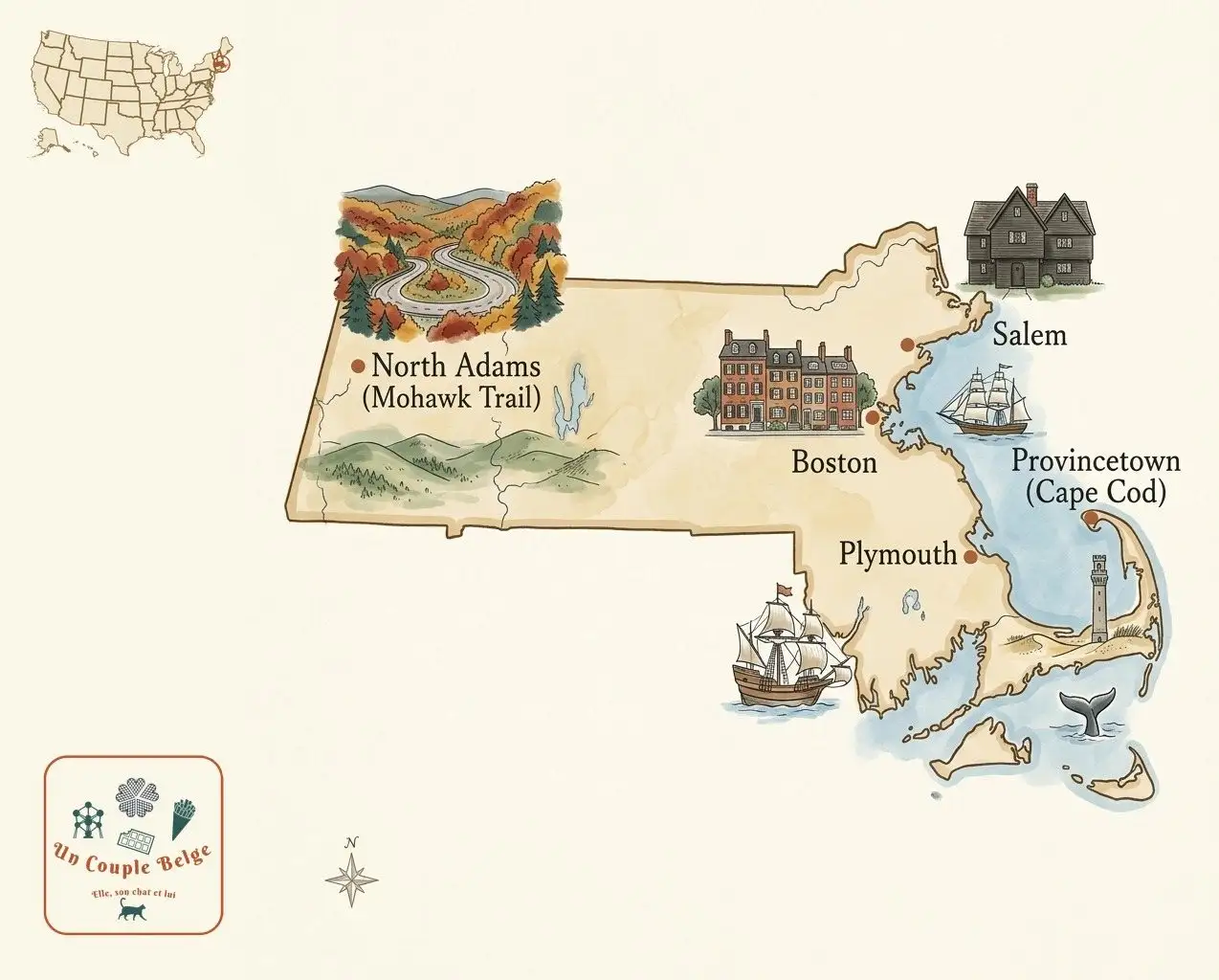
Boston and the east hold most of the population, around the harbour and Massachusetts Bay, with the “North Shore” (Salem, Gloucester, Rockport) to the north and the “South Shore” (Plymouth) to the south.
Cape Cod, an arm of land curved like a fish hook, reaches about a hundred kilometres into the Atlantic. To the south, the islands of Martha’s Vineyard and Nantucket can only be reached by ferry or plane.
The centre, around Worcester, is more rural, with the Connecticut River valley and its college towns (Amherst, Northampton).
The Berkshires, to the west, are wooded hills dotted with lakes, farms and small cultural towns.
A bit of history
The Wampanoag, the Massachusett (who gave the state its name) and other peoples lived on the coast when the Mayflower landed in November 1620 at the tip of Cape Cod, then settled at Plymouth in December. The Puritans founded Boston in 1630. In 1692, the Salem witch trials claimed twenty victims.
In the 18th century, Boston became the hotbed of revolt against the British crown: the Boston Massacre (1770), the Boston Tea Party (1773), then the first shots of the War of Independence at Lexington and Concord in April 1775. In the 19th century, Massachusetts was at the forefront of the textile industry (Lowell), whaling (New Bedford, Nantucket), literature (Thoreau, Emerson, Dickinson, Melville) and the abolitionist movement. In the 20th century, it became the cradle of the Kennedy family and a world centre for education, healthcare and technology.
The must-sees
Boston
Boston deserves at least three days. It’s one of the few American cities that can really be discovered on foot. The Freedom Trail, a red line marked on the pavement for about 4 kilometres, links sixteen sites of the Revolution: Boston Common (the oldest public park in the country), Faneuil Hall, the Old North Church, where lanterns signalled the arrival of the British, Paul Revere’s house and the USS Constitution, the oldest warship still afloat in the world.
For the rest: the brick houses and gas lamps of Beacon Hill, the Italian North End and its cannoli, the Museum of Fine Arts, the Isabella Stewart Gardner Museum, famous for the theft of 13 works in 1990, never recovered (the empty frames are still hanging), the JFK Library and Museum, and a Red Sox game at Fenway Park, the oldest ballpark in Major League Baseball, opened in 1912. Across the Charles River, Cambridge is home to Harvard and MIT, whose campuses can be visited.
From April to October, whale-watching trips leave the harbour for Stellwagen Bank, where you’re almost certain to see humpback whales.
Lexington, Concord and Walden
Half an hour from Boston, Minute Man National Historical Park follows the road where the American militiamen faced British soldiers on 19 April 1775. In Concord, you can visit the homes of the writers Louisa May Alcott (Little Women) and Ralph Waldo Emerson, and swim in Walden Pond, where Henry David Thoreau lived for two years in a cabin.
Salem
Half an hour north-east of Boston, Salem lives off the memory of the witch trials of 1692, in which twenty people were executed (nineteen hanged and one pressed to death under stones). The Salem Witch Trials Memorial is sober and moving. The rest of the town milks the theme for all it’s worth, between more or less serious museums and occult shops. In October, for Halloween, the town is overrun with visitors. The Peabody Essex Museum, one of the oldest museums in the country, is worth the detour, as is the House of the Seven Gables, which inspired Nathaniel Hawthorne.
Further north, Gloucester, the oldest fishing port in America, and Rockport, with its red fishing shack, are pretty stops.
Plymouth
In Plymouth, the Mayflower II, a replica of the ship, is moored in the harbour, and the Plimoth Patuxet living museum recreates a settlers’ village of 1627 and a Wampanoag homesite. The famous Plymouth Rock, on which the Pilgrims are said to have stepped ashore, is a modest boulder that disappoints everyone, but that people go to see anyway.
Cape Cod
Cape Cod takes in dozens of villages with very different atmospheres. Chatham is elegant, Hyannis keeps the memory of the Kennedy family’s summers, and Provincetown, right at the tip, is artistic, festive and very open-minded, with the monument to the Pilgrims who first landed there. The Cape Cod National Seashore protects more than 60 kilometres of beaches, dunes, marshes and lighthouses on the Atlantic side. Cycle paths such as the Cape Cod Rail Trail are ideal for exploring it.
Martha’s Vineyard and Nantucket
South of Cape Cod, Martha’s Vineyard is a green island with very different villages: the colourful gingerbread cottages of Oak Bluffs, the fishing harbour of Menemsha, the clay cliffs of Aquinnah. Nantucket, further out, has kept its grey-shingled houses and cobbled streets from the whaling era, recounted in an excellent museum. Both islands are expensive and very busy in summer: book ferries and accommodation well in advance.
The Berkshires
To the west, the Berkshires offer a quite different Massachusetts: wooded hills, red barns and an intense cultural life. In summer, the Boston Symphony Orchestra moves to Tanglewood, where you listen to the concerts on the lawn with a picnic. Jacob’s Pillow hosts a major dance festival, MASS MoCA, in North Adams, fills a giant former factory with contemporary art, and the Norman Rockwell Museum, in Stockbridge, exhibits the painter of everyday America. Mount Greylock, the highest point, can be climbed by car or on foot.
The Mohawk Trail, Route 2, one of the oldest scenic roads in the country, crosses the region for about a hundred kilometres and is at its best in autumn.
And more…
The Basketball Hall of Fame in Springfield, where basketball was invented in 1891. The Dr. Seuss Museum, in the same city. Emily Dickinson’s house, in Amherst. The old textile mills of Lowell, where the American industrial revolution took off. And Old Sturbridge Village, a reconstructed village of the 1830s.
Itinerary ideas
4-5 days. Boston (3 days) → Lexington and Concord → Salem.
One week. Boston (3 days) → Plymouth → Cape Cod (2-3 days) → Salem on the way back.
10 days, with the autumn. Boston → Salem → Cape Cod → Martha’s Vineyard → drive west → Berkshires and the Mohawk Trail. Then carry on to Vermont or New Hampshire for a grand loop of New England.
On the plate
- New England clam chowder, a creamy soup of clams and potatoes.
- Lobster and the lobster roll, and fried clams, which Woodman’s restaurant, in Essex, claims to have invented in 1916.
- Boston cream pie, a cake filled with custard and topped with chocolate, created at the Parker House hotel, and Parker House rolls, soft little bread rolls.
- Baked beans, oven-baked with molasses, which earned Boston its nickname “Beantown”.
- Cape Cod cranberries, harvested in October in flooded bogs that turn bright red.
- And a few local inventions: the chocolate chip cookie (Toll House, 1938), the Fluffernutter (a peanut butter and marshmallow creme sandwich) and Dunkin’, founded in Quincy in 1950. Here, a milkshake is called a “frappe”.
Culture and trivia
- Volleyball was invented in Holyoke in 1895, a few kilometres from Springfield, where basketball had been born four years earlier.
- The Boston Marathon, the oldest annual marathon in the world, is run on the third Monday of April, Patriots’ Day, a public holiday Massachusetts shares with only a few states, including Maine.
- The Boston accent swallows its Rs: “Pahk the cah in Hahvahd Yahd” (Park the car in Harvard Yard). And here everything is “wicked”: “wicked good” means “really good”.
- Boston’s subway, the “T”, is the oldest in the United States, opened in 1897.
- Four presidents were born in Massachusetts, including John F. Kennedy.
When to go
- Summer (June to August): the season for Cape Cod, the islands and the Berkshires festivals. High prices and crowds on the coast.
- Autumn (late September to late October): the best time, with the colours in the Berkshires, the cranberry harvest and Halloween in Salem.
- Spring (April-May): pleasant in Boston, with the marathon and the first whales.
- Winter: cold and often snowy, with storms (“nor’easters”). Boston stays very lively, but Cape Cod and the islands are asleep.
Practical information
- Recommended length of stay: one week to combine Boston, the coast and Cape Cod, 10 days with the Berkshires.
- Getting there: Boston Logan airport has direct flights from many European cities.
- Getting around: in Boston, forget the car (expensive parking, complicated traffic): walk and take the subway. For Cape Cod and the Berkshires, a car becomes essential. Ferries to the islands should be booked ahead in summer.
- Budget: high, especially in Boston and on the islands in summer. More affordable in the Berkshires and out of season.
- Things to watch out for: few pitfalls. Ticks are plentiful in summer in the grasses of Cape Cod: check yourself after walks.
- One more tip: for Salem in October, book accommodation months ahead and arrive early in the morning.