Michigan: Detroit, the Great Lakes and the far north
Updated on
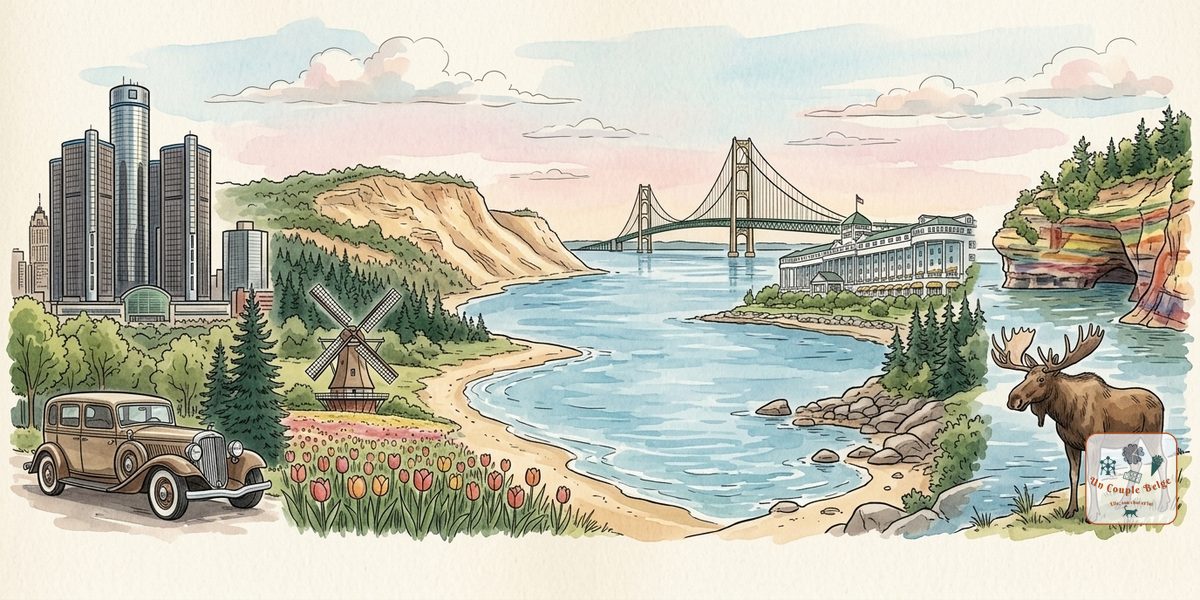
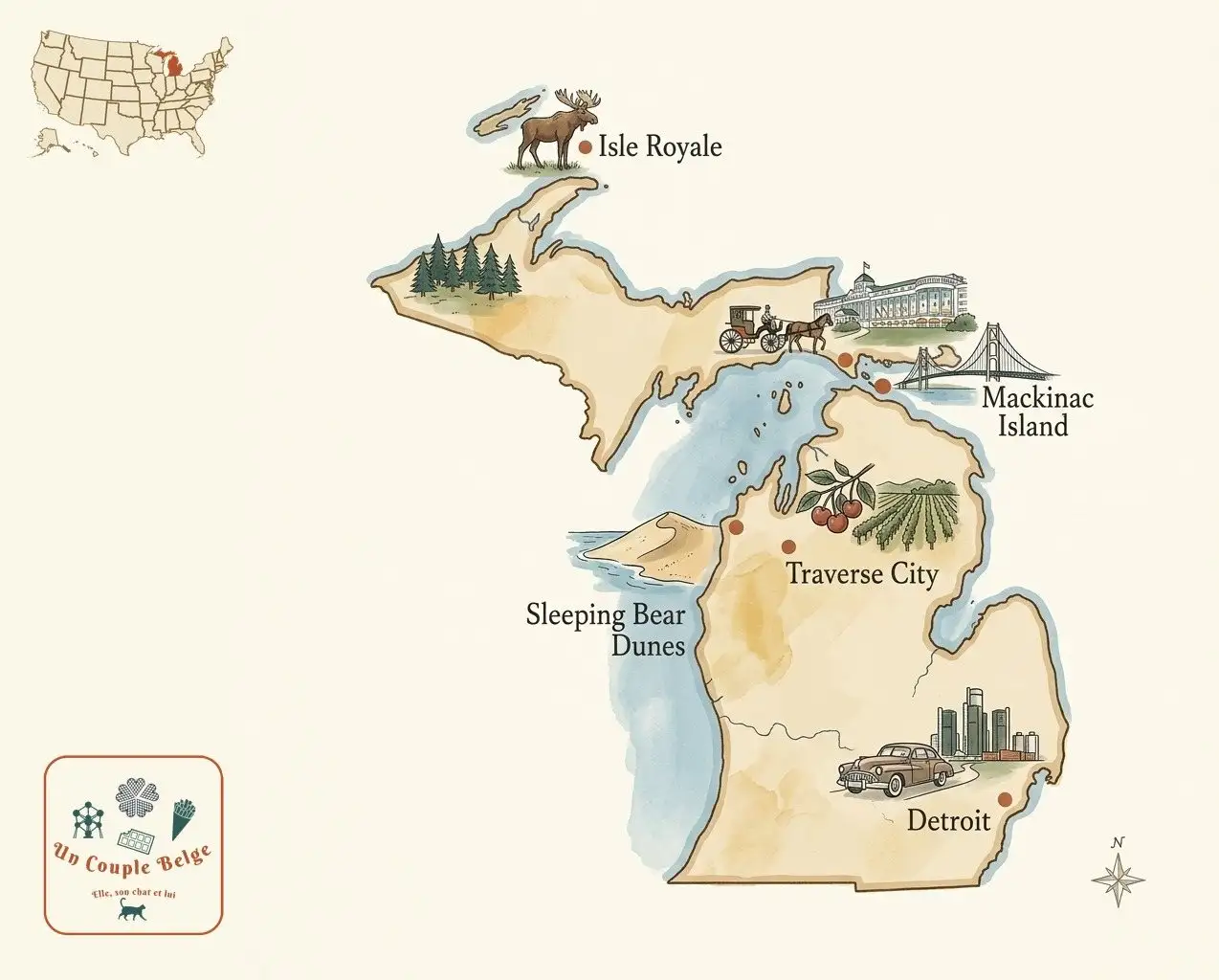
Look at a map of Michigan before reading on; it will save you some confusion. The state is shaped like a mitten, the “Lower Peninsula”, with a detached piece to the north, the Upper Peninsula, which everyone calls “the U.P.”, linked to the rest by an 8-kilometre bridge. It’s the only state to touch four of the five Great Lakes, which gives it more freshwater shoreline than any other state, and landscapes you don’t associate with the Midwest at all: sand dunes, beaches, lighthouses and cliffs.
Michigan is also Detroit, which invented the mass-produced car and the Motown sound before going through a long decline, and which is now enjoying a real revival. Between the industrial city in the south and the almost empty forests of the far north, you feel as if you’re crossing two countries.
Michigan at a glance
- Capital: Lansing
- Largest city: Detroit
- Population: about 10 million
- Area: about 250,000 km² including its waters (of which 150,000 km² is land), nearly five times Belgium for the land alone
- Joined the Union: 1837, 26th state
- Time zone: Eastern Time (6 hours behind Brussels), except for four counties in the western Upper Peninsula, on Central Time
- Nicknames: Great Lakes State, Wolverine State
- Highest point: Mount Arvon, 603 metres
Geography: two peninsulas and four lakes
The south-east holds most of the population and industry: Detroit, Ann Arbor, Flint, Lansing.
The west of the mitten, along Lake Michigan, lines up beaches, dunes and small resort towns (Holland, Saugatuck, Ludington), up to Traverse City and its cherry orchards.
The north of the mitten, nicknamed “Up North”, is a region of forests, lakes and cabins where people from the south spend their summer weekends.
The Upper Peninsula (U.P.), between Lake Superior and Lake Michigan, is wild and sparsely populated: forests, waterfalls, old copper and iron mines, and very snowy winters. Its inhabitants call themselves “Yoopers”.
A bit of history
The Ojibwe, the Odawa and the Potawatomi, the “Three Fires”, lived around the Great Lakes. The French arrived in the 17th century: Antoine de la Mothe Cadillac founded Detroit in 1701, and French names (Marquette, Sault Ste. Marie, Charlevoix) are still everywhere. The territory passed to the British in 1763, then to the Americans.
Michigan became a state in 1837. In the 19th century it lived off timber, copper and iron. In the 20th century, Detroit became the car capital of the world: Henry Ford launched the moving assembly line there in 1913, and General Motors and Chrysler set up there. The city drew hundreds of thousands of workers, many of them African Americans from the South. In the 1960s, Motown invented a sound there that went around the world. Then came industrial decline, up to the city’s bankruptcy in 2013, the largest municipal bankruptcy in American history.
The must-sees
Detroit
Detroit was long synonymous with wasteland and abandoned houses. Some remain, but downtown and the Midtown district have found real energy again. The Detroit Institute of Arts is one of the largest art museums in the country, with Diego Rivera’s impressive murals on the car industry. The Motown Museum, in the little “Hitsville U.S.A.” house where the hits of the Supremes, Marvin Gaye and Stevie Wonder were recorded, is a must.
Eastern Market, one of the largest historic markets in the country, comes alive on Saturdays. The RiverWalk follows the river opposite Windsor, in Canada. The immense Michigan Central station, long a symbol of the city’s ruin, has been restored by Ford and reopened in 2024.
In Dearborn, right next door, The Henry Ford combines a museum of American innovation (you can see the bus on which Rosa Parks refused to give up her seat and Kennedy’s limousine) and Greenfield Village, an open-air historic village. You can also tour the Ford Rouge plant, where F-150 pickups are assembled.
Traverse City and cherry country
In the north-west, Traverse City is the tart cherry capital: Michigan produces the great majority of the country’s tart cherries, and the National Cherry Festival takes place every early July. The area is surrounded by vineyards, notably on the Old Mission and Leelanau peninsulas, with pretty villages such as Suttons Bay and Glen Arbor.
Sleeping Bear Dunes
Right nearby, Sleeping Bear Dunes National Lakeshore is probably the most beautiful landscape on the Great Lakes. Sand dunes tower more than 100 metres above Lake Michigan. Going up the Dune Climb is torture for the calves; running back down is a guaranteed childhood memory. The Pierce Stocking Scenic Drive offers spectacular views over the turquoise water. The name comes from an Ojibwe legend: a mother bear waiting for her cubs, drowned in the lake while fleeing a fire, who became the Manitou Islands.
Mackinac Island
At the Straits of Mackinac, the Mackinac Bridge links the two peninsulas over 8 kilometres. In high wind, the crossing is impressive. Right nearby, Mackinac Island (pronounced “Mackinaw”) is an island where cars have been banned since the end of the 19th century. You get around by bike, on foot or by horse-drawn carriage, among Victorian houses, a British fort and the Grand Hotel with its 200-metre porch. And you buy fudge there, sold in dozens of shops, to the point where tourists are nicknamed “fudgies”. The bike ride around the island is 13 kilometres.
The Upper Peninsula
Pictured Rocks National Lakeshore, near Munising, lines up sandstone cliffs coloured red, ochre and green by minerals, plunging into Lake Superior. You discover them by boat, by kayak or on foot. Further east, Tahquamenon Falls are tea-coloured waterfalls (because of the tannins from the trees), and the spring of Kitch-iti-kipi, its turquoise water so clear you can see the bottom, is crossed on a raft.
In Sault Ste. Marie, you watch immense freighters pass through the Soo Locks, the locks between Lake Superior and Lake Huron. To the west, the Porcupine Mountains and the Keweenaw Peninsula, a former copper-mining region, are the wildest corners of the state.
Isle Royale
In the middle of Lake Superior, Isle Royale National Park can only be reached by ferry or seaplane, and it’s one of the least visited national parks in the country. No roads, no cars: just trails, lakes, around a thousand moose and some thirty wolves, studied for more than sixty years. For lovers of hiking and solitude. The park is closed in winter.
And more…
Holland, founded by the Dutch, has its residents parading in clogs among millions of tulips at its May festival. Frankenmuth, a Bavarian-style village, is home to the world’s largest Christmas store, Bronner’s. Ann Arbor, a lively university town, has a football stadium with more than 107,000 seats, nicknamed “The Big House”.
Itinerary ideas
One week, the mitten. Detroit (2 days) → Frankenmuth → Traverse City and the peninsulas (2 days) → Sleeping Bear Dunes → Mackinac Island (1-2 days).
10-12 days, up to the Upper Peninsula. The same route, then across the Mackinac Bridge to Tahquamenon, Pictured Rocks and Kitch-iti-kipi, returning along the Lake Michigan shore (Ludington, Saugatuck, Holland).
In combination. Michigan combines with Chicago (Holland is 2 hrs 30 away), Wisconsin via the Upper Peninsula, or Canadian Ontario from Detroit.
On the plate
- The Coney dog, a hot dog topped with chili, onions and mustard. In Detroit, the Lafayette and American Coney Island restaurants, side by side, have been fighting over the title for decades.
- Detroit-style pizza, square, with a thick crust and edges of caramelised cheese, born at Buddy’s in 1946 in car-factory parts trays.
- The pasty, a turnover of meat, potatoes and onions, brought by Cornish miners to the Upper Peninsula.
- Cherry pie and everything made with Traverse City cherries.
- Whitefish from the Great Lakes, grilled or smoked.
- Mackinac Island fudge.
- And the local sodas, Vernors (a very fizzy, spicy ginger ale) and Faygo.
Culture and trivia
- Motown was founded in Detroit in 1959 by Berry Gordy with a family loan of 800 dollars. Its name comes from “Motor Town”.
- Detroit is north of Windsor, in Canada: it’s one of the few places where you head south to enter Canada.
- Michigan has more than 5,000 kilometres of shoreline on the Great Lakes, and you’re never more than 10 kilometres from a lake or a stream.
- Residents often hold up their hand to explain where they live on the “mitten”.
- Paczki Day, the local Fat Tuesday, sees immense queues outside the Polish bakeries of Hamtramck for filled doughnuts.
When to go
- Summer (June to August): the best time for the beaches, the dunes, the islands and the Upper Peninsula. The lake water stays cool.
- Autumn (late September to mid-October): spectacular colours in the north and the Upper Peninsula, with fewer people.
- Spring (May): the tulips of Holland and the fruit trees in blossom around Traverse City. Nights are still cool.
- Winter: cold and very snowy, especially near Lake Superior. For skiing, snowmobiling and frozen waterfalls.
Practical information
- Recommended length of stay: around ten days to combine Detroit, the north-west and the Upper Peninsula, 4-5 days for Detroit and Sleeping Bear Dunes.
- Getting there: Detroit airport has direct flights from several European cities. Chicago is also a good gateway for the west of the state.
- Getting around: a car is essential (4 hours between Detroit and Traverse City). For Mackinac Island, you leave the car on the mainland and take the ferry.
- Budget: moderate, higher in summer on Mackinac Island and in Traverse City.
- Things to watch out for: beware of deer on the northern roads, especially at dawn and dusk. Mosquitoes and black flies are plentiful in early summer in the Upper Peninsula.
- One more tip: book accommodation early on Mackinac Island and in Traverse City for July-August, and the Isle Royale ferry several months ahead.