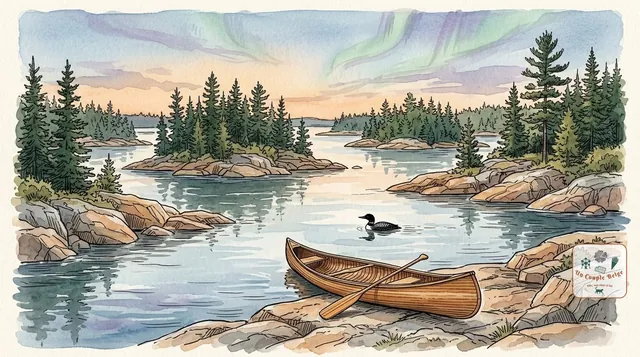
Minnesota: the land of ten thousand lakes
Updated on
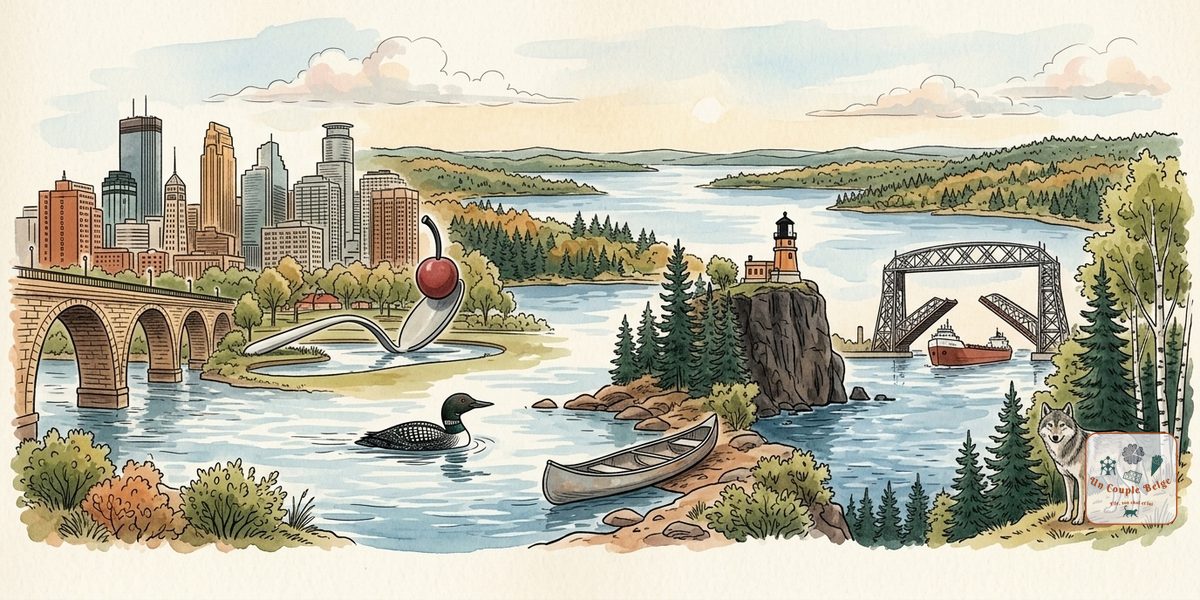
Minnesota announces itself on its licence plates as the “Land of 10,000 Lakes”, and the slogan errs on the side of modesty: the state has more than 11,000, left by the glaciers some ten thousand years ago. It’s also one of the coldest places in the 48 contiguous states, where winter regularly drops below –30 °C near the Canadian border, and where the locals set up whole villages of shacks on the frozen lakes to fish through the ice.
But Minnesota has another, much gentler season. In summer the lakes become playgrounds, the shore of Lake Superior looks like a wild sea coast, and the Twin Cities, Minneapolis and Saint Paul, move out onto café terraces and bikes. Add to that a strong Scandinavian culture, a sense of politeness famous throughout the country (“Minnesota nice”) and Prince, and you have a state that doesn’t really match the flat image people have of the Midwest.
Minnesota at a glance
- Capital: Saint Paul
- Largest city: Minneapolis
- Population: about 5.7 million
- Area: about 225,000 km², more than seven times Belgium
- Joined the Union: 1858, 32nd state
- Time zone: Central Time (7 hours behind Brussels)
- Nicknames: North Star State, Land of 10,000 Lakes, Gopher State
- Highest point: Eagle Mountain, 701 metres
Geography: forests, lakes and prairies
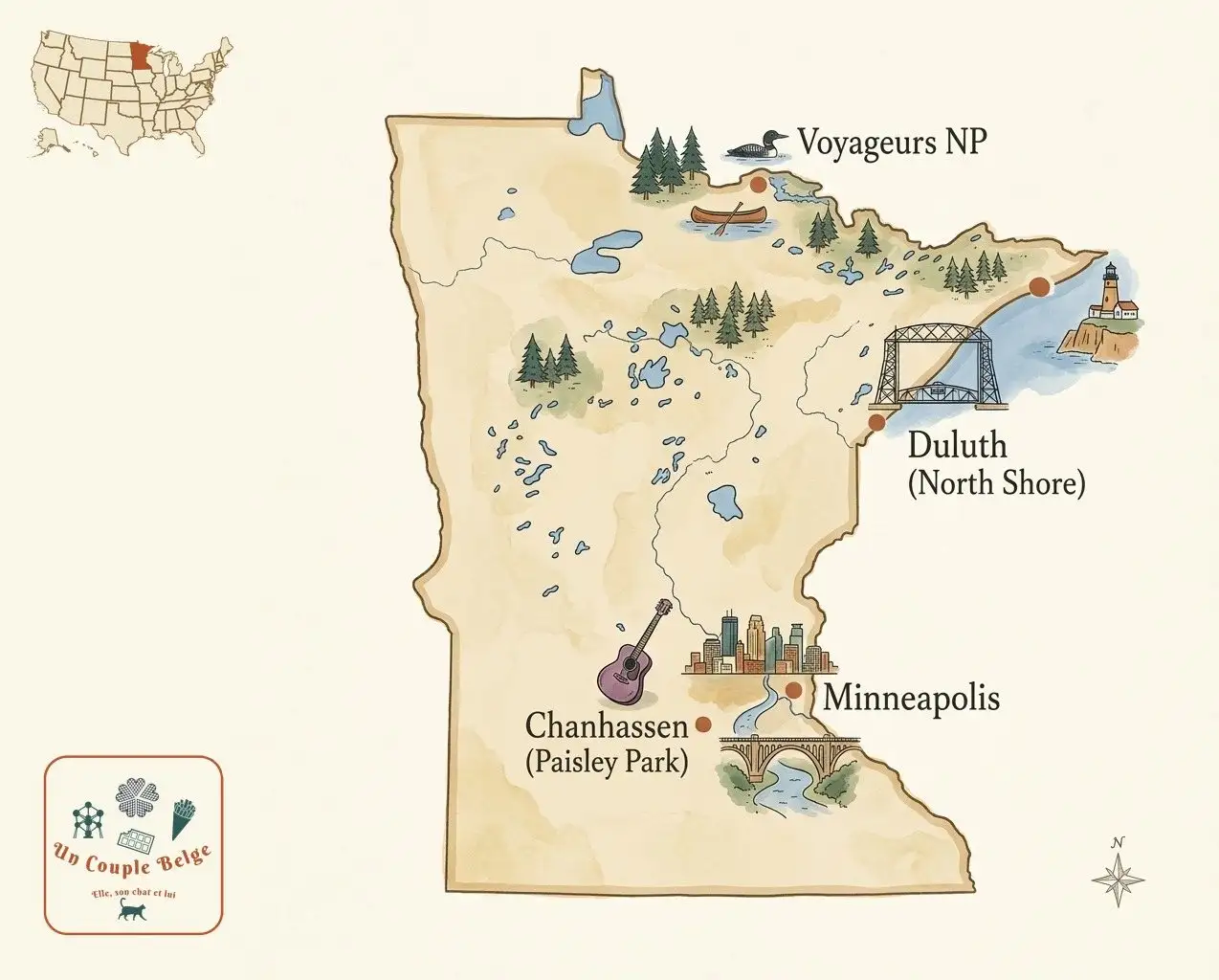
The north-east, the “Arrowhead”, is covered in boreal forest and lakes, between Lake Superior and the Canadian border. This is where you’ll find the North Shore, the Boundary Waters and the Iron Range, the iron-mining region.
The centre and the north alternate forests and lakes, with the source of the Mississippi in Itasca State Park and a multitude of lakeside holiday villages.
The Twin Cities, in the south-east, hold more than half of the state’s population.
The south and the west are prairie farmland, flatter, with a few wooded valleys along the Mississippi and the Minnesota River.
A bit of history
The Dakota (Sioux) and the Ojibwe shared the territory when the French-Canadian “voyageurs”, trappers travelling by canoe, traded furs there in the 17th and 18th centuries. Minnesota became a state in 1858. In 1862, the Dakota War, born of promises broken by the government, ended with the largest mass execution in American history (38 Dakota hanged at Mankato) and the expulsion of the Dakota from the state.
In the 19th century, hundreds of thousands of Scandinavian and German immigrants settled there to farm the land and work the forests. Minneapolis became the flour capital of the world, with its mills on St. Anthony Falls (which gave rise to the General Mills and Pillsbury brands). In the 20th century, the Iron Range supplied the iron for American industry, and the state built a reputation as a progressive, well-run place.
The must-sees
Minneapolis and Saint Paul
Minneapolis has around twenty lakes within the city itself, linked by cycle paths: in summer people paddleboard right in the middle of town, and in winter they skate. The Walker Art Center and its sculpture garden, with the famous giant spoon carrying a cherry, the Guthrie Theater and its walkway cantilevered above the Mississippi, the Mill City Museum in the ruins of a flour mill and the Stone Arch Bridge, a former stone railway bridge, are the essentials. Prince fans will go to First Avenue, the venue where he filmed Purple Rain 🎬, and to Paisley Park, his home and studio in Chanhassen, which can be visited.
Saint Paul, older and calmer, has a fine cathedral, a marble State Capitol and an avenue of Victorian mansions, Summit Avenue. Every winter, the Saint Paul Winter Carnival, one of the oldest winter festivals in the country, livens up the city with ice sculptures.
And then there’s the Mall of America, in Bloomington, the largest shopping centre in the United States, with a complete amusement park inside. You go more out of curiosity than to do your shopping.
The North Shore of Lake Superior
In the north-east, Highway 61, the one from the album Highway 61 Revisited by Bob Dylan, who was born in Duluth and grew up in Hibbing, follows Lake Superior for about 240 kilometres between Duluth and the Canadian border (Explore Minnesota). The road passes through forests, past cliffs and over rivers that tumble into the lake in waterfalls: Gooseberry Falls, Split Rock Lighthouse perched on its cliff, Tettegouche State Park, then the artists’ village of Grand Marais. The lake is so big it looks like a sea, with an endless horizon and water barely at 10 °C in summer.
Duluth, built on a hillside at the end of the lake, watches immense freighters pass under its Aerial Lift Bridge, a bridge whose deck rises several times a day. The Canal Park promenade and the harbour district are pleasant.
The Boundary Waters and Voyageurs
On the Canadian border, the Boundary Waters Canoe Area Wilderness covers more than 400,000 hectares of forests and interconnected lakes, accessible only by canoe, carrying your gear from one lake to the next. You can paddle for a whole day and meet nothing but a loon. Permits are limited and must be reserved in advance. Ely is the main gateway, with outfitters who rent all the equipment.
Further west, Voyageurs National Park is 40% water: you discover it by boat, or by renting a houseboat for a few days. In clear weather, you can sometimes see the northern lights there.
Itasca and the source of the Mississippi
At Itasca State Park, the oldest in Minnesota, the Mississippi leaves a lake as a small stream that you can walk across on stones. It then travels more than 3,700 kilometres to the Gulf of Mexico. The forest of centuries-old pines around it is superb.
The south and the west
In Rochester, the Mayo Clinic, one of the most renowned hospitals in the world, has shaped the whole city. In Austin, the Spam Museum is free, funny and surprisingly well done. In the west, Pipestone National Monument protects quarries of red stone where Native Americans still carve their ceremonial pipes, and Walnut Grove keeps the memory of Laura Ingalls Wilder and Little House on the Prairie. Along the Mississippi, in the south-east, the villages of the valley between Red Wing and Winona are very pretty in autumn.
Itinerary ideas
One week. Minneapolis and Saint Paul (2-3 days) → Duluth (1 day) → the North Shore up to Grand Marais or Grand Portage (2-3 days), with a possible night in Ely for the Boundary Waters.
10 days, lakes and forests. The same route, then Voyageurs National Park and back via Itasca and the source of the Mississippi.
In combination. Minnesota combines with Wisconsin (the Apostle Islands are 1 hr 30 from Duluth) and with the Dakotas to the west.
On the plate
- The Juicy Lucy, a burger with the melted cheese sealed inside the patty. Matt’s Bar and the 5-8 Club, in Minneapolis, both claim to have invented it. Careful with the first bite, the cheese is scalding.
- Hotdish, a casserole of ground meat, vegetables and canned soup, topped with tater tots. You bring it in a Pyrex dish to church gatherings.
- Walleye, the state fish, breaded or in a sandwich.
- Wild rice soup, made with a rice traditionally harvested by canoe by the Ojibwe.
- And for the brave, lutefisk, dried fish rehydrated in lye, a Scandinavian legacy served in winter in Lutheran churches.
Culture and trivia
- International Falls, on the Canadian border, calls itself the “Icebox of the Nation”. Minnesota’s record low is –51 °C, in 1996.
- Charles Schulz, the creator of Snoopy and Peanuts, grew up in Saint Paul. Judy Garland, Dorothy in The Wizard of Oz 🎬, was born in Grand Rapids, in the north of the state, where a museum is devoted to her.
- The Minnesota State Fair, in late August in Saint Paul, draws nearly 2 million visitors in twelve days. You’ll find butter sculptures and dozens of specialities served on a stick.
- “Uff da” is an expression of Norwegian origin for surprise or weariness, still common in Minnesota.
- Minnesota nice refers to the extreme (and sometimes passive-aggressive) politeness of the inhabitants, who avoid conflict at all costs.
When to go
- Summer (June to August): the best time for the lakes, canoeing and the North Shore. It’s hot and sometimes humid in the south. Mosquitoes are plentiful in the north in June.
- Autumn (mid-September to mid-October): the forests of the north and the North Shore take on spectacular colours.
- Winter (December to March): for the experience of real cold, ice fishing, cross-country skiing, dog sledding and the Saint Paul carnival. Serious gear required.
- Spring (April-May): a muddy in-between season, with the ice melting. Of little interest.
Practical information
- Recommended length of stay: one week for the Twin Cities and the North Shore, 3-4 days for Minneapolis and Saint Paul alone.
- Getting there: Minneapolis-Saint Paul airport has direct flights from several European cities (notably Amsterdam, Paris and London).
- Getting around: the Twin Cities have good light rail and cycle paths. For everything else, a car is essential.
- Budget: moderate, fairly affordable for accommodation and restaurants.
- Things to watch out for: in winter, never underestimate the wind chill, pack technical clothing and keep water and a blanket in the car. In summer, think about insect repellent and ticks.
- One more tip: for the Boundary Waters, reserve your permit as soon as bookings open, in January, especially for July-August.