Mississippi: the birthplace of the blues
Updated on
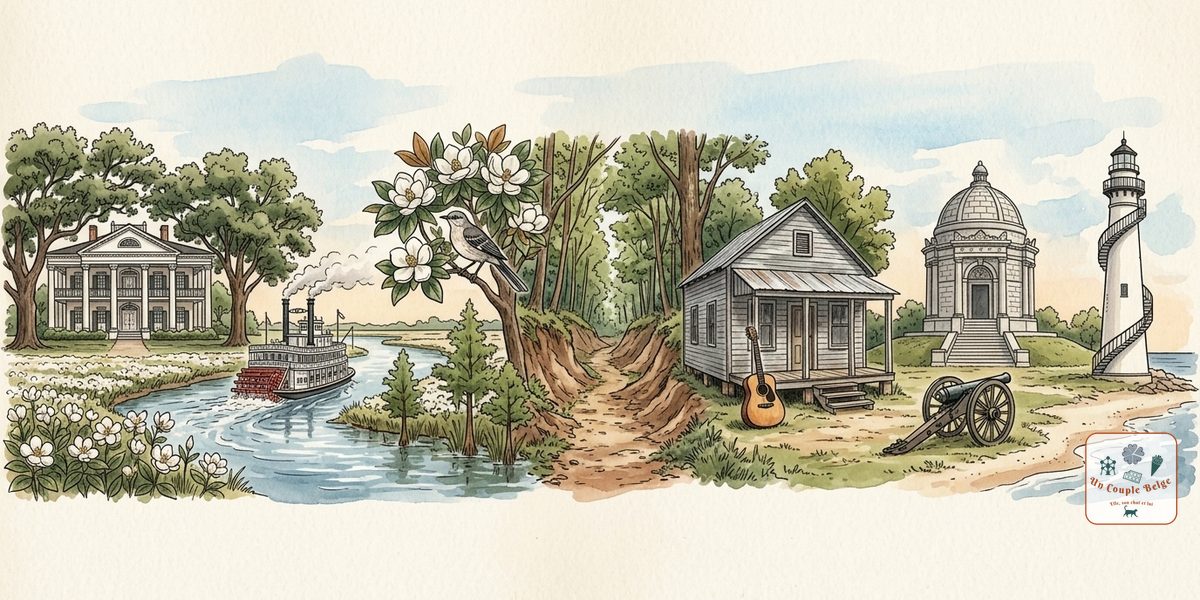
Mississippi has neither spectacular parks nor buzzing cities. You visit it for the stories it tells. It’s the poorest state in the United States by most rankings, marked by slavery and then segregation, and it wears that legacy close to the surface. But it’s also the land that gave the world the blues, and through it rock ‘n’ roll, as well as a long line of great writers.
You drive alongside cotton fields as flat as your hand, stop at juke joints where the blues is still played in a plank-walled room, and visit columned mansions and battlefields. It’s a trip that is sometimes hard, often moving, and always warm: Southern hospitality isn’t a cliché here.
Mississippi at a glance
- Capital and largest city: Jackson
- Population: about 2.9 million
- Area: about 125,000 km², roughly four times Belgium
- Joined the Union: 1817, 20th state
- Time zone: Central Time (7 hours behind Brussels)
- Nickname: Magnolia State
- Highest point: Woodall Mountain, 246 metres
Geography: the Delta, the hills and the coast
The Delta, in the north-west, has nothing to do with the mouth of the river: it’s a completely flat alluvial plain between the Mississippi and the Yazoo, with soils among the most fertile in the world, where cotton made the planters’ fortune. This is blues country.
The hills of the north and east, more wooded, with Oxford, Tupelo and Columbus.
The centre, around Jackson and the “Pine Belt”, a region of pine forests.
The Gulf Coast, in the south, is only about 70 kilometres long, between Louisiana and Alabama, with Biloxi, Gulfport and Ocean Springs, and barrier islands offshore.
A bit of history
The Choctaw, the Chickasaw and the Natchez lived here. The French founded Biloxi in 1699 and then Natchez in 1716. In the 19th century, after the deportation of the Native American nations, Mississippi became the heart of the “Cotton Kingdom”, founded on slavery: in 1860, more than half of its population was enslaved.
During the Civil War, the siege of Vicksburg in 1863 gave the Union control of the river. After the war, segregation laws and racist violence drove hundreds of thousands of African Americans from the Delta to leave for Chicago and the cities of the North: this was the Great Migration, which took the blues with it. In the 1950s and 60s, Mississippi was one of the most violent places in the struggle for civil rights: the murder of young Emmett Till in 1955, the assassination of the activist Medgar Evers in 1963 and the “Freedom Summer” of 1964.
The must-sees
The Delta and the blues trail
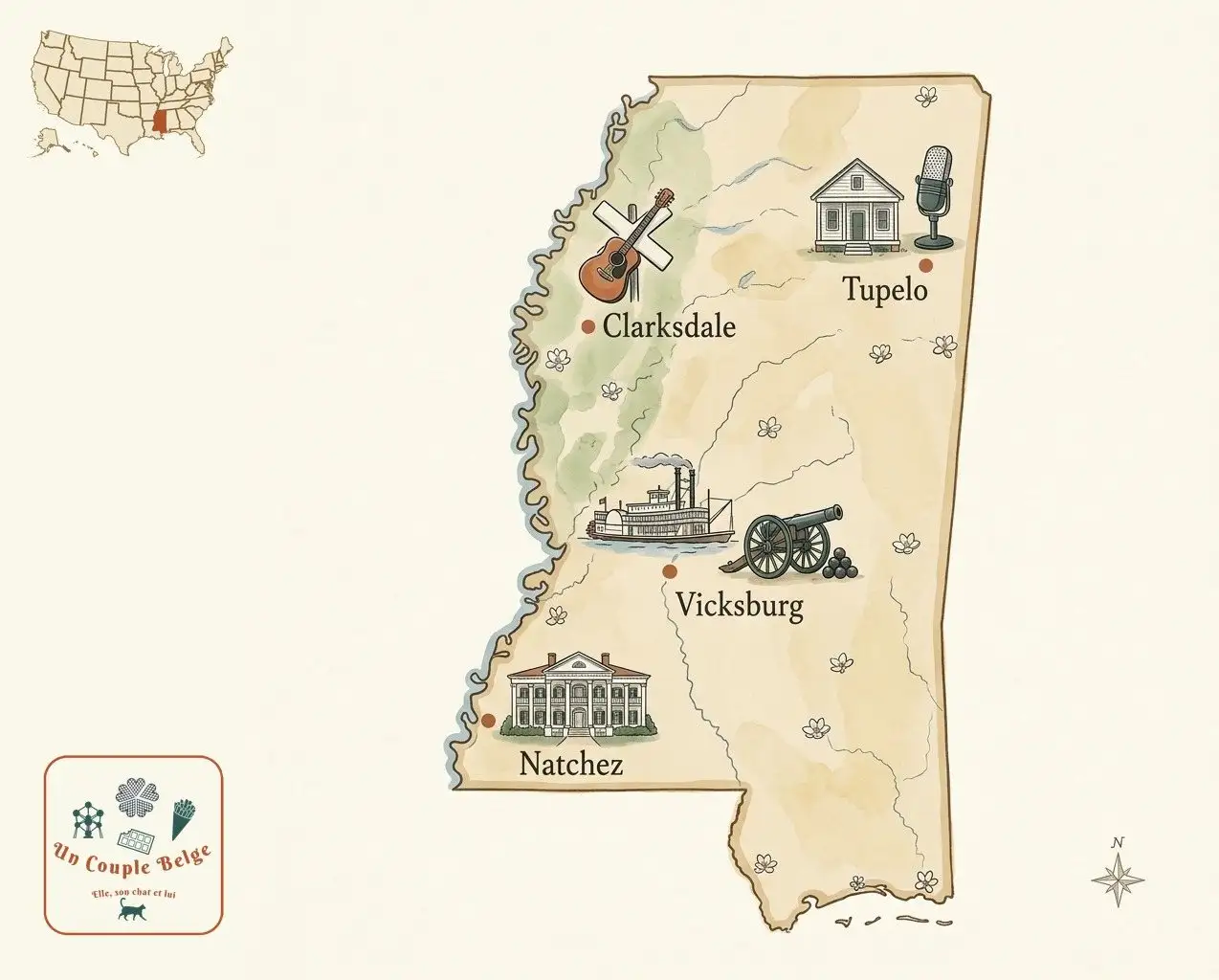
The Mississippi Blues Trail marks nearly 200 places linked to the history of the blues with explanatory signs. Clarksdale is its capital: the Delta Blues Museum, the crossroads of Highways 61 and 49, where legend has it that Robert Johnson sold his soul to the devil in order to play the guitar, and juke joints where you can hear live blues almost every night, such as the Ground Zero Blues Club, co-founded by the actor Morgan Freeman, or the more authentic Red’s Lounge. The Juke Joint Festival, in April, is the ideal occasion to go.
Nearby: Dockery Farms, a former plantation often presented as the birthplace of the blues, where Charley Patton played, the B.B. King Museum in Indianola, the town where the “King of the Blues” grew up, and the three supposed graves of Robert Johnson, none of which anyone can say is the right one.
The Delta also has a painful memory: in Sumner and Money, the Emmett Till Interpretive Center tells the story of the lynching of a 14-year-old in 1955; the acquittal of his murderers galvanised the civil rights movement.
Tupelo and Elvis
In Tupelo, in the north-east, Elvis Presley was born in 1935 in a two-room house built by his father. The birthplace and museum can be visited, along with his childhood church, where he discovered gospel. You can also see the shop where he got his first guitar, at the age of 11. Graceland, his famous home, is in Memphis, a 1 hr 30 drive away.
Oxford and the writers
Oxford, a university town with Southern charm, revolves around its central square, the Square Books bookshop and the University of Mississippi, Ole Miss, whose pre-game picnics in the park known as “The Grove” are legendary. William Faulkner lived here and wrote almost all his work here, and his house, Rowan Oak, can be visited. Mississippi has produced a surprising number of great writers: Eudora Welty, whose house in Jackson is a museum, Richard Wright, Tennessee Williams, born in Columbus, and John Grisham.
Jackson and civil rights
The capital is home to the Mississippi Civil Rights Museum, opened in 2017, one of the most powerful museums in the country on the subject, and the home of Medgar Evers, now a national monument, in front of which he was assassinated in 1963. The Museum of Mississippi History, right next door, completes the visit.
Vicksburg
On a bluff above the river, Vicksburg endured a 47-day siege by General Grant’s troops in 1863. The inhabitants took refuge in caves dug into the hillsides to escape the shelling. The city surrendered on 4 July, and for decades it refused to celebrate Independence Day. Vicksburg National Military Park is toured by car over 26 kilometres, with a Union ironclad, the USS Cairo, raised from the bottom of a river. It was also in Vicksburg that Coca-Cola was first bottled, in 1894: a small museum tells the story.
Natchez and the Natchez Trace
Natchez, founded by the French in 1716, came through the Civil War almost undamaged and preserves dozens of antebellum mansions, built with cotton fortunes and the labour of enslaved people. In spring and autumn, during the “Pilgrimages”, the owners open them to the public. Several tours at last address the history of the enslaved people who lived there.
Starting from Natchez, the Natchez Trace Parkway follows an old Native American and trading path for 715 kilometres, as far as Nashville. With no lorries and no billboards, and a 50 mph limit, it’s a magnificent, peaceful road, perfect by bike or by car.
The Gulf Coast
Biloxi and Gulfport live off the beach and the casinos, allowed on the coast since the 1990s. More charming, Ocean Springs is a small artists’ town, with the museum of the painter Walter Anderson. Offshore, the Gulf Islands National Seashore protects white-sand barrier islands: in summer a ferry goes to Ship Island, where you swim in clear water at the foot of a Civil War fort.
Itinerary ideas
5-6 days, the blues trail. Memphis → Tupelo (Elvis) → Oxford → Clarksdale and the Delta (2 days) → Indianola → Vicksburg → Jackson → Natchez. About 800 kilometres.
The musical Deep South. Nashville → Natchez Trace → Natchez → New Orleans, then back up through the Delta to Memphis: from country to jazz by way of the blues, in two weeks.
In combination. Mississippi slots in naturally between Memphis (Tennessee), New Orleans (Louisiana) and Alabama.
On the plate
- Catfish, breaded and fried, with hushpuppies (fried cornmeal balls). Mississippi is the country’s leading producer of farmed catfish, and Belzoni proclaims itself its capital.
- Delta tamales, which arrived with Mexican labourers at the beginning of the 20th century and were adopted by the African American community. Smaller and spicier than Mexican tamales, they’re simmered in a sauce.
- Comeback sauce, a mayonnaise and chili sauce invented in a Greek restaurant in Jackson, served with everything.
- Mississippi mud pie, a dense chocolate cake, the colour of the river’s mud.
- Kool-Aid pickles, gherkins steeped in sweet Kool-Aid drink, a Delta curiosity.
- Seafood from the Gulf, po’boys and gumbo on the coast, close to Louisiana’s.
- And Barq’s, a root beer invented in Biloxi in 1898.
Culture and trivia
- The teddy bear was born in Mississippi: in 1902, on a hunting trip, President Theodore “Teddy” Roosevelt refused to shoot a tethered bear. The story inspired a toy maker.
- Jim Henson, the creator of the Muppets, grew up in Leland, in the Delta. A small museum there tells the story of the birth of Kermit the Frog, inspired by the local creeks.
- The blues was born in the cotton fields of the Delta at the end of the 19th century, blending work songs, spirituals and African traditions.
- Mississippi was the last state to officially ratify the 13th Amendment abolishing slavery, in… 2013, following an administrative oversight.
When to go
- Spring (March to May): the best time, with the azaleas, the Juke Joint Festival in Clarksdale and the Natchez Pilgrimages.
- Summer (June to August): hot and very humid, often above 33 °C. Hard going for outdoor sightseeing, but good for the beach.
- Autumn (October-November): excellent, with mild temperatures and the blues festivals, including King Biscuit in Helena, just across the river in Arkansas.
- Winter: mild and quiet.
- Hurricane season: June to November on the coast.
Practical information
- Recommended length of stay: 5 to 6 days for the Delta, Vicksburg and Natchez, a long weekend for Clarksdale and the Blues Trail.
- Getting there: Memphis (Tennessee) and New Orleans (Louisiana) are the most convenient gateways. Jackson also has an airport.
- Getting around: a car is essential.
- Budget: one of the cheapest states in the United States.
- Things to watch out for: carry cash in the Delta, as some juke joints and small restaurants don’t take cards. Check the opening hours of small rural museums, often closed at the start of the week.
- One more tip: ask at your hotel in Clarksdale where there’s blues that night. The best evenings aren’t always advertised online.