Nebraska: the Oregon Trail, the dunes and the cranes
Updated on
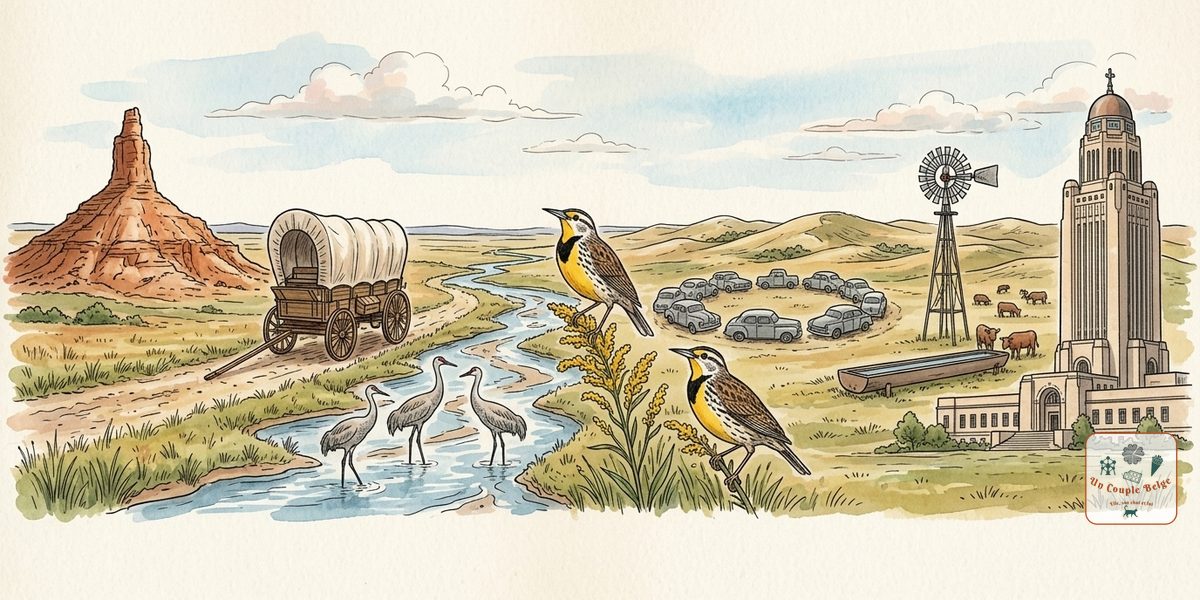
Ask any American who has driven across the country: Nebraska is that interminable stretch of Interstate 80 where the landscape doesn’t change for hours, where you set the cruise control and wait for Colorado. That’s partly true, and very incomplete. Because a few kilometres from the motorway, Nebraska hides the rocks that guided the pioneers of the Oregon Trail, an immense ocean of grass-covered dunes, and one of the greatest wildlife spectacles in North America.
It’s also a state that loves curiosities: a single-chamber legislature, a Stonehenge made of old cars, the birthplace of Kool-Aid and the Reuben sandwich. In short, a territory that deserves a detour off the motorway.
Nebraska at a glance
- Capital: Lincoln
- Largest city: Omaha
- Population: about 2 million
- Area: about 200,000 km², six and a half times Belgium
- Joined the Union: 1867, 37th state
- Time zone: Central Time (7 hours behind Brussels), Mountain Time in the west
- Nickname: Cornhusker State
- Highest point: Panorama Point, 1,654 metres, more than twice as high as Belgium’s highest point, in the middle of a flat prairie
Geography: from the Missouri valley to the High Plains
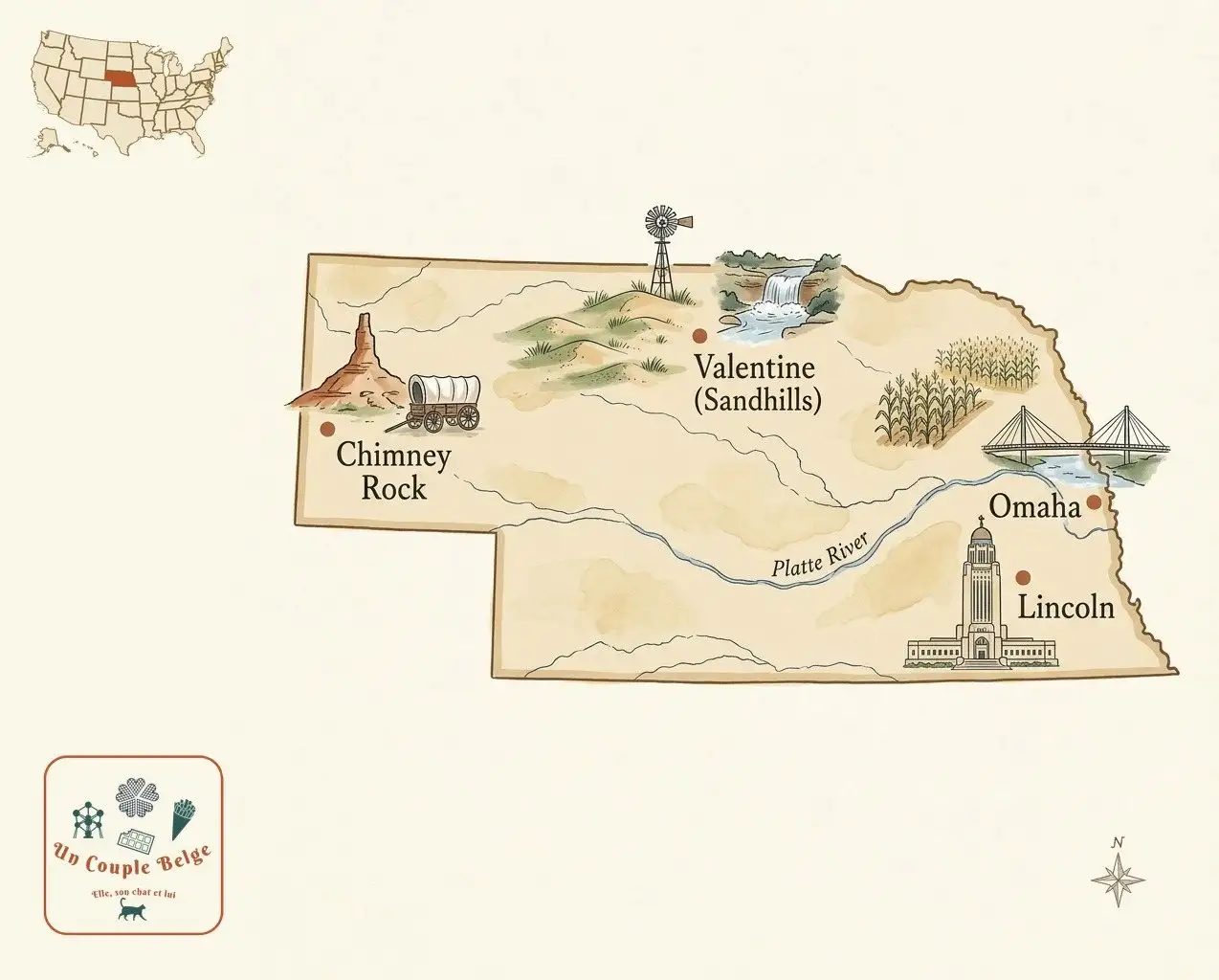
The east, along the Missouri, is the hilliest and most populated part, with Omaha and Lincoln, and fields of corn and soybeans.
The Platte valley, which crosses the whole state from east to west, guided the pioneers and is now followed by Interstate 80.
The Sandhills, in the north-centre, form the largest dune field in the Western Hemisphere, held in place by prairie. An almost treeless landscape, dotted with lakes, populated mostly by cows.
The Panhandle, in the west, belongs to the High Plains, with sandstone rocks and bluffs, badlands and fossil beds.
A bit of history
The Pawnee, the Omaha, the Otoe, the Ponca and, to the west, the Lakota lived on these plains. In the mid-19th century, nearly half a million emigrants followed the Platte valley on the Oregon, California and Mormon trails. The Homestead Act of 1862, which offered free land to anyone who would farm it, drew waves of German, Czech and Scandinavian immigrants and Germans from Russia. The first land claim in the history of the Homestead Act was filed near Beatrice.
Nebraska became a state in 1867. In 1877, the Lakota leader Crazy Horse was killed at Fort Robinson, in the north-west. In the 20th century, irrigated farming and ranching made Nebraska one of the country’s breadbaskets, and Omaha became a financial centre, thanks in particular to Berkshire Hathaway, Warren Buffett’s group.
The must-sees
Chimney Rock and Scotts Bluff
In the Panhandle, Chimney Rock, a rock spire around a hundred metres high, was the landmark most often mentioned in the diaries of the Oregon Trail pioneers: the sign that they had crossed the plains and that the mountains were approaching. A small museum tells the story of their journey.
A little further on, Scotts Bluff National Monument is an imposing sandstone bluff. A road with tunnels climbs to the top, from where you can still see the ruts left by the wagons in the ground. Further north, Toadstool Geologic Park is a lunar landscape of mushroom-shaped rocks, and Agate Fossil Beds displays 20-million-year-old mammal fossils.
The Sandhills and Carhenge
The Sandhills are the least known and most beautiful region of Nebraska: sand hills rolling on endlessly, covered in grass that is green in summer and golden in autumn. The Sandhills Journey Scenic Byway (official website), on Highway 2, crosses them for about 440 kilometres between Grand Island and Alliance. Set off with a full tank: petrol stations are rare.
Near Alliance, Carhenge is one of the most famous roadside curiosities in the United States: in 1987, Jim Reinders planted 39 old American cars in a field, painted grey, to reproduce Stonehenge to scale. Entry is free.
North of the Sandhills, the Niobrara River is perfect for a trip by canoe, kayak or tube, between bluffs and waterfalls, including Smith Falls, the highest in the state.
The crane migration
Every spring, from late February to early April, hundreds of thousands of sandhill cranes stop over on the Platte River, between Kearney and Grand Island, to feed before heading on to Canada and Siberia. At dawn and dusk, their take-off and their calls make up one of the most beautiful wildlife spectacles in North America. Rowe Sanctuary and the Crane Trust offer viewing blinds, to be booked well in advance.
In Kearney, the Great Platte River Road Archway, a bridge-shaped museum spanning Interstate 80, tells the story of the trails west.
Omaha
Omaha is a more pleasant city than you might imagine. The Henry Doorly Zoo, often ranked among the best in the world, houses the world’s largest indoor desert and one of the largest indoor rainforests on the planet. The Old Market district, with its cobbles and old warehouses, is full of restaurants and galleries. Every spring, the annual meeting of Berkshire Hathaway draws tens of thousands of shareholders, an event nicknamed the “Woodstock for Capitalists”. And in June, the city hosts the College World Series, the big college baseball tournament.
Right nearby, Boys Town, founded in 1917 by Father Flanagan to take in children in difficulty, has become a town in its own right, with its own town hall and post office.
Lincoln
The capital deserves a stop for its State Capitol, a 120-metre limestone tower topped by a golden statue of the Sower, nicknamed the “Tower on the Plains”. Nebraska is the only state with a single-chamber legislature, whose 49 senators are elected without party labels. On autumn Saturdays, the Cornhuskers’ football games fill an 85,000-seat stadium, sold out for every game since 1962: on those days, the stadium becomes the third-largest “city” in the state.
And more…
Ashfall Fossil Beds, in the north-east, nicknamed the “Rhino Pompeii”: dozens of prehistoric rhinoceroses and horses buried by a volcanic eruption 12 million years ago, preserved intact. Red Cloud, in the south, the home town of the novelist Willa Cather, who told the story of pioneer life in My Ántonia. And Nebraska City, where Arbor Day was created in 1872, the tree-planting day now celebrated all over the world.
Itinerary ideas
4-5 days, east to west. Omaha (1 day) → Lincoln → Kearney and the Platte (in March for the cranes) → the Sandhills on Highway 2 → Carhenge → Scotts Bluff and Chimney Rock. Then on to Wyoming, South Dakota (Black Hills) or Colorado.
Driving across. Even if you stick to I-80, a few detours are worth it: the Archway in Kearney, Chimney Rock and Scotts Bluff, which add only an hour or two to the journey.
A long weekend. Omaha, Lincoln and, in March, a morning with the cranes.
On the plate
- The Runza, a bread pocket stuffed with ground beef, cabbage and onions, inherited from the Germans from Russia. A restaurant chain of the same name serves them everywhere.
- The Reuben sandwich (rye bread, corned beef, sauerkraut, Swiss cheese, dressing), said to have been born at the Blackstone Hotel in Omaha in the 1920s. New York also claims it.
- Omaha steaks, renowned throughout the country: the state is one of the leading beef producers.
- The cheese frenchee, a cheese sandwich breaded and deep-fried.
- Kool-Aid, the powdered drink invented in Hastings in 1927, which holds a festival for it every summer.
- And the unexpected pairing of chili with cinnamon rolls, as in neighbouring Kansas.
Culture and trivia
- Many celebrities were born in Omaha: Fred Astaire, Marlon Brando, Malcolm X and President Gerald Ford. Johnny Carson grew up in Norfolk, in the north of the state.
- Nebraska’s unicameral legislature was adopted in 1934 to save money during the Great Depression.
- “Nebraska Nice”: like their Minnesota neighbours, the inhabitants are known for their kindness, and the official tourism slogan was for a time: “Honestly, it’s not for everyone”.
When to go
- March: the crane migration, the most spectacular moment of the year, despite the early-morning cold.
- Spring and early summer (May-June): the Sandhills are green and in flower. Storm and tornado season.
- Summer (July-August): hot, ideal for the Niobrara and the back roads.
- Autumn (September-October): beautiful light on the dunes, Cornhuskers games.
- Winter: cold, windy and sometimes with blizzards. Of little interest, apart from driving through.
Practical information
- Recommended length of stay: 4 to 5 days from east to west, a long weekend for Omaha and Lincoln.
- Getting there: Omaha airport is served by connecting flights. Denver is a 6-hour drive from the west of the state.
- Getting around: a car is essential. Amtrak’s California Zephyr train crosses the state by night.
- Budget: one of the most affordable states in the country.
- Things to watch out for: fill up before heading into the Sandhills and follow the weather in spring (tornadoes) and winter (blizzards).
- One more tip: for the cranes, book a blind at Rowe Sanctuary as soon as reservations open, often in January.