New Hampshire: White Mountains and "Live Free or Die"
Updated on
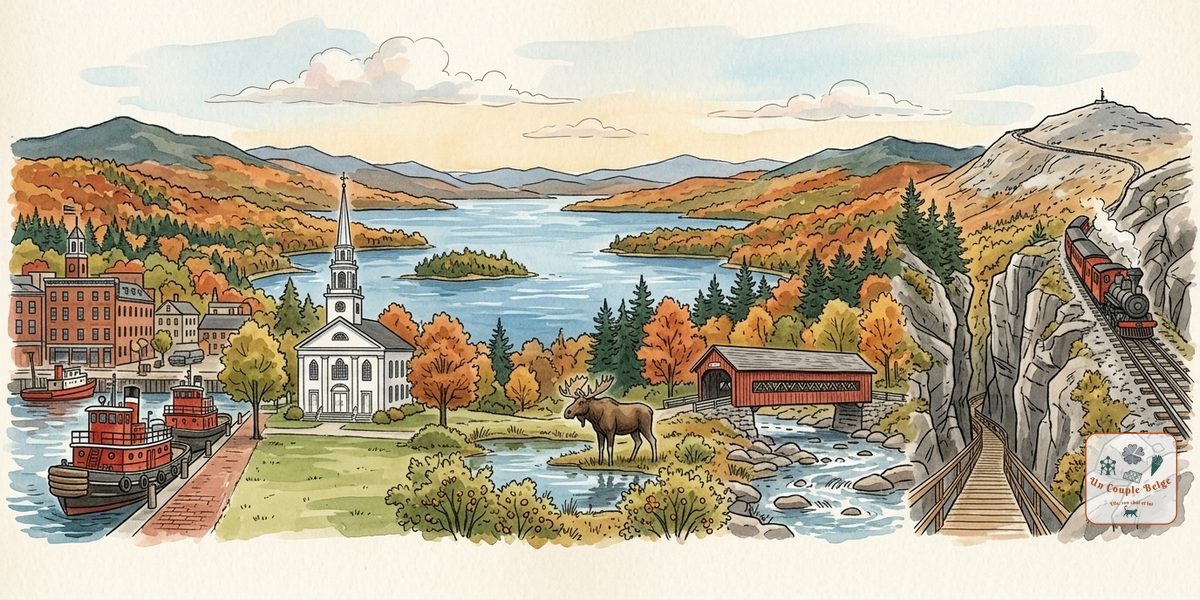
Between Vermont, famous for its maple syrup and its cows, and Massachusetts, where Boston takes all the attention, New Hampshire is often seen as a mere corridor to Maine. That’s a mistake: this small granite state has the highest mountains in the north-eastern United States, some of the finest autumn drives in the country and lakes by the hundred.
It also has a character all of its own. Its motto, written on the licence plates, says it all: “Live Free or Die”. No tax on wages, no sales tax, no requirement for adults to wear a seat belt, and a fierce pride in its independence. And every four years, this is where presidential candidates come to shake hands, in diners and town halls.
New Hampshire at a glance
- Capital: Concord
- Largest city: Manchester
- Population: about 1.4 million
- Area: about 24,000 km², a little over three-quarters of Belgium
- Joined the Union: 1788, 9th state. Its ratification brought the Constitution into force.
- Time zone: Eastern Time (6 hours behind Brussels)
- Nickname: Granite State
- Highest point: Mount Washington, 1,917 metres, the highest peak in the north-eastern United States
Geography: from the mountains to the sea
The north is dominated by the White Mountains, with the Presidential Range (the summits are named after presidents) and an immense national forest. Right in the north, the Great North Woods region is almost empty, populated by moose.
The Lakes Region, in the centre, is organised around Lake Winnipesaukee, the largest in the state, and dozens of other lakes.
The south, more populated, takes in Manchester, Nashua and Concord, with Mount Monadnock in the south-west.
The coast, finally, is only about thirty kilometres long, the shortest of any coastal state, with Portsmouth and Hampton Beach.
A bit of history
The Abenaki and the Pennacook lived here when the English settled from the 1620s. New Hampshire was one of the thirteen colonies and the first to set up its own independent government, in January 1776. Its motto comes from a toast by General John Stark, a hero of the War of Independence, in 1809.
In the 19th century, the rivers powered giant mills: in Manchester, the Amoskeag Manufacturing Company became the largest cotton textile plant in the world, employing up to 17,000 workers, many of them French Canadians. Mountain tourism developed at the same time, with the grand hotels and the cog railway up Mount Washington. In 1944, the Bretton Woods conference, which created the IMF and the World Bank, was held in a hotel in the White Mountains.
The must-sees
The Kancamagus Highway
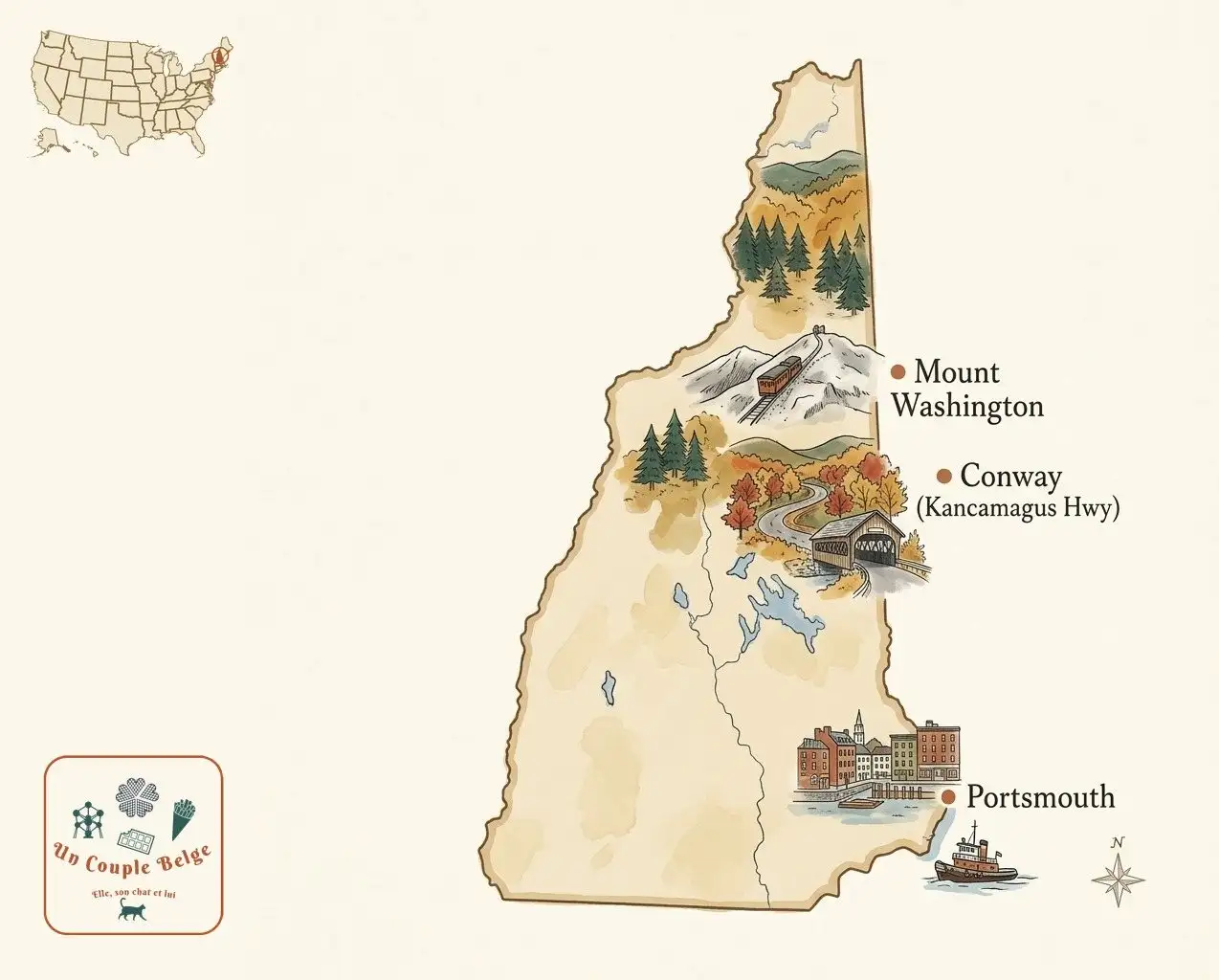
The Kancamagus Highway (Route 112) crosses the White Mountains for about 55 kilometres between Lincoln and Conway, without a single petrol station or shop. In autumn, it’s one of the most famous roads in the United States for the colours. Along the way: Sabbaday Falls, Lower Falls where people swim in summer, and viewpoints over the mountains. On October weekends, do it early in the morning to avoid the traffic jams.
Mount Washington
Mount Washington doesn’t look like much at 1,917 metres, but it has some of the worst weather in the world, at the meeting point of several storm tracks. In April 1934, its observatory measured a gust of 372 km/h, which remained the world record for more than 60 years. Even in summer it can freeze and snow up there, and fog covers the summit on most days.
There are three ways up: by the Mount Washington Auto Road, a toll road opened in 1861, by the Cog Railway, the first mountain-climbing cog railway in the world (1869), or on foot, for experienced hikers. At the summit, a small museum recounts the weather records.
At the foot of the mountain, the Mount Washington Hotel, in Bretton Woods, an immense white building with a red roof, hosted the 1944 conference.
Franconia Notch
In the western White Mountains, Franconia Notch State Park brings together the best easy walks: the wooden walkways of Flume Gorge, a narrow gorge between granite walls, Echo Lake, and the Cannon Mountain aerial tramway, which reaches the summit in a few minutes. For nearly two centuries, a rock profile in the shape of a face, the Old Man of the Mountain, looked down on the valley. The symbol of the state, engraved on coins and licence plates, it collapsed in May 2003. A memorial lets you “see” it again thanks to steel rods lined up with the mountain.
Hiking and huts
The White Mountains are among the best hiking areas in the eastern United States, with part of the Appalachian Trail. The Appalachian Mountain Club runs high huts where you sleep in a bunkroom with meals. The Presidential Traverse, which links the summits in one or two days, is a great classic, to be done only in good weather.
In the south, Mount Monadnock is one of the most climbed mountains in the world, thanks to a rocky summit a few hours from Boston.
Lake Winnipesaukee and the Lakes Region
Lake Winnipesaukee, whose Abenaki name is said to mean “beautiful water in a high place” or “smile of the Great Spirit”, is lined with beaches, small harbours and 1950s holiday villages, such as Wolfeboro, which proclaims itself “the Oldest Summer Resort in America”. The cruise ship M/S Mount Washington, in service since the 1940s, tours the lake. Further north, Squam Lake, where On Golden Pond 🎬 was filmed with Henry Fonda and Katharine Hepburn, is wilder. Above the shore, Castle in the Clouds is a hilltop mansion with a sweeping view of the lake.
Portsmouth and the coast
Portsmouth, one of the oldest towns in the United States, founded in the 17th century, has kept a centre of brick and timber full of restaurants and breweries. The Strawbery Banke open-air museum preserves a whole neighbourhood of houses from 1695 to 1950. Boats go out to the Isles of Shoals, offshore. To the south, Hampton Beach is the state’s popular beach, with its boardwalk and seafood stands.
And more…
In Manchester, the immense brick mills of Amoskeag line the Merrimack River. In Hanover, the campus of Dartmouth, one of the eight Ivy League universities, founded in 1769. In Cornish, the studio of the sculptor Augustus Saint-Gaudens, now a national site. And Canterbury Shaker Village tells the story of the Shakers, a religious community that lived here for two centuries.
Itinerary ideas
4-5 days, mountains and lakes. Portsmouth (1 day) → Wolfeboro and Lake Winnipesaukee (1 day) → North Conway → Kancamagus Highway → Lincoln and Franconia Notch (1 day) → Mount Washington and Bretton Woods (1 day).
A grand loop of New England in autumn. Boston → Portsmouth → White Mountains → Vermont (Stowe, Woodstock) → Berkshires → Boston, in 10 to 14 days.
In combination. New Hampshire combines naturally with Maine (Portland is 1 hour from Portsmouth), Vermont and Boston, 1 hour from the state line.
On the plate
- Maple syrup, made at the end of winter in the “sugar houses” that open their doors to visitors in March.
- Apple cider donuts, sold at the orchards in autumn, often with a cup of hot cider.
- Clam chowder and seafood in Portsmouth and Hampton.
- Boiled dinner, a New England one-pot meal of corned beef and vegetables.
- And traces of French-Canadian cooking in Manchester.
Culture and trivia
- The New Hampshire primary, held since 1920, is the first in the presidential race. A state law requires it to come before any other contest of the same kind.
- No tax on earned income and no sales tax: residents of neighbouring states come here to do their shopping. The state even runs tax-free liquor stores beside the motorways.
- New Hampshire is the only state where adults aren’t required to wear a seat belt in a car.
- Moose, which can weigh more than 400 kilos, are numerous in the north. “Brake for Moose” signs warn of the risk of collision.
- The Old Man of the Mountain still appears on the state quarter, minted in 2000, three years before it collapsed.
When to go
- Autumn (late September to mid-October): the best and busiest time, with the spectacular colours of the White Mountains. Book well in advance.
- Summer (July-August): for hiking, the lakes and the beach. Black flies invade the woods from mid-May to late June.
- Winter (December to March): for skiing (Bretton Woods, Loon, Cannon), snowshoeing and snowmobiling. Cold and snowy.
- Spring (March-April): the season of maple syrup and of mud, known here as “mud season”.
Practical information
- Recommended length of stay: 4 to 6 days for the mountains, the lakes and Portsmouth.
- Getting there: Boston is the most convenient gateway, 1 hour from Portsmouth and 2 hrs 30 from the White Mountains. Manchester airport is also served by connecting flights.
- Getting around: a car is essential. Buses link Boston to Portsmouth and Concord.
- Budget: moderate. The absence of sales tax makes shopping a little cheaper. Prices climb during foliage season.
- Things to watch out for: never underestimate Mount Washington. Hikers die there regularly, caught out by the weather. Beware of moose on the northern roads, especially at night.
- One more tip: for the colours, aim for the first half of October in the White Mountains and follow the foliage forecast maps published every year.