New York State: far beyond Manhattan
Updated on
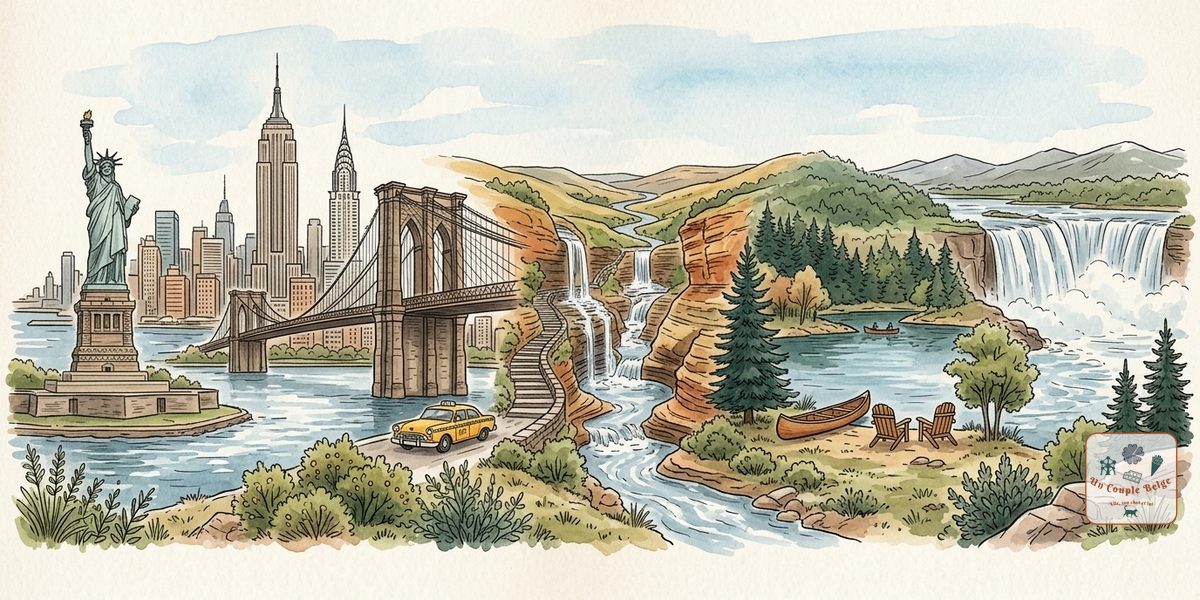
For almost everyone, New York is a city: skyscrapers, yellow cabs and Times Square drowning in neon. Except that it occupies only a tiny corner of New York State, which stretches more than 500 kilometres to Canada and the Great Lakes. North of the city you’ll find forest-covered mountains, glacial lakes lined with vineyards, some of the most famous waterfalls in the world and a rural America that invented baseball, spicy chicken wings and the women’s rights convention.
For New Yorkers, everything north of the city is called “upstate”, with a touch of condescension. Yet that’s where some of the most beautiful landscapes in the eastern United States are hiding, a few hours from the biggest city in the country. And going from one world to the other in a day’s drive is one of the great pleasures of a trip here.
New York State at a glance
- Capital: Albany
- Largest city: New York City (about 8.5 million inhabitants)
- Population: about 19.5 million
- Area: about 141,000 km², a little over four and a half times Belgium
- Joined the Union: 1788, 11th state
- Time zone: Eastern Time (6 hours behind Brussels)
- Nickname: Empire State
- Highest point: Mount Marcy, 1,629 metres, in the Adirondacks
Geography: from the Atlantic to the Great Lakes
New York City and Long Island, in the south-east, hold more than half the population. Long Island stretches 190 kilometres into the Atlantic, from the suburbs beyond Brooklyn to the beaches of the Hamptons and Montauk.
The Hudson Valley runs north to Albany, lined with hills, historic mansions and orchards. To the west, the Catskills are a wooded range of waterfalls and villages.
The Adirondacks, in the north-east, form an immense mountain and forest region, protected by the largest park in the 48 contiguous states.
The centre and the west are a region of hills and lakes: the Finger Lakes, then Rochester, Buffalo and Niagara Falls, on Lakes Ontario and Erie. To the north, the St. Lawrence and the Thousand Islands mark the Canadian border.
A bit of history
The Lenape and the five nations of the Iroquois Confederacy (Haudenosaunee) occupied the region when the Dutch founded New Amsterdam in 1625, on the tip of Manhattan. The English took it in 1664 and renamed it New York. The colony was a major battleground of the War of Independence, notably at Saratoga in 1777, a decisive victory. New York was even the first capital of the United States, where George Washington took the oath of office in 1789.
In 1825, the opening of the Erie Canal, which links the Hudson to the Great Lakes, made New York the country’s commercial gateway. In the 19th century, millions of immigrants arrived through Ellis Island, and upstate saw the birth of the women’s rights movement (Seneca Falls, 1848), religious movements and big companies such as Kodak and IBM. In the 20th century, New York City became the financial and cultural capital of the world.
The must-sees
New York City
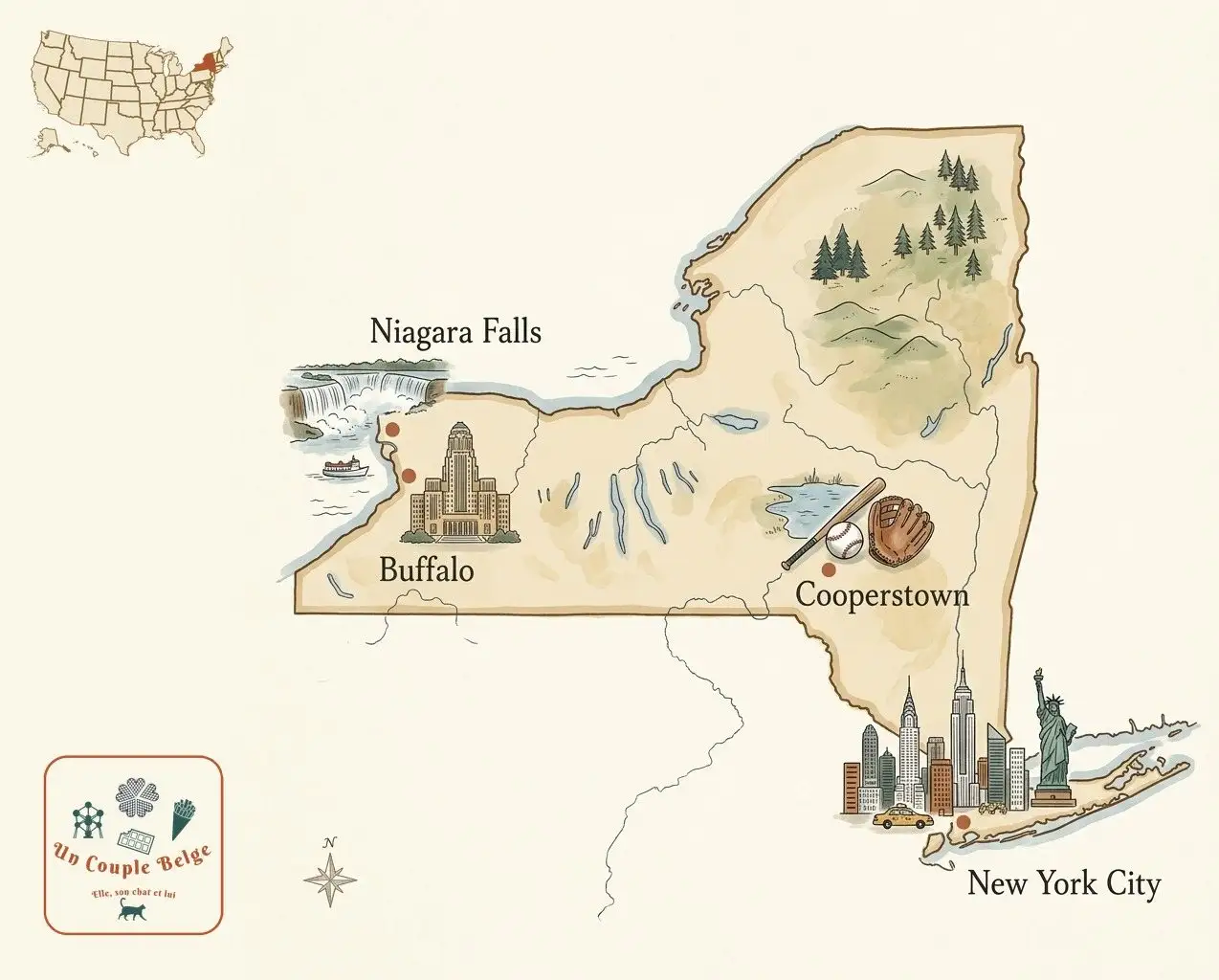
The city alone deserves several days, and we’ve given it a full guide. In brief: Manhattan and its skyscrapers (the Empire State Building, Top of the Rock, One World Trade Center), Central Park, the great museums (the Metropolitan, MoMA, the Museum of Natural History), the High Line, a walkway on a former elevated railway, the 9/11 Memorial, the Statue of Liberty and Ellis Island. Walk across the Brooklyn Bridge, explore the neighbourhoods of Brooklyn and Queens, and go to see a show on Broadway. The free Staten Island Ferry passes in front of the Statue of Liberty. Our four days there: day 1, day 2 (coming out on October 18, 2026), day 3 and day 4 of road trip 2.
Niagara Falls
In the far west, Niagara Falls State Park, created in 1885, is the oldest state park in the United States. You see the American Falls and the Horseshoe Falls, the most spectacular, from Goat Island. The Maid of the Mist boat takes you to the foot of the falls, under a blue poncho, in a deafening roar. The Cave of the Winds lets you approach the falls on wooden walkways.
For the overall view, the Canadian side is more spectacular: you walk across the Rainbow Bridge, with your passport. Canada’s Electronic Travel Authorization (eTA) is only required if you arrive by air: by land or sea, that is on foot, by car, bus, train or boat, a passport is enough for Belgians and the French, as stated on the Canadian government’s website.
The Adirondacks
Adirondack Park is the largest protected area in the 48 contiguous states, bigger than several major national parks put together. It isn’t a conventional national park, but a patchwork of public forests, private land and villages. It has more than 3,000 lakes and 46 summits above 4,000 feet, which hikers strive to climb in full.
Lake Placid, which hosted the Winter Olympics in 1932 and 1980, is the ideal base. You can see the rink where the American team beat the Soviets in 1980, the “Miracle on Ice”. The Great Camps of the wealthy families of the 19th century, Lakes George and Saranac, and canoeing on the St. Regis lakes complete the picture.
The Finger Lakes
In the centre of the state, eleven long, narrow lakes, carved by glaciers, draw “fingers” on the map. Their climate has allowed a wine region to flourish, renowned for its Rieslings, with more than 100 wineries. The gorges here are superb: Watkins Glen and its trail past 19 waterfalls, Taughannock Falls, higher than Niagara, and the gorges of Ithaca, whose slogan is “Ithaca is Gorges”. In Corning, the Corning Museum of Glass is one of the finest glass museums in the world. And in Seneca Falls, the historical park recalls the 1848 women’s rights convention.
Just to the west, Letchworth State Park, nicknamed the “Grand Canyon of the East”, follows a river sunk between 170-metre cliffs, with three big waterfalls.
The Hudson Valley
Heading up the Hudson from New York, you find the military academy at West Point, the contemporary art museum Dia Beacon, housed in a former box-printing factory, the Storm King outdoor sculpture park, the home and presidential library of Franklin D. Roosevelt and the Vanderbilt mansion at Hyde Park, and the Walkway Over the Hudson, a former railway bridge that has become one of the longest pedestrian bridges in the world. The region is also the cradle of the Hudson River School, the first great American painting movement.
The Catskills
Two hours from New York, the Catskills are the New Yorkers’ weekend retreat: hikes, artists’ villages such as Woodstock, and Kaaterskill Falls, a two-tiered waterfall. The famous Woodstock festival of 1969 was in fact held in Bethel, where a museum tells the story.
Long Island
East of the city, Long Island lines up fine sandy beaches: Jones Beach, the popular one, the Hamptons, the resort of wealthy New Yorkers, car-free Fire Island, and Montauk, right at the tip, with its 1796 lighthouse and its surfers. The North Fork has vineyards and farms.
And more…
Cooperstown and the National Baseball Hall of Fame, set up on the strength of a legend according to which baseball was invented there. Saratoga Springs and its racecourse in summer. The Thousand Islands, an archipelago of 1,800 islands on the St. Lawrence, with Boldt Castle. And Buffalo, a city of architecture (Frank Lloyd Wright, Louis Sullivan) and of passion for chicken wings.
Itinerary ideas
One week, New York and the Hudson Valley. New York City (4 days) → Hudson Valley (2 days) → Catskills.
10-14 days, the big loop. New York → Hudson Valley → Adirondacks and Lake Placid (2 days) → Thousand Islands → Finger Lakes (2 days) → Niagara → back by motorway or by plane from Buffalo.
In combination. New York State combines with Canada (Toronto is 1 hr 30 from Niagara), New England (Vermont, Massachusetts) or Pennsylvania.
On the plate
- In New York City: pizza by the folded slice, bagels with cream cheese and smoked salmon, pastrami from Katz’s, cheesecake and street hot dogs.
- Buffalo wings, created in 1964 at the Anchor Bar in Buffalo, served with celery and a blue cheese dressing.
- Buffalo’s beef on weck, a roast beef sandwich on a roll topped with caraway seeds and coarse salt.
- Rochester’s garbage plate, a mix of macaroni salad, fries, beans and meats covered in sauce, to be eaten after a night out.
- Syracuse salt potatoes, small potatoes boiled in very salty water.
- Binghamton spiedies, marinated meat skewers.
- Apples: the state is one of the country’s leading producers. And the Rieslings of the Finger Lakes.
Culture and trivia
- Annie Edson Taylor, a 63-year-old schoolteacher, was in 1901 the first person to go over Niagara Falls in a barrel and survive.
- The “Big Apple”, New York City’s nickname, was popularised in the 1920s by a sports journalist writing about the city’s horse races.
- Thousand Island dressing is said to have been born in the archipelago of the same name, at the beginning of the 20th century.
- Kodak and Xerox were born in Rochester, and IBM has its headquarters in the state.
- New York City alone has more inhabitants than most American states.
When to go
- Autumn (late September to late October): the best time for upstate, with spectacular colours in the Adirondacks, the Catskills and the Hudson Valley, and the grape harvest in the Finger Lakes.
- Summer (June to August): lakes, Long Island beaches and hikes. Hot and humid in New York City.
- Spring (April-May): Niagara Falls is at its fullest, and New York City is pleasant.
- Winter (December to March): New York City lit up for Christmas, skiing in the Adirondacks. Buffalo and the Great Lakes region get enormous snowfalls.
Practical information
- Recommended length of stay: 4 to 5 days for New York City, one more week for upstate.
- Getting there: JFK and Newark airports have direct flights from Brussels and most European cities. Buffalo, Albany and Syracuse are served by connecting flights.
- Getting around: in New York City, the subway and walking are enough (above all, no car). For upstate, a car is essential. Amtrak links New York to Albany, Buffalo and Niagara Falls.
- Budget: New York City is one of the most expensive cities in the world. Upstate is far more affordable.
- Things to watch out for: to cross into Canada at Niagara, take your passport (no eTA needed on foot or by car, see above). In winter, upstate snow can block the roads.
- One more tip: book the Maid of the Mist early in the morning in summer, and accommodation in the Adirondacks and the Finger Lakes several months ahead for the autumn.