Oklahoma: Route 66, Native nations and the Great Plains
Updated on
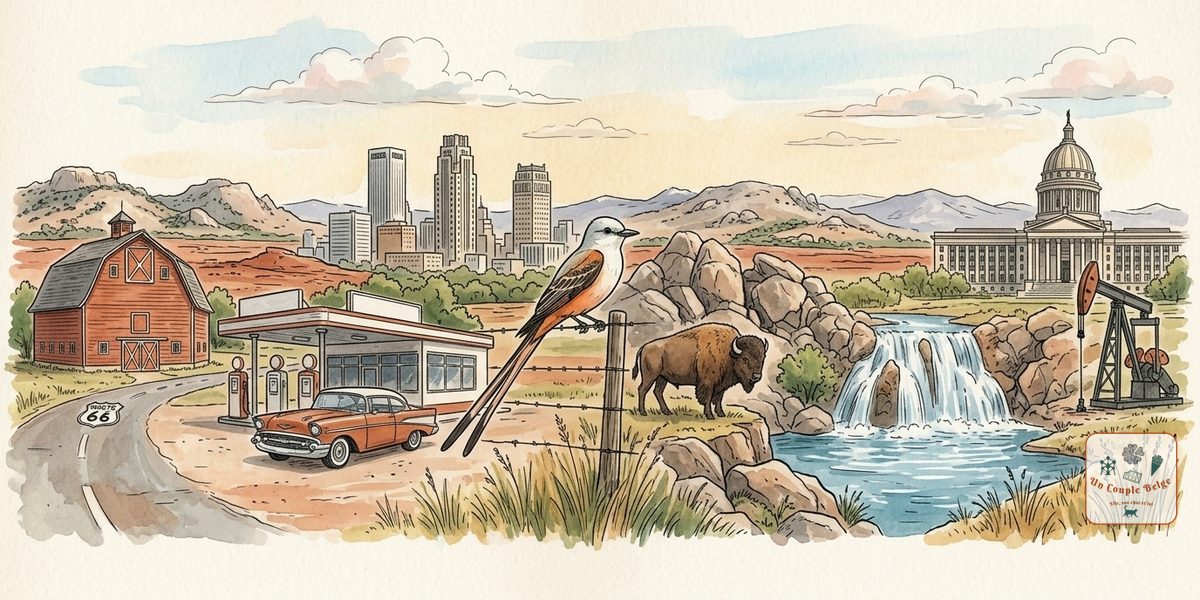
For those who have never set foot there, Oklahoma is an image of flat, wind-swept plains, and perhaps a tune from the musical. There’s far more to it. Oklahoma has the longest drivable stretch of Route 66, granite mountains where bison graze, forests and lakes in the east, and a Native American culture more present than almost anywhere else in the United States.
It’s also a state with a hard history: a land of exile for the Native nations driven out of the East, the scene of one of the worst racist massacres in the country in Tulsa, then struck by the Dust Bowl, which pushed hundreds of thousands of inhabitants towards California. Out of it came a strong culture and a music that has left its mark on America, from Woody Guthrie to modern country.
Oklahoma at a glance
- Capital and largest city: Oklahoma City
- Population: about 4.1 million
- Area: about 181,000 km², nearly six times Belgium
- Joined the Union: 1907, 46th state
- Time zone: Central Time (7 hours behind Brussels)
- Nickname: Sooner State
- Highest point: Black Mesa, 1,516 metres, right at the end of the Panhandle
Geography: from the forest to the High Plains
Oklahoma is shaped like a frying pan, with a long handle, the Panhandle, stretching west between Texas, Kansas and Colorado. The landscape changes a great deal from one end to the other.
The north-east, or “Green Country”, around Tulsa, is hilly, wooded and dotted with lakes, on the doorstep of the Ozarks.
The south-east, “Kiamichi Country”, is the wildest part: the Ouachita Mountains, pine forests, lakes and clear rivers.
The centre, around Oklahoma City, is a region of prairies and hills.
The west and the Panhandle belong to the Great Plains: wheat fields, ranches, red earth and mesas. In the south-west, the Wichita Mountains rise out of the plain.
A bit of history
Oklahoma was the territory of the Wichita, the Caddo, the Osage, the Comanche and the Kiowa. In the 19th century, the US government made it “Indian Territory”, to which it forcibly deported the nations of the East: Cherokee, Chickasaw, Choctaw, Creek and Seminole, along the “Trail of Tears”. The name Oklahoma in fact comes from the Choctaw “okla humma”, “red people”.
From 1889, the government opened land to settlers through “land runs”: at the sound of a cannon, thousands of settlers rushed to stake a claim. Those who set off before the signal were the “Sooners”, hence the state’s nickname. Oil was discovered, and Oklahoma became a state in 1907.
In 1921, the prosperous Black district of Greenwood, in Tulsa, was destroyed by a white mob. In the 1930s, the Dust Bowl, a series of dust storms, ravaged the plains and drove the “Okies” to California, a story told by Steinbeck in The Grapes of Wrath. In 1995, a bomb destroyed a federal building in Oklahoma City, killing 168 people. Today, 39 Native American nations have their headquarters in the state.
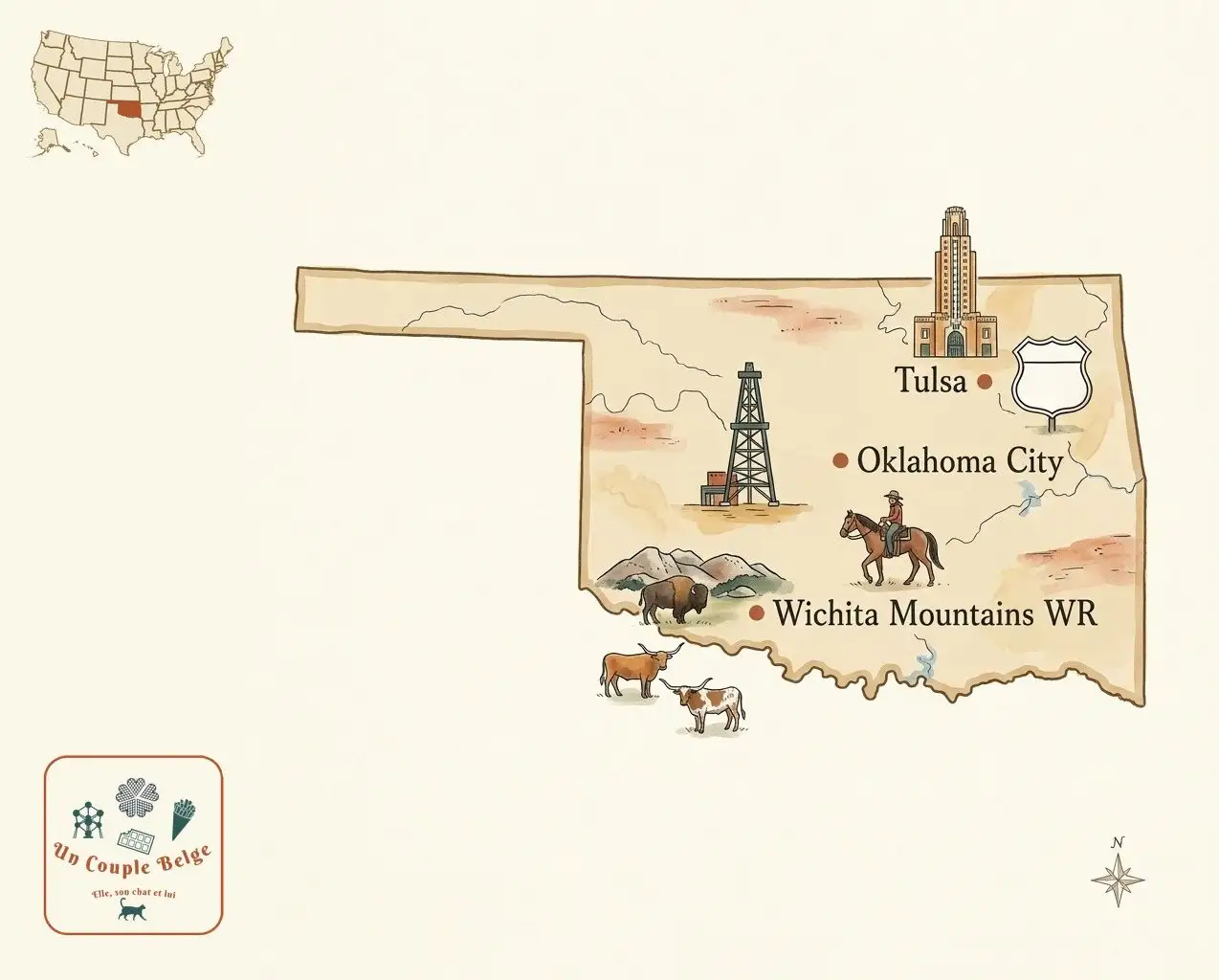
The must-sees
Route 66
Oklahoma has the longest drivable stretch of Route 66, more than 600 kilometres from one end of the state to the other. Cyrus Avery, nicknamed “the Father of Route 66”, was from Tulsa, where a plaza pays tribute to him. Along the way, the stops are many:
- the Blue Whale of Catoosa, a giant blue whale beside a pond, built in the 1970s as an anniversary present;
- the Round Barn in Arcadia, a round wooden barn from 1898;
- POPS, a futuristic petrol station with a giant illuminated soda bottle and hundreds of different sodas;
- the Route 66 Museum in Clinton, one of the best museums devoted to the road;
- and in the west, brick-paved stretches and ghost towns such as Texola.
Tulsa
Tulsa is the city you need to understand before Oklahoma. In the 1910s, its Black district, Greenwood, was so prosperous that it was called “Black Wall Street”. In 1921, a white mob looted and burned it, probably killing hundreds. The event was hushed up for decades. The Greenwood Rising museum, opened in 2021, tells this story powerfully.
Tulsa is also a city of Art Deco architecture, born of the oil boom, with the Philbrook Museum of Art, housed in an Italianate villa with its gardens. Gathering Place, an immense park opened in 2018 beside the Arkansas River, is one of the most beautiful public parks in the country, and free. And the city is home to the Woody Guthrie Center and the Bob Dylan Center, which holds Dylan’s archives.
Oklahoma City
The capital bears the scar of the 1995 bombing. The Oklahoma City National Memorial is one of the most poignant places of remembrance in the country, with its field of 168 empty chairs, one for each victim, and its reflecting pool. The accompanying museum is remarkable.
For the rest, the Bricktown district, with its canal and old warehouses, is lively in the evening. The National Cowboy & Western Heritage Museum is the best museum in the country on the West and cowboys. The First Americans Museum, opened in 2021, presents Oklahoma’s 39 Native American nations. And in Stockyards City, home to one of the largest cattle markets in the country, you can watch the livestock auctions and eat a steak.
The Wichita Mountains
An hour and a half south-west of the capital, the Wichita Mountains Wildlife Refuge protects nearly 24,000 hectares of granite mountains and prairie. You come across herds of bison, longhorns, elk and prairie dogs. The Mount Scott road climbs to the summit for an immense view. The village of Medicine Park, built of round river cobblestones, is charming.
The lakes and forests of the east
South of Oklahoma City, the Chickasaw National Recreation Area, near Sulphur, has mineral springs and streams of turquoise water where people swim in summer. In the south-east, Beavers Bend State Park, near Broken Bow, is the most popular nature destination in the state: a clear river, pine forest, cabins and canoeing. The Talimena Scenic Drive follows the crest of the Ouachita Mountains into Arkansas, at its best in autumn.
In Tahlequah, capital of the Cherokee Nation, the Cherokee National History Museum, in the nation’s former Capitol, tells the story of this deported people.
The strange west
In the north-west, at the Great Salt Plains, you can dig for yourself in a salt flat to find hourglass-shaped selenite crystals, unique in the world (from April to mid-October). The dunes of Little Sahara are explored by quad bike. And right at the end of the Panhandle, Black Mesa, the highest point, marks a corner where Oklahoma, Colorado and New Mexico almost touch.
Itinerary ideas
5-7 days, east to west. Tulsa (2 days) → Route 66 → Oklahoma City (2 days) → Chickasaw → Wichita Mountains → Route 66 westwards (Clinton) → Texas.
Nature in the south-east. Tulsa → Tahlequah → Beavers Bend and Broken Bow → Talimena Scenic Drive, in 3-4 days.
On Route 66. Oklahoma is a key stage of a Route 66 trip between Chicago and Los Angeles, between Kansas and Texas.
On the plate
- Chicken-fried steak, a beef steak breaded and fried, covered in white gravy, at the heart of the “official state meal”, a very generous plate that also includes barbecue, fried okra, corn, sweet potato, biscuits and pecan pie.
- The onion burger of El Reno, born during the Great Depression: thinly sliced onions smashed into the patty to stretch the meat.
- The Indian taco, fry bread topped with chili, cheese and lettuce.
- The barbecue and steaks of Stockyards City.
- The chains born here: Sonic, the drive-in with servers on roller skates, founded in Shawnee in 1953, and Braum’s, for its ice cream.
Culture and trivia
- Woody Guthrie, born in Okemah, wrote This Land Is Your Land and influenced Bob Dylan. Oklahoma has also given country music Garth Brooks, Reba McEntire and Carrie Underwood.
- Oklahoma is at the heart of “Tornado Alley”: it’s one of the states hit hardest by tornadoes, and many houses have a storm cellar.
- The band The Flaming Lips is from Oklahoma City, where a street is named after them.
- The land runs are commemorated in Oklahoma City by an immense bronze monument showing settlers in full flight.
- The Native American nations are sovereign on their lands, with their own governments, courts and licence plates.
When to go
- Spring (April-May) and autumn (September-October): the best times, with pleasant temperatures. Spring is also the height of the season for tornadoes and violent storms.
- Summer (June to August): very hot, often above 35 °C. Ideal for the lakes and rivers of the east.
- Winter: mild at times, but punctuated by sudden cold snaps, ice and snowstorms.
Practical information
- Recommended length of stay: 5 to 7 days for the two cities, the Wichita Mountains and a stretch of Route 66.
- Getting there: Tulsa and Oklahoma City airports are served by connecting flights. Dallas is a 3-hour drive from Oklahoma City.
- Getting around: a car is essential. Many motorways have electronic tolls: the rental company’s transponder makes things easier.
- Budget: affordable, for accommodation as well as meals.
- Things to watch out for: between April and June, keep a weather alert app handy and locate your hotel’s shelter. In the Wichita Mountains, keep your distance from the bison.
- One more tip: take the time to visit at least one Native American museum. It’s what makes Oklahoma truly different from the other states.