Oregon: wild coast, volcanoes and Portland
Updated on
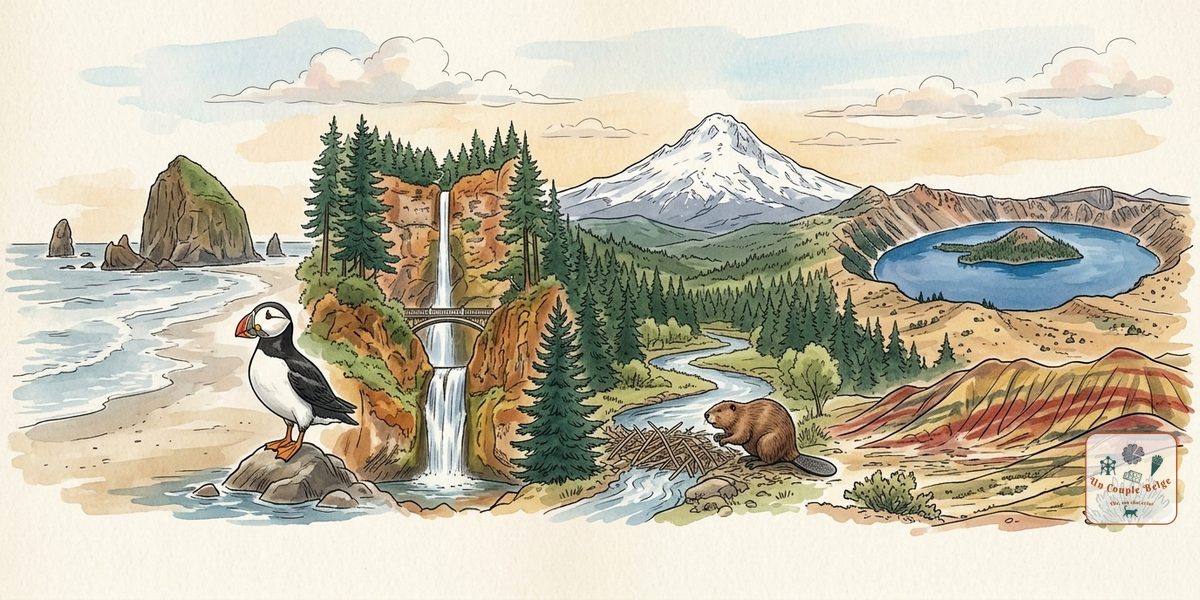
Oregon is California’s immediate neighbour, and almost its opposite. No crowded beaches or palm trees: its Pacific coast is made of black cliffs, mist clinging to the pines, rocks rising out of the ocean and fishing villages. Inland, a chain of snow-capped volcanoes, immense forests, a lake of deep blue and, on the other side of the mountains, a desert few people imagine here.
It’s also a state with a strong character, a pioneer of environmentalism (the bottle deposit has existed here since 1971) and proud of its independence. Portland, its largest city, claims the slogan “Keep Portland Weird”, between food trucks, giant bookshops and craft breweries. And there’s no sales tax.
Oregon at a glance
- Capital: Salem
- Largest city: Portland
- Population: about 4.2 million
- Area: about 255,000 km², more than eight times Belgium
- Joined the Union: 1859, 33rd state
- Time zone: Pacific Time (9 hours behind Brussels)
- Nickname: Beaver State
- Highest point: Mount Hood, 3,429 metres, a volcano still considered active
Geography: from the ocean to the desert
The coast, backed by the Coast Range, stretches for about 580 kilometres, all of it public: in Oregon, every beach has belonged to everyone since a 1967 law.
The Willamette Valley, between the coast and the Cascades, holds most of the population (Portland, Salem, Eugene) and the vineyards.
The Cascades form a chain of volcanoes from north to south: Mount Hood, Mount Jefferson, the Three Sisters, and the collapsed crater of Crater Lake.
The east, in the rain shadow of the mountains, is dry: high plateaus, sagebrush desert, ranches, and the gorge of Hells Canyon on the Idaho border. More than two-thirds of the state is in fact east of the Cascades.
The Columbia River Gorge, to the north, marks the border with Washington State.
A bit of history
The Chinook, the Klamath, the Nez Perce, the Paiute and other peoples had lived here for thousands of years. The Lewis and Clark expedition reached the Pacific at the mouth of the Columbia in 1805 and spent the winter at Fort Clatsop, near Astoria. In the 1840s, the Oregon Trail brought tens of thousands of settlers by wagon from Missouri, a six-month journey to the “promised land” of the Willamette Valley.
Oregon became a state in 1859. It long lived off timber, salmon fishing and farming. In the 20th century it built a reputation as a progressive, environmentally minded state, and Portland became a city of alternative culture, home to Nike (founded in Beaverton) and many breweries.
The must-sees
Crater Lake
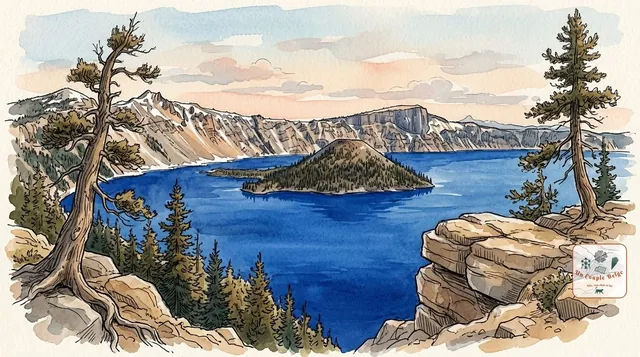
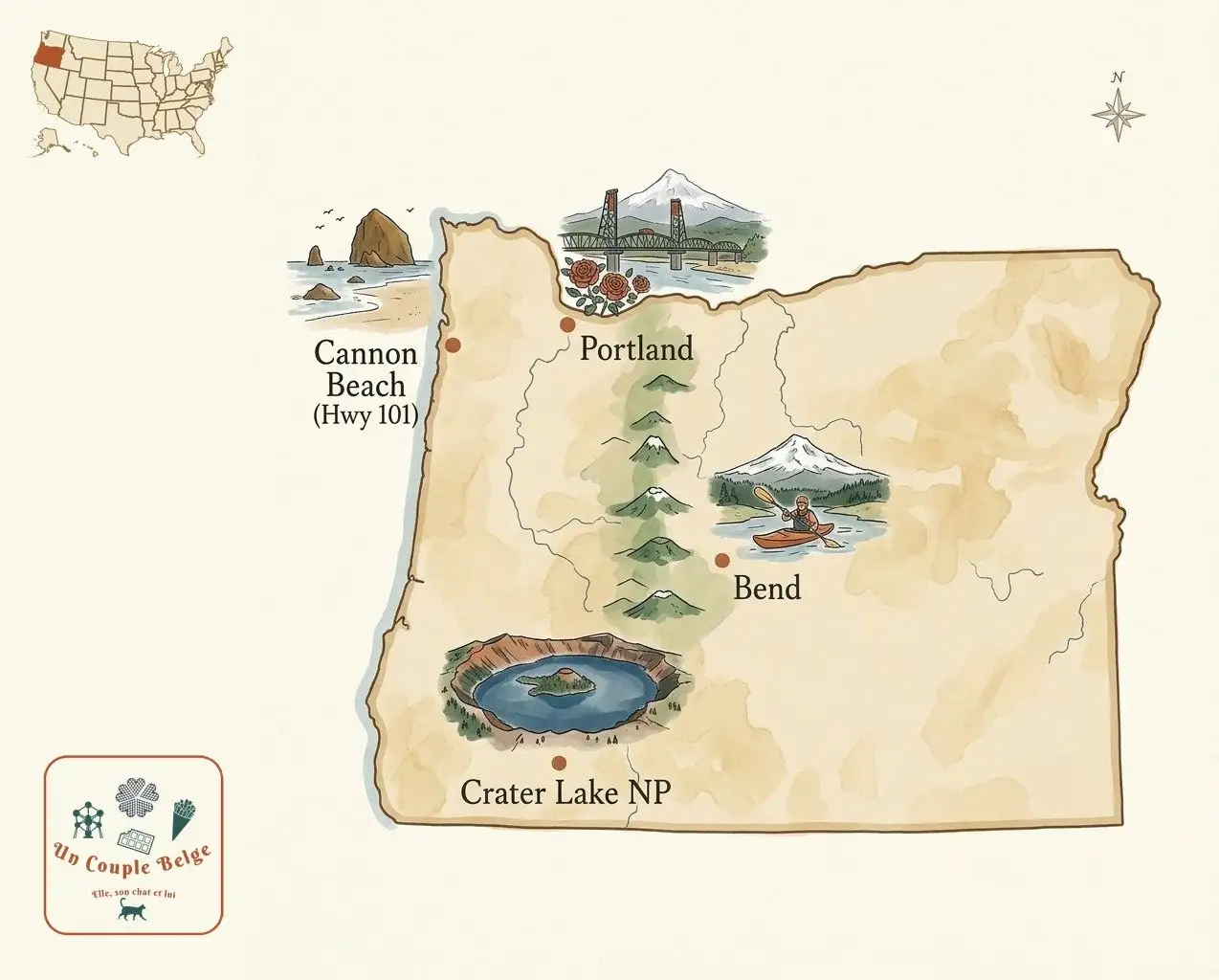
If you had to pick just one place in Oregon, it would be Crater Lake National Park, the state’s only national park. The lake formed about 7,700 years ago in the caldera left by the collapse of the Mazama volcano. At nearly 600 metres, it’s the deepest lake in the United States, and its water, fed only by rain and snow, is a blue that no photo really captures. Rim Drive circles the crater (in summer only; snow closes it for much of the year). In season, boats take you to Wizard Island, a small volcanic island in the middle of the lake.
The coast and Highway 101
Highway 101 follows the whole coast from north to south. It’s one of the finest road trips in the United States. Along the way:
- Astoria, at the mouth of the Columbia, where The Goonies 🎬 was filmed;
- Cannon Beach and its Haystack Rock, a 72-metre sea stack where puffins nest in spring;
- the Tillamook creamery, free to visit;
- Cape Perpetua and Thor’s Well, a hole in the rock that seems to swallow the ocean at high tide;
- Heceta Head Lighthouse and the Sea Lion Caves, an immense sea cave full of sea lions;
- the Oregon Dunes, up to 150 metres high, which inspired Frank Herbert’s novel Dune;
- and right in the south, the Samuel H. Boardman Scenic Corridor, 20 kilometres of arches, coves and cliffs.
Allow 4 to 5 days for the whole coast. Pack a jumper: the water is cold and fog is frequent, even in summer.
Portland
Portland deserves two or three days. The Powell’s Books bookshop occupies an entire city block and claims to be the largest independent bookshop in the world. Forest Park is one of the largest urban forests in the country, with more than 120 kilometres of trails. The Japanese Garden and the International Rose Test Garden overlook the city, with a view of Mount Hood in clear weather. You eat at the food carts, hundreds of mobile kitchens grouped in “pods”, try the eccentric doughnuts at Voodoo Doughnut and do the rounds of the breweries. And you go to see Mill Ends Park, a park 60 centimetres across, the smallest in the world.
The Columbia River Gorge and Mount Hood
Half an hour from Portland, the Columbia River Gorge is lined with forested cliffs and dozens of waterfalls. Multnomah Falls, nearly 190 metres high, is the most famous (a timed permit is sometimes required in summer to reach it by car). The Vista House viewpoint looks out over the river. Further east, Hood River is a kitesurfing and windsurfing capital, with its orchard route, the “Fruit Loop”.
Mount Hood dominates the region. Timberline Lodge, built in the 1930s, was used for the exterior shots of the hotel in The Shining 🎬. You can ski there almost all year round on the Palmer snowfield.
Bend and the centre
East of the Cascades, everything changes. Bend is the outdoor capital: hiking, mountain biking, skiing at Mount Bachelor, floating down the Deschutes River on a tube, and breweries. Right nearby, Newberry National Volcanic Monument has obsidian flows and a lava tube, Lava River Cave. To the north, Smith Rock is the birthplace of sport climbing in the United States, with cliffs of tuff above a river.
The Painted Hills and the east
The Painted Hills, part of John Day Fossil Beds National Monument, are hills striped with red, orange and ochre, among the most astonishing landscapes in the West. Further east still, the Wallowa Mountains are nicknamed “the Little Switzerland of Oregon”, and the Alvord Desert, a dry lake bed, is a flat white desert at the foot of Steens Mountain.
The Willamette Valley and the south
The Willamette Valley produces some of the best Pinot Noir in the world, with hundreds of wineries to discover around Dundee and McMinnville. Oregon City marks the end of the Oregon Trail. In the south, Ashland hosts a major Shakespeare festival from February to October.
Itinerary ideas
One week, the classics. Portland (2 days) → Columbia River Gorge and Mount Hood (1 day) → Bend (1 day) → Crater Lake (1 day) → back along the southern and central coast (2 days).
10-14 days, the coast and the interior. Portland → Astoria → the coast from Cannon Beach to Brookings → Crater Lake → Bend and Smith Rock → Painted Hills → Columbia River Gorge → Portland.
In combination. Oregon combines very well with northern California (the redwoods are just south of the border) and Washington State (Seattle is 3 hours from Portland).
On the plate
- The marionberry, a blackberry created in Oregon, in pie, jam or milkshake.
- Hazelnuts: Oregon produces almost all the hazelnuts in the United States.
- Tillamook cheese, Dungeness crab, salmon and oysters from the coast.
- Pinot Noir from the Willamette Valley.
- Craft beer: Portland is one of the cities with the most breweries in the world.
- Portland’s food carts, with cuisines from all over the world at low prices.
Culture and trivia
- The exploding whale: in 1970, in Florence, the authorities blew up a beached whale with dynamite to get rid of it. The pieces rained down on the spectators and cars, and the video became a cult classic. A park is now named after it.
- Filling up: Oregon long banned self-service at the pump. Since 2023 it has been allowed, but many stations still offer attended service.
- Bigfoot is part of local folklore, and many signs mark his “crossing” in the forests.
- Nike was born in Oregon: its founder, Phil Knight, was a runner at the University of Oregon, in Eugene, nicknamed “TrackTown USA”.
- All the beaches are public, thanks to the “Beach Bill” of 1967.
When to go
- Summer (July to September): the best time, dry and sunny, with Crater Lake’s Rim Drive open. On the coast, morning fog is frequent. Wildfires can bring smoke in August.
- Autumn (September-October): mild, with the grape harvest in the Willamette Valley and fewer people.
- Spring (April to June): waterfalls at their peak in the Columbia River Gorge, but often rainy weather in the west.
- Winter (November to March): rainy and grey in Portland and on the coast (ideal for storm watching and seeing migrating grey whales), snow and skiing in the mountains.
Practical information
- Recommended length of stay: 8 to 10 days for Portland, the coast and the interior.
- Getting there: Portland airport (PDX) has direct flights from a few European cities (notably Amsterdam and London) and many connections.
- Getting around: Portland has good light rail. For everything else, a car is essential.
- Budget: medium, a little cheaper than California. No sales tax.
- Things to watch out for: on the coast, beware of “sneaker waves”, sudden waves that sweep walkers away, and of logs rolling on the beach. Never turn your back on the ocean.
- One more tip: book accommodation near Crater Lake early for summer; supply is very limited.