Pennsylvania: where America was born
Updated on
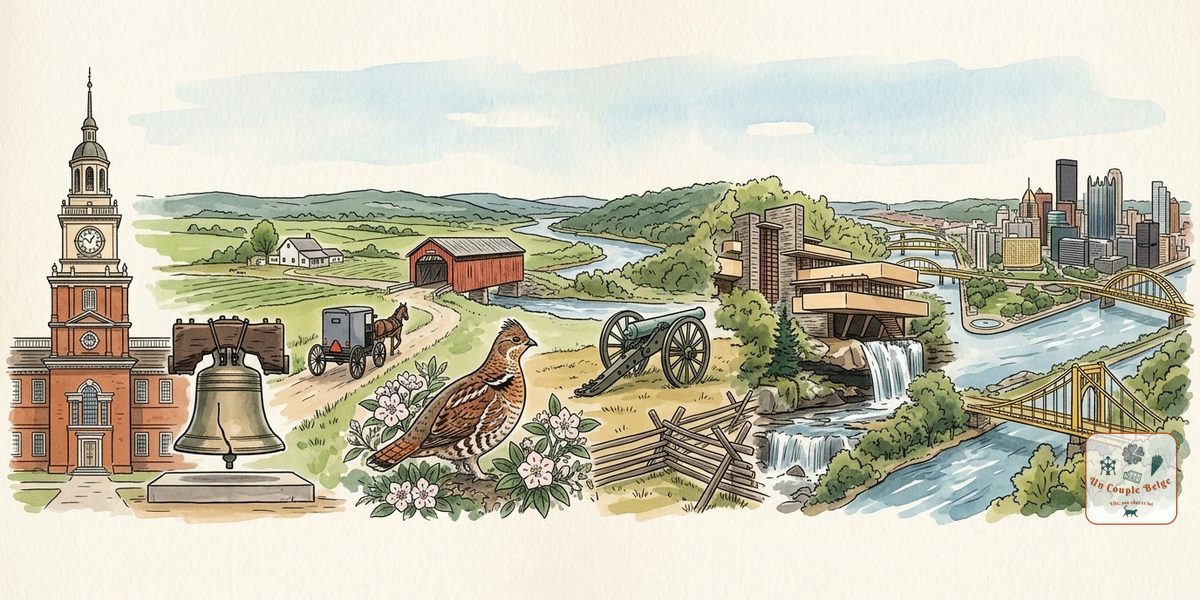
Pennsylvania has both the history and the landscapes, without overdoing it. It was here, in Philadelphia, that the Declaration of Independence was signed in 1776, and then the Constitution drafted in 1787. It was also here that Gettysburg took place, the bloodiest battle of the Civil War, along with Abraham Lincoln’s most famous speech.
But Pennsylvania is also forest-covered Appalachians that blaze in autumn, the farms and buggies of Amish country, a whole town that smells of chocolate, a masterpiece of architecture set over a waterfall, and Pittsburgh, the former steel capital that has become a pleasant city. Its nickname, the “Keystone State”, sums up its central place in the country’s history.
Pennsylvania at a glance
- Capital: Harrisburg
- Largest city: Philadelphia
- Population: about 13 million
- Area: about 119,000 km², nearly four times Belgium
- Joined the Union: 1787, 2nd state. Officially, it’s a “Commonwealth”.
- Time zone: Eastern Time (6 hours behind Brussels)
- Nickname: Keystone State
- Highest point: Mount Davis, 979 metres
Geography: from the hills of the east to the plateaus of the west
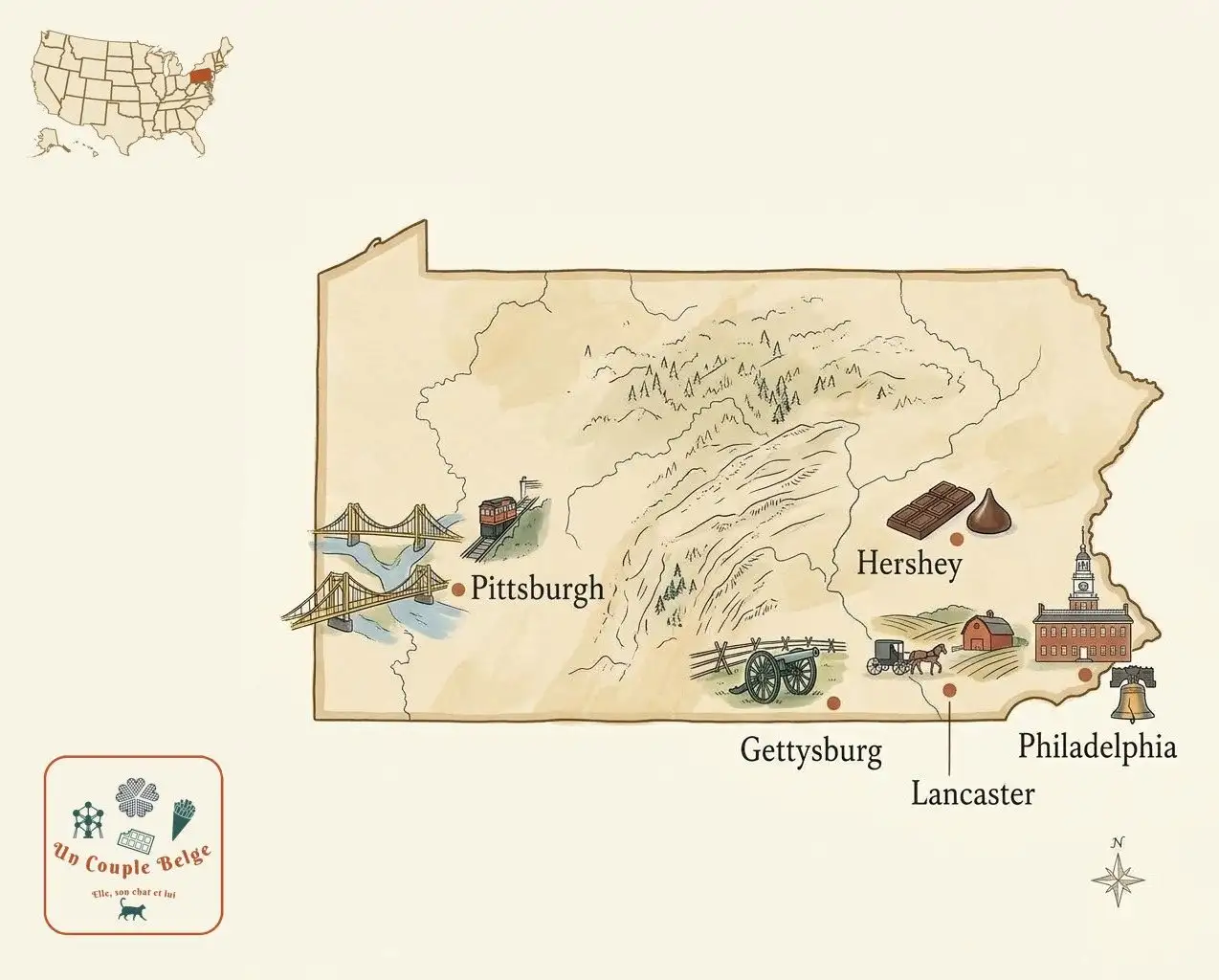
The south-east, around Philadelphia, is a region of gentle hills, with the Amish country of Lancaster, Hershey and Gettysburg.
The Appalachians cross the state diagonally, from south-west to north-east, in long parallel forest-covered ridges.
The north-east is home to the Pocono Mountains, a region of lakes and forests two hours from New York.
The north, nicknamed the “Pennsylvania Wilds”, is the wildest part: immense forests, few inhabitants, elk and some of the starriest skies in the East.
The south-west, around Pittsburgh, is hilly and cut by rivers, with the Laurel Highlands.
A bit of history
The Lenape, the Susquehannock and other peoples lived here. In 1681, King Charles II granted the territory to William Penn, an English Quaker, to settle a debt owed to his father. Penn founded a colony based on religious tolerance, which attracted communities persecuted in Europe: Quakers, Mennonites, Amish and German Lutherans (the “Pennsylvania Dutch”, “Dutch” coming from “Deutsch”).
Philadelphia became the largest city in the colonies and the heart of the Revolution: the Declaration of Independence (1776), the Constitution (1787), and capital of the United States until 1800. In 1863, the Battle of Gettysburg marked a turning point in the Civil War. In the 19th century, Pennsylvania became the country’s industrial powerhouse: coal, oil (the first commercial well was drilled at Titusville in 1859), steel in Pittsburgh with Andrew Carnegie. The industrial decline of the 1970s and 80s was hard, but Pittsburgh has reinvented itself in healthcare, education and technology.
The must-sees
Philadelphia
Philadelphia’s historic centre is where the birth of the United States is concentrated. At Independence National Historical Park, you visit Independence Hall, where the Declaration of Independence and the Constitution were signed (free entry with a timed reservation), and the famous cracked Liberty Bell. Right nearby, Elfreth’s Alley is one of the oldest continuously inhabited residential streets in the country.
The city isn’t only about its past. The Philadelphia Museum of Art has a first-rate collection, but everyone comes first to run up the steps as in Rocky 🎬, before having their photo taken in front of his statue. The Barnes Foundation has an extraordinary Impressionist collection (Renoir, Cézanne, Matisse). The former prison of Eastern State Penitentiary, where Al Capone was held, can be visited, somewhere between ruins and the history of the prison system. Reading Terminal Market, a big market hall, is perfect for lunch. And the Magic Gardens, a house covered in mosaics made from debris, are a curiosity.
Half an hour away, Valley Forge recalls the terrible winter of 1777-1778 endured by Washington’s army. And Longwood Gardens, to the south-west, is one of the most beautiful botanical gardens in the country.
Gettysburg
A little over two hours from Philadelphia, the Gettysburg battlefield is one of the most moving places of remembrance in the country. In July 1863, for three days, the armies of the Union and the Confederacy fought here, with more than 50,000 casualties (killed, wounded and missing). The visitor centre displays an immense circular painting of the battle, the Cyclorama. You then tour the battlefield by car, ideally with a licensed guide who rides in your car. It was in the military cemetery that Lincoln delivered his famous Gettysburg Address, in a few minutes.
The Amish country of Lancaster
An hour from Philadelphia, Lancaster County is home to one of the largest Amish and Mennonite communities in the United States, settled here since the 18th century. You share the road with black buggies, buy jam and pies at the farms and markets, and visit farm museums that explain this way of life. Villages with curious names such as Intercourse and Bird-in-Hand are very popular. Respect the Amish refusal to be photographed, and avoid Sunday, a day of rest when everything is closed.
Hershey
You can’t miss Hershey, the town built by Milton Hershey around his chocolate factory. The street lamps on Chocolate Avenue are shaped like Hershey’s Kisses, and the free Hershey’s Chocolate World offers a ride in a little car through a recreated chocolate factory. Right next door, the Hersheypark amusement park is one of the most popular on the East Coast.
Pittsburgh
Pittsburgh, the former steel capital of the world, is one of Pennsylvania’s nice surprises. At the confluence of three rivers, it has more than 440 bridges, which has earned it the nickname “City of Bridges”. The two funiculars, the Duquesne and Monongahela inclines, climb Mount Washington for the best view of the city, especially at night. The Andy Warhol Museum, devoted to the artist who was born here, is the largest museum in the United States dedicated to a single artist. The Carnegie museums (art and natural history, with its dinosaurs) and the lively Strip District complete the visit.
Fallingwater and the Laurel Highlands
An hour and a half south-east of Pittsburgh, Fallingwater, the house built by Frank Lloyd Wright in 1935 above a waterfall, is one of the masterpieces of 20th-century architecture, and a UNESCO World Heritage Site. Tours must be booked in advance. Right nearby, Ohiopyle is renowned for rafting and cycling, with a cycle trail, the Great Allegheny Passage, which links Pittsburgh to Washington. In Shanksville, the Flight 93 National Memorial pays tribute to the passengers who rose up against the hijackers on 11 September 2001.
The wild north and the Poconos
In the “Pennsylvania Wilds”, Pine Creek Gorge, nicknamed the “Grand Canyon of Pennsylvania”, is a wooded canyon nearly 450 metres deep. Cherry Springs State Park is one of the best places in the East to see the Milky Way, and around Benezette you can see wild elk, especially in autumn during the rut.
In the north-east, the Pocono Mountains were long the honeymoon destination of New Yorkers, with their heart-shaped bathtubs. Today people come for the lakes, the waterfalls (Bushkill Falls) and Jim Thorpe, a pretty little Victorian town nicknamed “the Switzerland of America”.
Curiosities
Punxsutawney, where a groundhog, Phil, “predicts” the end of winter every 2 February, a tradition made world-famous by the film Groundhog Day 🎬. Centralia, a town almost abandoned since a coal mine fire began burning beneath its streets in 1962. And the Martin guitar factory in Nazareth or the Crayola factory in Easton, both of which can be visited.
Itinerary ideas
One week, the east. Philadelphia (3 days) → Valley Forge → Lancaster’s Amish country (1-2 days) → Hershey → Gettysburg (1 day).
10 days, east to west. Philadelphia → Lancaster → Hershey → Gettysburg → Fallingwater and the Laurel Highlands → Pittsburgh (2 days). About 600 kilometres.
In combination. Pennsylvania slots in between New York (Philadelphia is 1 hr 30 away by train), Washington (Gettysburg is 1 hr 30 away) and Maryland.
On the plate
- The Philly cheesesteak, a sandwich of thinly sliced beef and melted cheese in a long roll. Pat’s and Geno’s, facing each other in South Philadelphia, fight over the title. You order “wit” or “witout” (with or without onions).
- The soft pretzel: Pennsylvania produces the majority of America’s pretzels, and the country’s first pretzel bakery opened in Lititz in 1861.
- Pittsburgh’s Primanti sandwich, with the meat, the cheese, the coleslaw… and the fries right inside the sandwich.
- Pittsburgh’s pierogi, a legacy of the Eastern European immigrants.
- Pennsylvania Dutch cooking: shoofly pie (a molasses pie), whoopie pie, scrapple, chicken and noodles.
- Heinz ketchup, born in Pittsburgh, and Yuengling beer, brewed in Pottsville since 1829: the oldest brewery in the United States.
Culture and trivia
- The Liberty Bell cracked on its very first uses in the 18th century. It hasn’t been rung since 1846.
- Wawa versus Sheetz: two chains of petrol stations and sandwich shops, one in the east, the other in the west, stir up a passionate rivalry among the inhabitants.
- Fred Rogers, host of the cult children’s programme Mister Rogers’ Neighborhood 🎬, filmed in Pittsburgh for more than 30 years, was born near the city.
- The world’s first commercial radio station, KDKA, broadcast from Pittsburgh in 1920.
- Knoebels amusement park, in the centre of the state, has free admission: you only pay for the rides.
When to go
- Autumn (late September to late October): the best time, with the colours of the Appalachians and the Poconos, and mild weather.
- Spring (April-May): mild and in bloom, perfect for Philadelphia and Longwood Gardens.
- Summer (June to August): hot and humid in the cities, ideal for the amusement parks, rafting and the northern forests.
- Winter: cold, with snow in the mountains and skiing in the Poconos. The Christmas lights at Longwood Gardens are superb.
Practical information
- Recommended length of stay: one week for the east, 10 days to cross the state.
- Getting there: Philadelphia airport has direct flights from many European cities. Pittsburgh is mostly served by connecting flights.
- Getting around: Philadelphia can be explored on foot and by public transport. Amtrak links Philadelphia to Lancaster, Harrisburg and Pittsburgh. For everything else, a car is essential.
- Budget: moderate, far cheaper than New York or Boston.
- Things to watch out for: in Amish country, slow down on country roads. The Pennsylvania Turnpike has electronic tolls.
- One more tip: book your time slot for Independence Hall and your Fallingwater tour in advance.