Rhode Island: the smallest state, facing the ocean
Updated on
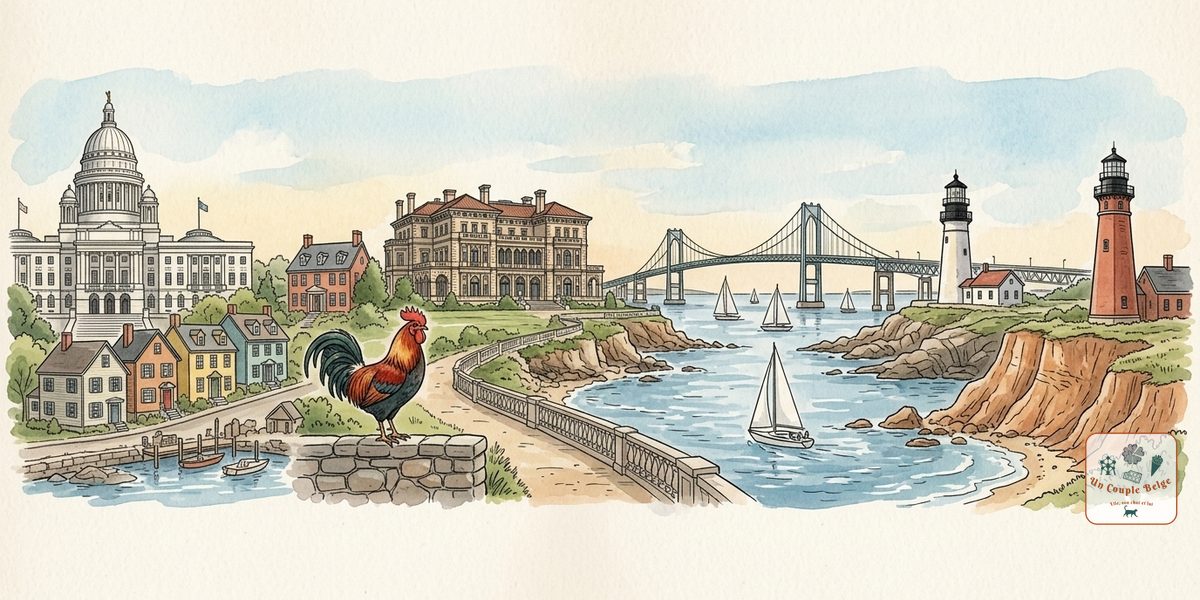
Rhode Island is pocket-sized. It’s the smallest state in the United States, about eight times smaller than Belgium, and you can drive across it in an hour. The locals themselves joke that you can miss it if you blink. It isn’t really an island either, apart from the part where Newport stands.
But its size has never stopped it from playing an outsized role. Founded by a minister banished for his ideas on religious freedom, it was the first colony to break with the British crown, and the cradle of the American industrial revolution. Today it’s the “Ocean State”: more than 600 kilometres of jagged coastline around Narragansett Bay, billionaires’ palaces, fishing harbours, lighthouses and an island with next to no cars. Ideal for a two- or three-day stop on a tour of New England.
Rhode Island at a glance
- Capital and largest city: Providence
- Population: about 1.1 million
- Area: about 4,000 km² including the bay, eight times smaller than Belgium. It’s the smallest state in the country.
- Joined the Union: 1790, 13th state, the last of the thirteen to ratify the Constitution
- Time zone: Eastern Time (6 hours behind Brussels)
- Nickname: Ocean State
- Highest point: Jerimoth Hill, 247 metres
Geography: a bay and its islands
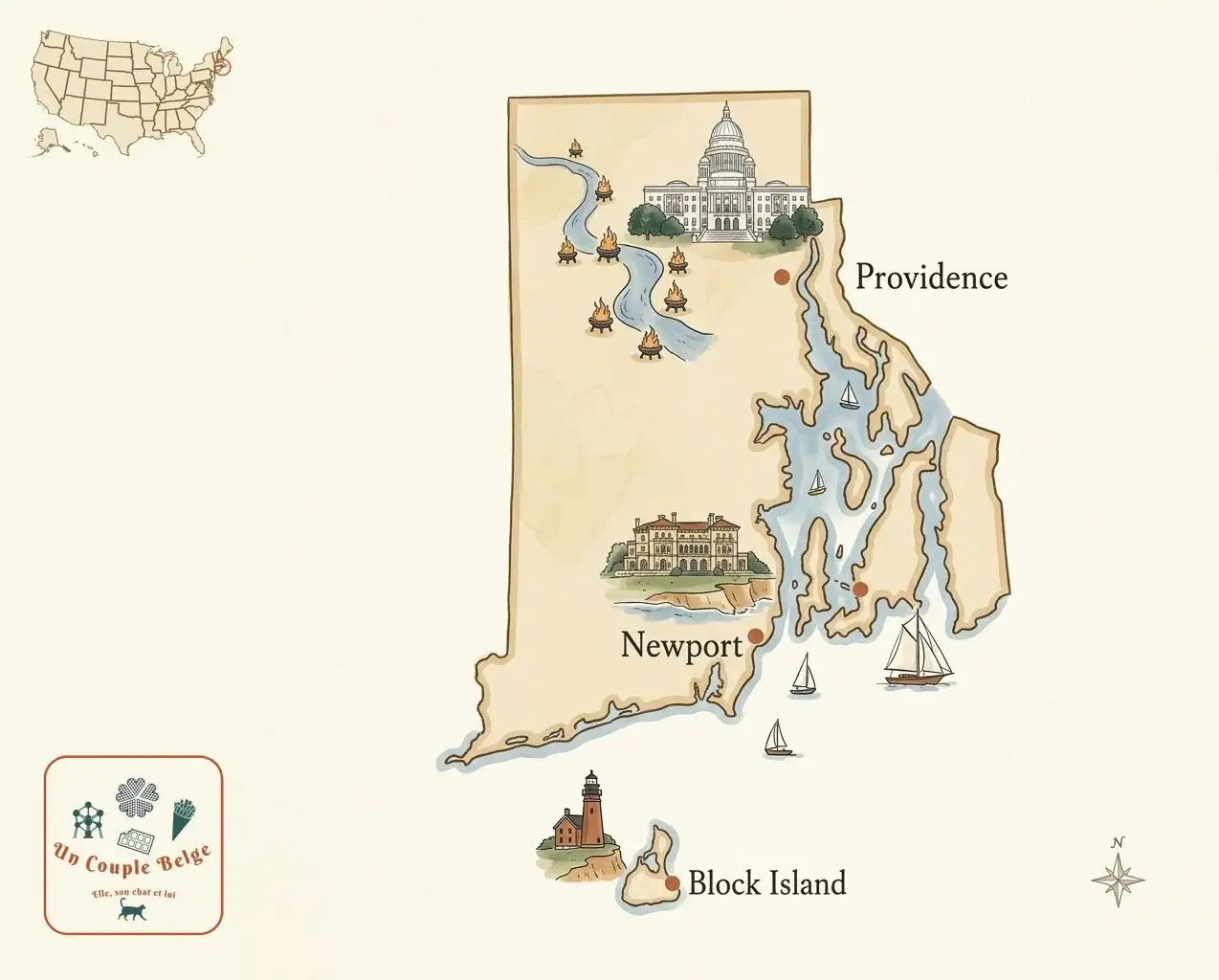
The whole of Rhode Island is organised around Narragansett Bay, an estuary that reaches deep inland and cuts the coast into peninsulas and islands.
Providence, the capital, sits at the head of the bay, to the north.
Aquidneck Island, in the middle of the bay, is home to Newport, and other islands such as Jamestown are linked by bridges.
The south coast, facing the Atlantic, lines up sandy beaches, salt ponds and villages such as Narragansett, Westerly and Watch Hill.
Block Island, finally, is an island about twenty kilometres offshore.
The north-west of the state, more wooded and rural, sees very few visitors.
A bit of history
The Narragansett, the Wampanoag and the Niantic lived around the bay. In 1636 the minister Roger Williams, driven out of Massachusetts for his ideas on the separation of church and state, founded Providence. The colony became a refuge for all those persecuted for their religion: Baptists, Quakers, Jews. In Newport, the Touro Synagogue, built in 1763, is the oldest in the United States.
On 4 May 1776, Rhode Island was the first colony to declare its independence, two months before the Declaration in Philadelphia. Ironically, it would be the last to ratify the Constitution, in 1790. In 1793 Samuel Slater built the country’s first water-powered cotton mill in Pawtucket, launching the American industrial revolution. At the end of the 19th century, Newport became the holiday resort of the country’s greatest fortunes. In 2020 the state shortened its official name, which was “State of Rhode Island and Providence Plantations”, because of the reference to plantations.
The must-sees
Newport
At the end of the 19th century, Newport was the summer playground of America’s greatest fortunes. Along Bellevue Avenue and Ocean Drive stand the “cottages”, a very ironic word for palaces inspired by European châteaux. The Breakers, the Vanderbilts’ home, is the most famous, with 70 rooms facing the ocean. Several mansions can be visited with the Preservation Society.
To see them from another angle, the Cliff Walk, a 5-kilometre path, follows the coast at the foot of the mansions’ gardens. Ocean Drive, the road that loops around the point, is superb at sunset. Newport is also a sailing town: it hosted the America’s Cup for more than 50 years. The town centre, with its colonial houses and its harbour, is very pleasant. And in summer, the Newport Folk Festival (where Bob Dylan first played electric in 1965) and the Newport Jazz Festival are institutions.
Providence
Providence is a small university capital full of charm, thanks to Brown University and the Rhode Island School of Design (RISD), one of the best art schools in the country, whose museum is worth the detour. Benefit Street, nicknamed the “Mile of History”, lines up perfectly preserved colonial and Federal houses. The Italian district of Federal Hill is perfect for dinner.
On some summer and autumn evenings, WaterFire lights around a hundred bonfires on the city-centre rivers, set to music: a magical, free show.
Block Island
One hour by regular ferry (or 30 minutes by fast ferry) from Point Judith, Block Island is a real change of scene. Few cars, lots of bikes, spectacular clay cliffs at Mohegan Bluffs, with a staircase down to the beach, two lighthouses and almost wild beaches. Nearly half the island is protected. You can do it in a day, but sleeping there is nicer.
The south coast
The beaches of Narragansett and Misquamicut are the most popular in the state. In Watch Hill you’ll find the Flying Horse Carousel, one of the oldest carousels in the United States. The Point Judith lighthouse and the Beavertail one, on the island of Jamestown, offer fine views of the ocean. Further north, Bristol holds the oldest Fourth of July parade in the United States, since 1785.
The Blackstone Valley
In Pawtucket, Slater Mill, the first modern textile mill in the United States, is part of a national historical park that tells the story of the birth of American industry. The region also gave birth to Hasbro and Mr. Potato Head, whose decorated statues are dotted around the state.
Itinerary ideas
2-3 days. Providence (1 day) → Newport (1 day) → south coast and Block Island (1 day).
In combination. Rhode Island is a perfect stop between Boston (1 hour from Providence) and New York (3 hours), or on a tour of New England with Connecticut (Mystic is 1 hour from Newport) and Cape Cod.
On the plate
- Coffee milk, milk mixed with a coffee syrup, the state’s official drink. You’ll find it in every supermarket.
- Fried calamari, served with pickled peppers: it has officially been the “state appetizer” since 2014.
- Clam cakes, clam fritters, and Rhode Island-style chowder, with a clear broth, no cream and no tomato.
- Stuffies, big clams stuffed with breadcrumbs and chorizo.
- Del’s frozen lemonade, a slushy iced lemonade, essential in summer.
- Hot wieners, small sausages topped with meat sauce, which you order “all the way”.
- The Awful Awful, a thick milkshake from the Newport Creamery chain.
Culture and trivia
- Rhode Island had the longest official name of any state until 2020, and remains the smallest.
- The oldest synagogue, the oldest Fourth of July parade, the oldest library still in use (the Redwood Library in Newport): this little state collects “firsts”.
- The series Family Guy 🎬 is set in a fictional Rhode Island town, Quahog, named after a local clam.
- The locals happily give directions based on things that no longer exist: “turn where the Dunkin’ used to be”.
- A giant blue insect, the “Big Blue Bug”, a termite nearly 18 metres long on the roof of a pest-control company, is a local celebrity beside the motorway in Providence.
When to go
- Summer (June to August): high season, for the beaches, Block Island, sailing and the Newport festivals. High prices in Newport.
- September-October: the water is still mild, the crowds have gone and WaterFire carries on. The best time.
- Spring (May): mild and quiet, ideal for the mansions and the Cliff Walk.
- Winter: cold and windy. The Newport mansions are decorated for Christmas, but Block Island is asleep.
Practical information
- Recommended length of stay: 2 to 4 days, as part of a tour of New England.
- Getting there: Providence airport (T.F. Green) is served by connecting flights. Boston is often more convenient, an hour’s drive away. Amtrak links Providence to Boston and New York.
- Getting around: Providence can be explored on foot. For Newport, the coast and the ferries, a car is useful. On Block Island, hire a bike.
- Budget: high in Newport in summer, more affordable in Providence.
- Things to watch out for: parking is difficult in Newport in summer. Arrive early, or take the bus from Providence.
- One more tip: book the Block Island ferry in advance in summer, especially if you want to take a car on board.