Virginia: Shenandoah, colonial history and wild ponies
Updated on
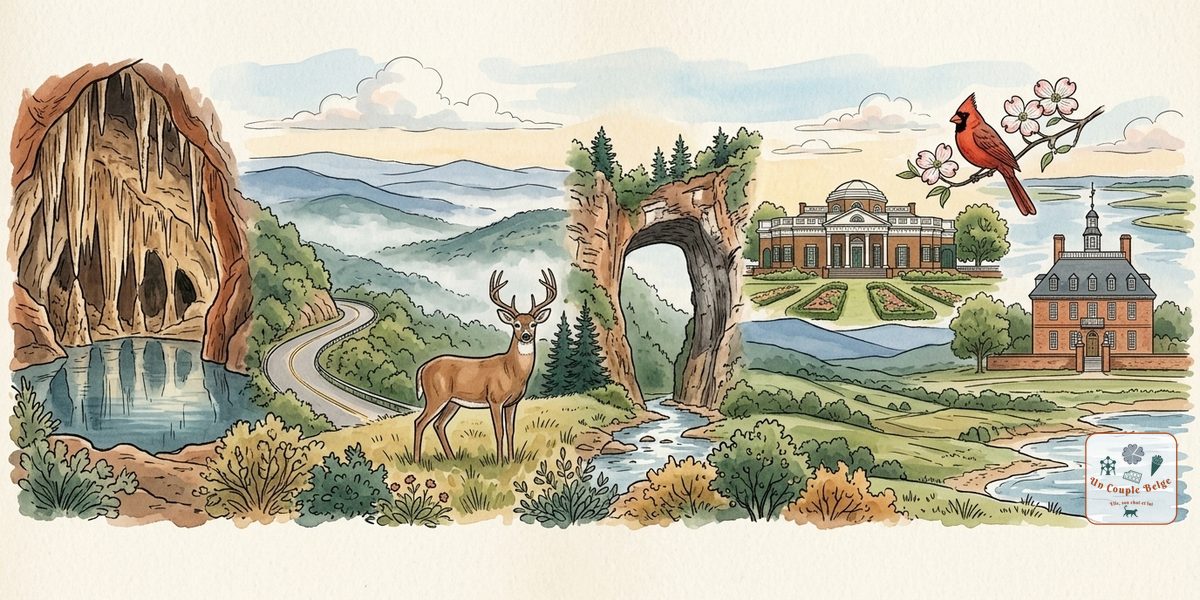
Virginia is visited like several countries in one. To the north, the Washington suburbs, with the Pentagon, Arlington Cemetery and thousands of civil servants crossing the Potomac every morning. To the west, the Blue Ridge Mountains, bluish ridges stacked up in the haze, and valleys where people still play the banjo on their porches. To the east, Chesapeake Bay, the beaches and the wild ponies.
It’s also the state where American history really begins. The first permanent English colony was founded here in 1607, eight presidents were born here, including George Washington and Thomas Jefferson, and it was here that most of the battles of the Civil War were fought, up to the final surrender at Appomattox. Between mountains, historic sites and coast, Virginia is an ideal destination for a road trip of one to two weeks, easily combined with Washington.
Virginia at a glance
- Capital: Richmond
- Largest city: Virginia Beach
- Population: about 8.8 million
- Area: about 110,800 km², a little over three and a half times Belgium
- Joined the Union: 1788, 10th state
- Time zone: Eastern Time (6 hours behind Brussels)
- Nicknames: Old Dominion, Mother of Presidents
- Highest point: Mount Rogers, 1,746 metres
Geography: from Chesapeake Bay to the Appalachians
The Tidewater, to the east, is a low plain cut by the estuaries that flow into Chesapeake Bay: Norfolk, Virginia Beach, Williamsburg and, on the other side of the bay, the Eastern Shore, a peninsula of marshes and islands.
The Piedmont, in the centre, is a region of hills, farms and vineyards, with Richmond and Charlottesville.
The Blue Ridge Mountains form the first barrier of the Appalachians, with Shenandoah National Park.
The Shenandoah Valley, west of the Blue Ridge, is a broad agricultural valley, and the south-west, mountainous and isolated, pushes towards Kentucky and Tennessee.
A bit of history
The Powhatan and many other peoples lived here. In 1607, English settlers founded Jamestown, the first permanent English colony in America. This was the time of Pocahontas, daughter of Chief Powhatan. In 1619, the first enslaved Africans arrived in Virginia, and the same year the first elected assembly in the colonies met. Tobacco growing, which rested on slavery, made the colony’s wealth.
Virginians played a central role in independence: Washington commanded the army, Jefferson drafted the Declaration, and the war ended in 1781 with the Franco-American victory at Yorktown. During the Civil War, Richmond was the capital of the Confederacy, and Virginia was the main battleground. On 9 April 1865, General Lee surrendered to General Grant at Appomattox Court House. West Virginia, opposed to secession, broke away in 1863 to form a new state. In the 20th century, the proximity of Washington transformed the north of the state, which is home to the Pentagon, the CIA and many technology companies.
The must-sees
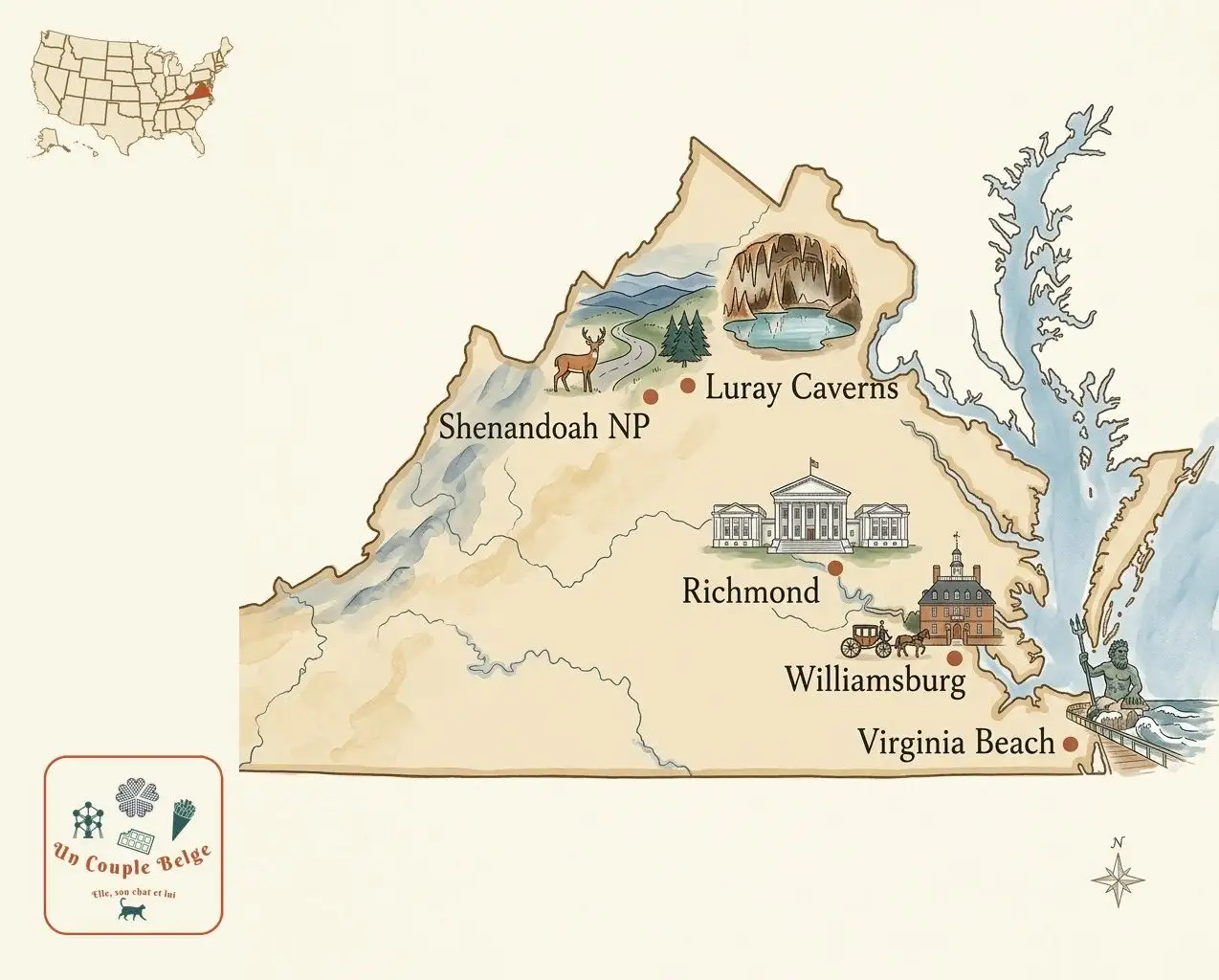
Shenandoah and Skyline Drive
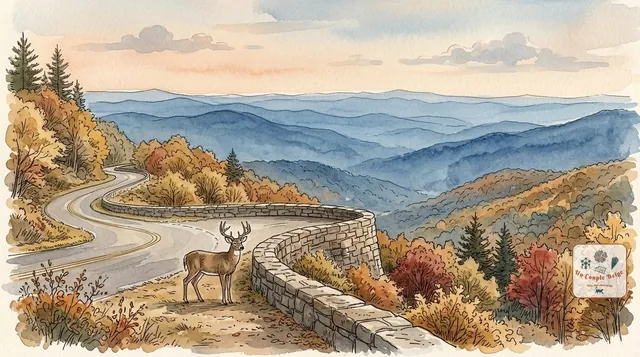
Shenandoah National Park, less than two hours from Washington, is the gateway to the Blue Ridge Mountains. Skyline Drive, a winding road of 105 miles (about 170 km), follows the crest for the whole length of the park, with more than 70 overlooks onto the valley. The park has more than 800 kilometres of trails, including a section of the Appalachian Trail. The hikes to Old Rag (by permit, with a strenuous rock scramble), Dark Hollow Falls or Stony Man are classics. You often come across deer and, sometimes, black bears.
The Blue Ridge Parkway
South of Shenandoah, the road continues as the Blue Ridge Parkway, which follows the ridges into North Carolina, for 755 kilometres in all. In Virginia, people stop at the Peaks of Otter, at Mabry Mill, a much-photographed old mill, and near Roanoke, whose giant illuminated star looks down over the city. Near Roanoke, the hike to McAfee Knob, on the Appalachian Trail, leads to an overhanging rock that is among the most photographed spots on the trail.
The caverns and Natural Bridge
The Shenandoah Valley hides many limestone caves. Luray Caverns, the most famous in the East, are home to the Great Stalacpipe Organ: an organ that produces notes by striking the stalactites with small mallets. Further south, Natural Bridge is a stone arch 65 metres high, which George Washington is said to have surveyed, and which Thomas Jefferson bought in 1774.
Charlottesville and Monticello
Charlottesville is a pretty university town at the foot of the Blue Ridge. Next to it, Monticello, the neoclassical house Thomas Jefferson designed himself, can be visited with its gardens and its full history, including that of the enslaved people who lived there, among them Sally Hemings. The campus of the University of Virginia, founded and designed by Jefferson, is listed with Monticello as a UNESCO World Heritage Site. The area is also the heart of Virginia wine country.
The Historic Triangle: Jamestown, Williamsburg and Yorktown
Three sites a few kilometres from one another, linked by a scenic parkway, tell the story of the beginning and the end of the colonial era. At Jamestown, you visit the excavations of the 1607 fort and a recreation with replicas of the ships.
Colonial Williamsburg, the former capital of colonial Virginia, is the largest living history museum in the United States. You stroll through restored 18th-century streets, where costumed interpreters play blacksmiths, printers or lawyers. It’s a little kitsch, but very well done, especially with children.
At Yorktown, the 1781 battlefield marks the decisive victory of Washington and the French troops of Rochambeau and Lafayette.
Richmond
The capital, Richmond, has changed a great deal in recent years. Monument Avenue, long lined with Confederate statues, has seen most of them removed since 2020. The city has a good, free Virginia Museum of Fine Arts, a lively district in Carytown, rapids to raft on the James River right in the city, and a dynamic food and brewery scene. The State Capitol, designed by Jefferson, can be visited.
Northern Virginia
Just across the Potomac, facing Washington, Arlington National Cemetery holds the grave of John F. Kennedy and the changing of the guard at the Tomb of the Unknown Soldier. Mount Vernon, George Washington’s plantation, on the Potomac, is one of the most visited historic homes in the country. Alexandria has a pretty brick Old Town. And the Steven F. Udvar-Hazy Center, the annexe of the National Air and Space Museum, near Dulles airport, displays the shuttle Discovery and a Concorde. See also our Washington D.C. guide.
The coast and the wild ponies
Virginia Beach is a big family seaside resort, with a 5-kilometre boardwalk. To get there from the Eastern Shore, the Chesapeake Bay Bridge-Tunnel, nearly 30 kilometres long, alternates bridges and tunnels under the bay.
To the north, on the Eastern Shore, Chincoteague Island and neighbouring Assateague Island are home to wild ponies that live on the dunes and in the marshes. Every late July, at the Pony Swim, “saltwater cowboys” swim them across the channel, an event that draws tens of thousands of people. Assateague’s beach is one of the wildest on the East Coast.
The battlefields and Appomattox
Virginia saw more Civil War battles than any other state. Manassas, Fredericksburg, Petersburg and Appomattox Court House, where Lee surrendered to Grant, are managed by the National Park Service. They’re best visited by listening to the rangers rather than looking for anything spectacular.
The south-west and the Crooked Road
In the south-west, the Crooked Road is a route devoted to bluegrass and old-time music, linking venues, museums and jam sessions. On Friday nights, the Floyd Country Store hosts an evening of music and dancing. Abingdon, a small historic town, has the Barter Theatre, where you could pay for your seat with vegetables during the Great Depression, and the Virginia Creeper Trail, a 55-kilometre cycle trail that runs down the mountain (its upper half, destroyed by Hurricane Helene in 2024, is due to reopen in spring 2027). Mount Rogers, the highest point, is home to wild ponies in Grayson Highlands State Park.
Itinerary ideas
One week, mountains and history. Washington D.C. → Mount Vernon → Shenandoah and Skyline Drive (2 days) → Charlottesville and Monticello (1 day) → Richmond (1 day) → Williamsburg, Jamestown and Yorktown (2 days).
10-14 days, the grand tour. Washington → Shenandoah → Luray → Blue Ridge Parkway and Roanoke (2 days) → Floyd and the Crooked Road → Charlottesville → Richmond → Williamsburg → Virginia Beach → Chincoteague.
In combination. Virginia combines with Washington D.C., West Virginia (New River Gorge is 3 hours from Roanoke) and North Carolina via the Blue Ridge Parkway.
On the plate
- Virginia ham, notably Smithfield’s, a salt-cured, smoked ham, often served in thin slices in small soft rolls (ham biscuits).
- Virginia peanuts, large and crunchy, and peanut pie.
- Oysters from Chesapeake Bay and the Eastern Shore, and blue crabs.
- Brunswick stew, a stew of meat and vegetables, which Virginia and Georgia both claim to have invented.
- Virginia wine: the state has more than 300 wineries, notably around Charlottesville. Viognier is the signature grape.
- Cider, increasingly popular in the orchards of the Blue Ridge.
Culture and trivia
- “Virginia is for Lovers”, the state’s tourism slogan launched in 1969, is one of the most famous in the country.
- Spirits are only sold in state-run shops, the “ABC stores”.
- Tangier Island, in Chesapeake Bay, is so isolated that its inhabitants speak with a very particular accent, sometimes described as close to the English of earlier centuries. It shrinks every year under the effect of erosion.
- The Pentagon, one of the largest office buildings in the world, is in Virginia, not Washington.
- The Appalachian moonshine runners, who souped up their cars to outrun the police, are often cited among the ancestors of NASCAR racing.
When to go
- Spring (April-May): mild and in bloom, ideal for the whole state.
- Autumn (late September to early November): blazing colours in the Blue Ridge, peaking in mid-October. Skyline Drive is saturated at weekends.
- Summer (June to August): hot and humid, beach season. The mountains stay cooler.
- Winter: quiet, with occasional snow in the mountains. Some sections of Skyline Drive and the Blue Ridge Parkway close in bad weather.
Practical information
- Recommended length of stay: one week for a taste of mountains and history, 10 to 14 days for the grand tour.
- Getting there: the Washington airports (Dulles and Reagan) are the most convenient, with many direct flights to Europe, including Brussels from Dulles. Dulles is in fact in Virginia. Richmond and Norfolk are served by connecting flights.
- Getting around: a car is essential outside Washington. Amtrak links Washington to Richmond, Williamsburg and Charlottesville.
- Budget: moderate, higher in the north of the state and at Colonial Williamsburg. More information on Virginia.org.
- Things to watch out for: the traffic jams around Washington and on I-95 are among the worst in the country. In the mountains, beware of ticks in summer.
- One more tip: for autumn in Shenandoah, book the park lodges months ahead and avoid Skyline Drive at the weekend.