West Virginia: mountains, rivers and country roads
Updated on
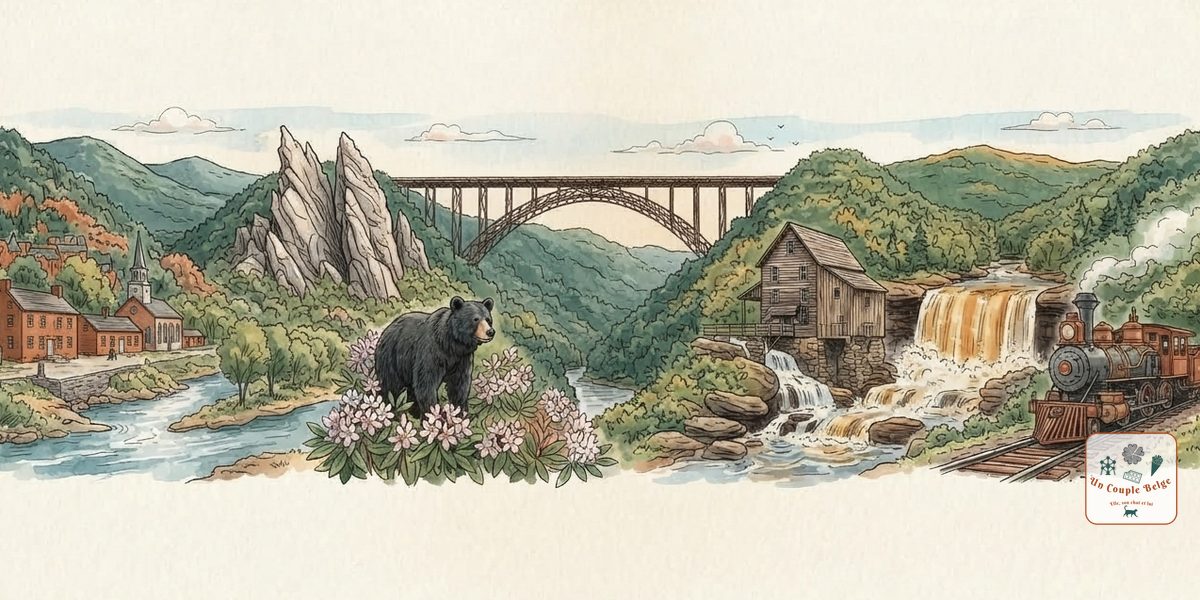
Many Americans confuse West Virginia with Virginia. Yet the two were a single state until 1863: in the middle of the Civil War, the western counties, opposed to the Confederacy, broke away to join the Union. Ever since, West Virginia has carried the image of a poor, forgotten region, that of coal mines and rural Appalachia.
It’s a very incomplete picture. West Virginia is the only state lying entirely within the Appalachians, and it’s one of the wildest in the East: forest-covered mountains as far as the eye can see, rivers that are among the best in the country for rafting, climbing cliffs, plateaus that look like Canada and a recent national park, the New River Gorge. All of it a few hours from Washington, with prices among the lowest in the country. John Denver summed it up in two words in his song: “Almost Heaven”.
West Virginia at a glance
- Capital and largest city: Charleston (only just ahead of Huntington)
- Population: about 1.8 million
- Area: about 62,800 km², a little over twice Belgium
- Joined the Union: 1863, 35th state
- Time zone: Eastern Time (6 hours behind Brussels)
- Nickname: Mountain State
- Highest point: Spruce Knob, 1,482 metres
Geography: the most mountainous state in the East
West Virginia has a strange shape, with two “panhandles” stretching to the north and east. Its average elevation is the highest of any state east of the Mississippi.
The Allegheny Highlands, to the east, are the highest and wildest part: the Monongahela National Forest, Seneca Rocks, Dolly Sods, Canaan Valley and Spruce Knob.
The Appalachian Plateau, which covers most of the state, is a maze of wooded hills and narrow valleys, cut by gorges such as that of the New River. This is coal country.
The Eastern Panhandle, with Harpers Ferry, looks towards Washington, and the west runs down to the Ohio River.
A bit of history
The region served as a hunting ground for several peoples, including the Shawnee. Settlers, often of Scottish, Irish and German origin, moved in during the 18th century, into isolated valleys where they led a very different life from the big planters of eastern Virginia.
In October 1859, the abolitionist John Brown attacked the federal arsenal at Harpers Ferry, hoping to set off a slave uprising. He failed and was hanged, but his raid hastened the march towards the Civil War. In 1861, when Virginia seceded, the western counties refused to follow and formed a new state, admitted to the Union in 1863. At the end of the 19th century, coal mining transformed the state: mining towns, disasters and violent labour conflicts. In 1921, the Battle of Blair Mountain, in which about 10,000 armed miners confronted the companies’ forces, was the largest labour uprising in American history. Since the decline of coal, the state has increasingly bet on outdoor tourism.
The must-sees
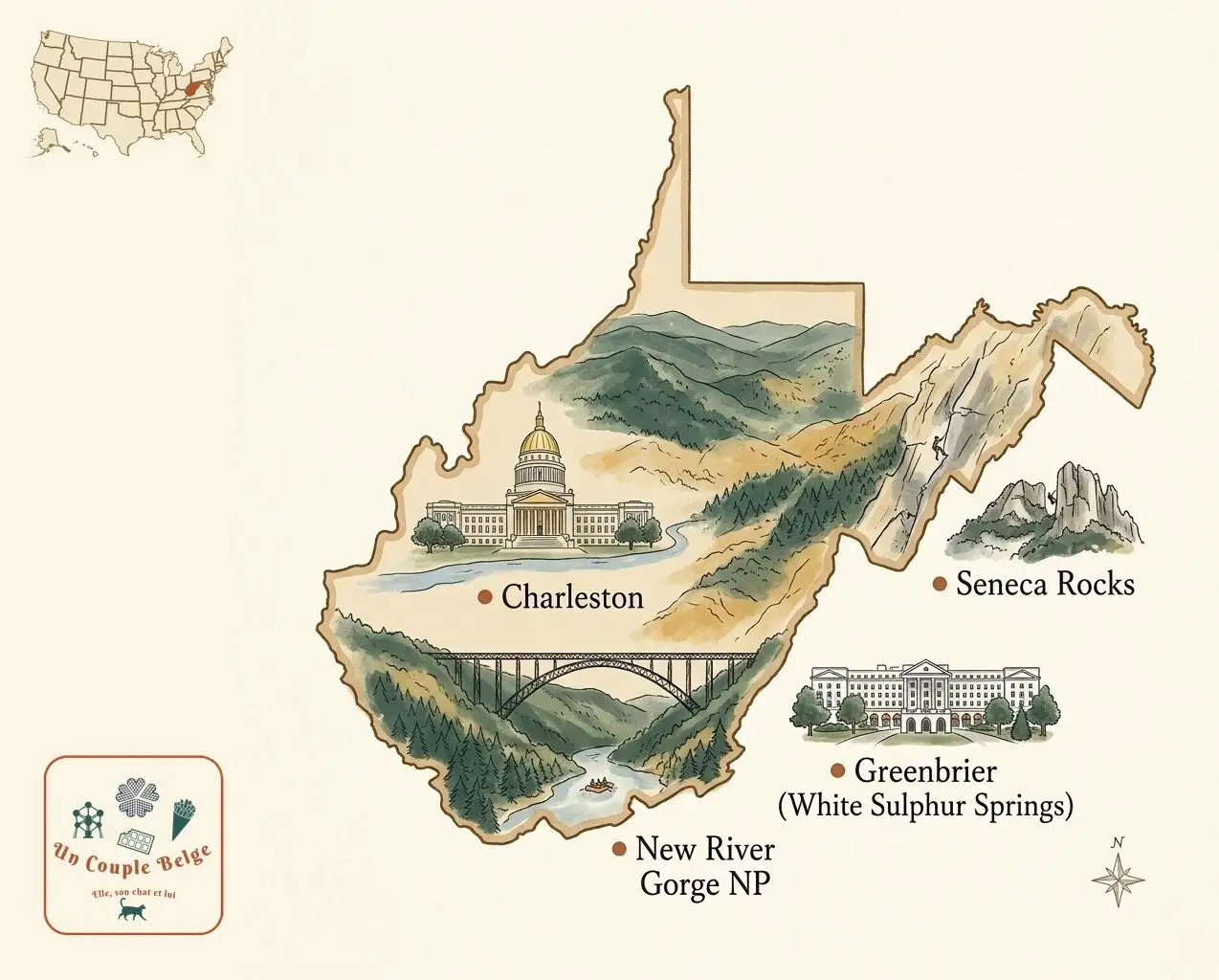
New River Gorge
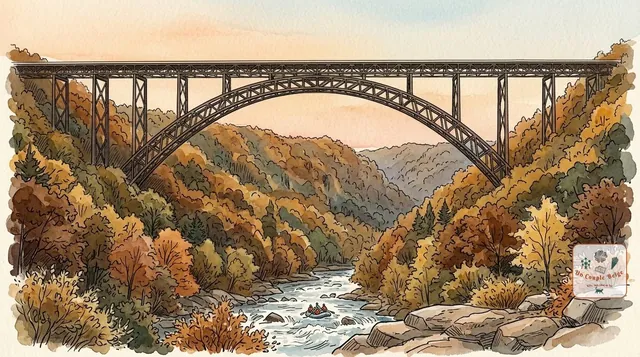
New River Gorge National Park became the 63rd national park in the United States in 2020, after decades as a “national river”. Despite its name, the New River is thought to be one of the oldest rivers in the world, and it has carved a gorge more than 300 metres deep.
The New River Gorge Bridge, a steel arch bridge 924 metres long, spans the gorge 267 metres above the water. When it opened in 1977, it was the longest single-span arch in the world. You can admire it from the Canyon Rim Visitor Center, or on the Bridge Walk, a guided tour along the maintenance catwalk, beneath the deck. Once a year, on the third Saturday of October, Bridge Day closes the bridge to traffic: hundreds of BASE jumpers parachute off it in front of tens of thousands of spectators.
The gorge is also one of the best rafting and climbing spots in the East, with thousands of routes on the sandstone cliffs. The Long Point (view of the bridge) and Endless Wall trails are musts, as is the old Glade Creek grist mill, in Babcock State Park, one of the most photographed in the country.
Rafting on the Gauley
Every autumn, from September to October, Summersville Dam opens its gates to draw down its lake. During Gauley Season, the Gauley River becomes one of the most difficult and most famous whitewater runs in the world, with more than a hundred rapids. For beginners, the New River, in summer, is more accessible.
Seneca Rocks and Spruce Knob
In the Monongahela forest, Seneca Rocks raises its knife-edge quartzite crags nearly 275 metres above the valley. During the Second World War, the US Army trained mountain troops in climbing here. Today climbers gather here, but a trail also lets hikers walk up to an observation platform. Close by, Spruce Knob, the highest point, offers a 360-degree view from an observation tower.
Dolly Sods, Canaan Valley and Blackwater Falls
Dolly Sods is a surprising high plateau: rocky heathland, bogs and blueberries, more reminiscent of Canada than of Virginia. It’s a beautiful place for hiking, especially in autumn when the heath turns red.
Right nearby, Canaan Valley is one of the highest and coldest valleys in the East, with ski resorts. At Blackwater Falls State Park, an 18-metre waterfall drops into amber-coloured water, tinted by the tannins from fallen needles. Further south, Snowshoe Mountain is the largest ski resort in the state.
Harpers Ferry
In the far east of the state, at the confluence of the Potomac and the Shenandoah, Harpers Ferry is a historic village preserved by the National Park Service. Stone houses, recreated workshops, museums on John Brown and on African American history: you can easily spend a day here. From Jefferson Rock, the view of the two rivers is superb, and the Appalachian Trail runs through the village, which is home to the headquarters of the organisation that manages the trail. Harpers Ferry is an hour and a half from Washington, by train.
The Greenbrier
In White Sulphur Springs, The Greenbrier is an immense white luxury hotel, which has been welcoming presidents and celebrities to its springs since the 19th century. Beneath one of its wings hides a nuclear fallout bunker built in secret at the end of the 1950s to shelter the US Congress in the event of nuclear war. Its existence was only revealed in 1992, by a Washington Post journalist. The bunker can now be toured.
The curiosities
- Green Bank Observatory, home to one of the largest steerable radio telescopes in the world, in a “radio quiet zone” where Wi-Fi and mobile phones are heavily restricted.
- The Cass Scenic Railroad, a former steam logging train that climbs the mountainside.
- The Beckley Exhibition Coal Mine, where former miners take visitors down into a real coal mine.
- The Mothman of Point Pleasant, a winged creature with red eyes that residents said they saw in 1966 and 1967, just before the collapse of the Silver Bridge over the Ohio, which killed 46 people. The town devotes a statue, a museum and a September festival to it.
- The Trans-Allegheny Lunatic Asylum, in Weston, a giant former psychiatric hospital built of stone, which offers historical tours and “ghost” tours.
- Berkeley Springs, a small spa town where George Washington already came to bathe.
Itinerary ideas
5-7 days, the mountain loop. Harpers Ferry (1 day) → Canaan Valley, Blackwater Falls and Dolly Sods (2 days) → Seneca Rocks and Spruce Knob (1 day) → Green Bank and Cass → Lewisburg and the Greenbrier → New River Gorge (2 days).
A long weekend from Washington. Harpers Ferry → Berkeley Springs, or Harpers Ferry → Blackwater Falls and Dolly Sods.
In combination. West Virginia combines with Washington D.C., Virginia (Shenandoah is an hour from Harpers Ferry) and Kentucky or Tennessee further south.
On the plate
- The pepperoni roll, a small bread roll stuffed with sticks of pepperoni, whose spicy fat soaks into the crumb as it bakes. It is said to have been invented in the 1920s in Fairmont, by an Italian baker, Giuseppe Argiro, for the miners, who could take it down the mine.
- Ramps, wild leeks with a very powerful garlic smell, gathered in spring and celebrated at festivals all over the state.
- The West Virginia-style hot dog, topped with chili and coleslaw.
- Buckwheat cakes, buckwheat pancakes, a speciality of Preston County.
- The Golden Delicious apple, discovered in West Virginia, in Clay County, in the early 20th century.
- Apple butter, cooked for hours in big copper kettles at autumn festivals.
Culture and trivia
- “Take Me Home, Country Roads”, John Denver’s song released in 1971, has been one of the official state songs since 2014, sung by the whole stadium after the university’s football games. The irony: the Blue Ridge Mountains and the Shenandoah it mentions are mostly in Virginia.
- Mother’s Day was launched by a resident of Grafton, Anna Jarvis, in 1908.
- Chuck Yeager, the first pilot to break the sound barrier, and the writer Pearl Buck, winner of the Nobel Prize in Literature, were born in West Virginia.
- The feud between the Hatfield and McCoy families, at the end of the 19th century, on the Kentucky border, has remained legendary. Quad bike trails are named after them.
When to go
- Spring (April-May): wildflowers, rivers swollen for rafting and ramp season.
- Summer (June to August): hot, but pleasant at altitude. Ideal for rafting on the New River and climbing.
- Autumn (late September to late October): the best time, with spectacular colours, Gauley Season and Bridge Day.
- Winter: skiing at Snowshoe and in Canaan Valley. The mountain roads can be snow-covered.
Practical information
- Recommended length of stay: 5 to 7 days for the mountains and the New River Gorge.
- Getting there: Washington (Dulles) is the most convenient international airport, an hour from Harpers Ferry and 3-4 hours from the mountains. Charleston is served by connecting flights.
- Getting around: a car is essential. The mountain roads are winding and take far longer than the map suggests.
- Budget: one of the cheapest states in the country, for accommodation as well as food. More information on WV Tourism.
- Things to watch out for: there’s often no mobile signal in the mountains, so download your maps. Beware of deer on the roads at night.
- One more tip: for Gauley Season or Bridge Day, book rafting and accommodation several months ahead.