Wisconsin: lakes, cheese and supper clubs
Updated on
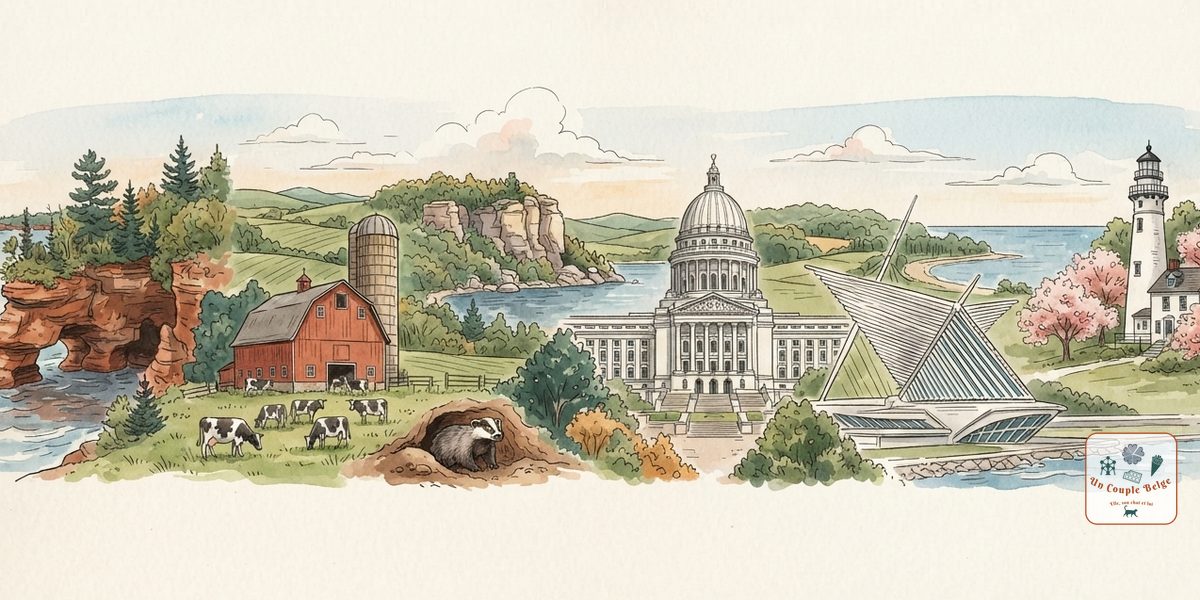
Wisconsin’s reputation comes down to two words: cheese and beer. It’s true: it produces more cheese than any other state, its inhabitants call themselves “Cheeseheads” and wear foam hats shaped like a wedge of cheese to football games, and Milwaukee was once the beer capital of the world. But the state has far more to offer than its rather hearty food.
Set between Lake Michigan and Lake Superior, Wisconsin has more than 15,000 lakes, immense forests in the north, a coastal peninsula that looks like New England, sea caves, hills sculpted by glaciers and some of Frank Lloyd Wright’s finest works. Above all you’ll find a very Midwestern friendliness, that of Friday-night supper clubs and fish fries, where you always end up chatting to the people at the next table.
Wisconsin at a glance
- Capital: Madison
- Largest city: Milwaukee
- Population: about 5.9 million
- Area: about 169,600 km², five and a half times Belgium
- Joined the Union: 1848, 30th state
- Time zone: Central Time (7 hours behind Brussels)
- Nickname: Badger State, from the nickname of the 19th-century lead miners who lived in holes dug into the hillsides
- Highest point: Timms Hill, 595 metres
Geography: between two Great Lakes
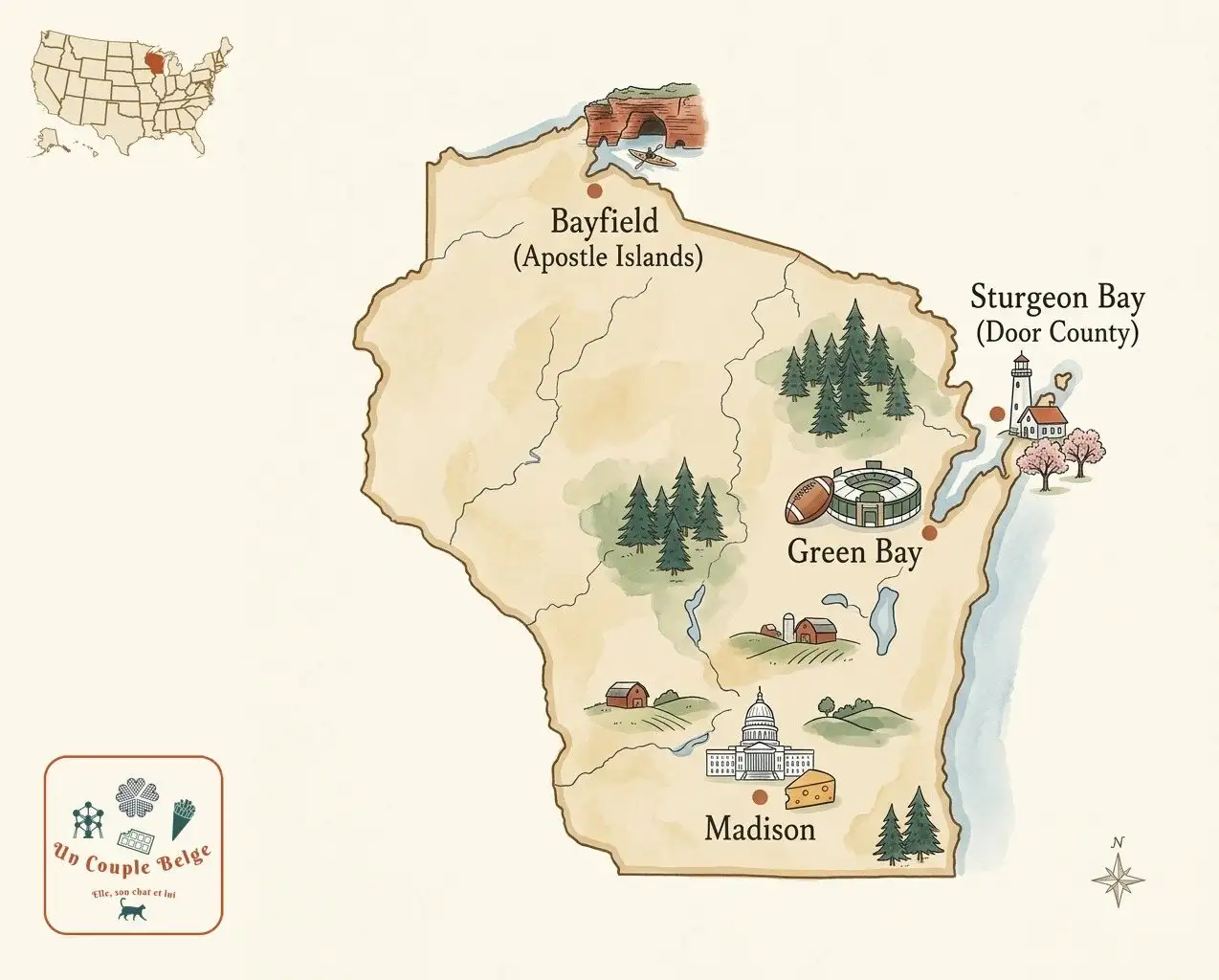
The Lake Michigan shore, to the east, holds the big cities (Milwaukee, Green Bay) and the Door County peninsula.
The Northwoods, to the north, is an immense region of forests and lakes, bordered to the north by Lake Superior and the Apostle Islands.
The centre is a region of dairy farms, rivers and sandstone formations, such as the Wisconsin Dells, and of the glacial moraine of the Kettle Moraine.
The south-west, the “Driftless Area”, escaped the glaciers of the last ice age: it’s a region of hills, steep-sided valleys and small farms, along the Mississippi.
A bit of history
The Ho-Chunk, the Menominee, the Ojibwe, the Potawatomi and other peoples lived here. The name Wisconsin is said to come from a Native American word for the river of the same name. In 1634, the Frenchman Jean Nicolet reached Green Bay, and the French traded furs there for more than a century, as many place names attest (Fond du Lac, Prairie du Chien, Eau Claire).
In the 19th century, lead mining and then logging drew settlers. The state entered the Union in 1848, and a massive wave of German immigration, along with Norwegian, Polish and Swiss, shaped its culture. The Germans founded Milwaukee’s great breweries. In 1871, the Peshtigo fire killed more than 1,200 people, the deadliest in American history, on the same day as the Great Chicago Fire. In the 20th century Wisconsin became “America’s Dairyland” and a land of social reform: it was the first state to create unemployment insurance, in 1932.
The must-sees
Door County
The Door County peninsula reaches nearly 120 kilometres into Lake Michigan, with more than 400 kilometres of shoreline, lighthouses, five state parks and villages such as Fish Creek, Ephraim and Sister Bay, which recall New England. In spring the cherry orchards are in blossom, and in July people pick the tart cherries. Peninsula State Park has a fine shoreline road and an observation tower.
The local tradition is the fish boil: lake fish (whitefish) and potatoes cooked in a big kettle over a wood fire. At the end, kerosene is thrown on the fire, the flames shoot up and the water boils over, carrying off the scum. The show is worth the meal. In Sister Bay, the restaurant Al Johnson’s has goats grazing on its grass roof. The Door County Coastal Byway loops around the peninsula.
The Apostle Islands
In the north, on Lake Superior, the Apostle Islands form an archipelago of 21 wooded islands, protected as a National Lakeshore. They’re renowned for their sea caves sculpted in the red sandstone by the waves. In summer you discover them by kayak or boat, from Bayfield, a pretty little harbour town. In some winters, when the lake freezes solidly enough, you can walk to the ice caves of Mawikwe Bay, hung with icicles. That happens less and less often. The ferry to Madeline Island, the only inhabited island, is a pleasant excursion.
Milwaukee
Milwaukee, on the shore of Lake Michigan, was nicknamed “Brew City”: German immigrants founded Pabst, Schlitz and Miller there. You can still tour the Miller brewery, the old Pabst complex and many craft breweries. The Harley-Davidson Museum tells the story of the motorbike born in Milwaukee in 1903. The Milwaukee Art Museum, with its Santiago Calatrava extension whose “wings” open and close, is spectacular. In June-July, Summerfest is one of the biggest music festivals in the world. And on Friday night, do as everyone does: a fish fry.
Madison
The capital, Madison, is built on a narrow isthmus between two lakes, Mendota and Monona. It’s a university town, progressive and very green. On Saturday mornings, the Dane County Farmers’ Market rings the Capitol: it’s one of the largest producer-only markets in the country. In the evening, the university’s Memorial Union Terrace, with its colourful chairs facing Lake Mendota, is the perfect spot for a beer at sunset.
Green Bay and the Packers
Green Bay is the smallest city to host a major professional team in the United States, the Packers. It’s also the only major franchise owned by its fans: more than half a million shareholders, who receive no dividend. Lambeau Field can be toured, with its museum. On a game day, even if you understand nothing about football, the atmosphere is worth the trip.
Frank Lloyd Wright
Wisconsin is the native land of Frank Lloyd Wright, born in Richland Center in 1867. Near Spring Green, Taliesin, his home and studio built in the hills, can be visited and is one of the Wright works on the UNESCO World Heritage list. In Racine, the SC Johnson headquarters and its research tower are other masterpieces. Right next to Taliesin, the House on the Rock is the complete opposite: a wild house built on a rock, with a room cantilevered out over the valley and the world’s largest indoor carousel.
The Wisconsin Dells and Devil’s Lake
The Wisconsin Dells have proclaimed themselves the “Waterpark Capital of the World”, with the highest concentration of water parks in the country. It’s kitsch, noisy and perfect with children. But behind the slides, the Wisconsin River has carved magnificent sandstone cliffs, to be discovered by boat.
Close by, Devil’s Lake State Park, a lake ringed by quartzite bluffs, is the most visited in the state, with fine hikes. In Baraboo, the Circus World Museum recalls that the Ringling brothers founded their famous circus there in 1884.
The Northwoods
Northern Wisconsin is a region of forests, lakes, cabins and fishing, ideal for canoeing. The town of Hayward has a fishing museum shaped like a giant muskie (a big pike), and you can climb right up into its jaws. In winter, the area hosts the Birkebeiner, the biggest cross-country ski race in North America.
Itinerary ideas
7-10 days, the Wisconsin loop. Milwaukee (2 days) → Green Bay (1 day) → Door County (2-3 days) → Wisconsin Dells and Devil’s Lake (1 day) → Spring Green and Taliesin → Madison (1-2 days).
The far north. Madison → Northwoods → Bayfield and the Apostle Islands (2 days) → Duluth (Minnesota), on Lake Superior.
In combination. Wisconsin combines with Chicago (Milwaukee is 1 hr 30 away), Minnesota or Michigan’s Upper Peninsula.
On the plate
- Cheese curds, pieces of fresh cheese, to be eaten plain, ideally the same day, when they “squeak” between your teeth, or deep-fried.
- The Friday-night fish fry, fish breaded and fried (perch, walleye or cod) served with coleslaw, fries or potato pancakes, and rye bread.
- Bratwursts, German sausages, grilled and often simmered in beer, eaten at tailgates before the games.
- The supper club, an old-fashioned restaurant where you start with a brandy old fashioned, the local version of the cocktail, made with brandy rather than whiskey, and a relish tray, before the fried fish or the prime rib.
- Kringle, a large oval flaky pastry inherited from the Danish immigrants of Racine.
- The butter burger and frozen custard, a very creamy ice cream, made famous by the Culver’s chain.
- Beer, of course, from the big historic brands to craft breweries such as New Glarus, which you’ll only find in Wisconsin.
Culture and trivia
- Cheeseheads: the foam hat shaped like a wedge of cheese, created in 1987, has become the symbol of Packers fans.
- EAA AirVenture, every summer in Oshkosh, is the largest aviation gathering in the world, with thousands of aircraft and more than half a million visitors.
- The film-maker Orson Welles was born in Kenosha, in 1915.
- Wisconsin produces more than 600 varieties of cheese, and it has created its own “Master Cheesemaker” certification, unique in the United States.
- The locals say “bubbler” for a drinking fountain, and often pronounce “Milwaukee” by swallowing the first syllable.
When to go
- Summer (June to August): high season, for the lakes, Door County, the Apostle Islands and the festivals. Book early.
- Autumn (September-October): fine colours in the Northwoods and Door County, fewer people. Football season is in full swing.
- Winter (December to March): very cold, often below –15 °C. Ice fishing, cross-country skiing and, in some years, the ice caves of the Apostle Islands.
- Spring (April-May): the orchards in blossom in Door County, but the weather is still cool and changeable.
Practical information
- Recommended length of stay: 7 to 10 days for a full loop, or a long weekend for Door County.
- Getting there: Chicago (O’Hare) is the most convenient international airport, 1 hr 30 from Milwaukee. Milwaukee and Madison are served by connecting flights.
- Getting around: a car is essential outside Milwaukee and Madison. An Amtrak train links Chicago to Milwaukee.
- Budget: fairly affordable, except in Door County in summer.
- Things to watch out for: mosquitoes in the Northwoods in summer. On Lake Superior, the water stays very cold and the waves can be dangerous for kayakers: go with a guide if you lack experience.
- One more tip: for Door County in July-August, book several months ahead. And for a fish boil, check the times: the show happens at a set hour.