Coffee and breakfast in the United States: ordering without getting it wrong
Updated on
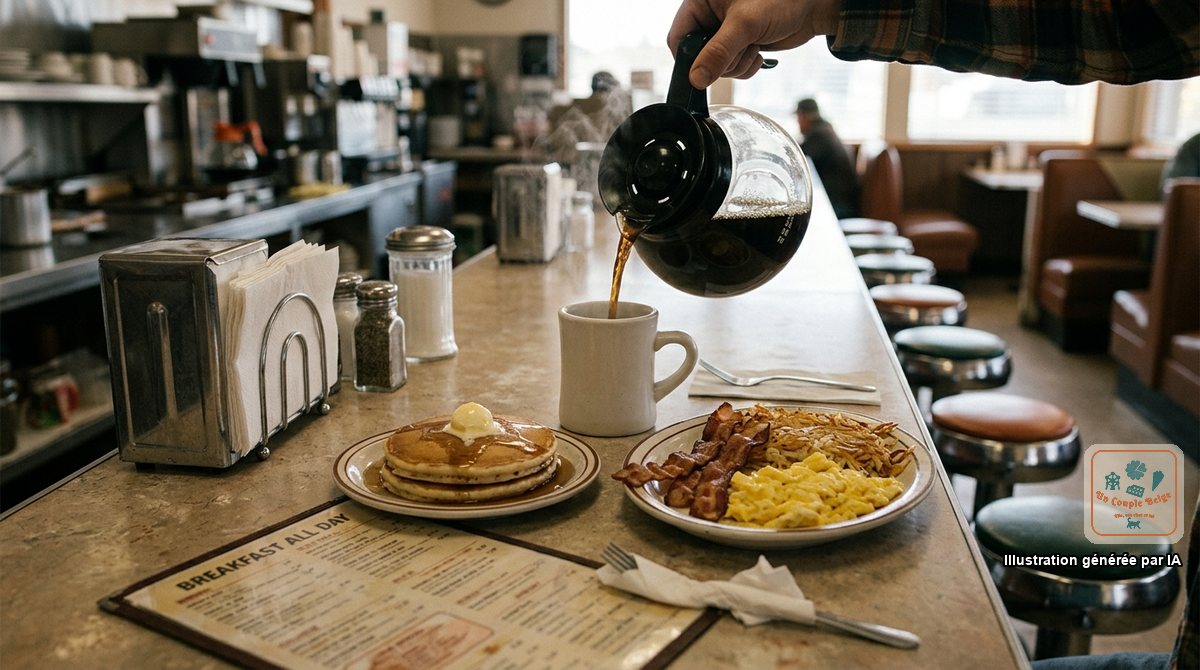
We spent 226 euros at Starbucks in 18 days of road trip. We’re not proud of it, but it says something: in the United States, coffee sets the rhythm of the day, is drunk while walking and is ordered in a language of its own.
As for breakfast, it may well be the best meal in the country.
American coffee
Filter coffee (drip coffee or brewed coffee) is the basic drink: long, light, served very hot in a large cup. It’s the coffee of diners, petrol stations and hotel lobbies.
- In a diner, it’s served bottomless: the waitress comes round again with the pot.
- You’ll be asked: “Room for cream?” (should space be left for milk?).
- Milk, cream and sugar are self-service on a separate counter.
- Half and half is a mixture of milk and cream.
Espresso exists wherever there’s a machine, but it isn’t the default. For a short, strong coffee, ask for “a single espresso” or “a double”. For a longer coffee that resembles ours, have an Americano.
Iced coffee is drunk all year round, even in the depths of winter: iced coffee (chilled filter coffee) or cold brew (steeped cold, smoother and stronger).
Ordering in a coffee shop
The usual order: the size, the drink, the options.
“Can I have a medium latte with oat milk, please?”
The sizes
| Common name | At Starbucks | Volume |
|---|---|---|
| Small | Tall | 35 cl |
| Medium | Grande | 47 cl |
| Large | Venti | 59 cl hot, 71 cl cold |
The vocabulary
- Latte: espresso and a lot of hot milk.
- Cappuccino: less milk, more foam.
- Flat white: a small, stronger latte.
- Mocha: with chocolate.
- Decaf: decaffeinated.
- Skim, whole, oat, almond: skimmed, full-fat, oat or almond milk.
- Extra shot: an additional shot of espresso.
- To go or for here: to take away or to drink in.
You’ll be asked for your first name, written on the cup and called out when the drink is ready. If yours is hard to pronounce in English, give a simple one.
The tip: the tablet suggests 15, 20 or 25%. At the counter it’s optional: a dollar or nothing at all (see tipping).
The chains
- Starbucks: everywhere, including in supermarkets and at motorway rest stops. In December, the Christmas drinks come out.
- Dunkin’: mainly in the East, cheaper, with doughnuts.
- Peet’s Coffee: in California.
- Dutch Bros: drive-through kiosks in the West, very popular.
- Tim Hortons: near the Canadian border.
- Independent roasters, in every city: that’s where you drink the best coffee. Seattle, Portland and San Francisco are its capitals.
A filter coffee costs 2.50 to 4 dollars, a latte 5 to 7 dollars.
Ordering on the app
We became hooked on mobile orders: you order and pay in the app, then collect your drink at the counter without queuing. At rush hour in New York, that’s welcome.
The American Starbucks app only appears in the American app store. You have to change the region of your account for the length of the trip, which sometimes means cancelling your current subscriptions. It’s up to you to decide whether it’s worth it. We talk about it in the day 2 travel diary in New York (coming out on October 18, 2026).
Coffee on the road
- Petrol stations all have a self-service coffee corner, at 2 or 3 dollars for a large cup. Some chains are renowned for it.
- Motel rooms have a small pod coffee maker. The result is rarely memorable.
- The hotel lobby often offers free coffee all day.
- An insulated mug keeps coffee hot for two hours in the car. Many chains will fill it at a small discount.
And tea?
Hot tea often comes down to a tea bag and lukewarm water. Iced tea, on the other hand, is everywhere, served without sugar (unsweetened) or very sweet in the South (sweet tea), with free refills.
Breakfast
Three ways to have it.
At the hotel
Many mid-range chains offer it: waffles you cook yourself in a flip waffle iron, scrambled eggs, sausages, cereal, yoghurts, muffins, juice and coffee. Everything is served on disposable tableware. It isn’t gourmet, but it’s filling and saves 15 to 20 dollars per person.
In big city hotels, breakfast is charged for and expensive: 25 to 40 dollars. You’re better off going out.
In a diner
It’s the experience to have at least once: a vinyl booth, a counter, a laminated menu as long as your arm. Allow 15 to 20 dollars per person, tip included.
A typical plate: two eggs, bacon or sausages, potatoes and toast. You’ll be asked:
- How you want your eggs: scrambled, sunny side up (fried), over easy (flipped, runny yolk), poached.
- Bacon or sausage: bacon, sausage links (small sausages) or patties.
- The potatoes: hash browns (grated and griddled) or home fries (diced).
- The bread: white, wheat (wholemeal), sourdough, rye, or an English muffin.
The other classics:
- Pancakes, in stacks of two or three (short stack or full stack), with butter and syrup.
- Waffles and French toast.
- Eggs Benedict: poached eggs on a muffin, with ham and hollandaise sauce.
- The breakfast burrito in the Southwest: eggs, potatoes, cheese and chilli in a tortilla.
- Biscuits and gravy in the South: soft rolls covered in a white sausage sauce.
- Oatmeal: porridge, for lighter mornings.
The bacon is thin and very crispy. If you prefer it less cooked, ask for it “not too crispy”.
On the go
- A toasted bagel with cream cheese.
- A breakfast sandwich: egg, cheese and bacon in a muffin or a bagel.
- Doughnuts or a muffin, much bigger than ours.
- An açaí bowl or a smoothie in California and Florida.
- Fruit, yoghurts and cereal bought at the supermarket, for dawn starts (see grocery shopping).
Brunch
On Saturdays and Sundays, from 10am to 2pm, Americans brunch. The fashionable restaurants have an hour’s wait: book or arrive at opening time. Morning cocktails (a mimosa with orange juice, a bloody mary) are sometimes offered bottomless.
Opening hours
Diners open at 6am, and some stay open all night. Hotel buffets close at 9 or 10am. In the towns near the parks, cafés open early for hikers.
The rest of the meals are in eating at restaurants.