Building your road trip itinerary in the United States
Updated on
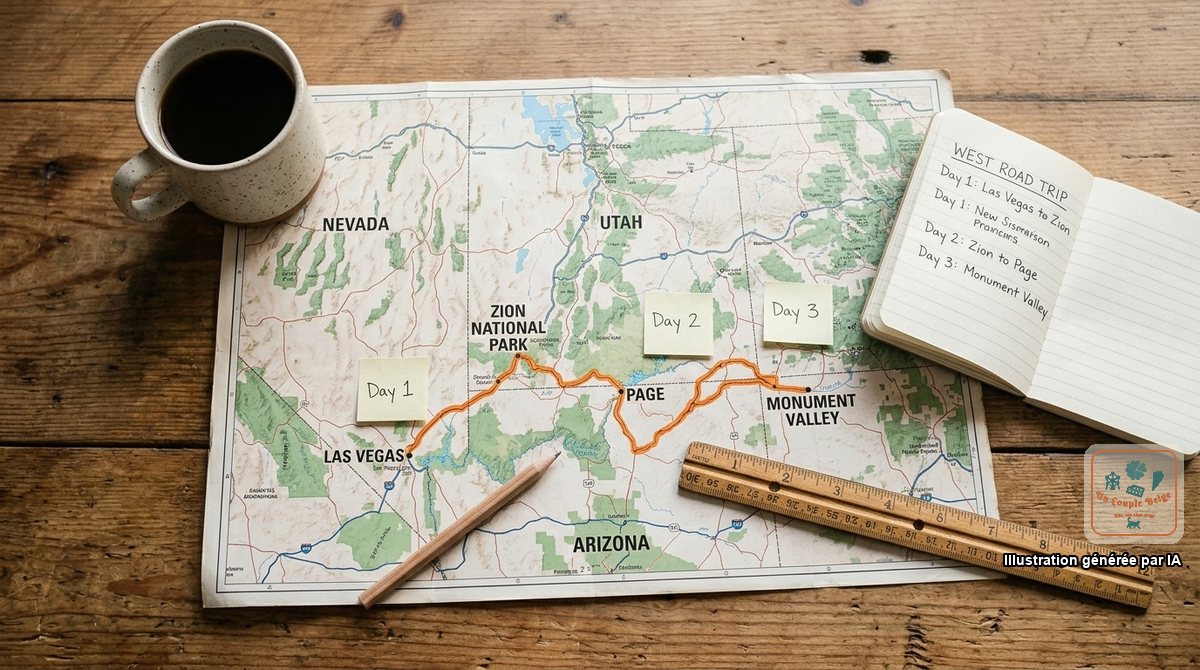
On a map, everything looks close. Then you check the scale: from Los Angeles to the Grand Canyon is the distance from Brussels to Milan.
The classic mistake on a first road trip is wanting to see everything, and spending your holiday behind the wheel. Here’s how we go about avoiding it.
Start from the length of the trip, not the wish list
Begin by counting your days on the ground, leaving out the day you arrive and the day you leave. Only then see what fits.
| Time on the ground | What is realistic |
|---|---|
| 10 days | One region: California, or Florida, or the Utah parks from Las Vegas |
| 2 weeks | A loop in the West (Las Vegas, Grand Canyon, Page, Monument Valley, Bryce, Zion) or the East Coast from north to south |
| 3 weeks | The big loop of the West with California |
| 5 weeks | The same at a leisurely pace, like our first road trip |
How many kilometres a day?
Our benchmarks, after three trips:
| Distance in a day | What it means |
|---|---|
| 200 to 300 km | On average on driving days: you drive in the morning and visit in the afternoon. |
| 400 to 500 km | That’s a transit day, and you see almost nothing else. |
| Over 600 km | Keep that for a real emergency. |
On the first road trip we covered a little over 4,000 km in 37 days, an average of about 110 km a day: a very gentle pace, with plenty of days with little or no driving. On the second, 3,650 km in two weeks, including one leg of nearly 900 km between Washington and Savannah. It was planned and we went in knowing it: a full day on the road, so we could enjoy the rest without rushing.
Loop or one-way?
A loop (leaving from and returning to the same city) avoids drop-off fees for the car and makes the flights simpler. It works very well in the West from Las Vegas, Los Angeles, San Francisco or Denver.
A one-way trip saves retracing your steps when the itinerary is a line: the East Coast from north to south, Route 66, the Pacific coast. It calls for a multi-city flight ticket and, often, a one-way fee of 100 to 500 dollars, sometimes more. Some one-way trips are a good deal, though, because rental companies want to move cars from one region to another. Compare before ruling the idea out.
The two-night rule
Changing hotel every evening is exhausting: suitcases, check-in, check-out. We try to sleep at least two nights in the big parks and in cities, and keep single nights for the driving stops.
At Yosemite, Zion or the Grand Canyon, a single night leaves only half a day on site, and no margin if the weather turns.
In what order to go about it
- List your must-sees, no more than five or six for two weeks.
- Put them on a map and link them in a logical order.
- Check the fixed constraints: roads closed depending on the season (see the calendar), timed-entry visits (Antelope Canyon, Alcatraz), hiking permits, scarce accommodation (Monument Valley, park lodges).
- Book what is scarce first, then build the rest around it.
- Fill the gaps with driving stops, and look for what there is to see along the way: that’s often where the nice surprises are.
- Slip in a buffer day each week, with nothing planned.
The mistakes to avoid on your first trip
- Too many stops. If your programme works on paper without a single free hour, it won’t work on the road.
- Arriving after dark. In the West you come across deer and cattle on the road at dusk, and you miss the scenery. Aim to arrive an hour before sunset.
- Forgetting the time difference between states. Between Nevada, Utah and Arizona the time changes, and not always the way you’d think (we explain it all here).
- Planning a big day right after you arrive. With six to nine hours of jet lag, the first day is a blur.
- Finishing far from the airport. Keep the last night within two hours of your flight home.
- Renting the car for a big city. In New York or San Francisco, it costs a lot in parking and serves no purpose. Pick it up when you leave the city, or return it when you arrive.