Going through US immigration and customs (with or without MPC)
Updated on
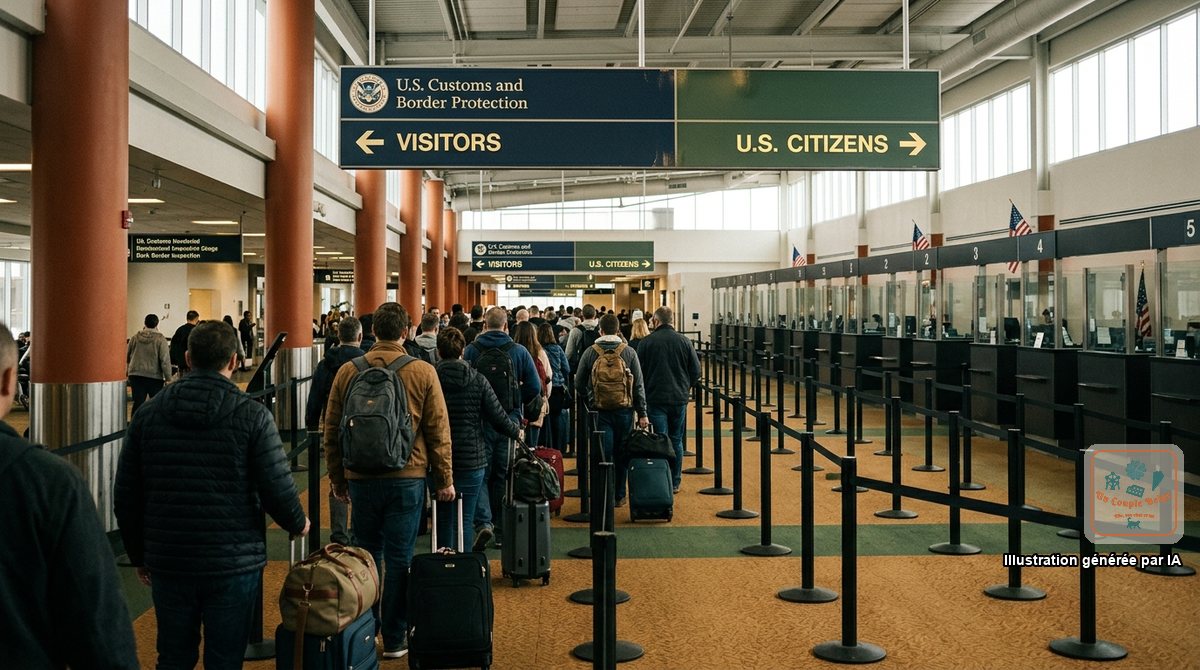
The most stressful moment at the start of a trip to the United States isn’t the flight: it’s the immigration queue on arrival.
In reality, if your ESTA is in order and you simply answer the questions, it almost always goes without a hitch. The longest part is the wait.
How it works
Coming off the plane, you follow the “Arrivals / Immigration” signs. Three steps follow one another:
- Immigration (Passport Control): a CBP officer checks your passport, your ESTA and the reason for your stay.
- Baggage reclaim, even if your bags are checked through to your final destination when you have a connection.
- Customs: you walk through with your bags, sometimes without even stopping, sometimes with an inspection.
The queues: which one to choose?
At the entrance to the immigration area, several queues are signposted:
- U.S. Citizens / Residents: not for us.
- Visitors / Non-U.S. Citizens (or All Passports): the regular queue for travellers with an ESTA.
- Mobile Passport Control (MPC): the queue reserved for those who have filled in the app (see below).
The automated kiosks (APC) you used to see a few years ago have disappeared from most airports.
In front of the officer
The officer takes your photo and your fingerprints (the four fingers of each hand, then the thumbs). Then come a few questions:
- What’s the purpose of your visit? → Tourism (Tourism / Vacation).
- How long are you staying? → The exact length.
- Where are you staying? → The first hotel, or “a road trip through Utah and Arizona”.
- What do you do for a living? → Your job.
- Is this your first time in the US?
- Sometimes: How much cash are you carrying? or Do you have a return ticket?
Keep your answers short and precise, with no jokes. Have to hand (on your phone or printed): the return ticket, the first accommodation booking, possibly the itinerary. You’re almost never asked for them, but it’s reassuring if you are.
If you’re travelling as a couple or a family, go up to the desk together.
For our part, it’s a lot of stress and waiting for not much in the end. Arriving well prepared helps: you show straight away why you’re there, how long you’re staying and that your return is booked. The officers have nothing against visitors coming to spend their money. They want to be sure you aren’t coming to work and that you will leave. When that’s clear, it all goes quickly and in a good atmosphere.
With the MPC app (Mobile Passport Control)
Mobile Passport Control is a free CBP app that lets you send your photo, your passport and your customs declaration in advance. On arrival, you take a dedicated queue, often much shorter.
Who can use it? ESTA travellers who are returning to the United States (returning Visa Waiver Program travelers), meaning those who have already been admitted at least once with an ESTA. For a very first trip to the United States, it isn’t possible.
How it works:
- Download the Mobile Passport Control app (publisher: U.S. Customs and Border Protection) before you leave.
- Create your profile and scan your passport. You can add the members of your family to the same submission.
- Once you’ve landed, on the tarmac or in the terminal: choose the airport, answer the customs questions and take a selfie in the app.
- Submit. You receive a virtual receipt with a QR code.
- Follow the MPC queue and show your passport to the officer. Fingerprints and a few questions are still possible.
Advantages: the time saved, sometimes an hour in big airports such as JFK or Miami. Limits: you need a connection on arrival (airport wifi or roaming), and it doesn’t exempt you from the check. The app works in about thirty American airports, including all the main points of arrival from Europe (New York JFK, Newark, Boston, Washington Dulles, Atlanta, Chicago O’Hare, Miami, Orlando, Dallas, Denver, Los Angeles, San Francisco, Seattle), as well as in Dublin for preclearance. The up-to-date list is on the CBP website.
Without MPC: the regular queue
Nothing complicated, it just takes longer. A few tips:
- If you can choose your seat on the plane, take one at the front: the first off are the first in the queue.
- Go to the toilet before landing, not after: the queue can last.
- Keep your passport and phone within reach, not at the bottom of your bag.
- No phone and no photos in the immigration area: it’s forbidden and the officers are quick to remind you.
Customs: what you can bring (or not)
The blue paper form (Customs Declaration 6059B) handed out on the plane has all but disappeared, but the rules remain the same and the questions are asked orally or through MPC.
Must be declared:
- Any food, even a packet of biscuits. Declaring doesn’t mean you’ll have to throw it away: it just means the officer can check. Not declaring, on the other hand, can cost you a hefty fine.
- More than 10,000 dollars (or the equivalent in euros) in cash, per family.
Banned or tightly controlled:
- Fresh fruit and vegetables, meat and charcuterie (even vacuum-packed), plants, seeds, soil.
- Hard, aged cheeses (parmesan, comté, old gouda) are generally accepted. Soft or fresh cheeses (brie, camembert, feta, ricotta) are subject to restrictions: better to leave them at home.
- Chocolate, biscuits, factory-made sweets: accepted, but to be declared.
- Medication: in its original packaging, with a prescription or a letter from your doctor in English for long-term treatments.
Allowances for non-residents (personal use): 1 litre of alcohol (if you are 21), 200 cigarettes or 50 cigars, and up to 100 dollars’ worth of gifts (excluding alcohol and tobacco) if you’re staying at least 72 hours.
And on the way home?
There’s no immigration check on leaving the United States: the airline passes on the information that you’ve departed. You only have to go through the TSA security check, with the usual rules on liquids.
Our advice
- Check your ESTA before you leave: it’s the airline that checks it at boarding. See our article on applying for an ESTA.
- Don’t take fresh food in your hand luggage for the flight, or eat it before landing.
- Answer honestly and simply. The officer isn’t there to trap you, but has the right to refuse entry without having to give a reason.
- If you travel via Dublin or Shannon, US immigration is done in Ireland before boarding (preclearance): you then arrive in the United States as if on a domestic flight.