Fuel in the United States: prices, paying at the pump and your fuel budget
Updated on
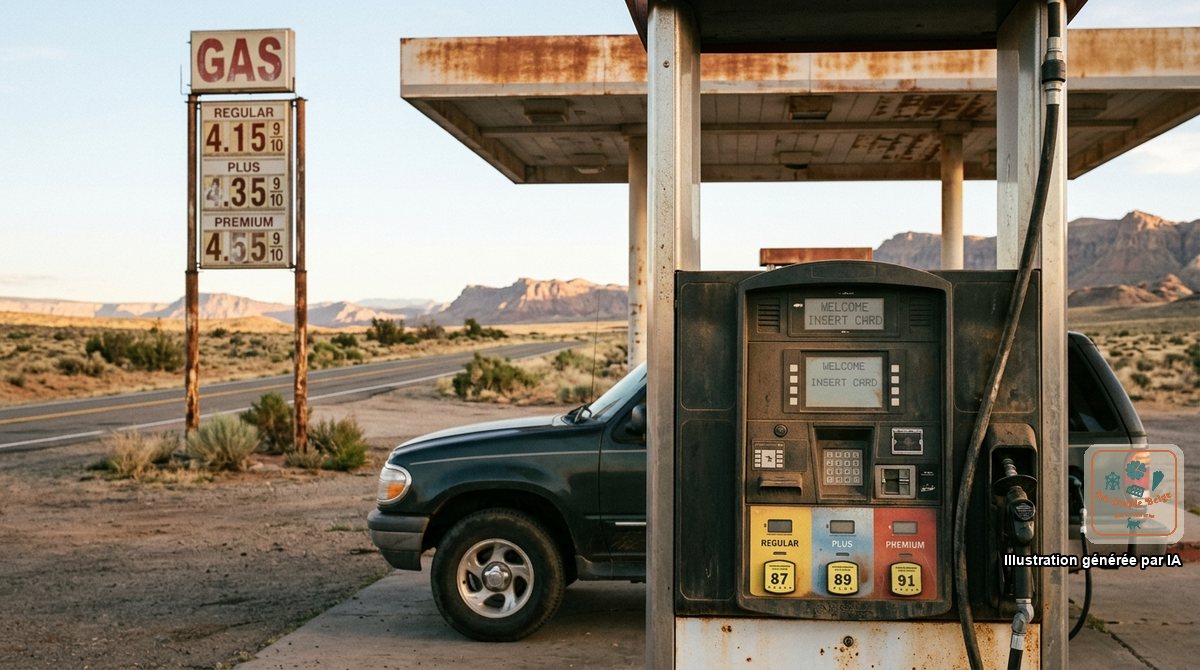
Filling up is the first thing you do with a car in the United States, and the first thing that throws you: gallons, the numbers 87, 89 and 91, and a terminal demanding a postcode. Nothing complicated once you’ve understood it.
Reading the prices
Fuel is sold by the gallon, which is 3.785 litres. The price displayed in large figures on the station’s sign is the price per gallon, taxes included.
In early October 2026, the national average was about 4.40 dollars a gallon of Regular, or roughly 1.15 dollars a litre. Prices move fast: look at the current figures on the AAA website (gasprices.aaa.com) before working out your budget.
Which fuel to choose?
| Name | Octane | For whom |
|---|---|---|
| Regular | 87 | Almost all rental cars |
| Mid-grade or Plus | 89 | Unnecessary in most cases |
| Premium | 91 to 93 | Certain sports or luxury models |
| Diesel | Rare in cars, common in pick-ups and motorhomes |
The American octane rating isn’t calculated as in Europe: American 87 corresponds roughly to our 91-92. Your rental car runs on Regular, unless stated otherwise on the fuel flap.
At altitude, in the Rockies, Regular sometimes drops to 85. If the rental company says nothing, take 87.
Paying at the pump
You pay before you fill up. The pump’s terminal accepts cards, but often asks for a ZIP code, the postcode linked to the card, which Belgian cards don’t have.
Three solutions, from the most reliable to the least:
- Pay at the till. Go into the shop and give the pump number and an amount: “Forty dollars on pump six, please.” If the tank is full before that, the difference is refunded to your card, or you’re given change if you paid in cash.
- Contactless. Apple Pay and Google Pay work on more and more pumps, with no postcode question.
- Ask for a full tank. Say “Fill it up on pump six”: the cashier keeps or pre-authorises your card, and you come back to settle up.
The terminal sometimes blocks a pre-authorisation of 100 to 175 dollars, released a few days later. It isn’t a double payment.
The other rules of the road are in our driving guide.
Huge gaps from one state to another
Fuel taxes depend on each state. In early October 2026, California was at 6.40 dollars a gallon, two dollars above the national average. Hawaii, Washington State, Nevada and Oregon are also among the most expensive. Texas, Oklahoma, Mississippi and the Southeast in general are the cheapest.
A few habits to adopt:
- Fill up before crossing a state line into an expensive state. Coming from Arizona, fill the tank before entering California.
- Avoid isolated stations. In Death Valley, near Yosemite or on Highway 1 at Big Sur, a gallon can cost one to two dollars more, sometimes beyond that.
- Steer clear of stations right next to airports when returning the car: they’re the most expensive in town. Fill up ten kilometres before.
- Costco, Sam’s Club and supermarkets (Kroger, Safeway) often have the best prices, sometimes reserved for members.
- The GasBuddy app compares the stations around you.
- The “cash” price is sometimes 5 to 10 cents lower than the “credit” price.
Estimating your fuel budget
Fuel consumption is expressed in miles per gallon (mpg). The higher the figure, the less the car uses. To convert: 235 divided by the mpg gives litres per 100 km. A car doing 30 mpg uses 7.8 litres per 100 km.
The formula:
distance in miles ÷ mpg × price per gallon
An example for 2,500 miles (4,000 km), with a compact SUV at 28 mpg and a gallon at 4.80 dollars on average in the West: 2,500 ÷ 28 × 4.80 = about 430 dollars.
| Vehicle | Consumption | Budget for 4,000 km at $4.80 |
|---|---|---|
| Hybrid saloon | 45 mpg | $270 |
| Compact SUV | 28 mpg | $430 |
| Large SUV or pick-up | 20 mpg | $600 |
| Campervan | 17 mpg | $705 |
| Motorhome | 10 mpg | $1,200 |
Not running out of fuel
In the West, some roads have no station for 100 to 200 km. Among the well-known stretches:
- Death Valley, where there are only three places to buy fuel, all very expensive;
- US-50 in Nevada, nicknamed the Loneliest Road in America;
- UT-95 and UT-261 between Monument Valley, Natural Bridges and Hanksville;
- Scenic Byway 12 between Escalante and Torrey;
- US-89A towards the North Rim of the Grand Canyon;
- Big Sur, between Carmel and San Simeon.
The rule we apply: we fill up as soon as the gauge drops below half, and without fail before entering a park. Air conditioning, hills and wind push consumption up far faster than expected.
And what about an electric car?
Rental companies offer more and more of them, sometimes for less. The fast-charging network is good along the main motorways and in California, and much sparser in the Utah parks, around Monument Valley or in Wyoming. For a first road trip in the West, we stick to petrol or a hybrid.