Driving in the United States: licence, rules of the road and pitfalls to avoid
Updated on
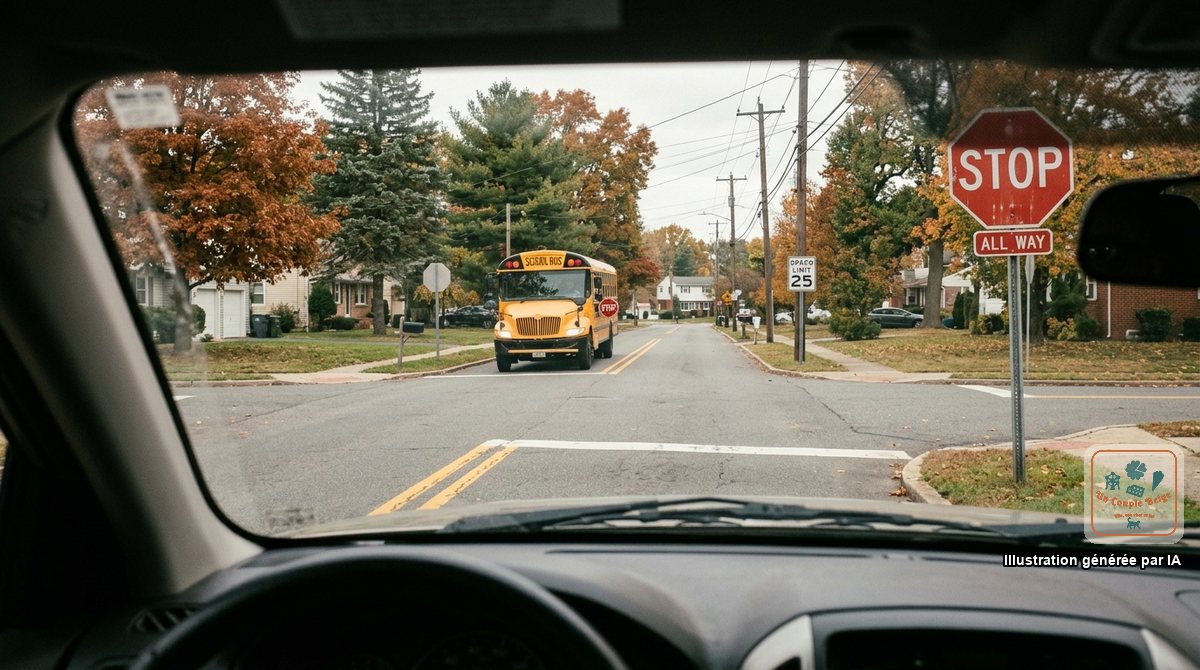
Driving in the United States is fairly restful when you come from Belgium: wide roads, cars that are almost all automatic, patient drivers over long distances. But a few rules are very different from ours, and some can prove expensive if you ignore them.
Here’s what you need to know before picking up the rental car.
The driving licence
A Belgian licence is generally enough to drive as a tourist, for a limited period. But the rules are a matter for each state, and some also ask for an international permit.
We still recommend applying for an international driving permit at your town hall before you leave. It doesn’t replace the Belgian licence, it translates it. It’s useful:
- in states where it’s required or strongly recommended;
- if a police officer doesn’t understand the Belgian licence;
- with certain rental companies that ask for it.
It costs around twenty euros (the price varies by municipality), is applied for with your identity card, your licence and a recent passport photo, and is valid for 3 years (but never longer than your Belgian licence). Apply a few weeks before departure: some town halls issue it on the spot, others have it sent.
Always carry both, along with your passport.
Units
| Unit | Benchmarks |
|---|---|
| Speeds in miles per hour (mph) | 1 mile = 1.6 km. 55 mph ≈ 90 km/h, 65 mph ≈ 105 km/h, 75 mph ≈ 120 km/h. |
| Distances in miles | A 300-mile journey is about 480 km. |
| Fuel in gallons | 1 gallon = 3.785 litres. A price of $3.50 a gallon is about $0.92 a litre. |
Speed limits
They vary from one state to another, and they are posted everywhere on rectangular white Speed Limit signs.
| Type of road | Usual limit |
|---|---|
| In town | 25 to 35 mph (40 to 55 km/h). |
| School zones | 15 to 25 mph at the times shown (often with a flashing amber light). Heavily enforced. |
| Main roads | 45 to 65 mph (70 to 105 km/h). |
| Motorways (Interstates) | 65 to 80 mph depending on the state (105 to 130 km/h). Texas even goes up to 85 mph on one stretch. |
The rules that change everything
Turning right on a red light. In almost every state, you can turn right when the light is red, after coming to a complete stop and if the way is clear (pedestrians included). Unless a “No Turn On Red” sign forbids it. In New York City it’s banned everywhere, unless a sign says otherwise.
The light is beyond the junction. Traffic lights are often hung on the far side of the intersection. You stop at the white line on the ground, not under the light.
The four-way stop (4-Way Stop or All-Way Stop). There’s a stop sign at every entry to the junction. Everyone comes to a complete stop, and the first to arrive is the first to go. If two arrive at the same time, the one on the right has priority. It works very well, provided you look carefully at who was there before you.
No general priority to the right. Unlike in Belgium, priority is shown by the signs (Stop, Yield). Where there’s no sign, stay cautious.
Overtaking on the right is allowed on multi-lane motorways. Cars can therefore pass you on both sides: check your mirrors carefully before changing lane.
Carpool lanes (HOV / Carpool lane). Marked by a white diamond on the road surface, they are reserved for vehicles with at least 2 (or 3) occupants, at the times shown.
Emergency vehicles. As soon as you hear a siren, pull over to the right and stop. On the motorway, if a police car or a tow truck is stopped on the hard shoulder, change lane or slow right down (Move Over Law, in every state).
Parking. Read all the signs: street-cleaning days, maximum stay, painted kerbs (red = no parking, yellow = deliveries, blue = disabled drivers). Never park in front of a fire hydrant.
Alcohol, phone, seat belt
- Alcohol: a limit of 0.8 g/l (0.08%) in every state, 0.5 g/l in Utah. And above all the open container rule: no opened bottle of alcohol inside the car, even an empty one. Put it in the boot.
- Phone: banned in the hand in most states. Use a holder and hands-free mode.
- Seat belt: compulsory in the front everywhere, and in the back in most states. Child seats are compulsory.
Filling up
This is often the first surprise. At the pumps you pay by card, but the terminal asks for a ZIP code (an American postcode), which European cards don’t have.
The solution:
- Go into the station shop.
- Give the pump number and an amount: “Fifty dollars on pump four, please”.
- Fill up. If there’s money left over, go back to the till: you’ll be refunded the difference.
The tricks doing the rounds (typing 00000 or a made-up postcode) rarely work. For our part, we often add a 0 in front of our Belgian postcode to reach the five digits asked for. Another solution: Apple Pay or Google Pay, accepted at the pump in more and more stations, which avoid the ZIP code question.
Standard fuel is called Regular (87 octane). There’s no need to take Premium for a rental car. Diesel is rare in passenger cars: don’t pick up the wrong nozzle (often the green one).
In the West, never let the tank drop below half in desert areas: one station can be 150 km from the next.
All the detail is in our fuel guide.
Tolls
Many states have almost none, but Florida, New York, New Jersey, California (certain bridges and express lanes) and Illinois have plenty. And more and more tolls have no booth: a camera reads the number plate.
- Rental companies offer a transponder or toll package (SunPass, E-ZPass…), charged by the day on top of the tolls. Convenient, but expensive over a long stay.
- Without a package, the rental company receives the bill and charges it on to you with an administrative fee for each passage.
Compare the options at the desk according to your itinerary.
On the East Coast and in Florida, we took Alamo’s TollPass, and there’s nothing to worry about: we paid 88 dollars extra for the whole journey from New York to Florida, with the various bridges. We didn’t use the paid express lanes, which weren’t worth it.
The rental companies’ plans and the special cases are in our tolls guide.
If the police stop you
Blue and red flashing lights behind you: they’re for you.
- Put your indicator on and pull over onto the verge as soon as you safely can.
- Switch off the engine, lower the window, and turn on the interior light if it’s dark.
- Stay in the car and keep your hands on the steering wheel. Don’t look for your papers before you’re asked.
- When the officer asks for your licence and the vehicle documents, say where they are before making a move (“My license is in my bag, can I reach for it?”).
- Be polite, and don’t argue about the fine on the spot. And above all, don’t offer to pay it in cash.
Our advice
- Take the first few kilometres gently, in a car park or a quiet area, to get the feel of the car.
- Download offline maps (Google Maps or Maps.me): the signal soon disappears in the parks.
- Watch out for animals at sunrise and sunset on country roads: deer, elk, free-roaming cattle (Open Range).
- Keep water and something to eat in the car for the long crossings.
Our experience at the wheel
The first kilometres are stressful: the cars are bigger and everything is new. But you quickly get used to multi-lane motorways, to being overtaken on the right, to four-way stops and to turning right on red. Once the habit is there, you see the advantages. On the whole, we also find Americans more relaxed and more courteous on the road.