Badlands: a lunar landscape sculpted by erosion, rich in fossils
Updated on
How long should you spend there?
At a glance
- Entrance fee
- $30 per vehicle for 7 days, with no surcharge for non-residents. Card payment only.
- Best time to go
- May, June, September and October. Summer is very hot and stormy, winter freezing and windy.
- Book ahead
- None.
- Getting around
- By car, on a scenic road about 50 km long that crosses the park.
| Walks and hikes | Distance | Time | Level |
|---|---|---|---|
| Window Trail | 0.4 km (round trip) | 15 min | easy |
| Fossil Exhibit Trail | 0.4 km (loop) | 20 min | easy |
| Door Trail | 1.2 km (round trip) | 30 min | easy |
| Notch Trail | 2.4 km (round trip) | 1 hr 30 | moderate |
| Castle Trail | 16 km (round trip) | 5 hrs | moderate |
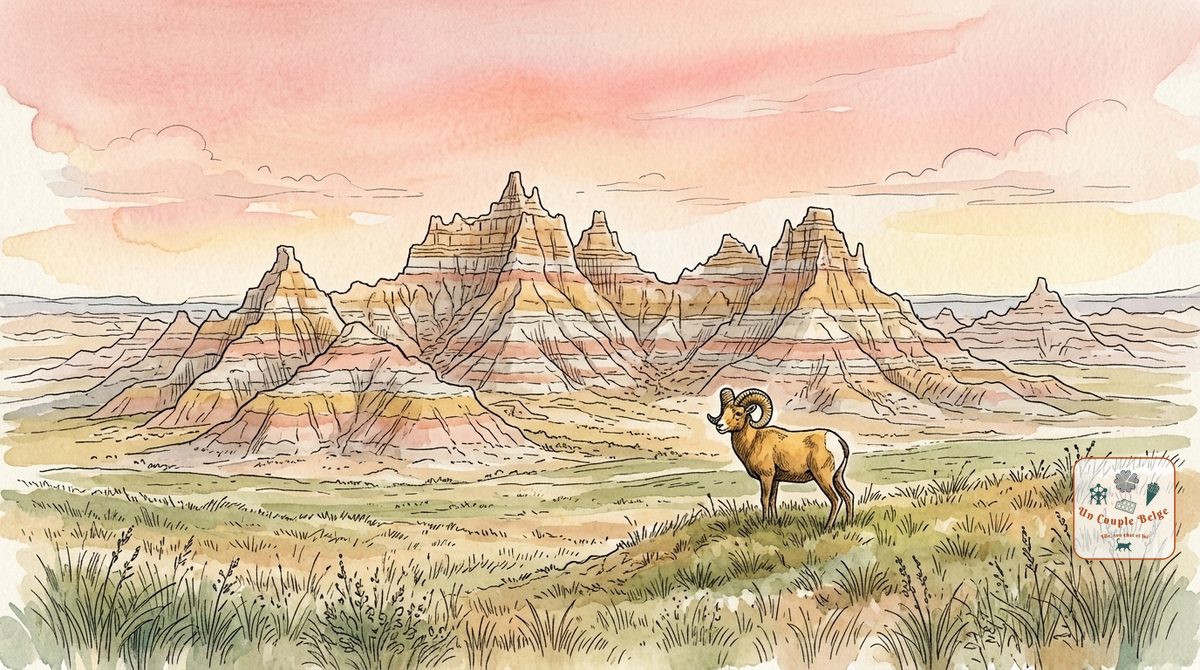
In the middle of the South Dakota prairie, the ground suddenly opens up. For dozens of kilometres, erosion has cut hills striped with pink, yellow and grey, along with spires and ravines. The Badlands are easy to visit, on a road that runs along this chaos and trails that take a few minutes.
History and origins
The name says exactly what it is. The Lakota already called the place mako sica, “bad lands”, and French trappers “les mauvaises terres à traverser”, bad lands to cross: no water, impossible terrain, clay that sticks as soon as it rains.
These layers of sediment are an open book. They hold one of the richest mammal fossil beds in the world, more than 30 million years old: ancestors of the horse, the rhinoceros, the camel. Erosion uncovers new ones every year.
The site was protected in 1939 and became a national park in 1978. Its southern half lies on the Pine Ridge reservation of the Oglala Lakota.
What to do there
- The scenic road: the Badlands Loop Road winds from one overlook to the next, along the “wall” that separates the upper prairie from the lower. Allow two hours with stops.
- Door, Window and Notch Trails: three trails starting from the same car park. The first two lead you into the heart of the ravines in a few minutes. The third climbs a log ladder to a view over the valley.
- The overlooks: Big Badlands, Yellow Mounds, with its yellow and purple hills, and Pinnacles, the most beautiful at sunset.
- Sage Creek Rim Road: a gravel road where you are almost certain to come across bison, bighorn sheep and a huge colony of prairie dogs.
- The fossil trail: a boardwalk lined with casts of the animals found here. In summer you sometimes see palaeontologists at work.
- The night sky: far from any town, the park is very dark. Stargazing evenings are held in summer.
Stories and good to know
- The black-footed ferret, once believed extinct, has been reintroduced here. It only comes out at night and hunts prairie dogs.
- The Badlands are retreating by about two centimetres a year. At that rate, they will have disappeared in 500,000 years.
- If you find a fossil, don’t touch it: report it to the rangers. Several important discoveries have been made by visitors.
Practical information for your road trip
- Pass: the America the Beautiful pass covers the entrance fee. Everything is explained in our guide to the national parks pass.
- Getting there: the park runs alongside Interstate 90, about an hour from Rapid City. You go in at one end and come out at the other.
- Nearby: Wall Drug, a giant drugstore turned roadside attraction, and the Minuteman Missile site, a former nuclear silo from the Cold War.
- Where to stay: in Wall or Interior. The park has a lodge of cabins and two campgrounds.
- Combine it with: Mount Rushmore, the Black Hills and Wind Cave, less than two hours away.
Quick quiz
Question 1 / 3
Where to stay near Badlands: a lunar landscape sculpted by erosion, rich in fossils
Stay22 affiliate links: if you book through here, we earn a small commission at no extra cost to you. Thanks for your support!
On the ground

Sponsored by UnCoupleBelge
Follow us on Instagram
Box sponsored by a partner
Comments