US national parks and the America the Beautiful pass
Updated on
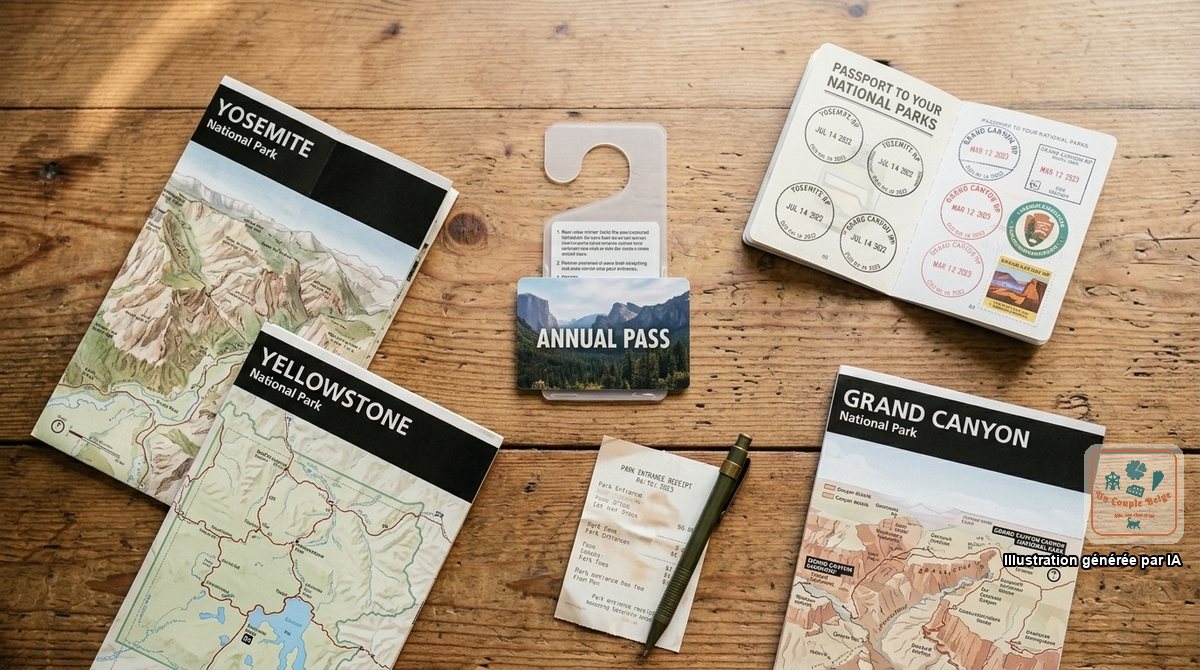
National parks are often the whole point of a road trip in the American West. They are run by the National Park Service (NPS), a federal agency, and are very well organised: scenic roads, marked trails, visitor centers, rangers.
But there’s an entrance fee, some reservations are made months ahead, and the rates for foreign visitors changed at the start of 2026.
The parks in brief
- 63 national parks in the strict sense (National Parks), spread over 30 states and two territories.
- More than 400 sites managed by the NPS in total: national monuments, recreation areas, historic sites, seashores…
- The most visited: Great Smoky Mountains, straddling Tennessee and North Carolina. The most famous in the West: Grand Canyon, Yellowstone, Yosemite, Zion.
- The largest: Wrangell–St. Elias in Alaska, about 53,000 km², almost twice the size of Belgium.
How much does it cost to get in?
In most parks that charge, the entrance fee is paid per vehicle and remains valid for 7 days. Allow in general between 20 and 35 dollars per car, depending on the park (35 dollars at Zion or the Grand Canyon, for example). Some parks are free: Redwood, Congaree or Gateway Arch, for example. Great Smoky Mountains has no entrance fee, but you need a parking tag whenever you park for more than 15 minutes (5 dollars a day, 15 dollars a week).
What changed in 2026 for foreigners
The America the Beautiful pass
It’s the annual card that gives access to all federal sites: national parks, national monuments, national forests, areas managed by the Bureau of Land Management, and so on.
| The pass | Good to know |
|---|---|
| Validity | 12 months from the month of purchase (bought in May 2026, it expires at the end of May 2027). |
| Coverage | The holder and the passengers in their vehicle (in parks that charge per vehicle), or the holder plus 3 adults (in those that charge per person). In the eleven surcharge parks, the non-resident pass also covers the 100 dollars for the holder and three other non-residents aged 16 and over. Under-16s get in free. |
| Signatures | Two people can sign the pass. For two, that means a single pass for the couple, even if you split up for a day. |
| Where to buy it | At the entrance to any park that charges, at visitor centers, or online at Recreation.gov, which has offered a fully digital version since 2026: you buy it before you leave and keep it on your phone. |
| Identification | Keep your passport on you, as rangers may ask to see it along with the pass. |
What it doesn’t cover: campgrounds, paid guided tours, private shuttles, state parks and Navajo sites.
Does it pay for itself?
With the new rates, the answer is almost always yes as soon as two of you visit one of the eleven big parks. An example: two people at Zion without a pass means the car entrance fee plus 2 × 100 dollars in surcharges, already more than 230 dollars for a single park. The 250-dollar pass has paid for itself by the first visit, or nearly.
For a stay that only takes in less busy parks, do the sums: from seven or eight paying parks, it’s still worthwhile.
The reservations to plan ahead
Some parks limit access in high season with timed entry reservations, to be made on Recreation.gov. The systems change every year, so always check the park’s official page (nps.gov) a few months before you leave.
Other reservations are made a long time ahead:
- Campgrounds in the parks: they generally open 6 months ahead, and places go in a few minutes for Yosemite, Zion or the Grand Canyon.
- Historic lodges (El Tovar, Old Faithful Inn…): sometimes more than a year ahead.
- Popular permit hikes: Angels Landing at Zion, Half Dome at Yosemite, The Wave near Page. They work by lottery.
Arriving in a park
The routine is almost always the same, whatever the park.
- The entrance station. You show your pass (or pay the entrance fee) from the car. The ranger hands you, free of charge, the official park map, a leaflet with all the roads, viewpoints and trails, and often the park newspaper, with the shuttle timetables, the ranger programmes and the current closures. Keep them: they are the best documents for getting organised, and lovely souvenirs.
- The visitor center. It’s the first stop to make. You’ll find rangers to advise you according to the time you have, a relief model or an exhibition about the park, often an introductory film, toilets, water and a shop. It’s also where you check the weather and the state of the trails.
- The park stamps. Every visitor center has a small counter with a free ink stamp, bearing the park’s name and the day’s date (a cancellation stamp). You can put it in a notebook of your own, or in the Passport To Your National Parks, a small official booklet sold in the park shops (about 15 dollars for the classic edition). It’s a souvenir that costs next to nothing and makes you want to collect parks. We got our first stamps at Joshua Tree, and haven’t stopped since.
- The Junior Ranger programme. Ask for the booklet at the visitor center: it’s free. Children complete activities during the visit (observing, drawing, answering questions), then take an oath in front of a ranger and receive a badge. It’s designed for ages 5 to 13, but anyone can do it, adults included.
- Ranger programmes. Guided walks, talks, stargazing: most are free and are announced in the park newspaper.
Closed roads and trails: where to look
A road cut off by snow, a trail closed after a flood, a campground under repair: it happens in every park, and it changes from one week to the next. The only place that is truly up to date is the park’s official website.
- Every park has its page on nps.gov, at a short address: nps.gov/grca for the Grand Canyon, nps.gov/zion for Zion, nps.gov/care for Capitol Reef.
- At the very top of that page, an Alerts banner flags current closures. The Plan Your Visit section, then Alerts & Conditions, gives the details: roads, trails, campgrounds, water points.
- The NPS App carries the same alerts, and works offline if you’ve downloaded the park beforehand.
- On the spot, the visitor center posts the day’s closures.
Look at this page a few days before you arrive, then again the day before. It’s also what we point to in our place guides, rather than copying out closures that would no longer be true a month later.
Once there: the rules to know
- Stay on the trails. In desert areas, the soil crust (cryptobiotic soil) takes decades to form again.
- Don’t feed the animals and keep your distance: at least 23 metres (25 yards) from bison, elk and other animals, 91 metres (100 yards) from bears, wolves and mountain lions.
- Food in the car or in the bear lockers in parks that have them.
- Drones are banned in all national parks.
- No collecting: stones, flowers and petrified wood stay where they are.
- Phone signal is rare: download offline maps and the official NPS App, which also works offline.
- Fill up before you enter: petrol stations are few and expensive in the parks.
Our advice
- Buy the pass at the first park on your itinerary, directly at the entrance station. It’s the simplest way.
- Arrive early. Before 8am there’s no queue at the entrance, parking is available and the light is more beautiful.
- Talk to the rangers at the visitor center: they know the state of the trails and the day’s closures.
- Call at the visitor center before you start: map, stamp, rangers’ advice, everything is done in the same place.
For our part, we had bought our pass for 80 dollars, before the price change. It served us in all the national parks we visited, right up to Shark Valley, in the Everglades, in January 2026. At the new price of 250 dollars, it still pays for itself as soon as two of you visit one of the eleven big parks.
The pass at 80 dollars a year was a real bargain, and the increase disappointed and rather shocked us. Even so, it still beats paying each entrance separately once you string several parks together.