Craters of the Moon: an ocean of black lava in Idaho
Updated on
How long should you spend there?
At a glance
- Entrance fee
- $20 per vehicle for 7 days. The national parks pass is accepted.
- Best time to go
- From May to October. The monument road is closed to cars from mid-November to mid-April.
- Book ahead
- None. The cave permit is free and collected at the visitor center.
- Getting around
- By car, on an 11 km loop. Nothing to eat on site, and almost no shade.
| Walks and hikes | Distance | Time | Level |
|---|---|---|---|
| North Crater Flow | about 0.5 km (loop) | 20 min | easy |
| Devils Orchard | 0.8 km (loop) | 20 min | easy |
| Inferno Cone | about 0.8 km (round trip) | 30 min | moderate |
| The caves, as far as Indian Tunnel | about 2.5 km (round trip) | 1 hr to 1 hr 30 | moderate |
| Tree Molds | 3.2 km (round trip) | 1 hr | easy |
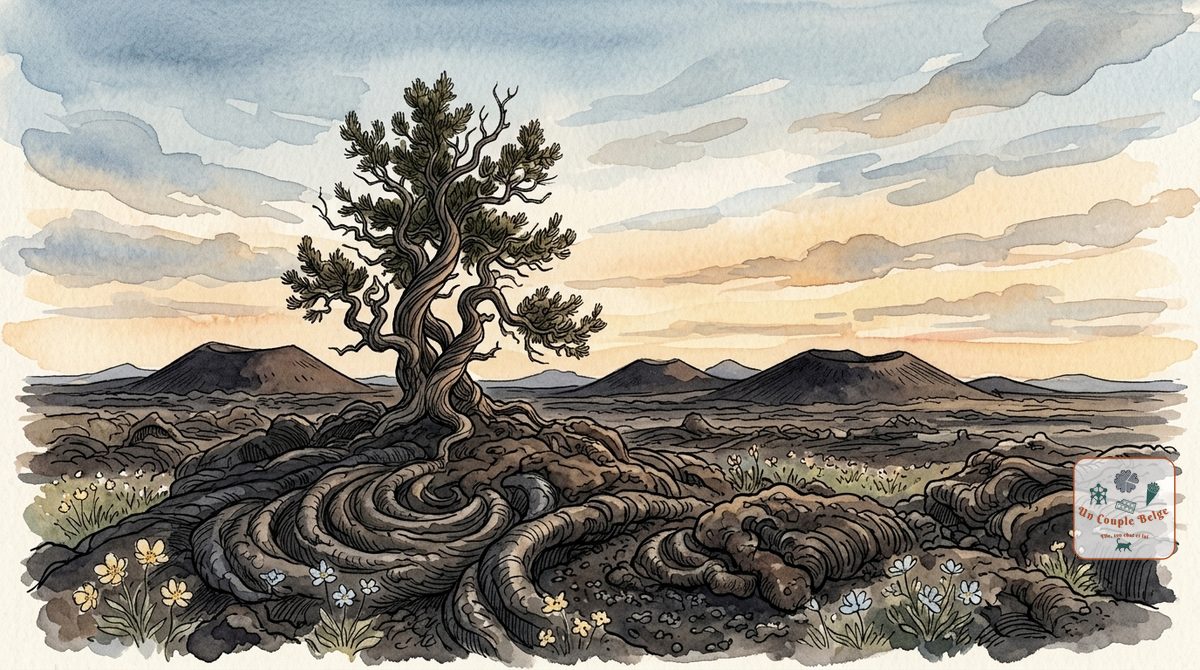
In the middle of Idaho’s farmland, Highway 20 suddenly crosses a black landscape: frozen lava as far as the eye can see, cinder cones, fissures. Craters of the Moon is well named. In 1969, the Apollo astronauts came here to train before leaving for the Moon.
History and origins
There’s no big volcano here. The lava came out of a long fissure, the Great Rift, which runs for more than 80 km. The eruptions followed one another between 15,000 and 2,000 years ago. The last one is therefore very recent, on the Earth’s timescale, and geologists expect more one day.
The Shoshone had always known the place. The settlers, for their part, avoided it: nothing grows there, and the lava cuts shoes to pieces. In the 1920s an explorer, Robert Limbert, crossed it on foot, photographed it and campaigned to have it protected. President Coolidge created the national monument on 2 May 1924.
What to do there
- The loop by car: 11 km of road, serving all the sites. Allow half an hour without stops.
- Inferno Cone: a black cinder cone that you climb in ten minutes, up a steep slope. From the top you see the whole lava field and the line of cones along the fissure.
- The Spatter Cones: small craters formed by spatters of lava. You can look down into them from the rim, a stone’s throw from the car park.
- The lava caves: tunnels hollowed out by molten lava. Indian Tunnel is the largest: its roof has partly collapsed, and it’s light enough inside to walk through without a torch. The others call for a torch and a bit of agility.
- North Crater Flow: a boardwalk across a 2,000-year-old flow, its surface wrinkled like cloth.
- Devils Orchard: a flat trail among blocks of lava and twisted trees.
- Tree Molds: a trail to tree moulds, the imprints of trunks left in the lava.
- The night sky: the site has been certified for the quality of its night sky since 2017. Far from any town, the Milky Way is very clear here.
Stories and good to know
- In August 1969, four astronauts from the Apollo programme, including Alan Shepard, came here to learn to recognise volcanic rocks.
- It’s the largest recent lava field in the United States, outside Alaska and Hawaii.
- Arco, the nearest village, 29 km away, became in 1955 the first town in the world to be lit by nuclear power.
- In winter the road isn’t cleared of snow. It becomes a cross-country skiing and snowshoeing trail.
Practical information for your road trip
- Getting there: the monument is on Highway 20, 135 km from Idaho Falls and 145 km from Twin Falls, about 1 hr 30 in both cases. Allow nearly 4 hrs from the west entrance of Yellowstone.
- How long: two to three hours are enough for the loop, Inferno Cone and the Spatter Cones. Add one to two hours for the caves.
- Equipment: a torch for the caves, closed shoes, water and sun cream.
- Where to stay: there’s no hotel on site, only a campground in the middle of the lava. The nearest motels are in Arco.
- Combine it with: Yellowstone and Grand Teton to the east. It’s a small site, which is very easy to visit in a day along the way.
Our experience at Craters of the Moon
We went there on our road trip 3, and we’ll be telling you all about it soon. Until then, if you’d like more details, feel free to write to us by message or on Instagram.
The day-by-day account will be available soon.
Quick quiz
Question 1 / 3
Expert
Craters of the Moon: an ocean of black lava in Idaho
Where to stay near Craters of the Moon: an ocean of black lava in Idaho
Stay22 affiliate links: if you book through here, we earn a small commission at no extra cost to you. Thanks for your support!
On the ground

Sponsored by UnCoupleBelge
Follow us on Instagram
Box sponsored by a partner
Comments