Great Basin: absolute solitude among caves, ancient pines and starry skies
Updated on
How long should you spend there?
At a glance
- Entrance fee
- Free. Cave tours cost $8 to $15 per adult.
- Best time to go
- From June to September, when the Wheeler Peak road is open all the way up. The cave can be visited all year.
- Book ahead
- Cave tours, online at recreation.gov. They sell out in summer.
- Getting around
- By car. The park is more than an hour from the nearest real town.
| Walks and hikes | Distance | Time | Level |
|---|---|---|---|
| Alpine Lakes Loop | 4.3 km (loop) | 1 hr 30 | moderate |
| The bristlecone pines | 4.5 km (round trip) | 2 hrs | moderate |
| Wheeler Peak, to the summit | about 14 km (round trip) | 6 to 8 hrs | strenuous |
The Great Basin is an immense dry region of the American West, where the rivers never reach the sea: they vanish into salt lakes or into the sand. In the middle of it, isolated mountain ranges rise like islands. The park protects one of them, in eastern Nevada, very close to Utah.
History and origins
From the sagebrush desert at its foot to the summit of Wheeler Peak, at 3,982 metres, you pass in an hour’s drive through every band of vegetation, up to the alpine meadows.
Around 1885, a local rancher, Absalom Lehman, discovered a cave and began showing people round it. It was protected in 1922. The national park itself dates from 1986.
What to do there
- Lehman Caves: a marble cave with densely packed formations: columns, draperies, and “shields”, large stone discs that are fairly rare. It can only be visited with a ranger.
- The Wheeler Peak road: 19 km of hairpin bends, from the desert to over 3,000 metres, with views of empty valleys to the horizon.
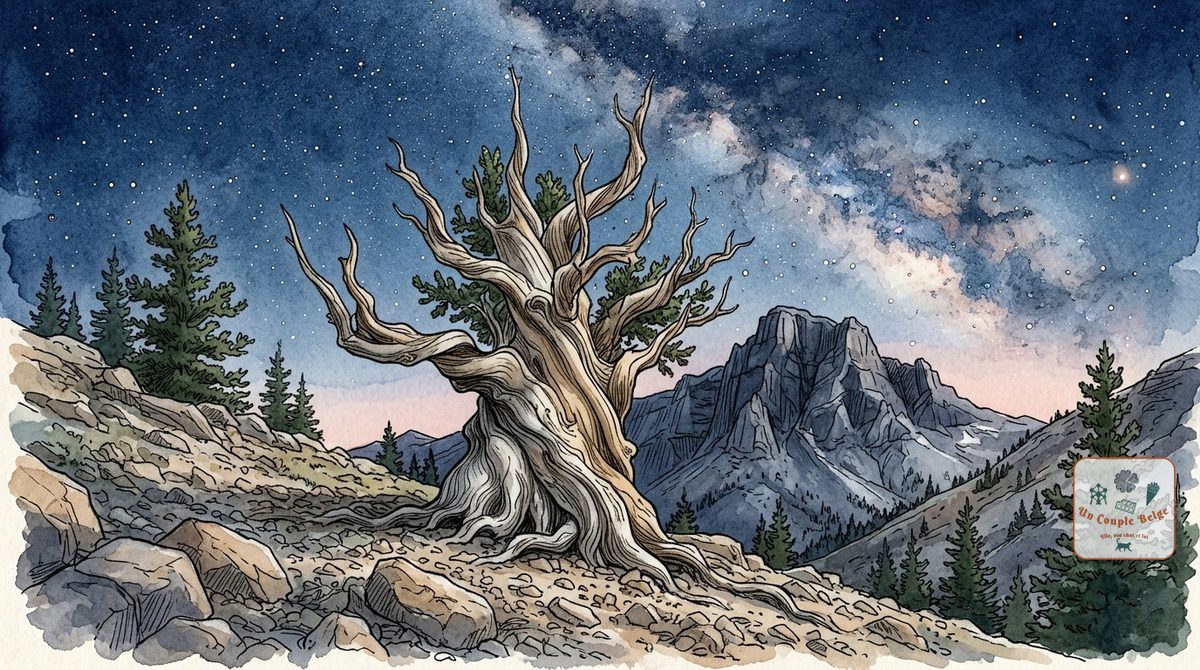
- The bristlecone pines: twisted trees, half dead to look at, growing at the treeline. Some are more than 3,000 years old. They are among the oldest living things on the planet.
- The alpine lakes: two small lakes at the foot of the cliffs of Wheeler Peak, on an easy loop.
- Wheeler Peak: a long climb up a stony ridge, to the second-highest summit in Nevada.
- The stars: the park is one of the darkest places in the contiguous United States. Rangers hold astronomy evenings in summer.
Stories and good to know
- In 1964, a student had a bristlecone pine felled here in order to count its rings. It had nearly 4,900. Without his knowing it, it was one of the oldest trees in the world.
- Highway 50, which runs north of the park, is nicknamed “the Loneliest Road in America”.
- The park is one of the least visited in the country.
Practical information for your road trip
- Getting there: the park is about 4 hrs 30 from Las Vegas and 4 hrs from Salt Lake City. The last town, Ely, is an hour away.
- Fuel and food: the hamlet of Baker, at the entrance, has only one pump and one or two cafés, not always open. Fill up beforehand.
- Altitude: the trails start at 3,000 metres. You get out of breath quickly, and storms arrive in the afternoon in summer.
- Where to stay: in Baker or Ely. The park has several campgrounds.
- Combine it with: a drive across Nevada on Highway 50, or the parks of southern Utah.
Quick quiz
Question 1 / 3
Where to stay near Great Basin: absolute solitude among caves, ancient pines and starry skies
Stay22 affiliate links: if you book through here, we earn a small commission at no extra cost to you. Thanks for your support!
On the ground

Sponsored by UnCoupleBelge
Follow us on Instagram
Box sponsored by a partner
Other places nearby
Lake Tahoe: the blue jewel between California and Nevada
A large mountain lake of deep blue, at an altitude of 1,900 metres, between California and Nevada. Beaches, coves and trails in summer, and skiing in winter.

Las Vegas: the Strip, its neon lights and the desert all around
An Eiffel Tower, a pyramid and dancing fountains in the middle of the desert: you either love it or soon have enough. The finest landscapes begin half an hour from the Strip.
Comments