South Carolina: Charleston, islands and Lowcountry marshes
Updated on
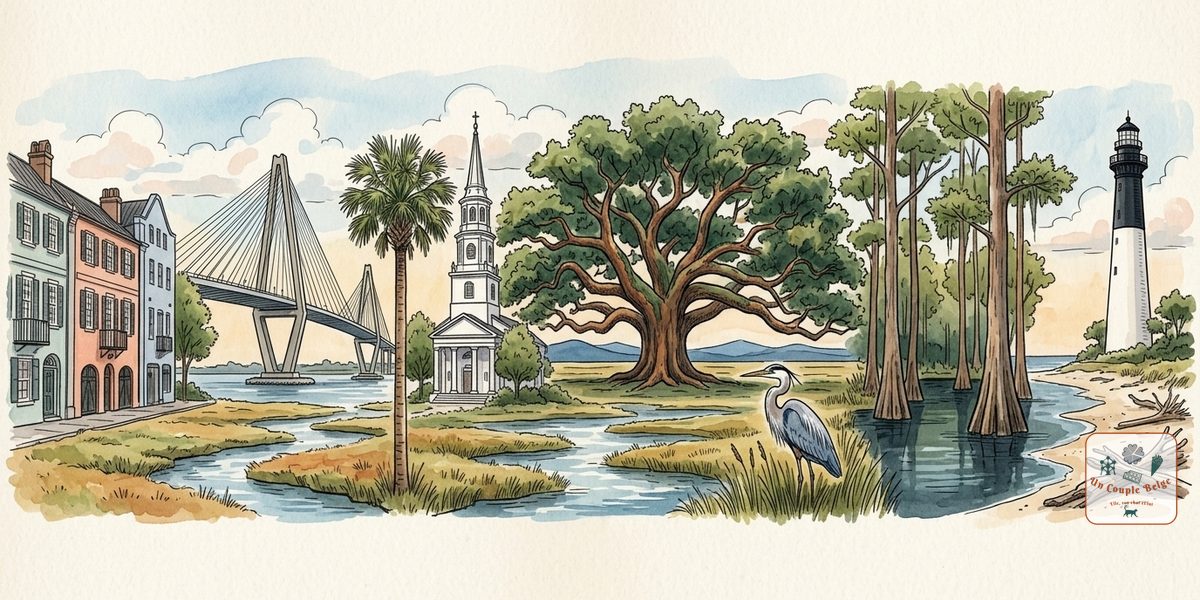
South Carolina has something few Southern states can match: a coast that smells of salt and jasmine, swamps where cypresses sink their roots into tea-coloured water, and a city, Charleston, whose historic centre seems frozen between the 18th and 19th centuries. The “Lowcountry”, this low-lying region of marshes, islands and tidal rivers, has an easy way of life and a cuisine that are enough to justify the trip.
But South Carolina also carries a heavy history. Charleston was one of the largest ports of arrival for enslaved Africans in North America, and it was here that the first cannon shot of the Civil War was fired, in 1861. Today the state is increasingly facing up to that memory, through its museums and Gullah culture, the living heritage of the deported Africans. Between beaches, marshes, history and mountains, it’s easy to explore in a week.
South Carolina at a glance
- Capital: Columbia
- Largest city: Charleston (which recently overtook Columbia)
- Population: about 5.4 million
- Area: about 83,000 km², a little under three times Belgium
- Joined the Union: 1788, 8th state
- Time zone: Eastern Time (6 hours behind Brussels)
- Nickname: Palmetto State, after the palmetto palm that appears on its flag
- Highest point: Sassafras Mountain, 1,085 metres
Geography: from the Lowcountry to the Upstate
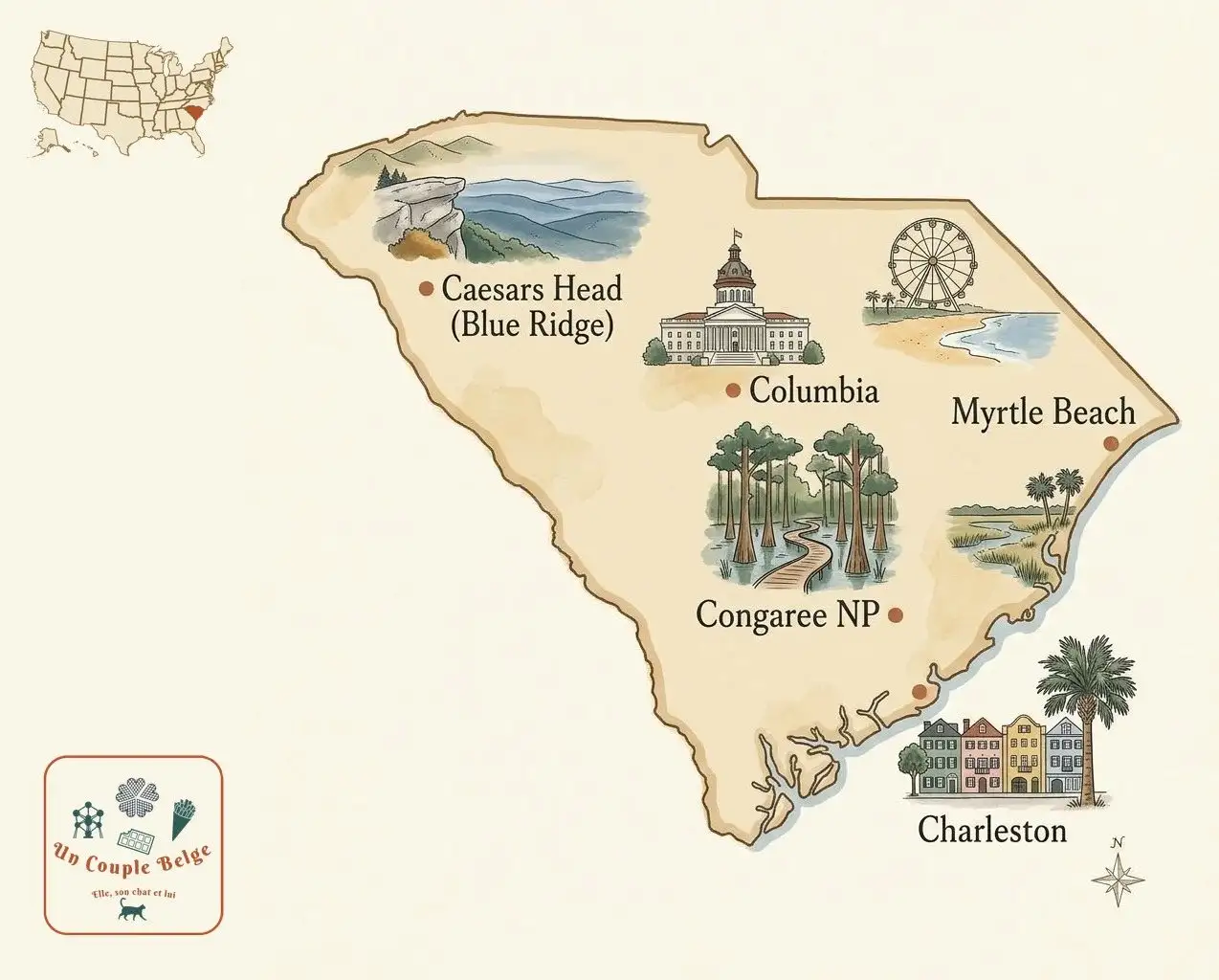
The Lowcountry, on the southern part of the coast, is a region of salt marshes, tidal rivers and barrier islands: Charleston, Beaufort, Hilton Head and the Sea Islands.
The Grand Strand, on the northern part of the coast, lines up nearly 100 kilometres of beaches around Myrtle Beach.
The Midlands, in the centre, with Columbia, are a region of pine forests, sandy hills and reservoirs, with Congaree National Park.
The Upstate, in the north-west, climbs towards the Blue Ridge Mountains, with Greenville, waterfalls and mountain lakes.
A bit of history
The Cherokee, the Catawba, the Yamasee and other peoples lived here. After Spanish and French attempts in the 16th century, the English founded Charleston in 1670. The colony became one of the richest in America thanks to plantations of rice, indigo and then cotton, which rested on slavery: in the 18th century, the majority of the population was enslaved, and about 40% of the Africans deported to North America passed through Charleston.
In December 1860, South Carolina was the first state to secede. On 12 April 1861, Confederate cannons fired on Fort Sumter, in Charleston harbour: the Civil War had begun. In 1865, Columbia was partly burned by Sherman’s troops. After the war the region grew poorer, then recovered with the textile industry and tourism. In 1989, Hurricane Hugo ravaged the coast. In 2015, the massacre of nine worshippers at Mother Emanuel church in Charleston led to the removal of the Confederate flag from the State House grounds.
The must-sees
Charleston
Charleston deserves at least three days. Its historic centre, with the colourful houses of Rainbow Row, the “single houses” with their long side porches, the secret gardens behind wrought-iron gates and the cobbled streets shaded by oaks, is explored on foot. The seafront at Waterfront Park with its pineapple fountain, the Battery and its mansions facing the harbour, and the Charleston City Market are essential. The city is nicknamed the “Holy City” for its many steeples.
A ferry leads to Fort Sumter, where the Civil War began. The International African American Museum, opened in 2023 on the wharf where enslaved Africans were landed, is an essential place. And Charleston is one of the best food cities in the United States.
In spring, the Spoleto Festival, a major performing arts festival, livens up the city for three weeks.
The plantations
Around Charleston, several former plantations can be visited. Magnolia Plantation and Middleton Place are famous for their gardens, among the oldest in America. Boone Hall has a spectacular avenue of oaks. McLeod Plantation, for its part, tells the story from the point of view of the enslaved people who lived there. For an accurate picture, start with that one.
The Sea Islands and Gullah culture
Along the coast, the islands long lived in isolation, which allowed the descendants of the deported Africans to preserve a culture and a creole language of their own: Gullah, or Geechee. You discover it at the Penn Center, on St. Helena Island, one of the first schools for formerly enslaved people, through the sweetgrass baskets woven and sold beside Highway 17 near Mount Pleasant, and in the cooking.
On Johns Island, the Angel Oak, an oak several centuries old with immense branches, is a moving stop.
Beaufort, Hilton Head and the beaches
Beaufort, a pretty little town of antebellum mansions, served as a backdrop for Forrest Gump 🎬 and The Big Chill 🎬. Hunting Island State Park has a wild beach, a palm forest and a lighthouse you can climb. Hilton Head Island is a big seaside resort of golf courses and cycle paths. Closer to Charleston, Folly Beach is the locals’ laid-back beach, while Kiawah and Isle of Palms are more upmarket.
To the north, Myrtle Beach and the Grand Strand are an immense, popular holiday area: beaches, golf courses, a big wheel and amusement parks. For something quieter, Brookgreen Gardens combines gardens with one of the largest collections of outdoor sculpture in the country.
Congaree
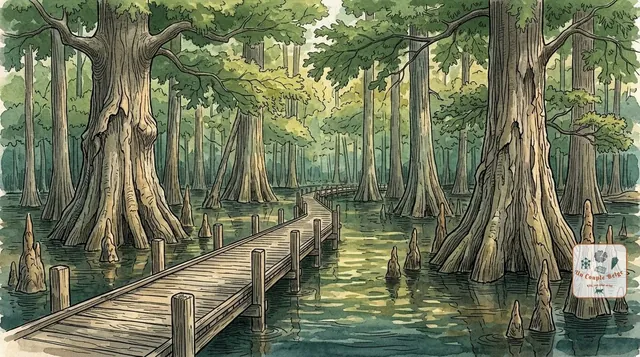
Half an hour from Columbia, Congaree National Park protects the largest old-growth bottomland hardwood forest in the United States, with trees among the tallest in the East. A boardwalk of nearly 4 kilometres lets you walk through it without getting your feet wet, and you can also explore it by canoe. In late May and early June, the park hosts synchronous fireflies, which all flash at the same time. Places to see them are allocated by lottery.
Columbia
The capital has a State House whose walls still bear bronze stars marking where Sherman’s shells struck. Riverbanks Zoo is one of the best in the Southeast, and the Vista district is lively in the evening.
The Upstate and the mountains
In the north-west, Greenville is a booming city, with a pleasant centre and Falls Park, where a curved suspension bridge spans a waterfall right in the middle of town. The Cherokee Foothills Scenic Highway runs along the mountains, with state parks such as Table Rock and Caesars Head, waterfalls and Lake Jocassee, with turquoise water, surrounded by forest. Whitewater Falls, on the North Carolina border, are among the highest waterfalls in the East.
Itinerary ideas
One week, the Lowcountry. Charleston (3 days) → plantations → Beaufort and Hunting Island (1-2 days) → Hilton Head → Savannah, right next door in Georgia.
10 days, from the sea to the mountains. Myrtle Beach → Charleston (3 days) → Beaufort → Congaree → Columbia → Greenville and the mountains (2 days).
In combination. South Carolina combines very well with Savannah (Georgia), 2 hours from Charleston, and with North Carolina (Asheville is 1 hour from Greenville).
On the plate
- Shrimp and grits, shrimp on creamy ground corn, the Lowcountry’s signature dish.
- Lowcountry boil (or Frogmore stew): shrimp, sausage, corn and potatoes boiled together and tipped out onto the table.
- Charleston’s she-crab soup, a creamy soup of crab and crab roe, lifted with a dash of sherry.
- Carolina Gold rice, an old variety that made the region’s fortune, and red rice, a tomato rice.
- The mustard-sauce barbecue of the Midlands, a speciality unique to South Carolina.
- Boiled peanuts, the state’s official snack, peaches (the state is one of the country’s big producers) and pimento cheese, a spread of cheddar and peppers.
- And sweet iced tea: Summerville presents itself as its birthplace.
Culture and trivia
- The shag, a partner dance born on the beaches of Myrtle Beach in the 1940s to “beach music”, is the state’s official dance.
- Gullah sweetgrass baskets are a skill handed down from West Africa, and some are on display at the Smithsonian.
- Charleston has been voted best city in the United States many times by the readers of travel magazines.
- Hurricane Hugo, in 1989, was one of the most destructive in the state’s history. Flood marks are still visible on some buildings.
When to go
- Spring (March to May): the best time, with the azaleas and the gardens in bloom, and mild temperatures.
- Autumn (October-November): excellent, with the sea still warm and fewer people.
- Summer (June to August): hot and very humid, with mosquitoes and afternoon thunderstorms. High season on the beaches.
- Winter: mild and quiet, ideal for visiting Charleston without the crowds.
- Hurricane season: from June to November, peaking from late August to October.
Practical information
- Recommended length of stay: 6 to 8 days for Charleston, the coast and a foray inland.
- Getting there: Charleston airport is served by connecting flights, as are Myrtle Beach and Greenville. Charlotte (North Carolina) and Atlanta are alternatives.
- Getting around: Charleston can be explored on foot. For everything else, a car is essential.
- Budget: moderate, but Charleston is expensive, especially for accommodation in the historic centre.
- Things to watch out for: in the marshes and at Congaree, insect repellent is essential. Be wary of alligators in ponds and lagoons.
- One more tip: for the Congaree fireflies, enter the lottery as soon as it opens, in spring.