South Dakota: Black Hills, Badlands and Mount Rushmore
Updated on
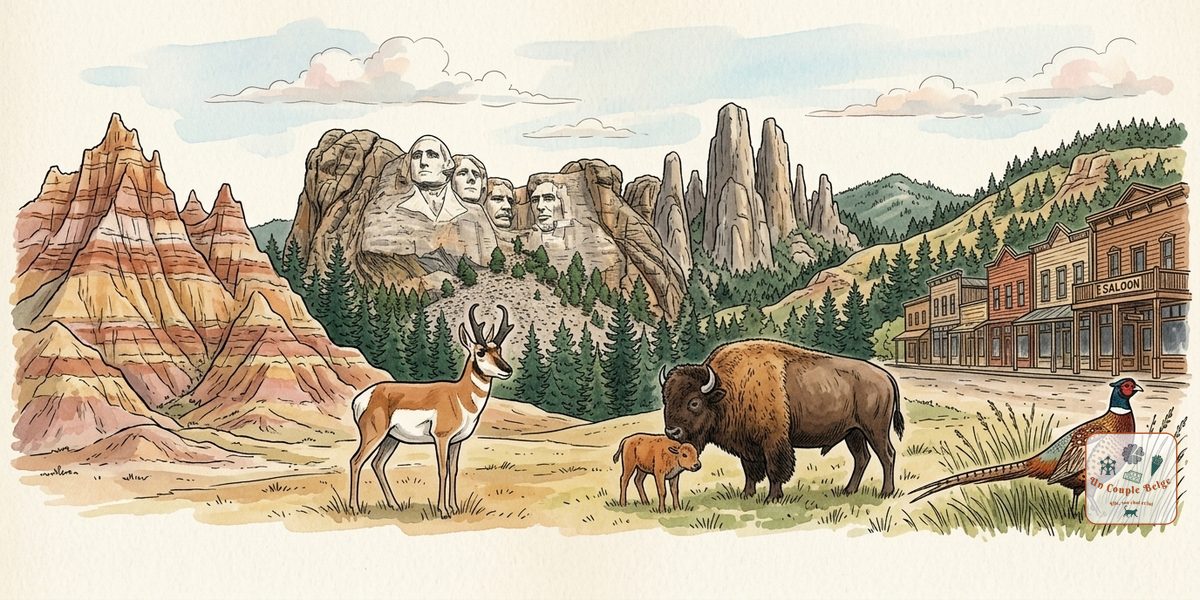
There’s something a little absurd about South Dakota, and that’s what makes it endearing. Four presidents 18 metres tall stare at the horizon from a mountain, a drugstore lost in the middle of nowhere has become one of the most visited attractions in the region, and hundreds of thousands of bikers meet up every summer in a small town of 7,000 people.
But South Dakota is above all two worlds. To the east, farming plains, grain silos and quiet little towns. To the west, beyond the Missouri, the Black Hills, mountains covered in dark pines (hence their name) and sacred to the Lakota, and the Badlands, a lunar landscape of spires and coloured canyons. It’s one of the most beautiful regions in the Midwest, and one of the richest in Native American history.
South Dakota at a glance
- Capital: Pierre
- Largest city: Sioux Falls
- Population: about 920,000
- Area: about 200,000 km², six and a half times Belgium
- Joined the Union: 1889, 40th state, on the same day as North Dakota
- Time zone: Central Time in the east (7 hours behind Brussels), Mountain Time in the west (8 hours behind), including the Black Hills
- Nickname: Mount Rushmore State
- Highest point: Black Elk Peak, 2,208 metres, the highest summit between the Rockies and the Pyrenees
Geography: the Missouri cuts the state in two
East of the Missouri (“East River”) is a region of farmed prairie and glacial lakes, with Sioux Falls and Mitchell.
The Missouri River, held back by large dams, forms a series of immense lakes in the centre of the state, near Pierre.
West of the Missouri (“West River”) is drier, made up of short-grass prairie, ranches and Native American reservations, with the Badlands and, in the far west, the Black Hills, an isolated range of mountains and forests.
South Dakota has nine Native American reservations, including Pine Ridge, one of the largest and poorest in the country.
A bit of history
The Lakota, the Dakota and the Nakota (the Sioux), as well as the Arikara, lived on these plains. In 1868, the Treaty of Fort Laramie recognised the Black Hills as Lakota land. But in 1874 an expedition led by Custer discovered gold there, and settlers poured in. The government seized the Black Hills in 1877, and in 1980 the Supreme Court ruled that seizure illegal: the Lakota refused the compensation, demanding the return of their land.
The gold rush gave birth to Deadwood and other mining towns. South Dakota became a state in 1889. In December 1890, the army massacred hundreds of Lakota, including many women and children, at Wounded Knee, on the Pine Ridge reservation. In 1927 the carving of Mount Rushmore began, and in 1948 that of Crazy Horse, as a Native American response.
The must-sees
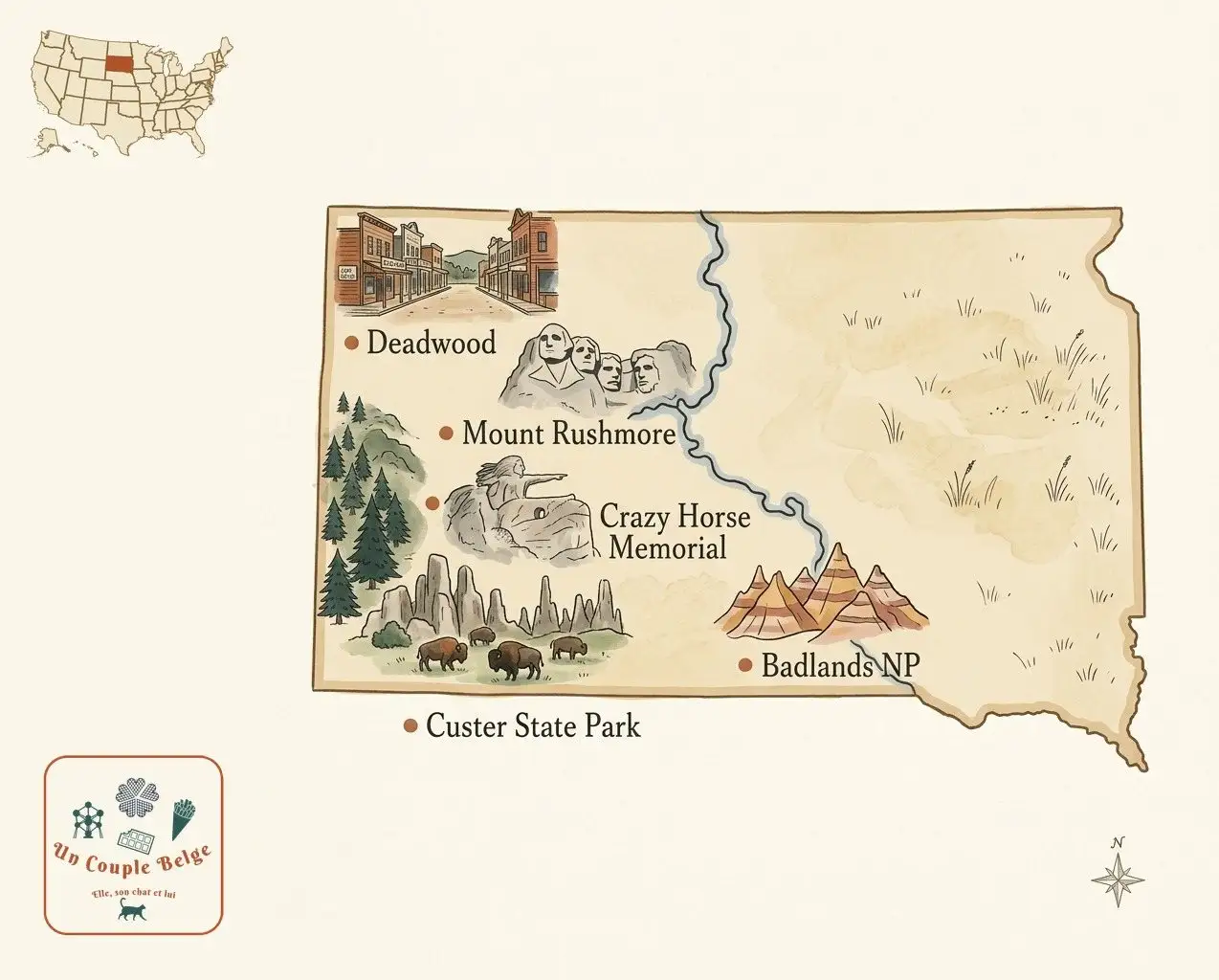
Mount Rushmore
We’ve all seen the photos, and yet the shock is still real when you arrive in front of Mount Rushmore. The faces of Washington, Jefferson, Theodore Roosevelt and Lincoln, carved between 1927 and 1941 under the direction of the sculptor Gutzon Borglum, are each 18 metres high. Entry is free (parking is paid). The Presidential Trail, an easy path, gets as close as possible to the sculptures, and the evening lighting ceremony, in summer, is moving. Bear in mind that the mountain is sacred to the Lakota, who consider the carving a desecration.
Crazy Horse Memorial
Half an hour away, the Crazy Horse Memorial is a colossal sculpture of the Lakota leader Crazy Horse on horseback, begun in 1948 by Korczak Ziolkowski at the request of Chief Henry Standing Bear, who wanted to show that “the red man has great heroes, too”. Only the face (27 metres high) has been completed so far. The project, funded without public money, continues with the sculptor’s family. The Native American cultural centre on site is interesting.
Custer State Park
Custer State Park deserves a whole day. On the Wildlife Loop Road, you’re almost certain to come across bison (about 1,300 in the park), pronghorn, prairie dogs and wild burros that come begging at car windows. The Needles Highway winds between granite spires and passes through tunnels barely wider than a car. Sylvan Lake, ringed by rocks, is superb. Every late September, the Buffalo Roundup sees cowboys gather the entire bison herd, an impressive sight.
The caves of the Black Hills
Beneath the Black Hills hide two of the longest caves in the world. Wind Cave National Park, sacred to the Lakota, is famous for its “boxwork” formations, calcite honeycombs that are rare elsewhere, and the prairie above is home to bison and prairie dogs. Jewel Cave National Monument, very close by, is among the longest known caves in the world. Both are visited with a ranger.
The Badlands
An hour east of Rapid City, Badlands National Park is a landscape of spires, ridges and canyons striped with ochre, pink and grey. The rock layers were laid down over millions of years, and erosion has been sculpting them for about 500,000 years, so fast that the landscape changes from year to year. The Badlands Loop Road crosses the park with many viewpoints. Fossils of prehistoric mammals are found here too. Stay until sunset, and in the Sage Creek area you’ll come across bison and bighorn sheep.
Right next door, the Minuteman Missile National Historic Site lets you visit a Cold War nuclear missile silo.
Deadwood, Sturgis and Spearfish
Deadwood is the former mining town where Wild Bill Hickok was shot dead in the middle of a poker game in 1876, holding, legend has it, two aces and two black eights, the “dead man’s hand”. The town has kept its saloon fronts and now lives off casinos. The series Deadwood 🎬 told its story. Right next door, Sturgis hosts the Sturgis Motorcycle Rally every early August, which draws nearly half a million bikers. And Spearfish Canyon is a beautiful drive between limestone cliffs and waterfalls.
Wall Drug and the curiosities
In 1931, a pharmacist, Ted Hustead, bought the drugstore in the tiny town of Wall, on the edge of the Badlands. Customers were rare, until his wife had the idea of offering free ice water to thirsty travellers, advertised by signs along the road. Today, Wall Drug is an immense kitsch emporium, announced by hundreds of signs hundreds of kilometres away, and the ice water is still free.
In Mitchell, the Corn Palace is a building entirely decorated with murals made of corn cobs, redone every year. In Hot Springs, the Mammoth Site is an ancient sinkhole where more than 60 mammoths were trapped, visible where they fell. In Sioux Falls, Falls Park offers waterfalls right in the city centre.
Pine Ridge and Wounded Knee
The Wounded Knee memorial, on the Pine Ridge reservation, marks the site of the 1890 massacre. It’s a simple and deeply moving place. If you go, be respectful: this is a living community, facing great poverty.
Itinerary ideas
5-7 days, the Black Hills and the Badlands. Rapid City → Mount Rushmore and Keystone (1 day) → Crazy Horse → Custer State Park (1-2 days) → Wind Cave and Jewel Cave → Hot Springs → Badlands and Wall (1 day) → Deadwood and Spearfish Canyon (1 day).
Driving across. Interstate 90 crosses the state from east to west: Sioux Falls, the Corn Palace in Mitchell, the Badlands, Wall and the Black Hills make a fine route between Chicago and Yellowstone.
In combination. The Black Hills combine with Wyoming (Devils Tower is 2 hours away, Yellowstone 6-7 hours), North Dakota or Nebraska.
On the plate
- Chislic, cubes of meat (lamb or beef) grilled or fried, served on toothpicks with crackers: the state’s official snack.
- The bison burger, leaner and more flavourful than beef.
- The Indian taco, built on fry bread, the Native American fried bread, which is the state’s official bread.
- Kuchen, a custard and fruit tart inherited from German immigrants, South Dakota’s official dessert.
- Pheasant: South Dakota is the American capital of pheasant hunting.
Culture and trivia
- Mount Rushmore was originally meant to show the presidents down to the waist. Lack of money and Borglum’s death, in 1941, stopped the work at the faces.
- Crazy Horse, once finished, would be the largest sculpture in the world. No completion date has been announced.
- Laura Ingalls Wilder lived in De Smet, in the east of the state, which inspired several of the Little House on the Prairie books.
- Black Elk Peak was called Harney Peak until 2016. It now bears the name of a famous Lakota holy man.
When to go
- Late May to September: the ideal season for the Black Hills and the Badlands. July-August is high season, with crowds at Mount Rushmore and afternoon thunderstorms.
- Early August: the town and the roads are overrun by bikers for the Sturgis Rally. Avoid it if you aren’t a biker, or enjoy the show.
- September: excellent, with fewer people, the colours in the Black Hills and the Buffalo Roundup.
- Winter: cold and windy, with snow. Many services close, but the Badlands under snow are magnificent.
Practical information
- Recommended length of stay: 5 to 7 days for the Black Hills and the Badlands.
- Getting there: Rapid City airport is the most convenient, served by connecting flights. Denver is a 6-hour drive away.
- Getting around: a car is essential.
- Budget: fairly affordable, except during the Sturgis Rally, when hotel prices triple.
- Things to watch out for: in Custer State Park and the Badlands, keep your distance from the bison, and don’t feed the burros. In the Badlands it’s very hot in summer: carry water.
- One more tip: book the guided tours of Wind Cave and Jewel Cave ahead in summer.
Our place guides in South Dakota
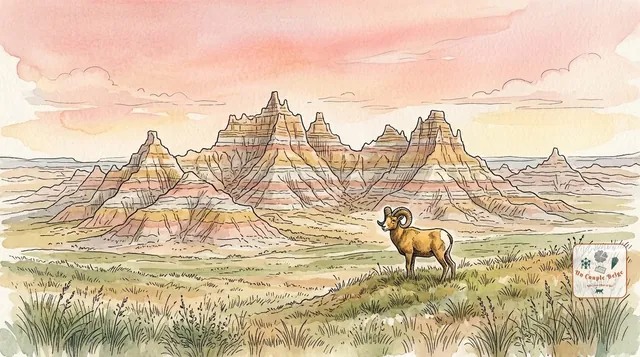
Badlands: a lunar landscape sculpted by erosion, rich in fossils
Striped hills, spires and clay ravines in the middle of the South Dakota prairie, with bison, prairie dogs and fossils everywhere.
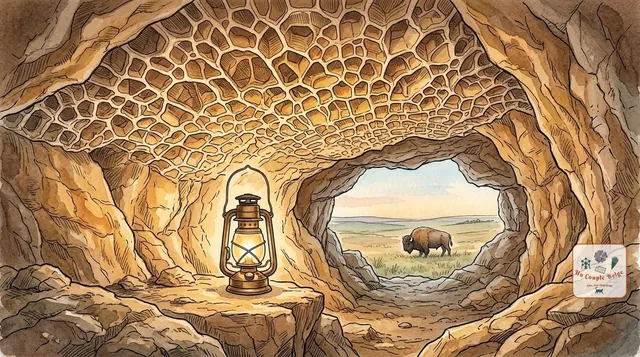
Wind Cave: the cave that breathes, sacred to the Lakota
A labyrinthine cave beneath the South Dakota prairie, famous for its stone lacework, and above ground bison, elk and prairie dogs.