Maine: lighthouses, lobsters and endless forests
Updated on
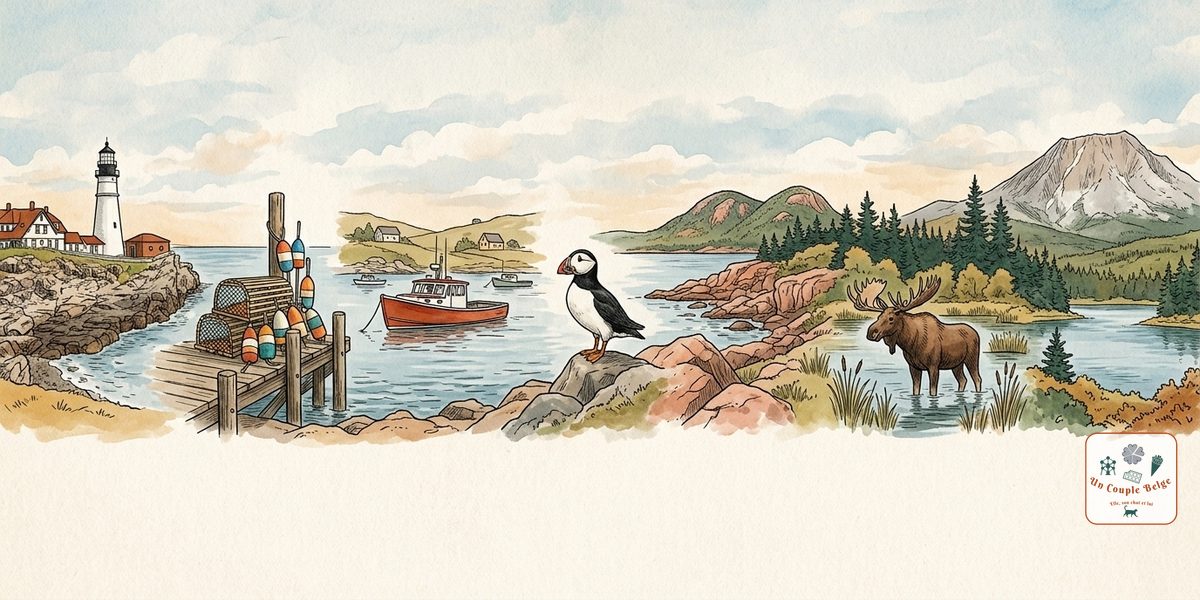
On a map, Maine looks like an appendage stuck right at the top of the East Coast, caught between Canada and the Atlantic, as if the rest of the country had rather forgotten it there. On the ground, you get the same impression, in a good way: time slows down, the fishing villages smell of seaweed and wet wood, and the locals are known for their reserve and their plain speaking, only a few hours from the bustle of Boston or New York.
Maine is an extraordinarily jagged coast, more than 5,000 kilometres of shoreline if you follow every bay and every island, lighthouses, lobsters and Acadia National Park. But it’s also an immense hinterland of forests and lakes, where you come across more moose than cars. Its licence plate simply says “Vacationland”. The word is well chosen.
Maine at a glance
- Capital: Augusta
- Largest city: Portland
- Population: about 1.4 million
- Area: about 92,000 km², three times Belgium. It’s the largest state in New England.
- Joined the Union: 1820, 23rd state, after separating from Massachusetts
- Time zone: Eastern Time (6 hours behind Brussels)
- Nicknames: Pine Tree State, Vacationland
- Highest point: Mount Katahdin, 1,606 metres, the northern terminus of the Appalachian Trail
Geography: a coast, forests and lakes
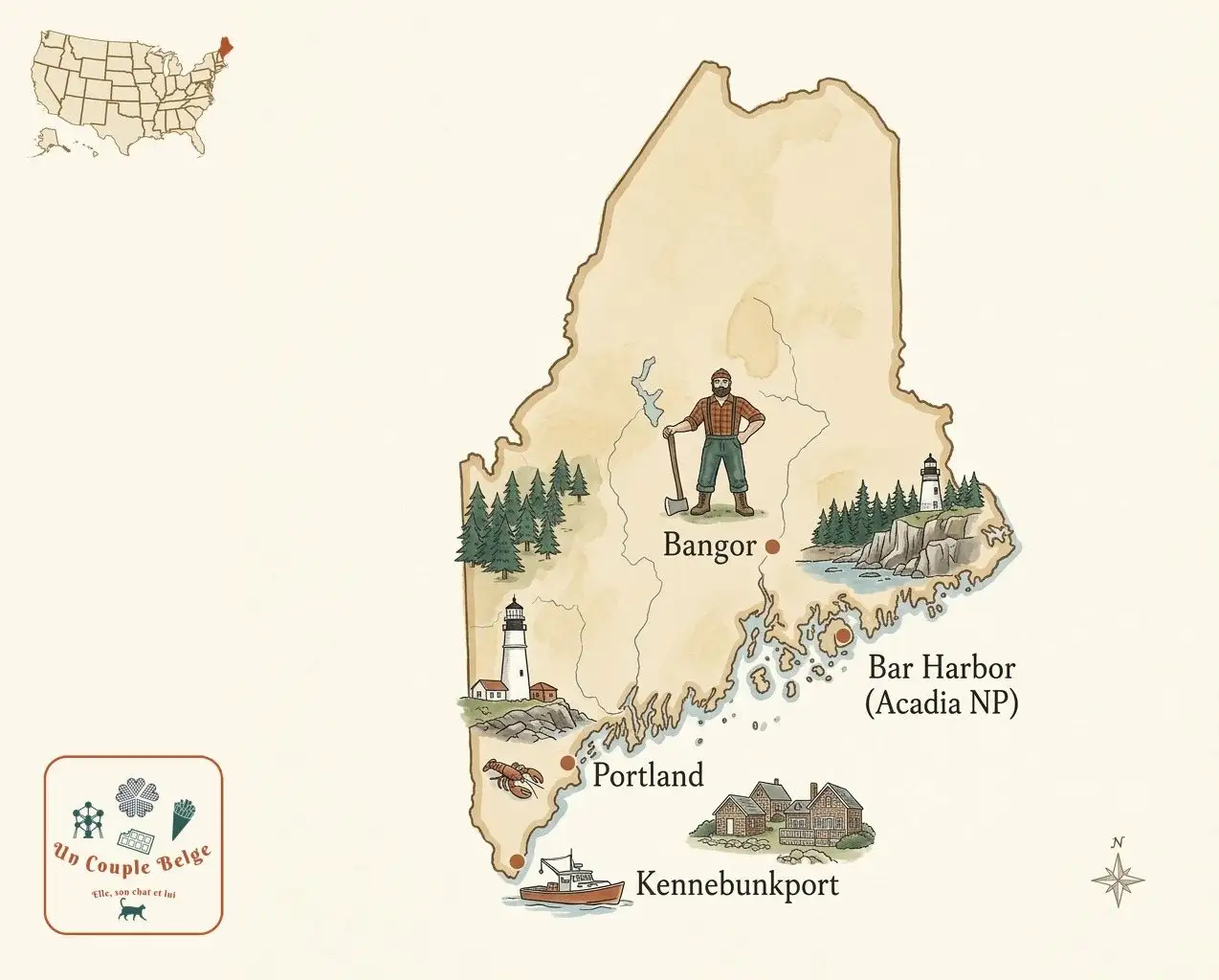
The south coast, from Kittery to Portland, has long sandy beaches and seaside resorts such as Ogunquit and Kennebunkport.
The Midcoast, from Portland to Penobscot Bay, is the most jagged part: peninsulas, fishing harbours, islands and lighthouses, with Boothbay Harbor, Camden and Rockland.
Down East, east of Bar Harbor, is the wildest and least visited part, as far as the Canadian border and the wild blueberry barrens.
The interior and the north are covered by the largest continuous forest in the eastern United States, dotted with thousands of lakes and ponds, with Moosehead Lake, Mount Katahdin and Aroostook County, partly French-speaking, on the border with Quebec and New Brunswick.
A bit of history
The Wabanaki (Penobscot, Passamaquoddy, Maliseet and Mi’kmaq) have lived here for thousands of years. In the 17th century, the French and the English fought over the region: the coast was first French, as part of Acadia, then gradually came under English control. Long attached to Massachusetts, Maine became a state in its own right in 1820.
In the 19th century it lived off the forest, shipbuilding, fishing and ice, which was cut from the lakes and exported as far as the Caribbean. At the end of the century, the great families of the East Coast built their summer homes here, notably in Bar Harbor, and tourism took hold for good.
The must-sees
Acadia and Mount Desert Island
Acadia National Park, on Mount Desert Island, sums up the beauty of Maine: pink granite cliffs plunging into the ocean, fir forests, glacial lakes and pebble beaches. The Park Loop Road takes in the main sites (Sand Beach, Thunder Hole, Jordan Pond), and more than 70 kilometres of car-free carriage roads can be explored by bike.
The summit of Cadillac Mountain is the highest point on the East Coast. From October to early March, it’s the first place in the United States to see the sunrise. From May to October, you have to reserve a slot to drive up (park website). The town of Bar Harbor serves as a base, with its lobster restaurants and boat trips to see whales and puffins. To avoid the crowds, the Schoodic Peninsula, the other part of the park, is far quieter.
Portland
Portland has fewer than 70,000 inhabitants, and yet it’s one of the best cities in the United States for eating. The Old Port, with its cobbled streets and brick warehouses, is full of restaurants, craft breweries and shops. To the south, Portland Head Light, first lit in 1791, is one of the most photographed lighthouses in the country. Casco Bay is explored by ferry, hopping from island to island.
The coast and Route 1
Route 1 follows the coast and links the prettiest villages. Ogunquit and its coastal path, the Marginal Way. Kennebunkport, with its sea captains’ houses (the Bush family has its summer home there). Freeport, where the L.L.Bean store, famous for its boots, is open 24 hours a day, 365 days a year. Wiscasset and its queue outside Red’s Eats for a lobster roll. Boothbay Harbor and its boat trips. Camden, at the foot of Mount Battie, the departure point for the “windjammers”, large schooners offering cruises of a few days. And Rockland, where the Farnsworth Museum exhibits the Wyeth family of painters.
Maine has around sixty lighthouses. Besides Portland Head, Pemaquid Point, on its striped rocks, and West Quoddy Head, painted in red and white stripes, are among the most beautiful.
Down East and the end of America
East of Bar Harbor, the coast becomes wilder and poorer, far from the crowds. Lubec is the easternmost town in the United States, and the first place in the country to see the sun rise for a good part of the year. Just opposite, across a bridge, the Canadian island of Campobello is home to Franklin D. Roosevelt’s summer house. In Washington County, the wild blueberry barrens turn bright red in autumn.
Mount Katahdin and the northern forests
In Baxter State Park, Mount Katahdin marks the end of the Appalachian Trail, after more than 3,500 kilometres from Georgia. The climb is long and demanding, and the park limits access (parking reservation required). Further west, Moosehead Lake, the largest lake in Maine, is a base for canoe trips and for watching moose at dawn. Right in the north, the Allagash Wilderness Waterway allows canoe trips of several days deep in the wild.
In the west, around Rangeley and Bethel, the mountains and lakes take on fine colours in autumn, and host skiing in winter.
French-speaking Maine
Right in the north, in the St. John Valley, communities of Acadian and Québécois origin still speak French day to day. Madawaska holds an Acadian festival every summer, and people eat ployes there, buckwheat pancakes typical of the region. A surprise for a Belgian traveller.
Itinerary ideas
One week, the coast. Portland (1-2 days) → Route 1: Freeport, Wiscasset, Boothbay, Camden (2 days) → Acadia and Bar Harbor (2-3 days). About 300 kilometres.
10 days, coast and nature. The same route, then Down East as far as Lubec, returning via Moosehead Lake or Baxter State Park.
The grand New England loop. Boston → New Hampshire coast → Maine → New Hampshire mountains → Vermont, ideally in autumn.
On the plate
- Lobster, obviously: Maine lands the great majority of American lobsters. You eat it whole, boiled, with melted butter, in waterside “lobster pounds”.
- The Maine-style lobster roll: cold lobster meat, lightly dressed with mayonnaise, in a toasted hot dog bun. (The Connecticut version is hot, with melted butter. Each side defends its own.)
- Wild blueberries: Maine produces almost all the wild blueberries in the United States, smaller and more fragrant than cultivated ones. In pie (the state’s official dessert), in pancakes or in muffins.
- The whoopie pie, two soft chocolate cakes sandwiched with cream, the state’s official treat.
- Clam chowder, fried clams and red snapper hot dogs, bright red sausages.
- Moxie, a soda with a very particular bitter taste, the state’s official drink. You love it or you hate it.
Culture and trivia
- Stephen King lives in Bangor, in a Victorian house surrounded by a fence decorated with bats and spiders. Many of his novels are set in Maine towns, real or imaginary.
- “Ayuh” means “yes” in the traditional Maine accent. And “you can’t get there from here” is a famous line of local humour.
- The first sunrise in the United States occurs, depending on the season, on Cadillac Mountain, in Lubec or on Mars Hill.
- Black flies invade the forests from mid-May to late June. Maine jokes about it, but take insect repellent.
When to go
- Summer (July-August): high season. The water stays cool (often below 18 °C), but the weather is mild. Lots of people and high prices on the coast.
- Autumn (mid-September to mid-October): the most beautiful time, with autumn colours, fewer people and magnificent light. Prices climb during peak colour.
- Spring (May-June): quiet, but cool and overrun by black flies in the woods. Many coastal restaurants don’t reopen until late May.
- Winter (December to March): harsh and snowy, for skiing, snowmobiling and absolute calm. Much of the coast is closed.
Practical information
- Recommended length of stay: 5 to 7 days for the coast, 10 days with the interior.
- Getting there: Portland airport is served by connecting flights. Boston is 2 hours from Portland, and it’s often the most convenient gateway from Europe.
- Getting around: a car is essential. A train, the Amtrak Downeaster, links Boston to Portland and Brunswick.
- Budget: high in summer on the coast (Bar Harbor, Camden, Kennebunkport), more affordable inland and out of season. Since 2026, the national parks pass has cost foreign visitors 250 dollars, and Acadia charges a 100-dollar surcharge per person without it: see our guide to the national parks pass.
- Things to watch out for: beware of moose on the roads, especially at dawn and dusk: a collision can be very serious. Take insect repellent in the forest.
- One more tip: book the Cadillac Mountain slot and accommodation in Bar Harbor very early for summer and early autumn.