Missouri: the Gateway to the West
Updated on
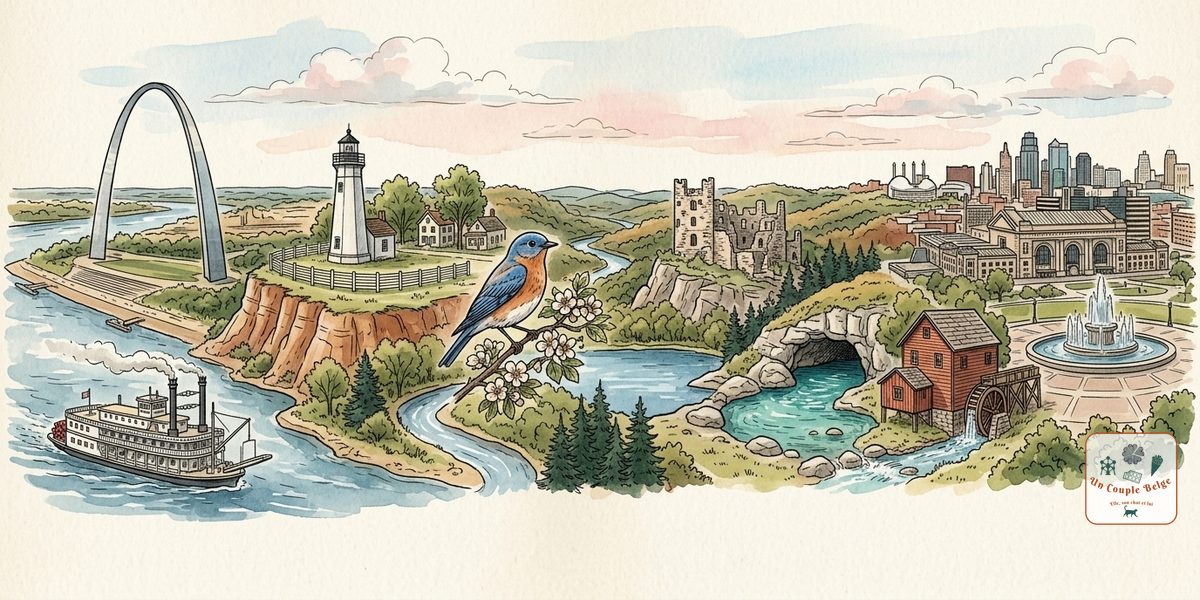
Missouri long bore the nickname “Gateway to the West”, and it wasn’t an adman’s phrase. It was from St. Louis that Lewis and Clark set off to explore the West in 1804, and from its riverbanks that tens of thousands of pioneers headed out for Oregon, California or Texas in covered wagons. Today, a giant steel arch recalls that role as a gateway.
It’s a crossroads state, between North and South, East and West, between the two great rivers that are the Mississippi and the Missouri. You’ll find two big cities with opposite personalities, St. Louis and Kansas City, a long stretch of Route 66, Mark Twain’s boyhood town and, in the south, the wooded hills and clear rivers of the Ozarks. Missouri is also nicknamed the “Show-Me State”, the state that needs convincing with proof. We’ll try.
Missouri at a glance
- Capital: Jefferson City
- Largest city: Kansas City (St. Louis has a larger metropolitan area)
- Population: about 6.2 million
- Area: about 180,000 km², nearly six times Belgium
- Joined the Union: 1821, 24th state
- Time zone: Central Time (7 hours behind Brussels)
- Nicknames: Show-Me State, Cave State
- Highest point: Taum Sauk Mountain, 540 metres
Geography: two rivers and the Ozarks
The north, above the Missouri River, is a rolling farming plain that resembles Iowa.
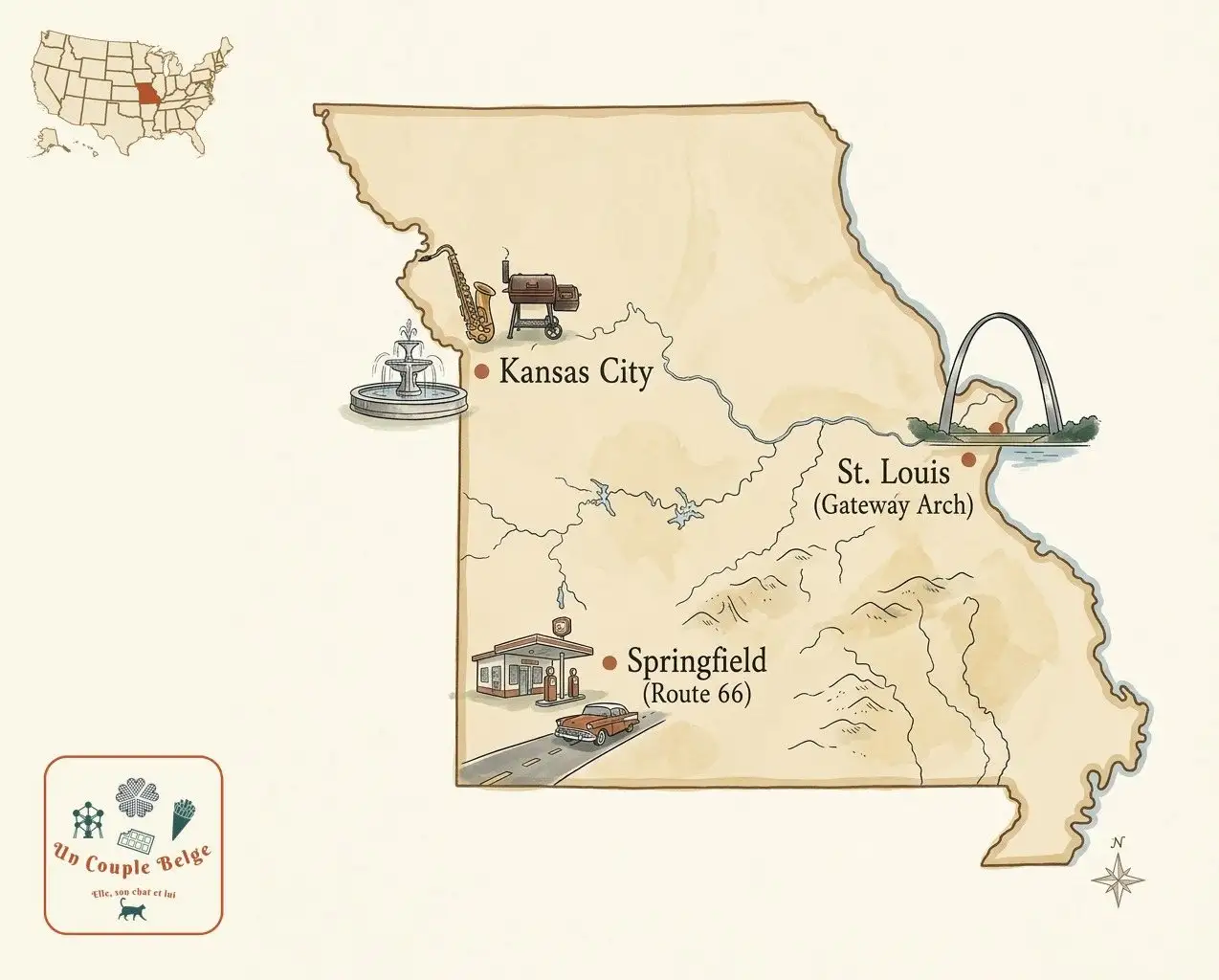
St. Louis, in the east, sits at the confluence of the Mississippi and the Missouri. Kansas City, in the west, sits on the Kansas border.
The Ozarks cover a large part of the centre and south: a plateau of wooded hills, clear rivers, springs and thousands of caves. Branson and the Lake of the Ozarks draw the crowds there.
The “Bootheel”, in the far south-east, is a piece of Mississippi plain with a Deep South feel, with fields of cotton and rice.
A bit of history
The Osage and the Missouria (who gave their name to the river and then the state) lived here when the French founded Ste. Genevieve, around 1750, then St. Louis in 1764. The territory passed to the United States with the Louisiana Purchase in 1803, and the Lewis and Clark expedition set off from the region the following year.
The admission of Missouri as a slave state in 1821 brought about the “Missouri Compromise”, a first great crisis over slavery. In 1857, it was from the St. Louis courthouse that the case of Dred Scott began, an enslaved man who sued for his freedom: the Supreme Court denied it to him, a ruling that hastened the Civil War. During the conflict, a torn Missouri stayed in the Union but went through a violent guerrilla war, out of which came the outlaw Jesse James.
In the late 19th and the 20th century, St. Louis hosted the 1904 World’s Fair, Kansas City became a jazz capital, and a resident of Independence, Harry Truman, became president in 1945.
The must-sees
St. Louis
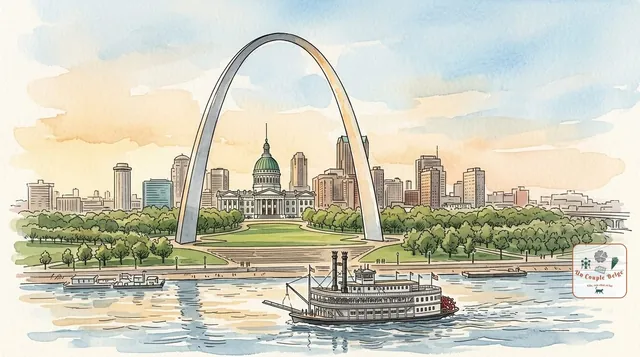
St. Louis can be recognised from afar thanks to the Gateway Arch, a 192-metre stainless steel arch completed in 1965, the tallest in the world and the tallest monument in the United States. Designed by Eero Saarinen, it can be visited from the inside: tiny egg-shaped capsules climb to the top, where small windows look out over the Mississippi. At the foot of the arch, the museum tells the story of westward expansion, and the Old Courthouse that of Dred Scott.
But the craziest place in the city is the City Museum: a former factory turned into an immense playground for children and adults, with tunnels, ten-storey slides, a plane hanging in mid-air and a Ferris wheel on the roof. Unclassifiable and brilliant.
Forest Park, bigger than Central Park in New York, holds the zoo, the art museum, the history museum and the science centre, all free. The Cathedral Basilica hides one of the largest collections of mosaics in the world. The Anheuser-Busch brewery, which makes Budweiser, can be toured, with its famous Clydesdale horses. And the Soulard district, with its old covered market, holds one of the biggest Mardi Gras celebrations in the United States.
Kansas City
About four hours to the west, Kansas City is more relaxed and more musical. In the 1920s and 30s, protected by a corrupt political boss who turned a blind eye to Prohibition, it became one of the capitals of jazz, where Charlie Parker grew up. The 18th & Vine district is home to the American Jazz Museum and the Negro Leagues Baseball Museum, devoted to the Black baseball leagues of the segregation era, one of the most endearing museums in the country.
The National WWI Museum and Memorial is surprising and excellent, with a fine view of the city from its tower. The Nelson-Atkins Museum of Art, free, is famous for the giant shuttlecocks sitting on its lawn. The city also has more than 200 fountains, including those of the Country Club Plaza, a shopping district inspired by Seville. And of course, people come for the barbecue (see below).
Hannibal and Mark Twain’s Mississippi
North of St. Louis, Hannibal is the small town where Samuel Clemens, the future Mark Twain, grew up in the 1840s. It directly inspired The Adventures of Tom Sawyer and Huckleberry Finn. You can visit his boyhood home and the cave where Tom and Becky get lost in the novel, and take a paddle-steamer cruise on the Mississippi. The pen name “Mark Twain” in fact comes from riverboat pilots’ vocabulary: it indicates a depth of two fathoms.
Further south, Ste. Genevieve, founded by the French, preserves rare French colonial houses built with vertical posts, the oldest in the country.
Route 66
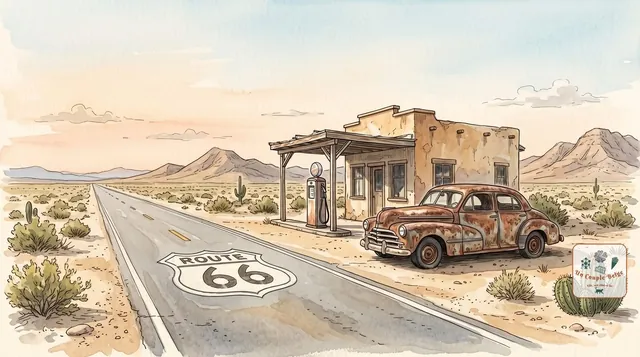
Route 66 crosses Missouri for nearly 480 kilometres, from St. Louis to the Kansas border (Visit Missouri). Along the way: Meramec Caverns, which long covered the barns along the road with painted advertisements (and claim to have been Jesse James’s hideout), the Wagon Wheel Motel in Cuba, in business since the 1930s, the Munger Moss Motel in Lebanon and its neon sign, and Springfield, which proclaims itself the “Birthplace of Route 66”: it was there, in 1926, that the road’s name was proposed. Gay Parita, in Paris Springs, is a recreated petrol station that welcomes travellers with a smile.
The Ozarks
In the south, Branson is a sort of family-friendly, Christian Las Vegas: dozens of theatres staging music shows, and the Silver Dollar City theme park, which recreates an 1880s mining town. You love it or you hate it.
For nature, the Ozark National Scenic Riverways, the first rivers to be federally protected, in 1964, are paddled by canoe or floated on a tube (the “float trip”, a local tradition), between turquoise springs and caves. Johnson’s Shut-Ins State Park has natural pools among volcanic rocks, Elephant Rocks are enormous rounded granite boulders, and Ha Ha Tonka State Park hides the ruins of a castle above the Lake of the Ozarks.
Missouri has more than 7,000 known caves, one of the highest numbers in the country. Several can be visited, such as Marvel Cave or Onondaga.
And more…
In Independence, Harry Truman’s home and presidential library. In St. Joseph, the Pony Express museum, whose riders set off from here in 1860 to deliver the mail to California in ten days, and the house where Jesse James was shot dead (you can still see the bullet hole in the wall). In Mansfield, the farm where Laura Ingalls Wilder wrote the Little House books. And in Marceline, the small town said to have inspired Walt Disney’s Main Street at Disneyland.
Itinerary ideas
One week, east to west. St. Louis (2 days) → Hannibal (1 day) → Route 66 to the south-west → the Ozarks and a float trip (2 days) → Branson → Kansas City (2 days).
For cycling fans. The Katy Trail, an old railway line turned into a cycle path of nearly 385 kilometres along the Missouri River, crosses the state through villages and vineyards.
In combination. Missouri fits naturally into a Route 66 road trip, between Chicago and Oklahoma, or into a circuit taking in Memphis, Arkansas and Kansas.
On the plate
- Kansas City barbecue: meats smoked for hours, covered in a thick, sweet, tomato-based sauce. Try the burnt ends, the caramelised pieces from the point of the beef brisket, at Joe’s Kansas City (housed in a petrol station), Arthur Bryant’s or Q39.
- St. Louis toasted ravioli, ravioli breaded and fried, served with a tomato sauce.
- St. Louis-style pizza, very thin, cut into squares, with Provel, a local processed cheese you either adore or detest.
- Gooey butter cake, a very soft cake of butter and sugar.
- Frozen custard from Ted Drewes, on Route 66 in St. Louis, so thick that they hand you the cup upside down.
- And Budweiser, brewed in St. Louis since 1876.
Culture and trivia
- The 1904 World’s Fair, in St. Louis, popularised the ice cream cone, iced tea and the hot dog, according to local legend. Forest Park is its legacy.
- The nickname “Show-Me State” is said to come from a Missouri congressman who, in 1899, declared: “I am from Missouri. Frothy eloquence neither convinces nor satisfies me. You have got to show me.”
- Scott Joplin published the Maple Leaf Rag in Sedalia in 1899, launching the ragtime craze. A festival pays tribute to him every year.
- Walt Disney, Mark Twain, Chuck Berry and Brad Pitt all grew up in Missouri.
- Kansas City straddles two states: most of it is in Missouri, and there’s another, smaller Kansas City in Kansas.
When to go
- Spring (April-May): the best time, mild and in bloom, perfect for the Ozark rivers. Watch out for storms and tornadoes.
- Summer (June to August): hot and very humid, often above 33 °C. It’s the season for float trips and the Lake of the Ozarks.
- Autumn (September-October): excellent, with the colours in the Ozarks and pleasant temperatures.
- Winter: cold, sometimes snowy, quiet. Branson lights up for Christmas.
Practical information
- Recommended length of stay: one week for St. Louis, Kansas City, Hannibal and the Ozarks, 3-4 days for a single city and its surroundings.
- Getting there: St. Louis and Kansas City airports are served by connecting flights.
- Getting around: a car is essential. An Amtrak train links St. Louis to Kansas City in 5 to 6 hours.
- Budget: affordable, more expensive in summer in Branson and at the Lake of the Ozarks.
- Things to watch out for: beware of ticks and chiggers (tiny mites) when hiking in the Ozarks, and of the heat in summer.
- One more tip: in Kansas City, get to the barbecue restaurants early. Some smoke their meat in limited quantities and close when it runs out.
Our place guides in Missouri
Gateway Arch: the smallest (and most controversial) of the national parks
A 192-metre steel arch beside the Mississippi, in St. Louis, recalling the conquest of the West. The smallest national park in the country, and the most urban.
Route 66: from Chicago to Santa Monica, America's legendary road
The most famous road in the United States, from Chicago to Santa Monica: 3,940 km, eight states, neon-lit motels and villages that have stayed in the 1950s.