Ohio: rock 'n' roll, aviation and Amish country
Updated on
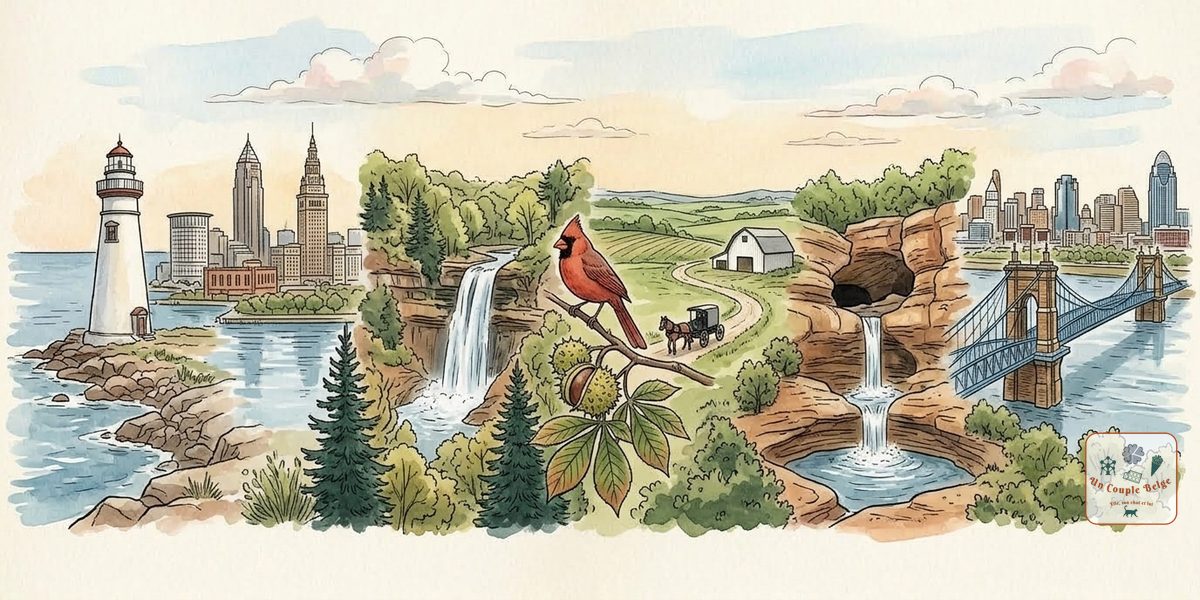
Ohio has a reputation as a drive-through state, crossed on the motorway between Chicago and New York without stopping. That’s rather comical when you look at what it has produced: seven presidents of the United States were born there, the Wright brothers built their first aeroplanes there, Neil Armstrong and John Glenn grew up there, and it was in Cleveland that the term “rock ‘n’ roll” was popularised on the radio.
Between Lake Erie to the north and the Ohio River to the south, the state mixes big industrial cities in full revival, countryside where Amish buggies still travel the roads, wooded gorges and record-breaking amusement parks. Its nickname, the “Buckeye State”, comes from a tree whose seed looks like a chestnut and is toxic if eaten raw. The locals have turned it into a sweet.
Ohio at a glance
- Capital and largest city: Columbus
- Population: about 11.8 million
- Area: about 116,000 km², nearly four times Belgium
- Joined the Union: 1803, 17th state
- Time zone: Eastern Time (6 hours behind Brussels)
- Nicknames: Buckeye State, Birthplace of Aviation
- Highest point: Campbell Hill, 472 metres
Geography: from Lake Erie to the Ohio River
The north borders Lake Erie, with Cleveland, Toledo, Sandusky and the lake islands.
The north-east is an industrial region (Akron, Youngstown) with hills, the Cuyahoga Valley and, further south, Amish country.
The centre and the west, around Columbus and Dayton, are flat farming plains.
The south-east is part of the Appalachian foothills, with wooded hills, the gorges of the Hocking Hills and small mining towns.
The south-west, along the Ohio River, is dominated by Cincinnati, facing Kentucky.
A bit of history
Long before the Europeans, the Adena and Hopewell cultures raised impressive earthen mounds in Ohio, several sites of which have been on the UNESCO World Heritage list since 2023. In the 18th century, the French, the British and Native American nations (Shawnee, Miami, Delaware) fought over the territory, which became the first state created out of the Northwest Territory, in 1803.
In the 19th century, Ohio was a key stage on the Underground Railroad, which helped people fleeing slavery to reach Canada. It then industrialised heavily: steel in Cleveland and Youngstown, tyres in Akron, soap in Cincinnati (Procter & Gamble). In the 20th century it produced pioneers of aviation and space.
The must-sees
Cleveland
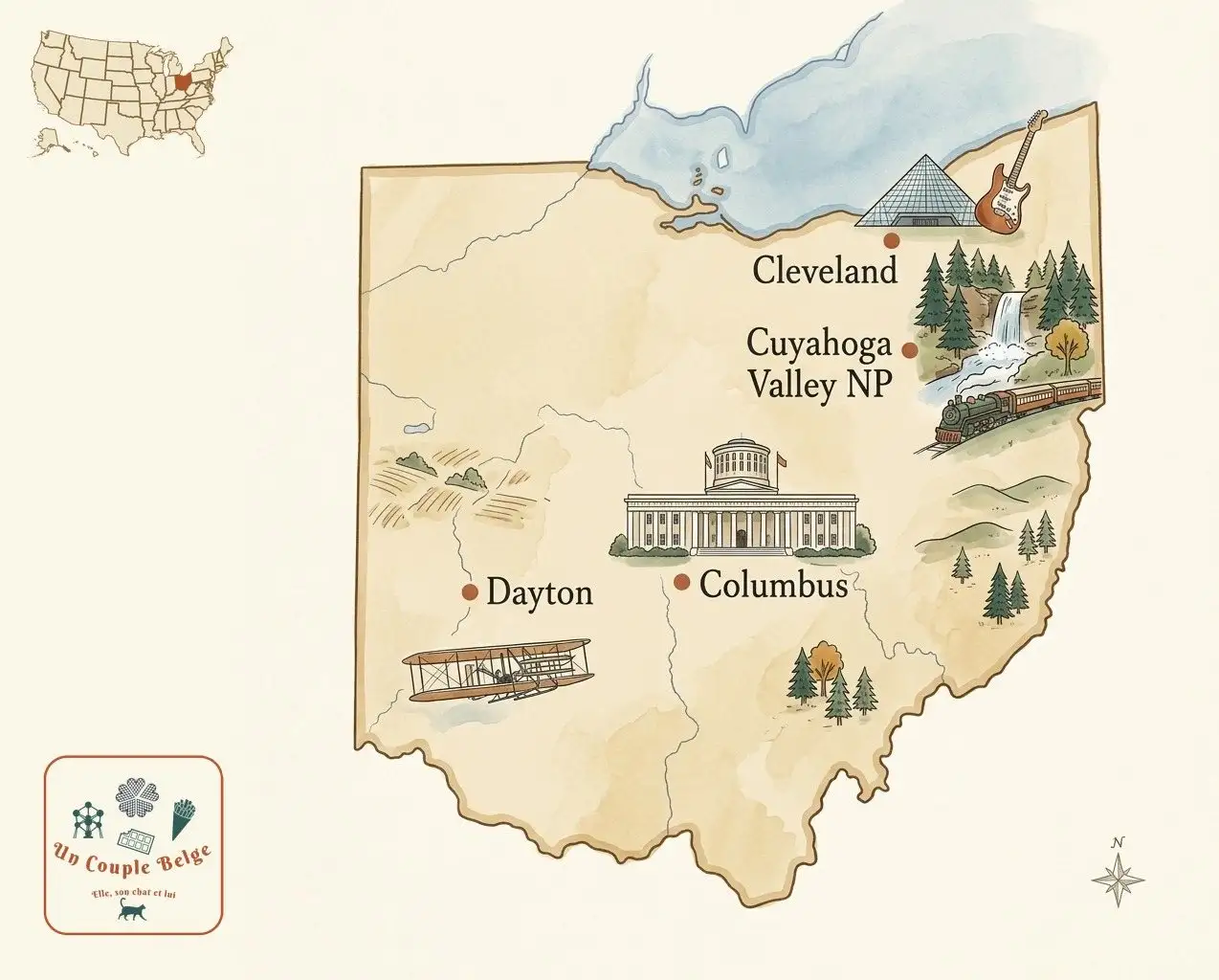
On the shore of Lake Erie, Cleveland is home to the Rock and Roll Hall of Fame, a glass pyramid by the architect I. M. Pei, which traces the history of rock with guitars, costumes and song manuscripts. The choice of city is no accident: it was a Cleveland DJ, Alan Freed, who popularised the term “rock ‘n’ roll” in the 1950s.
The free Cleveland Museum of Art is one of the best art museums in the country. West Side Market, a market hall from 1912, is packed with Eastern European specialities. Film fans will go to see the house from the cult Christmas film A Christmas Story 🎬, turned into a museum.
Cuyahoga Valley
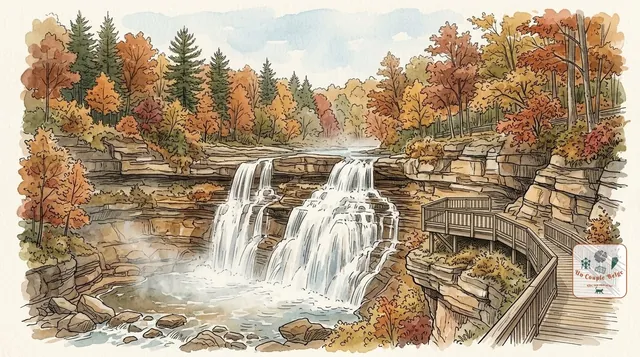
Between Cleveland and Akron, Cuyahoga Valley National Park protects about 130 km² of forests, waterfalls and farms along the Cuyahoga River. You walk or cycle on the Towpath Trail, the old towpath of the Ohio & Erie Canal, and you can come back on the scenic railroad with your bike. Brandywine Falls is the park’s most famous waterfall.
Amish country
South-east of Cleveland, Holmes and Wayne counties are home to one of the largest Amish communities in the world: nearly half the inhabitants of Holmes County are Amish. On the back roads you share the way with black buggies, buy cheeses, jams and handmade furniture, and eat in family restaurants. The villages of Berlin, Walnut Creek and Charm are the most visited. Respect the Amish refusal to be photographed close up.
Cedar Point and the Lake Erie islands
On a peninsula near Sandusky, Cedar Point, open since 1870, calls itself “the Roller Coaster Capital of the World”, with more than fifteen coasters, several of which have broken height and speed records. Plenty to satisfy thrill-seekers.
Just offshore, the Lake Erie islands are reached by ferry: Put-in-Bay, the party island, with its monument commemorating a naval battle of 1813, and Kelleys Island, calmer, where you can see deep glacial grooves carved into the rock.
The Hocking Hills
South-east of Columbus, the Hocking Hills are a region of gorges, caves and waterfalls in sandstone cliffs. Old Man’s Cave, Ash Cave and Cedar Falls can be explored in a few hours of easy walking. It’s one of the best-loved natural areas in Ohio, with many cabins to rent.
Columbus
The state’s capital and largest city is dynamic and young, thanks to the immense Ohio State University and its tens of thousands of students. German Village, a district of 19th-century brick houses, the Short North, with its galleries and restaurants, and the Columbus Zoo are the essentials. On autumn Saturdays, an Ohio State football game draws more than 100,000 people.
Dayton and aviation
In Dayton, where the Wright brothers ran a bicycle shop and designed their first aeroplanes, the National Museum of the United States Air Force is the largest military aviation museum in the world, and it’s free: from the aircraft of the early days of flight to stealth bombers, by way of the presidential plane. Dayton Aviation Heritage National Historical Park preserves the Wrights’ workshop. In Wapakoneta, the Neil Armstrong museum pays tribute to the first man to walk on the Moon, a native of the town.
Cincinnati
On the Ohio River, Cincinnati has a pretty historic district, Over-the-Rhine, built by German immigrants in the 19th century and now full of bars and restaurants, and Findlay Market, the oldest public market in the state. The National Underground Railroad Freedom Center tells the story of the Underground Railroad, which passed through the city. The Roebling Suspension Bridge, which leads to Kentucky, served as a prototype for the Brooklyn Bridge.
And more…
The Pro Football Hall of Fame, the temple of American football, in Canton. Serpent Mound, a Native American mound more than 400 metres long in the shape of a snake. And Milan, where Thomas Edison was born, whose birthplace can be visited.
Itinerary ideas
One week, the north and the centre. Cleveland (2 days) → Cuyahoga Valley → Amish country (1-2 days) → Columbus → Hocking Hills (1 day) → Dayton.
A summer by the lake. Cleveland → Sandusky and Cedar Point → Put-in-Bay and Kelleys Island.
In combination. Ohio combines with Pittsburgh (Pennsylvania), 2 hours from Cleveland, Michigan (Detroit is 1 hour from Toledo) or Kentucky, just across from Cincinnati.
On the plate
- Cincinnati chili, a chili with warm spices (cinnamon, clove, cocoa) of Greek inspiration, served on spaghetti and covered with a mountain of cheddar. You order it “3-way”, “4-way” or “5-way” depending on the toppings, at Skyline or Gold Star.
- Buckeyes, peanut butter balls dipped in chocolate, which imitate the seed of the state tree.
- Cincinnati goetta, a patty of pork and oats, a German legacy, served at breakfast.
- Cleveland’s Polish Boy, a sausage topped with fries, coleslaw and barbecue sauce, and the pierogi of the Eastern European communities.
- Akron’s sauerkraut balls, breaded balls of sauerkraut.
- Graeter’s ice cream from Cincinnati and, on the fast-food side, Wendy’s, founded in Columbus in 1969.
Culture and trivia
- Seven presidents were born in Ohio, including Ulysses S. Grant, William McKinley and Warren Harding.
- The Cuyahoga River caught fire more than a dozen times because of pollution. The 1969 fire, reported by Time, made a deep impression and advanced the cause of environmental protection.
- Ohio long voted like the rest of the country: for more than a century, the candidate who won Ohio almost always won the presidency.
- Ohio’s flag is the only state flag that isn’t rectangular: it’s shaped like a swallowtail.
When to go
- Summer (June to August): the season for the lakes, Cedar Point and the Lake Erie islands. Hot and sometimes humid.
- Autumn (late September to October): the most beautiful time for the Hocking Hills, Cuyahoga Valley and Amish country, with the autumn colours. It’s also college football season.
- Spring (May): mild and green, perfect for the waterfalls.
- Winter: cold and grey, with lake-effect snow from Lake Erie near Cleveland. The frozen waterfalls of the Hocking Hills have their charm.
Practical information
- Recommended length of stay: 5 to 7 days to combine the cities, Amish country and nature.
- Getting there: Cleveland, Columbus and Cincinnati (located in Kentucky) airports are served by connecting flights.
- Getting around: a car is essential. Amtrak serves Cleveland, Toledo and Cincinnati, but not Columbus.
- Budget: fairly cheap, especially outside the big cities.
- Things to watch out for: in Amish country, slow down on the narrow, hilly roads; the buggies are slow and hard to see.
- One more tip: for Cedar Point in summer, book online and arrive at opening time to limit the wait for the star rides.