Tennessee: Nashville, Memphis and the Smoky Mountains
Updated on
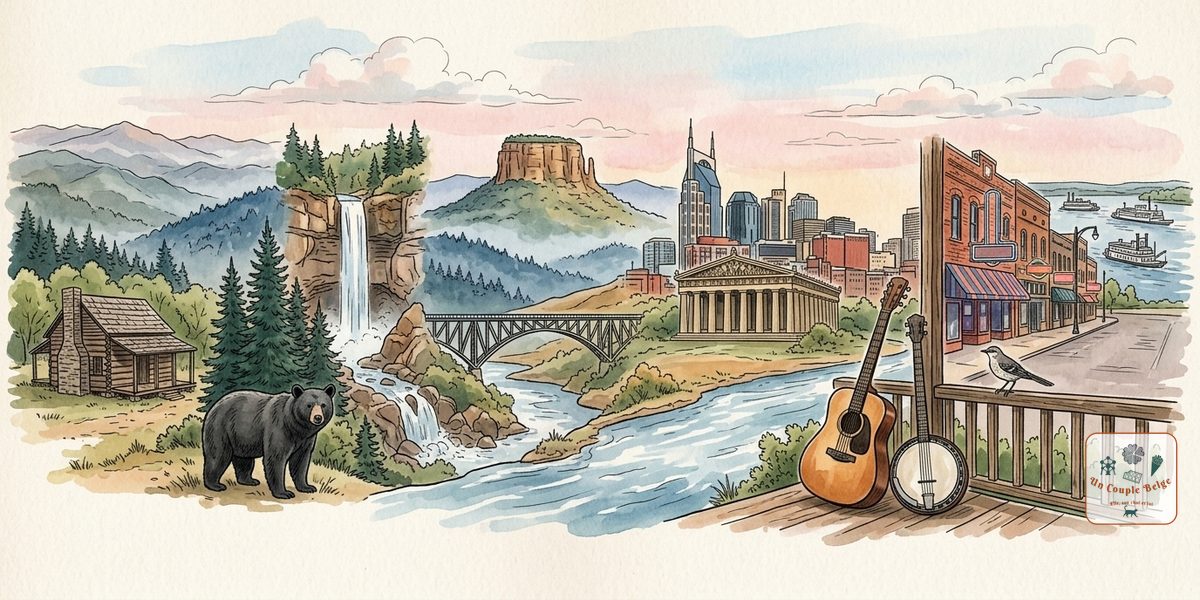
There are states you visit for the landscapes, others for the history, and then there’s Tennessee, which you visit mostly with your ears. Here, music isn’t one tourist activity among others: it’s the state’s raw material. Nashville is the world capital of country music, Memphis gave birth to rock ‘n’ roll with Elvis and to the soul of Stax, and the mountains of the east have kept the old Appalachian ballads.
But Tennessee also has the most visited national park in the United States, the Great Smoky Mountains, waterfalls, lakes, a whiskey famous the world over made in a county where you can’t buy alcohol, and an idol nobody dares criticise: Dolly Parton. All of it links up in a single road trip from west to east.
Tennessee at a glance
- Capital and largest city: Nashville
- Population: about 7.2 million
- Area: about 109,000 km², a little over three and a half times Belgium
- Joined the Union: 1796, 16th state
- Time zone: Eastern Time in the east (6 hours behind Brussels), Central Time in Nashville and Memphis (7 hours behind)
- Nickname: Volunteer State
- Highest point: Kuwohi (formerly Clingmans Dome), 2,025 metres, in the Smoky Mountains
Geography: three “Grand Divisions”
Tennessee stretches about 700 kilometres from east to west and is officially divided into three regions, represented by the three stars on its flag.
The east is mountainous: the Appalachians, with the Great Smoky Mountains, Knoxville, Chattanooga and Gatlinburg.
The centre is a rolling plateau of farms and horses, around Nashville.
The west, flat, hot and humid, runs down to the Mississippi and Memphis, already in the mood of the Delta.
A bit of history
The Cherokee, the Chickasaw and other peoples lived here. In the 1830s, the Cherokee were deported to Oklahoma on the “Trail of Tears”, which crosses a large part of the state. Tennessee became a state in 1796, and its nickname “Volunteer State” comes from the thousands of volunteers who went off to fight in the War of 1812 and the war with Mexico.
It was the last state to join the Confederacy and the first to be readmitted to the Union after the Civil War, which left major battlefields here (Shiloh, Chattanooga). In the 20th century, Tennessee became the heart of American music: the Bristol sessions in 1927, the Grand Ole Opry radio show in Nashville, then Sun Records and Elvis in Memphis in the 1950s. During the Second World War, the secret city of Oak Ridge took part in the Manhattan Project. And on 4 April 1968, Martin Luther King was assassinated in Memphis.
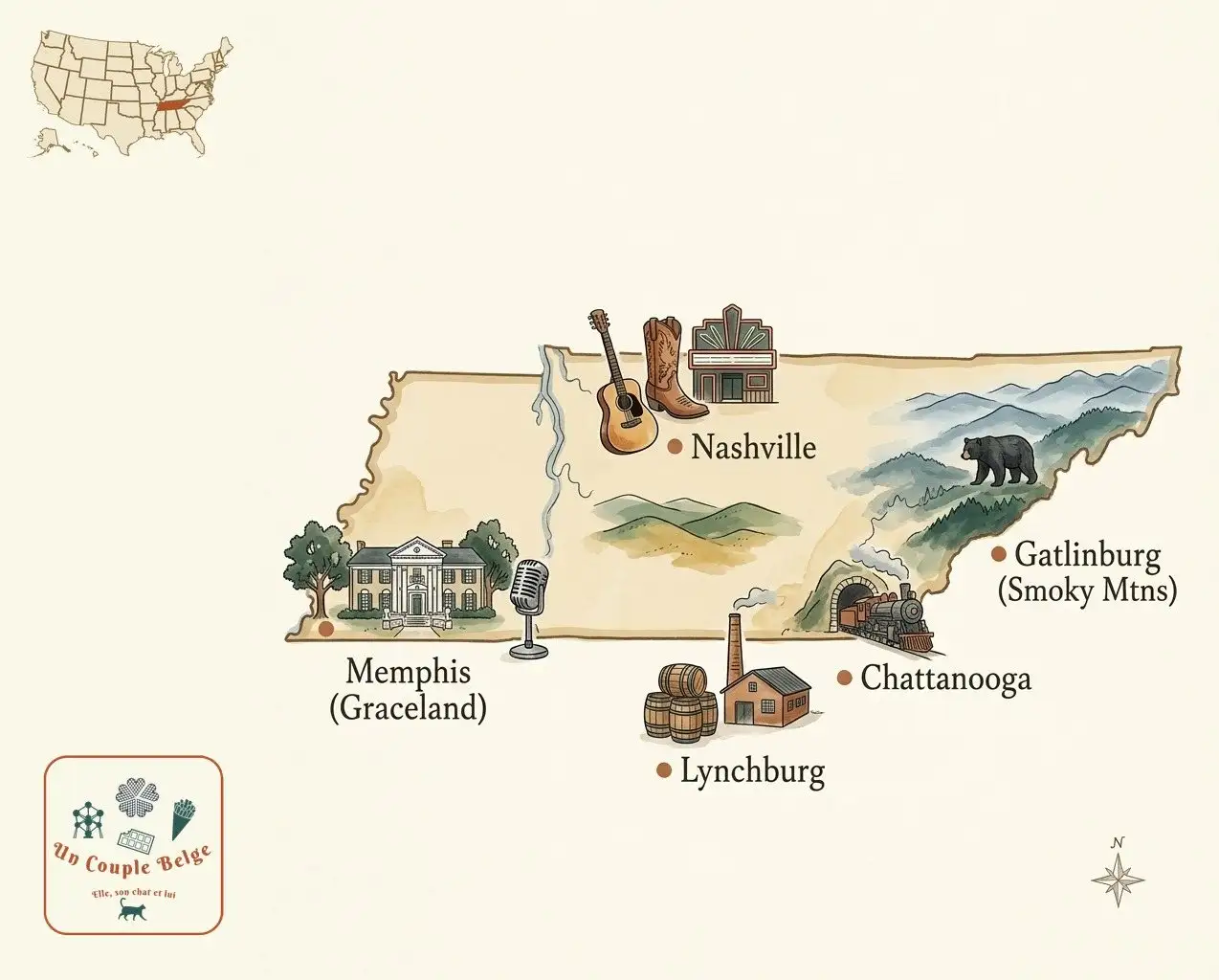
The must-sees
Nashville
Nashville, “Music City”, fully deserves its nickname. On Broadway, every bar (the “honky-tonks”) has its live band from 11 in the morning, with no cover charge, and the music spills out onto the pavements. The Country Music Hall of Fame is an excellent museum, even for those who don’t like country. The Ryman Auditorium, a former church nicknamed the “Mother Church of Country Music”, hosts concerts, and the Grand Ole Opry, the oldest American radio show still on the air, can be seen live several evenings a week.
To get away from Broadway, the East Nashville and The Gulch neighbourhoods are more relaxed. The Johnny Cash Museum and the Hatch Show Print poster shop are also worth a visit. And in Centennial Park, a full-scale replica of the Parthenon in Athens houses a 13-metre statue of Athena.
Memphis
Three hours to the west, the mood changes completely. Memphis is Beale Street, its neon and its blues clubs, and the smell of barbecue all over downtown.
Graceland, Elvis Presley’s home, can be visited with its 1970s living rooms, its cars, its planes and his grave. At Sun Studio, you can stand on the spot where Elvis, Johnny Cash, Jerry Lee Lewis and others recorded their first records. The Stax Museum of American Soul Music retraces the saga of Otis Redding and Isaac Hayes. And the National Civil Rights Museum, housed in the Lorraine Motel where Martin Luther King was assassinated, is one of the most powerful museums in the country.
For a lighter touch, the Peabody ducks: every day at 11 a.m., a group of ducks comes down in the lift and parades along a red carpet to the fountain in the lobby of the Peabody Hotel, where they spend the day, before going back up at 5 p.m.
The Great Smoky Mountains
To the east, Great Smoky Mountains National Park, the most visited in the country, owes its name to the bluish haze that floats over the ridges. You hike to waterfalls (Laurel Falls, Abrams Falls), go up to Kuwohi, the highest point, with its observation tower, and drive or cycle the Cades Cove loop, a valley of pioneer farms and churches where deer and black bears are often seen. In June, the synchronous fireflies of Elkmont are a unique spectacle (places allocated by lottery). Entry is free, but you need a parking tag.
At the gates of the park, Gatlinburg and Pigeon Forge are a strip of motels, restaurants and kitsch attractions. This is where you’ll find Dollywood, Dolly Parton’s theme park, in the mountains where she was born.
Chattanooga
In the south, on the Georgia border, Chattanooga has reinvented itself around its river. The Tennessee Aquarium is one of the best in the country. On Lookout Mountain, you ride up on a very steep funicular, the Incline Railway, to see the gardens of Rock City (from which you can supposedly see “seven states” in good weather) and Ruby Falls, a waterfall inside a cave. And the old Chattanooga Choo Choo station, made famous by Glenn Miller’s song, has become a hotel.
Lynchburg and whiskey
A small Tennessee irony: the Jack Daniel’s distillery, in Lynchburg, produces one of the best-selling whiskeys in the world, but sits in a “dry” county, where the sale of alcohol is banned. You can still tour it and, in some cases, taste. Tennessee whiskey differs from bourbon in being filtered through maple charcoal, the “Lincoln County Process”.
And more…
- Bristol, straddling the border with Virginia, where the 1927 recording sessions launched country music. The Birthplace of Country Music Museum tells this story.
- Franklin, south of Nashville, a pretty little historic town with a Civil War battlefield.
- Oak Ridge, the city built in secret to enrich the uranium for the atomic bomb, which can be visited.
- The Lost Sea, the largest underground lake in the United States, which you cross by boat.
- Fall Creek Falls State Park, with one of the highest waterfalls in the East.
- The Natchez Trace Parkway, which sets off from Nashville towards Mississippi.
Itinerary ideas
8-10 days, from Memphis to the Smokies. Memphis (2-3 days) → Nashville (2-3 days) → Lynchburg and Jack Daniel’s → Chattanooga (1 day) → Knoxville → Great Smoky Mountains (2 days). About 800 kilometres.
The musical Deep South. Nashville → Memphis → Clarksdale and the Delta (Mississippi) → New Orleans. Or, in the other direction, Memphis → Muscle Shoals (Alabama) → Nashville.
In combination. Tennessee combines with North Carolina (Asheville and the Blue Ridge Parkway), Kentucky (Mammoth Cave is 1 hr 30 from Nashville) or Georgia (Atlanta is 2 hours from Chattanooga).
On the plate
- Nashville hot chicken, fried chicken doused in a cayenne pepper oil, served on white bread with pickles. Prince’s Hot Chicken is said to have invented it, and the spiciest level is for the reckless only.
- Memphis barbecue, especially the ribs, served “wet” (covered in sauce) or “dry” (rubbed with spices), as at the Rendezvous.
- The meat-and-three, a down-home restaurant where you choose one meat and three sides.
- The Goo Goo Cluster, a chocolate bar born in Nashville in 1912, and the MoonPie, a marshmallow-filled biscuit born in Chattanooga, traditionally washed down with an RC Cola.
- And of course Tennessee whiskey.
Culture and trivia
- Dolly Parton, born in a cabin in the Smoky Mountains, the fourth of twelve children, is a local idol. Her programme, the Imagination Library, sends free books to millions of children every month.
- The state’s highest point took back its Cherokee name in 2024, Kuwohi, which means “mulberry place”.
- Graceland is the most visited house in the United States after the White House.
- Tennessee has the largest number of known caves in the United States, more than 10,000.
- Elvis recorded his first disc at Sun Studio in 1953, as a present for his mother, so the story goes.
When to go
- Spring (April-May): mild and in bloom, with the waterfalls of the Smokies at their peak.
- Autumn (September to early November): the best time for the Smokies, with spectacular colours. Very busy in October.
- Summer (June to August): hot and very humid, especially in Memphis. The mountains stay cooler. Nashville hosts CMA Fest, a big country music festival, in early June.
- Winter: mild in Memphis and Nashville, cold and sometimes snowy in the mountains. The Christmas lights at Dollywood and Gatlinburg are very popular.
Practical information
- Recommended length of stay: 8 to 10 days to combine Memphis, Nashville and the Smoky Mountains.
- Getting there: Nashville and Memphis airports are served by connecting flights (Nashville also has a few direct flights to London). Atlanta is a good alternative.
- Getting around: a car is essential between the cities.
- Budget: moderate. Nashville has become expensive, especially at weekends, when it hosts a lot of stag and hen parties.
- Things to watch out for: in the Smokies, keep your distance from black bears and store your food away. Avoid peak hours in Gatlinburg and Pigeon Forge in October.
- One more tip: book the Grand Ole Opry and Graceland tours ahead, especially at weekends.