Texas: a country within the country
Updated on
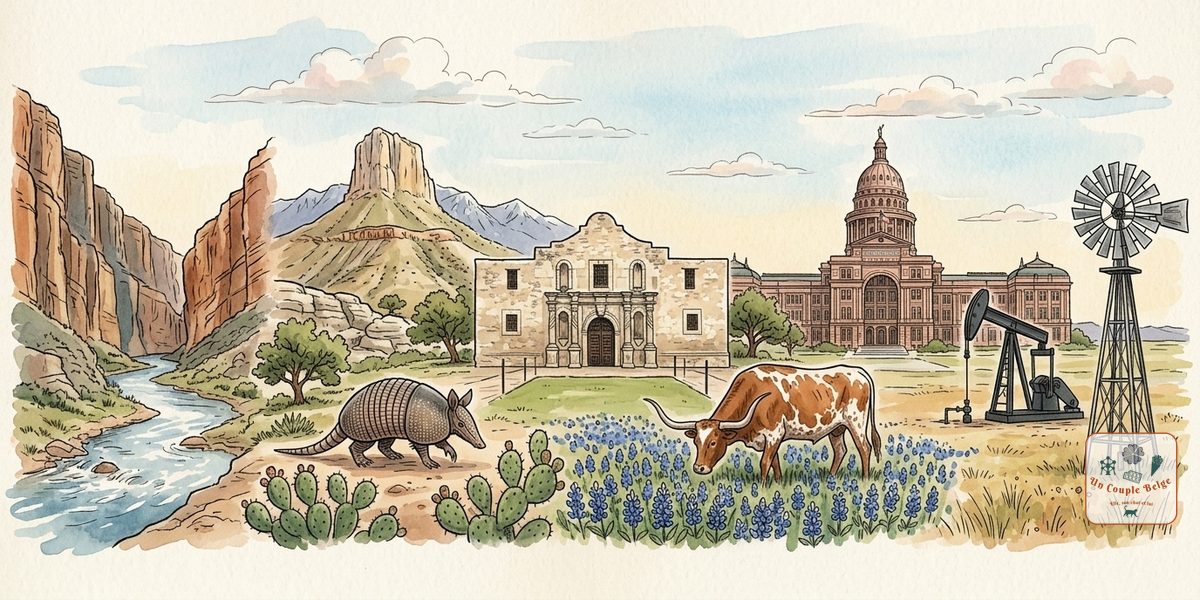
Texas doesn’t behave like an ordinary state, and makes no secret of it. Texans are happy to remind you: from 1836 to 1845 they formed an independent country, the Republic of Texas, with its own flag and diplomatic missions in Paris and London. Six flags have flown over this territory (Spanish, French, Mexican, Texan, Confederate and American), and the lone star is everywhere, from licence plates to petrol station signs.
The territory lives up to the myth. More than 1,200 kilometres from north to south, almost as much from east to west: you cross deserts and canyons, humid pine forests, endless cattle plains, hills covered in flowers in spring and beaches on the Gulf of Mexico. You’ll also find four of the largest cities in the country, a cuisine that stirs debate and a local pride that expresses itself in everything, size included. Everything is “bigger in Texas”.
Texas at a glance
- Capital: Austin
- Largest city: Houston
- Population: about 31 million, the second most populous state
- Area: about 696,000 km², nearly 23 times Belgium. It’s the largest state after Alaska.
- Joined the Union: 1845, 28th state
- Time zone: Central Time (7 hours behind Brussels), Mountain Time around El Paso
- Nickname: Lone Star State
- Highest point: Guadalupe Peak, 2,667 metres
Geography: several Texases in one
The east resembles the Deep South: pine forests, bayous, humidity, with Houston, the coast and the Louisiana border.
The centre is dominated by the Hill Country, limestone hills crossed by clear rivers, between Austin and San Antonio, and by the Dallas-Fort Worth corridor to the north.
The south, towards the Mexican border, is a region of brush and ranches, with the Rio Grande Valley and the Gulf Coast (Corpus Christi, Padre Island).
The north, the “Panhandle”, belongs to the Great Plains, with Amarillo and Palo Duro Canyon.
The west, finally, is desert and mountains: the Chihuahuan Desert, Big Bend, Marfa, El Paso and the Guadalupe Mountains.
A bit of history
Many peoples lived here, from the Caddo to the Comanche, masters of the plains. The Spanish set up missions in the 17th and 18th centuries, and the name Texas comes from a Caddo word meaning “friends”. The territory became Mexican in 1821, and Mexico invited in American settlers, who eventually rebelled.
In 1836, during the Texas Revolution, about 200 defenders were killed by the Mexican army at the siege of the Alamo, in San Antonio, before the Texan victory at San Jacinto a few weeks later. Texas became an independent republic for nine years, then joined the United States in 1845, which set off the war with Mexico. After the Civil War came the era of the great cattle drives and cowboys. In 1901, the discovery of oil at Spindletop changed everything. In the 20th century, Texas became an economic giant: oil, NASA in Houston, technology in Austin. In 1963, President Kennedy was assassinated in Dallas.
The must-sees
Austin
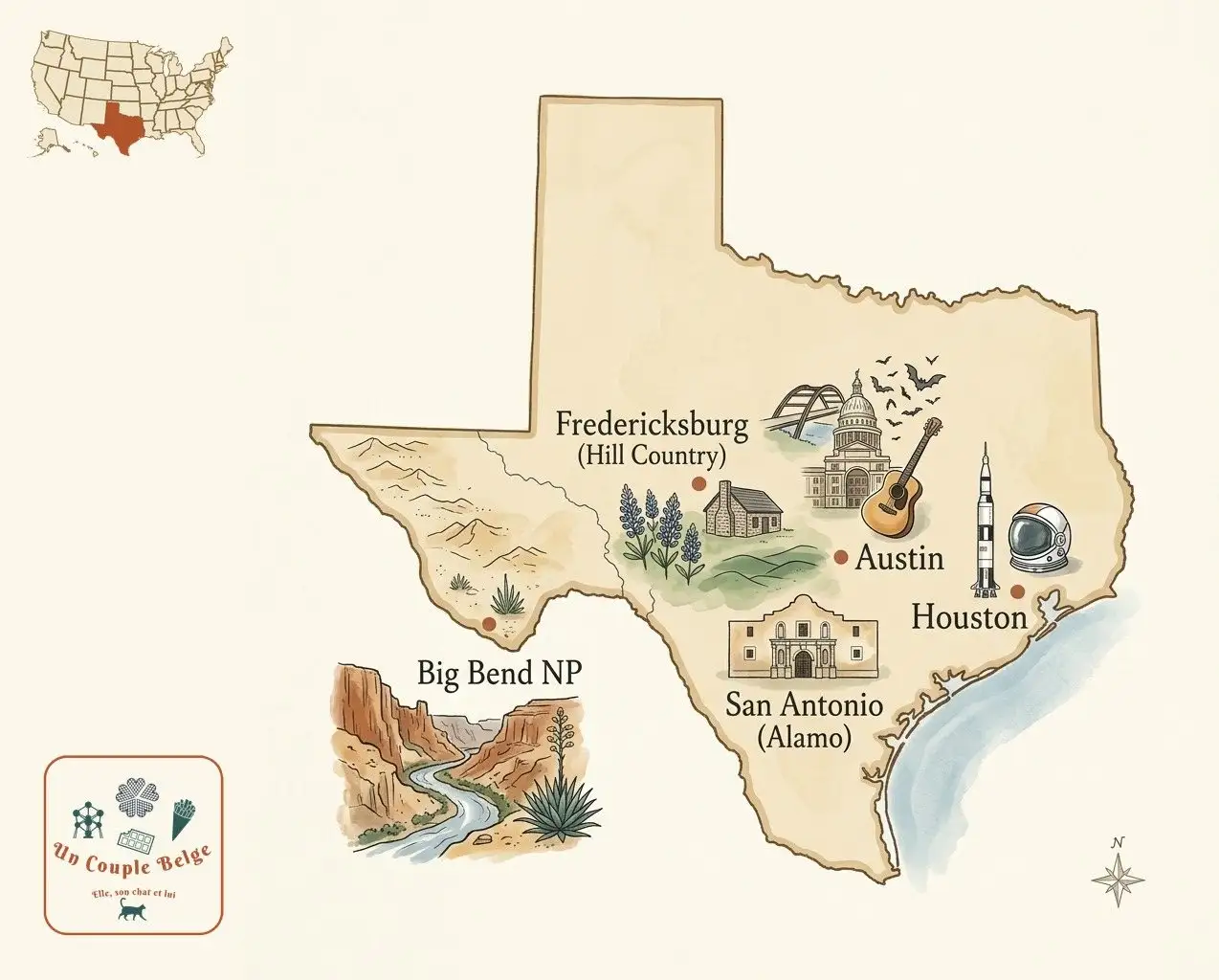
Austin, the capital, claims the slogan “Keep Austin Weird” and the title of Live Music Capital of the World: every evening, hundreds of gigs are played in the bars of 6th Street, Red River and South Congress. Every March, the SXSW festival draws musicians, film-makers and tech companies from all over the world.
In summer, at sunset, more than a million bats fly out from under the Congress Avenue Bridge, the largest urban bat colony in North America. You swim at Barton Springs, a natural pool fed by a spring at 20 °C all year round. And the State Capitol, taller than the one in Washington, is free to visit.
San Antonio
An hour and a half to the south, San Antonio is home to the Alamo, the former mission where the Texan defenders, including Davy Crockett and Jim Bowie, held out for thirteen days before being killed. “Remember the Alamo” became a rallying cry. The building is smaller than you imagine, but charged with emotion.
The River Walk, a promenade along the river, one level below the streets, is lined with restaurants and bars. South of the city, the San Antonio Missions, a UNESCO World Heritage Site, can be visited by bike, and Market Square is the largest Mexican market in the United States.
The Hill Country
Between Austin and San Antonio, the Hill Country is the most charming region of Texas: hills, crystal-clear rivers, vineyards and villages founded by German immigrants in the 19th century, such as Fredericksburg and its bakeries. In spring, the roadsides are covered in bluebonnets, blue lupins, the state flower. Enchanted Rock, an enormous dome of pink granite, can be climbed in half an hour. In summer, people float down the Guadalupe and Comal rivers on tubes, around New Braunfels. Bear in mind that these rivers can rise very fast: in July 2025, flash floods killed more than a hundred people along the Guadalupe. Always check the weather.
Big Bend and the west
In the far west, Big Bend National Park is one of the least visited in the country, simply because it’s a very long way from anywhere. It’s an immense desert ringed by mountains, along the Rio Grande, which marks the border with Mexico. You hike in the Chisos Mountains, walk into Santa Elena Canyon, and bathe in hot springs beside the river. The night sky here is one of the darkest in the United States. Right nearby, Terlingua is a former mining ghost town that has become an artists’ haunt.
Marfa, a small desert town, has become a mecca for contemporary art thanks to the artist Donald Judd and his Chinati Foundation. The mysterious Marfa lights appear on the horizon on some nights, and 60 kilometres away, Prada Marfa is a fake luxury boutique planted in the middle of the desert, a work of art that has become famous on Instagram. Further north, Guadalupe Mountains National Park holds the state’s highest point, an ancient fossil reef.
Houston
Houston, the largest city in Texas, is sprawling and very diverse. Space Center Houston, NASA’s visitor centre, lets you see the historic mission control room of the Apollo missions and a Saturn V rocket. The Museum District has around twenty museums, including the free Menil Collection. And the city has one of the most varied food scenes in the country, Vietnamese in particular.
Dallas and Fort Worth
In Dallas, the Sixth Floor Museum, housed in the former book depository from which the shots were fired, tells the story of Kennedy’s assassination in 1963, above Dealey Plaza. Fort Worth, its more “western” neighbour, has its Stockyards, where a herd of longhorns parades down the street twice a day, and the world’s largest honky-tonk, Billy Bob’s, with indoor rodeo.
The Panhandle
In the north, near Amarillo, Palo Duro Canyon is the second-largest canyon in the United States, with spectacular red cliffs. On Route 66, Cadillac Ranch lines up ten Cadillacs half-buried in the ground, which visitors are free to spray-paint.
The Gulf Coast
Texas has nearly 600 kilometres of coastline. Galveston, destroyed in 1900 by the deadliest hurricane in American history (between 6,000 and 12,000 dead), has pretty Victorian mansions and an amusement pier. Further south, Padre Island National Seashore, the longest barrier island in the world, protects wild beaches where, in summer, you can sometimes watch baby sea turtles being released.
Itinerary ideas
One week, central Texas. Austin (2 days) → Hill Country and Fredericksburg (2 days) → San Antonio (2 days) → back via Lockhart for the barbecue.
10-14 days, with the west. Austin → Fredericksburg → Marfa (1 day) → Big Bend (3 days) → Guadalupe Mountains → Carlsbad Caverns (New Mexico) → El Paso. The distances are enormous: plan on days of 5 to 6 hours’ driving.
The big cities. Dallas and Fort Worth → Austin → San Antonio → Houston, in a week, with domestic flights possible.
On the plate
- Central Texas barbecue: beef brisket smoked for 12 to 18 hours, served on butcher paper with white bread and pickles. Lockhart, the barbecue capital, and Franklin Barbecue, in Austin (a queue of several hours), are pilgrimages.
- Tex-Mex: fajitas, nachos, cheese enchiladas and queso, a melted cheese dip for chips.
- Chili con carne, the state dish, which, according to purists, never contains beans.
- Breakfast tacos, fought over by Austin and San Antonio.
- Kolaches, filled sweet buns inherited from Czech immigrants, notably in West.
- Dr Pepper, invented in Waco in 1885, Blue Bell ice cream and burgers from Whataburger, an institution.
- Pecan pie, the official state pie. And the frozen margarita machine was invented in Dallas in 1971.
Culture and trivia
- “Don’t mess with Texas” was originally an anti-littering slogan for the highways, launched in 1986. It has become a cry of pride.
- Buc-ee’s, a chain of giant petrol stations with dozens of pumps, spotless toilets, brisket and cuddly beaver toys, is an attraction in its own right.
- The Houston rodeo, every spring, is the biggest in the world, with concerts by big-name stars.
- The Texas State Capitol was deliberately built a few metres taller than the one in Washington.
- High school football is a religion, especially in small towns, as the series Friday Night Lights 🎬 showed.
When to go
- Spring (March to May): the best time, with the bluebonnets in the Hill Country, pleasant temperatures and SXSW in March.
- Autumn (October-November): excellent everywhere, and ideal for Big Bend.
- Summer (June to September): very hot, often above 38 °C, with high humidity in Houston. Big Bend is best avoided. The coast is exposed to hurricanes from June to November.
- Winter (December to February): mild in the south and at Big Bend, but the north can get cold snaps and ice.
Practical information
- Recommended length of stay: at least 10 days to combine a big city, the Hill Country and the west.
- Getting there: Houston and Dallas-Fort Worth are major international hubs, with direct flights from several European cities. Austin also has a few direct flights to Europe.
- Getting around: a car is essential. Distances are counted in hundreds of kilometres: a domestic flight can save a day in reaching El Paso.
- Budget: variable, Austin being the most expensive city. Petrol and food remain affordable.
- Things to watch out for: extreme heat in summer (carry plenty of water, especially at Big Bend), flash floods in the Hill Country and the canyons, hurricanes on the coast. At Big Bend, there’s almost no mobile signal.
- One more tip: for Big Bend, book accommodation very early, especially in spring and autumn. The only hotel in the park, the Chisos Mountains Lodge, fills up fast and was closed at times in 2026 (water supply failure): check that it’s open.
Our place guides in Texas
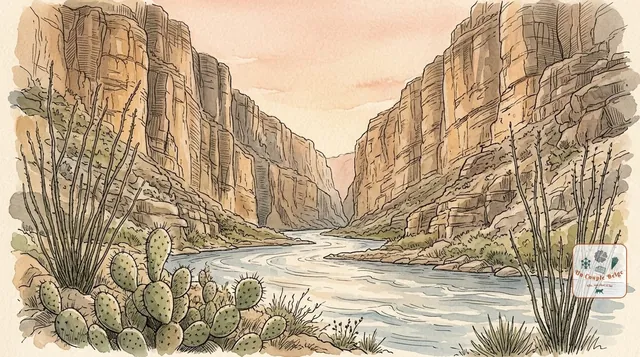
Big Bend: the Texan desert where the Rio Grande draws the border
A desert, a mountain range and the canyons of the Rio Grande, at the far end of Texas, on the Mexican border. Immense, remote and almost empty.
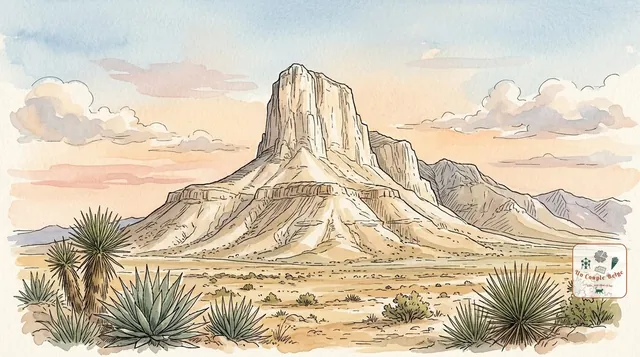
Guadalupe Mountains: the highest point in Texas, an ancient fossil reef
The roof of Texas: a range of dry mountains that is in fact an ancient marine reef, with canyons, white dunes and a great deal of wind.
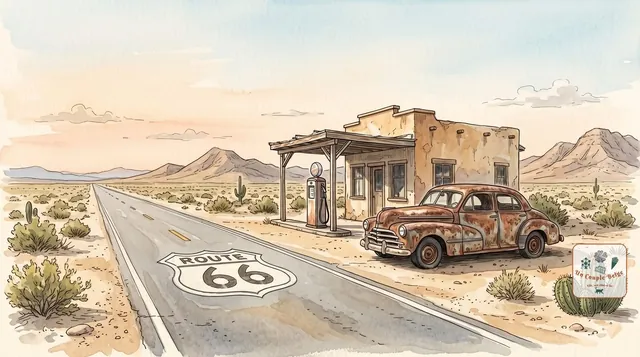
Route 66: from Chicago to Santa Monica, America's legendary road
The most famous road in the United States, from Chicago to Santa Monica: 3,940 km, eight states, neon-lit motels and villages that have stayed in the 1950s.