Washington State: Seattle, volcanoes and rainforests
Updated on
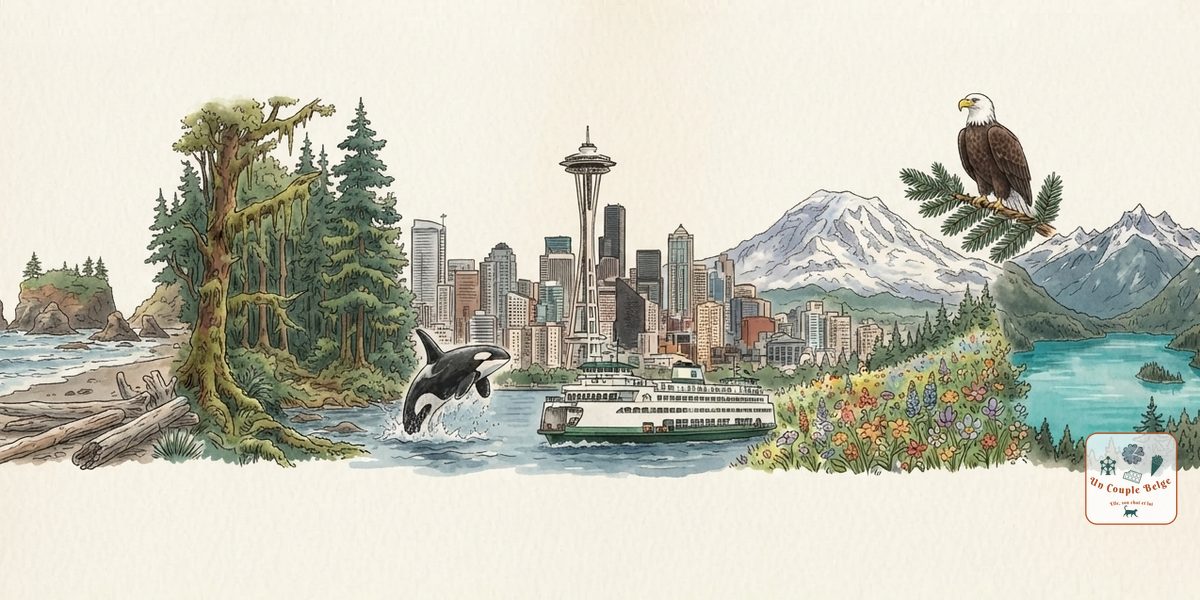
First thing to know: Washington State has nothing to do with Washington D.C. The federal capital is more than 4,000 kilometres away, on the East Coast. Here, you’re in the north-west corner of the United States, between the Pacific and Canada, and Americans say “Washington State” to avoid confusion. Or simply “the Pacific Northwest”.
It’s a state of grand nature, often in the rain, it has to be said. In a few hours on the road, you go from the temperate rainforest of the Olympic Peninsula to the glaciers of the Cascade volcanoes, then to a dry, sunny east of wheat-covered hills, vineyards and canyons. In the middle, Seattle, city of coffee, grunge, Amazon and Microsoft, set between the sea and the mountains. For lovers of wide green spaces, it’s one of the most beautiful states in the country.
Washington at a glance
- Capital: Olympia
- Largest city: Seattle
- Population: about 8 million
- Area: about 184,800 km², six times Belgium
- Joined the Union: 1889, 42nd state
- Time zone: Pacific Time (9 hours behind Brussels)
- Nickname: Evergreen State, for its evergreen forests
- Highest point: Mount Rainier, 4,392 metres
Geography: two states separated by the Cascades
West of the Cascades is wet and green: the Olympic Peninsula, with its mountains and wild coast, and Puget Sound, an inlet of the sea cut into islands and bays, where most of the inhabitants live (Seattle, Tacoma, Everett, Olympia).
The Cascade Range crosses the state from north to south, with its snow-capped volcanoes: Baker, Rainier, St. Helens and Adams.
East of the Cascades is dry, in the rain shadow: the orchards of the Wenatchee valley, the vineyards of Yakima and Walla Walla, the wheat hills of the Palouse, the canyons of the Channeled Scablands and the Columbia River, with its great dams.
A bit of history
Many peoples lived here: on the coast, the Makah, the Duwamish and the Suquamish lived off salmon fishing and whaling, and built cedar longhouses. Inland, the Yakama, the Spokane, the Nez Perce and others lived off the plains and rivers. Seattle is named after Chief Si’ahl, of the Duwamish and the Suquamish.
Spanish and British explorers arrived at the end of the 18th century, then the trappers and the pioneers of the Oregon Trail. In 1846, a treaty fixed the border with British Canada. The state entered the Union in 1889. Seattle grew by serving as the jumping-off point for the Klondike Gold Rush, in 1897. In the 20th century, the dams on the Columbia (including Grand Coulee) brought electricity, Boeing made the region an aerospace giant, then Microsoft, Amazon and Starbucks were born here. On 18 May 1980, the eruption of Mount St. Helens killed 57 people and blew the top off the volcano.
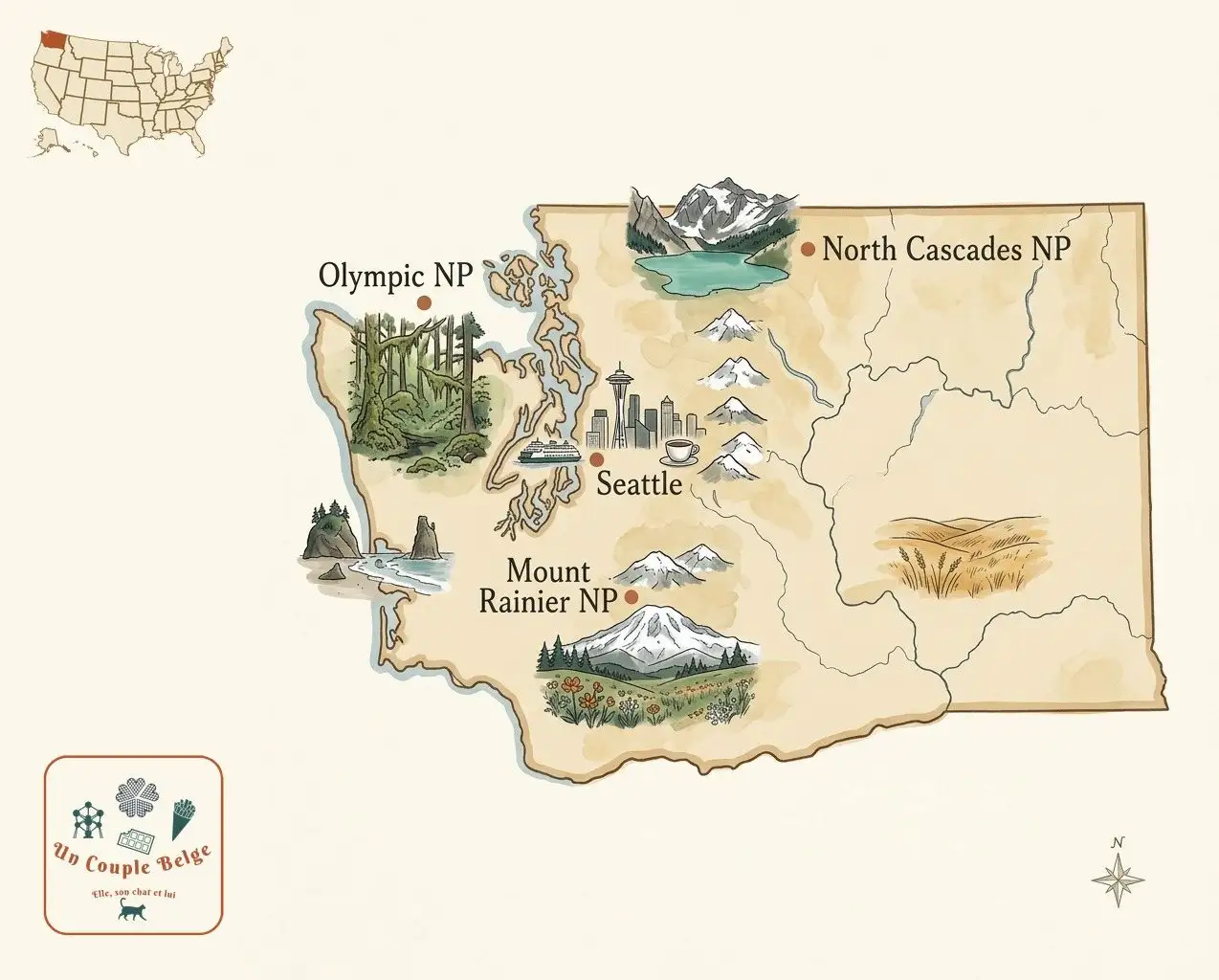
The must-sees
Seattle
Seattle deserves two or three days. Pike Place Market, opened in 1907, is one of the oldest public markets in the United States still in operation, with its fishmongers who throw whole salmon to each other over the counter. Just opposite is the oldest Starbucks still open, where the queue is often long. Below the market, the Gum Wall is a wall covered in chewing gum.
The Space Needle, built for the 1962 World’s Fair, towers over Seattle Center, which is also home to the Museum of Pop Culture, a building of colourful curves by Frank Gehry devoted to music (Jimi Hendrix, Nirvana) and science fiction, and Chihuly Garden and Glass, with spectacular glass sculptures. You also take the ferry to Bainbridge Island for the view of the city and, in clear weather, of Rainier. The Fremont neighbourhood has a giant troll under a bridge and a statue of Lenin.
North of Seattle, in Everett, you can tour the Boeing assembly plant, in one of the largest buildings in the world by volume.
Mount Rainier
In clear weather, Mount Rainier, a glacier-covered volcano of 4,392 metres, dominates the whole Seattle skyline. Mount Rainier National Park draws hikers for its wildflower meadows in summer, around Paradise and Sunrise, the highest point that can be reached by car. The Skyline Trail, at Paradise, offers views of the glaciers. In recent years, a timed reservation has been required in summer for some entrances: check the park’s website before you set off.
The Olympic Peninsula
Olympic National Park brings together three worlds in one: wild beaches strewn with tree trunks thrown up by the ocean, such as Rialto Beach and Ruby Beach, snowy mountains rising to Mount Olympus (2,432 metres), with the viewpoint of Hurricane Ridge, and above all the Hoh Rain Forest, a temperate rainforest where moss hangs from giant maples. More than 3 metres of rain falls there each year. Lake Crescent, with its turquoise water, is one of the finest in the park.
Around the park, Forks, the small town of the Twilight 🎬 saga, has made it its attraction, and Cape Flattery, on the Makah reservation, is the north-westernmost point of the contiguous United States. Port Townsend is a pretty Victorian seaside town.
The North Cascades
To the north, the North Cascades Highway, or Route 20, crosses North Cascades National Park, mountains so jagged and so covered in glaciers that they’re nicknamed the “American Alps”. Diablo Lake, a milky turquoise blue, is the essential photo stop, and the park is far quieter than Rainier. The road is generally closed by snow from November to April or May.
The San Juan Islands
In the strait that separates Washington from Vancouver Island, the San Juan Islands are reached by ferry from Anacortes. The crossing is already a pleasure, among the wooded islands. You can watch orcas, notably from Lime Kiln Point State Park, on San Juan Island, or on boat trips, as well as seals and bald eagles. Friday Harbor is a pretty port, and Orcas Island has Mount Constitution and its view over the whole archipelago.
Mount St. Helens
In the south of the state, Mount St. Helens lost 400 metres in height in the 1980 eruption. The Johnston Ridge Observatory, facing the crater, was long the best viewpoint, but a landslide cut the access road in 2023, and it isn’t expected to reopen before 2027: check its status before you set off. Ape Cave, a long lava tube you explore with a headlamp, and Windy Ridge, to the east, are other ways of discovering the volcano.
The Cascade Loop and Leavenworth
The Cascade Loop is a circuit of about 700 kilometres starting from Seattle. It crosses the Skagit Valley, covered in tulip fields in April, the North Cascades Highway, the Methow Valley and its western-themed village of Winthrop, Lake Chelan, then Leavenworth, a small town that turned itself entirely into a Bavarian village in the 1960s, with its Oktoberfest and its Christmas market, before returning over Stevens Pass.
The east of the state
Eastern Washington is little known. Around Walla Walla and the Yakima Valley, the vineyards have made Washington the second-largest wine-producing state in the country, behind California. The Palouse, with its rolling wheat hills, is a photographer’s paradise, especially in early summer. Palouse Falls, a 60-metre waterfall at the bottom of a canyon, and the Channeled Scablands, canyons carved by giant floods at the end of the last ice age, are out of the ordinary. Grand Coulee Dam, on the Columbia, is one of the largest concrete structures in the country.
Itinerary ideas
10-14 days, the big loop. Seattle (2-3 days) → Mount Rainier (2 days) → Mount St. Helens → Olympic Peninsula (3 days) → Port Townsend → San Juan Islands (2 days) → North Cascades → Leavenworth → Seattle.
One week. Seattle (2 days) → Olympic Peninsula (2-3 days) → Mount Rainier (2 days).
In combination. Washington combines with Oregon (Portland is 3 hours from Seattle), British Columbia (Vancouver is 2 hrs 30 away, Victoria by ferry) or Idaho.
On the plate
- Wild salmon, smoked, grilled on cedar planks in the Native American way, or in chowder.
- Oysters from Puget Sound and Willapa Bay, and geoduck, a giant clam with a surprising shape.
- Apples: Washington produces more than half of America’s apples. And Rainier cherries, yellow and red.
- Coffee: Seattle is the city of Starbucks, but above all of hundreds of small independent roasters.
- The Seattle dog, a hot dog topped with cream cheese and grilled onions, sold at night outside the bars.
- Seattle-style teriyaki, grilled chicken with rice, a local speciality that appeared in the 1970s.
- The wines of Walla Walla and Yakima, especially the Cabernets and Syrahs, and the beers: the Yakima Valley produces a large share of America’s hops.
Culture and trivia
- Grunge was born in Seattle, with Nirvana (including Kurt Cobain, from Aberdeen), Pearl Jam and Soundgarden. Jimi Hendrix was born there in 1942.
- The rain is more cliché than reality: Seattle gets less precipitation than New York, but as drizzle over a lot of grey days.
- No income tax in Washington State.
- The series Twin Peaks 🎬 was partly filmed in the Snoqualmie area, with its famous falls.
- Mount Rainier is considered one of the most dangerous volcanoes in the United States, because of its glaciers and the mudflows it could trigger.
When to go
- Summer (July to September): the best time, dry and sunny, with the wildflowers at Rainier and all the mountain roads open. Book early. In August, wildfires can sometimes haze the sky.
- Spring (April-June): Skagit tulips in April, waterfalls at their peak, but frequent rain in the west and snow in the mountains.
- Autumn (September-October): the colours of the golden larches in the North Cascades and the grape harvest in the east.
- Winter (November to March): grey and rainy in Seattle, skiing in the Cascades. Many mountain roads are closed.
Practical information
- Recommended length of stay: 10 to 14 days for Seattle, the three national parks and an island.
- Getting there: Seattle-Tacoma airport has direct flights to several European cities.
- Getting around: a car is essential outside Seattle. The state ferries (Washington State Ferries) are part of the road network: book in summer for the San Juan Islands, especially with a car.
- Budget: high in Seattle, one of the most expensive cities in the country, more affordable elsewhere.
- Things to watch out for: pack rain gear even in summer, and check that the mountain roads (North Cascades, Hurricane Ridge) are open before you set off.
- One more tip: at Rainier, set off very early in the morning to find a space in the Paradise car park and see the summit before the clouds roll in.
Our place guides in Washington
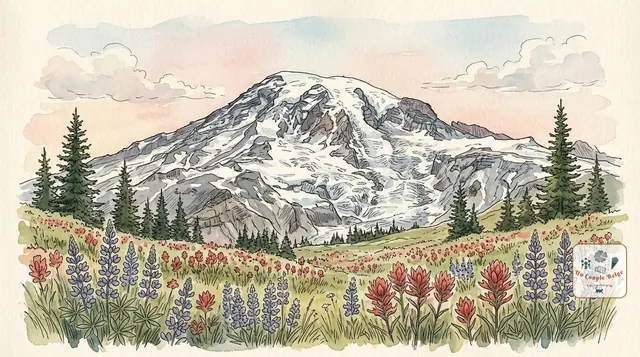
Mount Rainier: the giant volcano that towers over Seattle
A 4,392-metre volcano covered in glaciers, visible from Seattle, surrounded by flower meadows, waterfalls and old-growth forests.
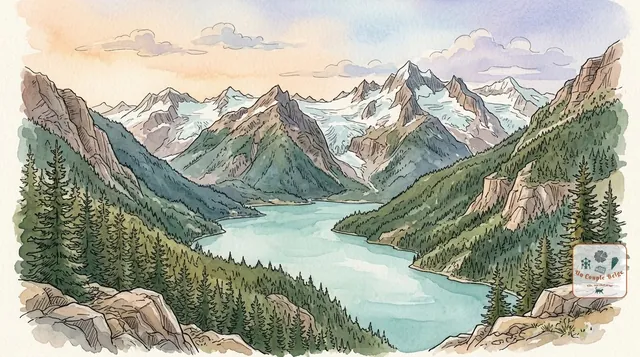
North Cascades: more glaciers than all the other US parks put together
Jagged peaks, hundreds of glaciers and lakes of a milky turquoise, three hours from Seattle. A wild, high-mountain park with almost no visitors.
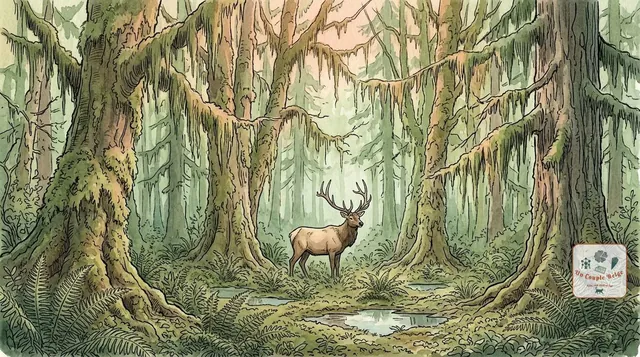
Olympic: three radically different ecosystems in a single park
Three parks in one, in the north-west of Washington State: glacier-clad mountains, a rainforest draped in moss and a wild coast studded with rocks.